

At three o'clock this afternoon, six blue and gold Super Hornets will taxi out at Naval Air Station Oceana and close an air show that roughly 300,000 people are expected to attend across the weekend. It is the second of two performances, and it lands in the Blue Angels' eightieth year.
The US Navy Flight Demonstration Squadron was established in 1946. Eight decades later it is still doing the same job with different hardware, at a base that calls itself the Navy's Master Jet Base and has been hosting this show for more than seventy years.
This year's theme is Celebrating 250 Years of America, and the flying line-up behind the Blues is unusually strong.
Kurzinfo
Ereignis: 2026 NAS Oceana Air Show, Virginia Beach, 19 and 20 September
Theme: Celebrating 250 Years of America
Headliner: US Navy Blue Angels, flying at 3 p.m. on both days, in the team’s 80th year
Also flying: F-22 Raptor Demo Team, F-35C Lightning II Demo Team, and the Rhino Demo Team of Strike Fighter Squadron (VFA) 106
Blue Angels aircraft: Boeing F/A-18E and F/A-18F Super Hornet
Expected attendance: Around 300,000 across the weekend
Admission: Free, including parking; a physical photo ID is required for anyone 18 or older
Venue: NAS Oceana, the US Navy’s Master Jet Base, host of the show for more than 70 years
Eighty Years of the Same Idea
The Blue Angels were stood up in 1946, and the premise has not changed: put naval aviators in front of the public, flying formation tight enough that it looks impossible, and let the recruiting take care of itself.
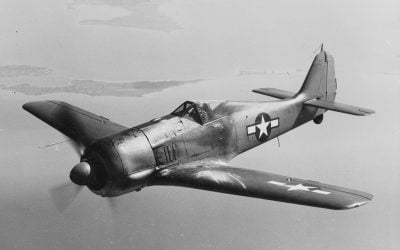
What has changed is the aeroplane. The team has worked through the Hellcat and Bearcat, the Panther and Cougar, the Tiger, the Phantom II, the Skyhawk and the legacy Hornet. Today it flies the Boeing F/A-18E and F/A-18F Super Hornet, a heavier and more powerful jet than the Hornet it replaced, which is a rather different machine to hold eighteen inches from another one.

The routine itself is the argument. The Diamond holds formation through loops and rolls with wingtip separation the team measures in inches, while the two Solos work the opposite side of the crowd line, and the whole thing converges into the six-ship Delta.
The Supporting Bill Is Not Supporting
Oceana has assembled a line-up that several shows would headline with. The F-22 Raptor Demonstration Team brings thrust vectoring and the tail-slide that never stops being absurd. The F-35C Lightning II Demonstration Team flies the carrier variant — bigger wing, heavier gear, the one built to come aboard.
And the Rhino Demo Team of Strike Fighter Squadron 106 flies the Super Hornet in its working colours rather than blue and gold, which is a useful thing for a crowd to see on the same afternoon. Same airframe, same base, very different presentation.
What the Base Says It Is For
NAS Oceana sits inside Virginia Beach, which means the show is partly an exercise in being a good neighbour to the people who live under the pattern the other 363 days of the year.
The 250th-anniversary framing runs through the ground displays as much as the flying, alongside static aircraft, local vendors and a set of STEM exhibits aimed squarely at the children who will spend the afternoon with their heads tipped back.
Watching From Somewhere Else
If you are not in Virginia Beach, Saturday's programme was streamed and is available to watch back.
Admission and parking are free, which is worth saying plainly because people assume otherwise. Anyone 18 or over needs a physical government-issued photo ID; a picture of one on a phone will not get you through the gate.
Gates opened at eight this morning and the flying starts around eleven. The Blues are the last act, as they always are. Eighty years in, the closing sequence still empties the car parks late.
Sources: US Navy press release and remarks by Capt. Rob Littman, NAS Oceana Public Affairs; NAS Oceana Air Show official schedule; Defense Visual Information Distribution Service imagery; Navy Exchange and LiveAirShowTV stream.
0 Comments