
Stealth is an argument about angles. Shape an airframe so that almost everything a radar sends at it leaves in some other direction, coat what is left so that part of the remainder turns into heat, and the energy coming back to the transmitter falls by orders of magnitude. The argument is sound, it has been built into three generations of combat aircraft, and it works.
It has one hole in it. The hole is not classified, it is not new, and no amount of engineering closes it: all that energy you so carefully deflected is still going somewhere. Most of it is going forwards, in the direction it was already travelling. Put a receiver out there, on the far side of the target, and you are no longer measuring a reflection at all. You are measuring a shadow.
That is forward-scatter radar. It is the oldest idea in radar and one of the least written about, and the reason it stays obscure is not that it fails. It is that what it gives you is so nearly useless for anything except the one job it does perfectly.
Quick Facts: forward-scatter radar
What it is: bistatic radar in which the target sits on or close to the straight line between transmitter and receiver, so the bistatic angle approaches 180 degrees
Forward-scatter radar cross-section: 4πA²/λ², where A is the target’s silhouette area and λ the wavelength
What does not appear in that expression: airframe shaping and radar-absorbent coating
Width of the forward-scatter lobe: of the order of the wavelength divided by the target’s size, in radians — wide at VHF, pencil-thin at X-band
The limitation: on the baseline, range, bearing and Doppler information all collapse towards zero
Fielded example: the Russian 52E6MU Struna-1MU, offered for export as Barrier-E — stations 40 to 50 km apart, 390 to 430 MHz, claimed coverage from 30 m to between 3 and 7 km altitude (manufacturer figures)
Best published result against a small drone: a quadcopter crossing a satellite television baseline, with the authors putting the maximum practical detection range at 100 m
The shadow, not the reflection
Ordinary radar is monostatic: one antenna transmits, the same antenna listens, and the quantity that matters is how much energy the target sends straight back the way it came. Bistatic radar separates the two. The transmitter stands in one place, the receiver in another, and the angle at the target between them — the bistatic angle — becomes a parameter in its own right.
Push that angle all the way towards 180 degrees and something changes in kind rather than in degree. The receiver is now looking straight into the transmitter, with the target in between. What reaches it is the direct signal plus a disturbance: the target has removed a target-shaped piece of the wavefront, and the edges of that missing piece diffract. The interference between the direct path and the diffracted field is the detection.
This is not a weak effect. It is usually far stronger than the backscatter from the same object, and it has one property that makes it strategically interesting.
Babinet’s principle, and why the paint stops mattering
The physics comes from optics, and it is nearly two centuries old. Babinet’s principle says that the field diffracted around an obstacle is the same, in magnitude, as the field that would pass through an identically shaped hole in an opaque screen. Applied to radar, the consequence is blunt: a perfectly absorbing target scatters forwards exactly as a target-shaped hole in a perfectly conducting sheet would.
A hole has no paint. A hole has no faceting, no serrated edges, no carefully aligned planform. It has an outline and nothing else. That is why the forward-scatter radar cross-section reduces to 4πA²/λ², in which A is the silhouette area the transmitter sees and λ is the wavelength, and in which neither the shape of the surfaces nor the material covering them makes an appearance.
Note the hedge in that first sentence. It says mainly depends, not only depends, and the honest version of this story keeps the hedge. Real targets are not infinitely thin screens, real geometries are never exactly 180 degrees, and the clean result degrades as you move off the baseline. But the direction of the argument is not in doubt, and the people who build radar for a living state it plainly.
Two things follow. The first is that a forward-scatter system does not need to out-engineer the target; it only needs to be in the right place. The second, which is the half that defence journalism usually leaves out, is that being in the right place is almost all it can do.
A tripwire, not a tracker
Everything that makes radar useful as a sensor — where the target is, how far away, how fast, which way — comes from measuring delay, angle and Doppler shift. Forward scatter destroys all three at once, and for the same geometric reason.
Delay: when the target sits on the baseline, the path transmitter-to-target-to-receiver is the same length as the direct path transmitter-to-receiver. The echo arrives with the reference signal. There is no delay to measure, so there is no range.
Doppler: the sum of the two ranges is what the system can sense changing, and for a target crossing the baseline that sum is momentarily stationary. Doppler shift passes through zero at the crossing. Angle: the forward-scatter lobe is tied to the baseline, not to the target, so the bearing you measure is the bearing of the transmitter.
Which is why nobody builds a forward-scatter radar to replace an air-surveillance radar. You build it as a fence. Line up a chain of transmitter and receiver posts, accept that you will learn almost nothing about what crossed, and take the one piece of information the geometry hands you for free: something went through, here, now. Against a target that was designed from the first drawing to deny you exactly that, it is not a small thing.
Real Engineering on how shaping and absorbent material suppress the backscatter return — the half of the problem that forward scatter simply walks around.
What has actually been built
The best-documented fielded example is Russian. The 52E6MU Struna-1MU, marketed for export as Barrier-E, is a chain of transmit and receive posts strung across terrain, with neighbouring stations 40 to 50 km apart and a single span running up to about 50 km. It works in the 390 to 430 MHz band at a radiated power measured in single-digit watts, which is a remarkable figure for an air-defence sensor and tells you how much the geometry is doing.
The manufacturer’s claims are what you would expect from a brochure and should be read as such: detection probability of around 0.89, roughly one false alarm per 72 hours, coverage from 30 m up to somewhere between 3 and 7 km altitude, and a bistatic signature two to three times the monostatic one and largely independent of coating. None of that has been independently verified in open literature. The published track accuracy makes the fence character obvious even in the vendor’s own numbers: on the order of 2,100 m along the span against roughly 170 m across it. It knows you crossed the line. It is vague about where along the line you did it.
Chain the spans and you get a barrier a few hundred kilometres long that no amount of radar-absorbent material defeats, because the thing it is measuring is the outline of the aircraft and the aircraft has to have an outline. What you cannot do with it is hand a fire-control solution to a missile battery. It is a trigger for other sensors, not a weapon system.
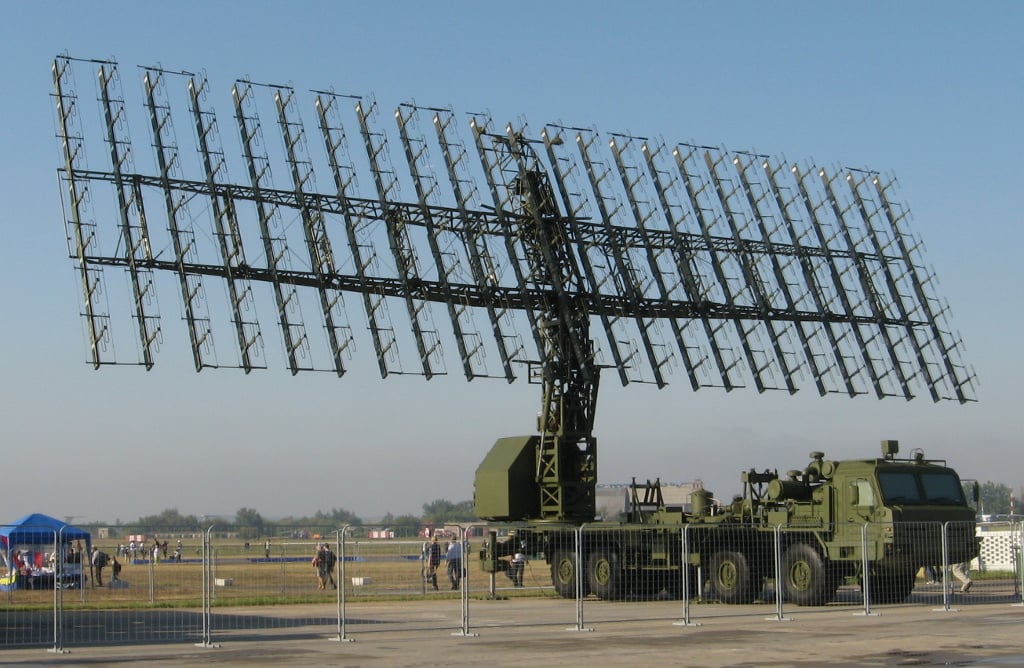
The distinction matters because the two are constantly conflated. A VHF surveillance radar such as Nebo-M attacks stealth by using wavelengths comparable to aircraft features, which degrades the effect of shaping. It is still monostatic, it still wants an echo, and it still has to fight radar-absorbent material and poor angular resolution. Forward scatter attacks the same problem from a completely different direction — literally — and pays for it in everything except detection.
Does it work against drones?
This is where the arithmetic turns against it, and it turns for a reason worth stating precisely. The forward-scatter lobe is narrow: its angular width runs roughly as the wavelength divided by the target’s size. A large aircraft at VHF produces a lobe wide enough to be useful across a 40 km span. A 30 cm quadcopter at microwave frequencies produces one that is pencil-thin, and the target has to fly through it.
The clearest published experiment makes the point without any help. A team at Universiti Putra Malaysia pointed a dish at the Measat-3 television satellite at 91.5 degrees east, took the strongest transponder it could find at 11.104 GHz, and flew a commercial quadcopter across the baseline. The crossing shows up unmistakably: the direct signal is disrupted for about two seconds, with a peak Doppler near 90 Hz, and empirical mode decomposition separates the rotor micro-Doppler from the body return. The authors then state the operational reality in one line: “the maximum practical detection range is 100 m”, with detections reaching only about 80 m above sea level.
That is a laboratory result on a futsal court, from two runs with one aircraft, and the authors say so. It is also the honest ceiling. Forward scatter against small drones is a doorway sensor: a gate, a perimeter, a single approach lane. It is not an area-surveillance answer, and anyone selling it as one is selling the aircraft-sized physics with the drone-sized picture.
MIT Lincoln Laboratory’s lecture on target radar cross-section — the monostatic baseline against which every forward-scatter claim should be read.
The same caution applies to the satellite-illuminator work more broadly. Recent studies using GPS and other satellite waveforms as forward-scatter transmitters are promising, and they are also simulations. Treat a simulated detection and a measured one as different categories of evidence, because they are.
A geometry older than radar itself
None of this is a recent discovery. British radar did not begin with a pulse and an echo; it began with a bistatic measurement. On 26 February 1935, in a field near Upper Stowe in Northamptonshire, Robert Watson-Watt and Arnold Wilkins parked a receiver van under the beam of the BBC’s Borough Hill shortwave transmitter at Daventry — 10 kW on a wavelength of 49.8 m, about 6 MHz — and waited for a Handley Page Heyford of the Royal Air Force to fly through it. Three of the bomber’s four passes produced clear deflections on the cathode-ray tube. The transmitter belonged to somebody else, the receiver was somewhere else again, and the aircraft was the only thing in the middle.
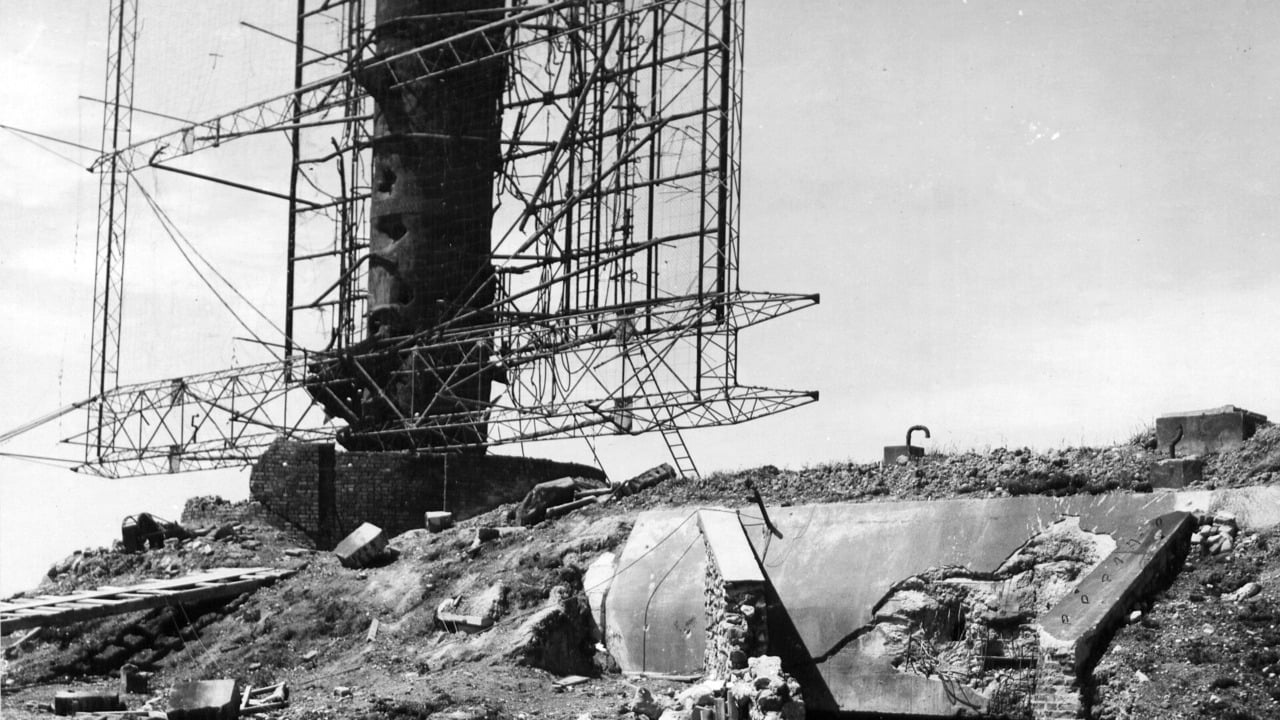
The Germans took the idea further than the British did. From late 1943 the Luftwaffe operated Klein Heidelberg, six stations along the coast from Cherbourg to the Netherlands that transmitted nothing at all and instead listened to Britain’s own Chain Home signals bouncing off Allied aircraft. Timing the reflected signal against the direct one placed a target on an ellipse; rotating the big receiving antenna gave a bearing; the intersection gave a position. It worked out to several hundred kilometres, and the Allies appear not to have understood what it was until well after D-Day.
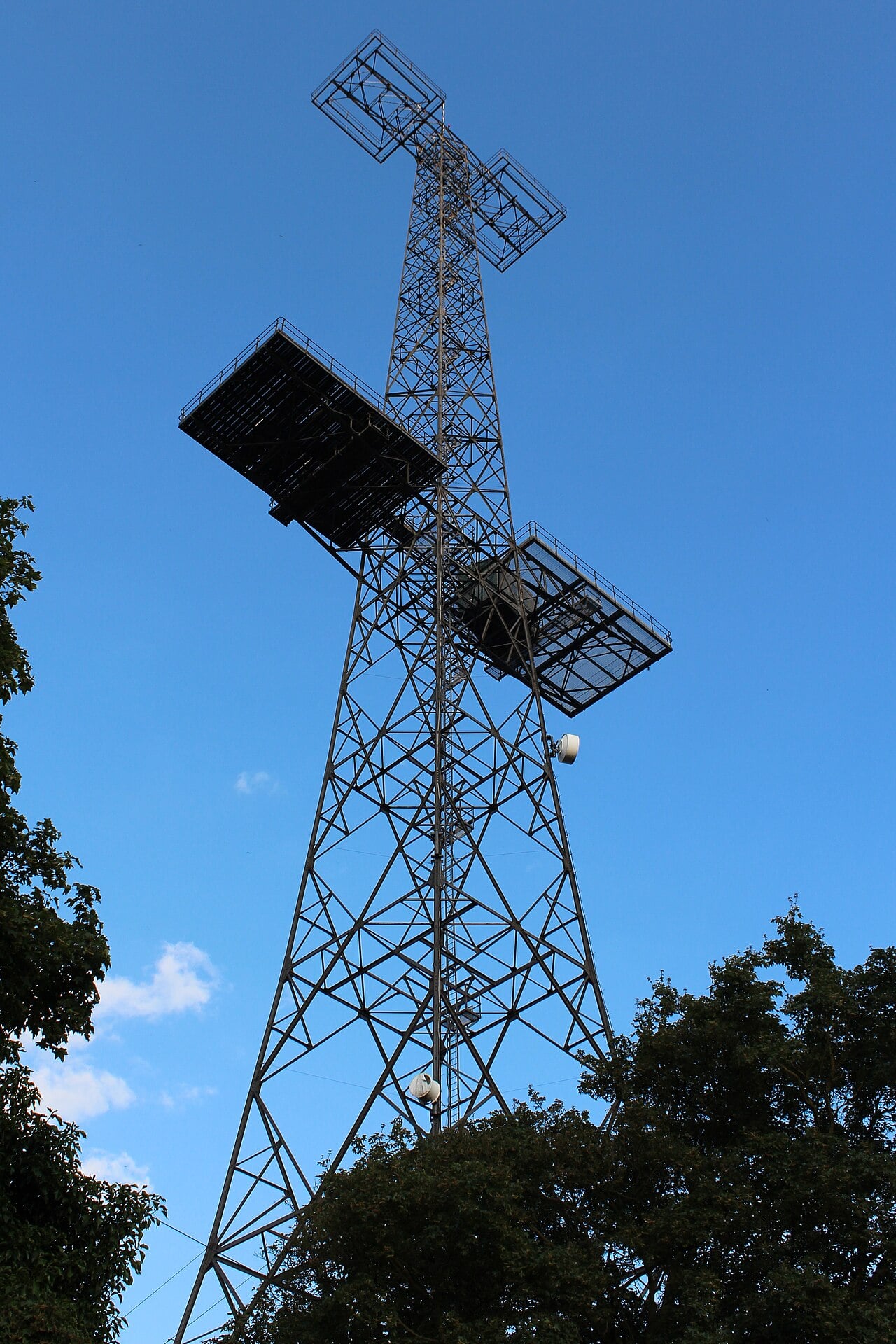
Klein Heidelberg was bistatic rather than forward-scatter: it worked off reflections at ordinary angles, not off the shadow on the baseline. But the lineage is the same one, and the lesson it taught in 1944 is the lesson the geometry still teaches. A receiver that transmits nothing is extremely hard to find, and a transmitter you do not own is extremely hard to switch off.
The Daventry experiment of February 1935, filmed at the sites where it happened. British radar began as a bistatic measurement using a broadcaster’s transmitter.
Why it stays a niche
Forward scatter is not an unexploited secret weapon, and the reason is not that governments have missed it. It is that the sensor answers exactly one question, and most air-defence money is spent answering the other four. A network that tells you something crossed a line, without telling you what, where along the line, at what height or how fast, is worth building only where the line itself is the point: a border, a coastal approach, the fence around an airfield, the mouth of a valley.
Where it is worth building, though, the arithmetic is unusually hard to argue with. The posts are cheap, the radiated power is measured in watts, and the one countermeasure that has consumed decades of aerospace engineering — making the aeroplane a poor reflector — does not apply, because the sensor was never asking for a reflection. You cannot stealth a silhouette. You can only avoid the line.
Sources: H. Griffiths, “Passive Radar — From Inception to Maturity”, SSPD 2017; C. J. Baker, “Forward Scatter Passive Radar”, NATO STO-EN-SET-243; R. S. A. Raja Abdullah and A. Ismail, “Forward Scattering Radar: Current and Future Applications”, International Journal of Engineering and Technology 3(1), 2006; R. S. A. Raja Abdullah et al., “Passive Forward-Scattering Radar Using Digital Video Broadcasting Satellite Signal for Drone Detection”, Remote Sensing 12(18):3075, 2020; M. Gyurosi and C. Kopp, “52E6MU Struna-1MU / Barrier-E Bistatic Radar”, Air Power Australia APA-TR-2009-1101; Liu et al., Remote Sensing 14(6):1375, 2022.
Häufig gestellte Fragen
What is forward-scatter radar?
Can forward-scatter radar detect stealth aircraft?
Why does stealth shaping not work against forward-scatter radar?
What is the forward-scatter radar cross-section formula?
What is the main weakness of forward-scatter radar?
Is the Russian Struna-1 Barrier-E a forward-scatter radar?
Can forward-scatter radar detect small drones?
Is forward-scatter radar the same as passive radar?
Ähnliche Beiträge
Passive Radar vs Drones: The Sensor That Never Transmits
DJI Phantom vs Pigeon: Why Radar Still Cannot Find Small Drones
The DEW Line: A Radar Fence Across the Top of the World
The Radar Wall That Won the Battle of Britain
SBX-1, Cobra Dane and PAVE PAWS: The Biggest Radars Ever Built



0 Comments