
“Pitch oscillation” is one of those phrases that sounds mild right up until you read what the Federal Aviation Administration thinks it can turn into.
On Monday the agency published a final rule ordering operators of almost two thousand American-registered Boeing 737s to go and measure the slop in the aeroplane’s tailplane. Not inspect it for cracks. Measure the play — the free movement in the pivot hinges that carry the horizontal stabilizer and in the jackscrew that drives it. Several airlines had reported their aircraft oscillating in pitch, and when the FAA traced the reports back, the answer was wear.
Airworthiness directives are routine. Boeing airframes collect dozens a year, most of them dull. This one is worth reading because of the single sentence the FAA uses to justify it, and because of what the agency told four operators who asked for a little more time.
Kurzinfo
Directive: FAA AD 2026-20-14 (Amendment 39-23487), Docket FAA-2025-5403, published 19 October 2026
Flugzeug: Boeing 737-600, -700, -700C, -800, -900 and -900ER — 1,987 of US registry
Auslösen: Reports from multiple operators of pitch oscillation events
Unsafe condition: Excessive horizontal stabilizer freeplay, which the FAA says could lead to a flutter event and loss of control
Required action: Measure freeplay at the stabilizer pivot hinges and the jackscrew, then repair or replace worn parts as the findings dictate
Effective date: 23 November 2026
Kosten: 6 work-hours, about 510 dollars per aeroplane; roughly 1.01 million dollars across US operators
Service information: Boeing Alert Requirements Bulletin 737-55A1104 RB, 12 June 2025
What the Directive Actually Requires
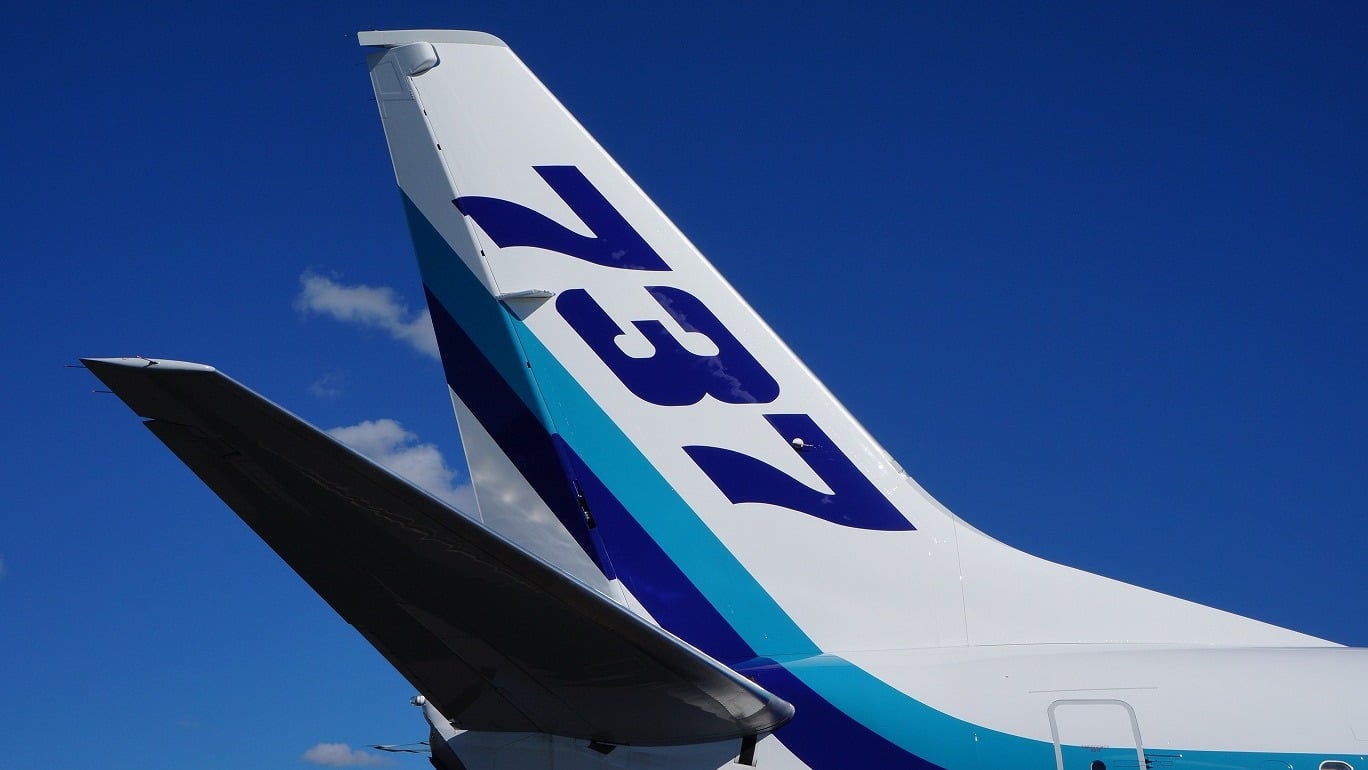
AD 2026-20-14, Amendment 39-23487, applies to Boeing 737-600, -700, -700C, -800, -900 and -900ER series airplanes — the Next Generation family, not the MAX. The FAA estimates it affects 1,987 airplanes of United States registry. The worldwide figure is larger, because American ADs bind American operators and other regulators then decide whether to mirror them, which for a Boeing product they almost always do.
The work itself is short. Operators must measure the freeplay of the left and right horizontal stabilizer pivot hinges and of the jackscrew, following Boeing Alert Requirements Bulletin 737-55A1104 RB of 12 June 2025, and then do whatever the measurement tells them to do: determine total stabilizer freeplay, repeat the measurement, or repair or replace worn parts. The bulletin sets the compliance times. The directive becomes effective on 23 November 2026.
Under the Air Transport Association chapter system this is ATA 55, Stabilizers — which is to say, the structure that holds the aeroplane’s nose where the crew put it. The FAA’s statement of the unsafe condition is three lines long and does not hedge.
Freeplay Is Not a Defect. Too Much of It Is.
Every mechanical joint has clearance. A hinge bearing that gripped its pin with zero play would seize; a ballscrew with no backlash would bind. The 737’s entire horizontal stabilizer is a moving surface, pivoting on hinges at the rear and driven in pitch trim by a jackscrew at the front, and both of those interfaces are designed with tolerances. New, they are small. After twenty years and sixty thousand cycles of a surface that loads and unloads on every rotation, every flare and every trim input, they are larger.
Boeing’s procedure measures four values — the bulletin calls them D1, D2, D3 and H — and compares them against what the service information labels Level 1 limits. Inside the limits, the aeroplane goes back to work. Outside, the operator either replaces the worn part or accepts an interim check, which Alaska Airlines described in its comment as falling due within 3,100 flight hours or six months of the last measurement, whichever comes first.
The crews who filed the original reports would not have seen any of this. They would have felt the aeroplane hunting slightly in pitch, in a way a 737 does not normally hunt.
Flutter Is the Word That Matters
Flutter is the reason this directive exists, and it is the most unforgiving failure mode in structural aeronautics. It is not vibration in the ordinary sense. It is a self-feeding oscillation in which the airflow couples two of a structure’s natural modes — classically bending and twisting — so that each cycle extracts more energy from the air than the structure’s own damping can absorb. Below the flutter speed, a disturbance dies away. Above it, the same disturbance doubles, and doubles again, and the component departs the aeroplane. The whole sequence can run its course in seconds.
Certification is supposed to put a wide margin between the fastest the aeroplane will ever go and the speed at which any of this can start. Freeplay eats into that margin, because a joint that can move without resistance behaves as a nonlinearity: the surface is free to begin oscillating on its own before the aerodynamic stiffness of the system has anything to push against. A structure with slack in it can enter a limit-cycle oscillation at speeds where the same structure, tight, is perfectly stable.
That is why the FAA is not asking anyone to look for cracks. There is nothing broken to find. It is asking operators to measure how loose the joint has become, because looseness is the thing that moves the boundary.
Four Operators Asked for Relief. The FAA Said No Four Times.
The proposal went out for comment in January and drew responses from nine parties. The Air Line Pilots Association, Boeing and two individuals supported it without change. Aviation Partners Boeing wrote in to confirm that its blended and split scimitar winglets, fitted under supplemental type certificate ST00830SE, do not get in the way of the inspection; the FAA agreed, and that was the only comment it accepted.
The other four went nowhere. Canadian North asked for the first inspection to fall due at 36 months rather than 12, so it would land on a heavy maintenance visit instead of pulling aircraft out of service unscheduled. United Airlines argued that an aeroplane with brand-new hinge bearings should not be on the same repeat interval as one still flying original production parts. Alaska Airlines asked to be allowed to repair straight to the Level 1 limits instead of running interim checks. United also asked for credit for freeplay inspections it had already done under a 2022 Boeing multi-operator message with, by its own account, identical work instructions.
The FAA disagreed with all four. On the intervals it was blunt: the repetitive checks “were chosen to ensure that excessive freeplay does not exist for either original or new or replaced parts.” Operators can still apply individually for an alternative method of compliance, which is the normal pressure valve. But as a fleet-wide matter, nobody got longer.
What It Costs, and What It Says
Almost nothing, by the standards of airline maintenance. The FAA prices the freeplay measurement at six work-hours at 85 dollars an hour — 510 dollars an aeroplane, 1,013,370 dollars across the US fleet. A repeat measurement costs the same again. Replacing or repairing a worn part is costed at one work-hour, 85 dollars, plus parts the agency admits it cannot price: it has received, in its own words, no definitive data on which to base the estimate.
A million dollars spread across every American 737NG operator is a rounding error. That is the point. The directive is cheap because measuring is cheap, and the FAA has decided that measuring 1,987 aeroplanes is a better trade than waiting to find out which one had the most wear. The agency closed the rule by noting that apart from minor editorial changes it was adopting the proposal exactly as written, and that none of the changes increase the economic burden on any operator.
Operators have until 23 November to start, and Boeing’s bulletin to tell them how soon after that each individual airframe is due. Most will fold it into work already scheduled. That is usually how the most serious-sounding directives end: not with aeroplanes grounded, but with a technician on a stand with a dial gauge, measuring a number that should be small.
Sources: Federal Register Vol. 91 No. 200, 19 October 2026, pages 65959 to 65961 (FAA Airworthiness Directive 2026-20-14, FR Doc 2026-21333); aeroTELEGRAPH.

0 Comments