
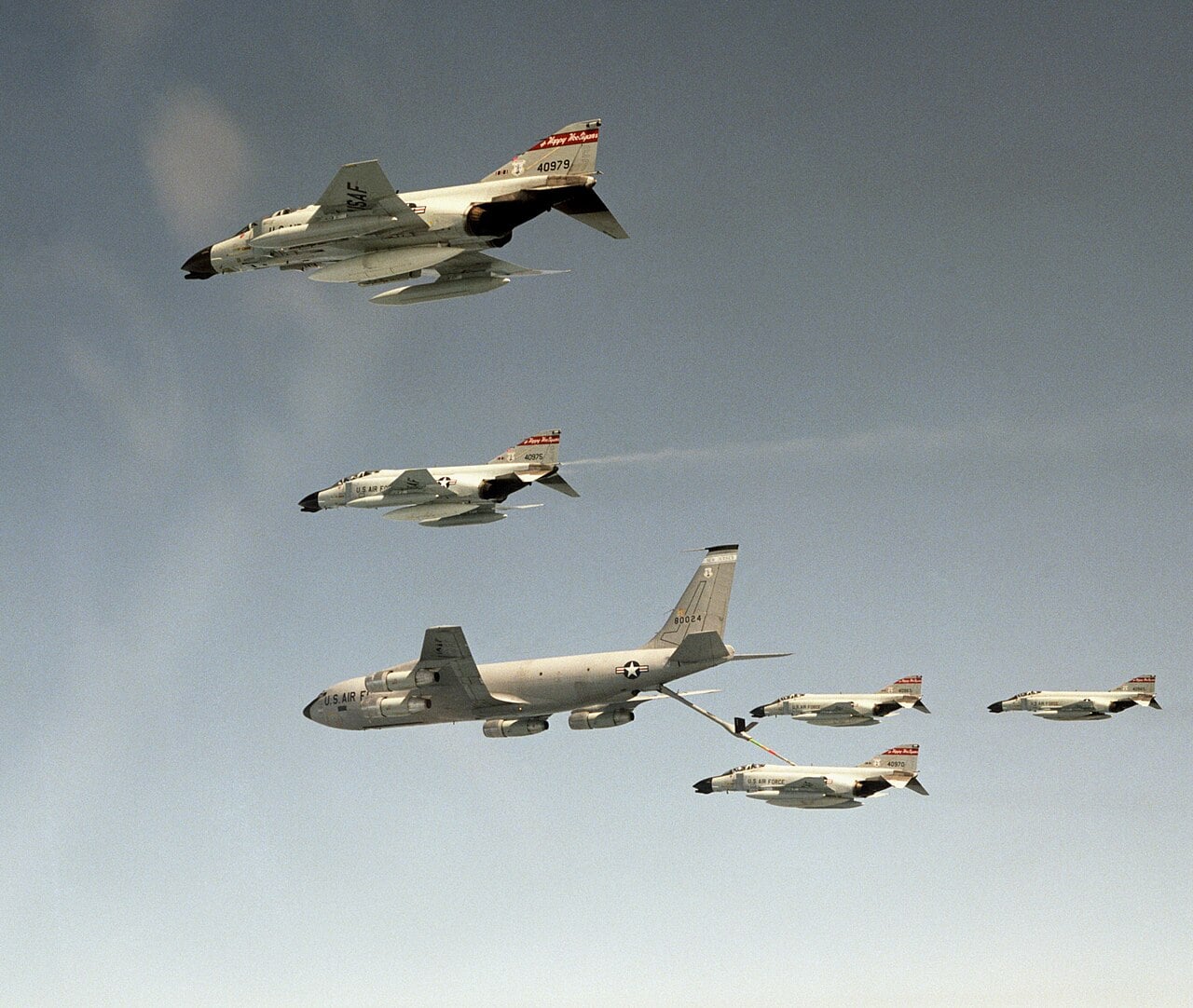
On 5 September 1983, a group of US Air Force F-4E Phantoms was crossing the Atlantic to Germany, refuelling from KC-135 tankers along the way. Halfway over, Major Jon “Ghost” Alexander’s Phantom began losing oil. What followed was one of the most remarkable feats of air refuelling ever flown: a tanker crew that kept a sinking fighter in the air by hooking on to it and pulling it towards land.
Kurzinfo
- Datum: 5 September 1983
- Kämpfer: McDonnell Douglas F-4E Phantom II, pilot Maj. Jon Alexander, WSO Dan Silvis
- Tanker: Boeing KC-135A, 42nd Air Refueling Squadron, Loring Air Force Base, Maine
- Tanker crew: Capt. Robert J. Goodman, Capt. Michael F. Clover, 1st Lt. Karol F. Wojcikowski, SSgt. Douglas D. Simmons
- Umleitung: Gander, Newfoundland, about 520 miles away
- Hook-ups: Four continuous refuellings, with the tanker towing the fighter on its boom
- Vergeben: Mackay Trophy for the most meritorious Air Force flight of 1983
Oil, Heat and Hydraulics
Another pilot in the formation spotted oil streaming from Alexander’s aircraft. A cracked oil line, according to the Bangor Daily News, cost the No. 2 engine most of its thrust; the No. 1 engine began to overheat, and the starboard hydraulic system failed. Alexander jettisoned his external fuel tanks, but the heavy fighter could not hold altitude or speed. Gander, the nearest runway, was about 520 miles away.
Lower and Slower
Captain Robert Goodman’s KC-135 crew from Loring took on the problem. A tanker normally refuels fighters at around 300 knots and well above 20,000 feet. The crippled Phantom could barely hold 190 knots. Goodman’s crew lowered flaps and pulled back the power to slow the big jet down to the fighter’s speed, and followed it down towards the ocean, at one point to around 1,400 feet. Boom operator Staff Sergeant Douglas Simmons repeatedly put the boom into the Phantom’s receptacle as the fighter fell off and was caught again.
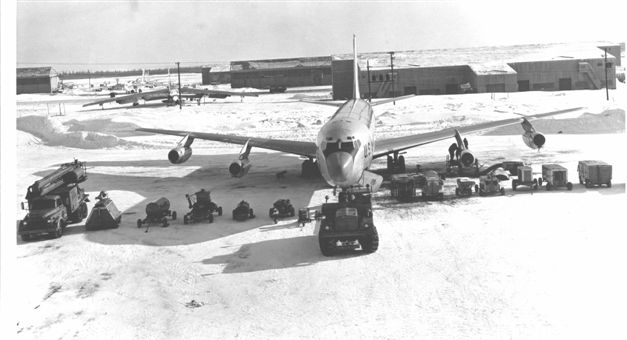
With the boom connected, the tanker did more than pass fuel. The Air Force Historical Foundation describes the mission as an escort and tow of the F-4 to Gander through four continuous refuellings: with the boom latched, the KC-135 effectively pulled the fighter along and helped it climb. As the coast approached, Alexander’s overheated engine had recovered enough for him to disconnect and land at Gander safely with his weapons systems officer.
The Mackay Trophy
Goodman’s crew received the Mackay Trophy, awarded for the most meritorious flight of the year in the US Air Force, for 1983. Alexander later wrote that he received the Kolligian Trophy, the Air Force’s award for outstanding airmanship in averting a mishap, shortly afterwards. It was not the first time a KC-135 crew had kept a crippled jet in the air on the end of its boom; we tell another such story in The KC-135 That Towed a Crippled F-111 Out of North Vietnam.
What the Popular Version Gets Right
The story as it is usually told is accurate: the date, the F-4 Phantoms crossing to Germany, the oil leak and engine and hydraulic failures, Gander about 520 miles away, the Loring KC-135 crew and their names, the tanker slowing to the fighter’s speed and following it down, the repeated hook-ups and the tow on the boom, the safe landing and the Mackay Trophy.
Sources: Air Force Historical Foundation, “September 5, 1983”; Aircrew Remembered, Jon Alexander, citing the Bangor Daily News; Sierra Hotel Aeronautics, “The Day a USAF KC-135 Crew Saved an F-4 Phantom by Dragging it Home”; Airman magazine, “Hell or High Water” (August 1984).
Häufig gestellte Fragen
Did a KC-135 really tow an F-4 Phantom?
What went wrong with the F-4 in 1983?
Who was the KC-135 crew that saved the F-4?
What award did the KC-135 crew receive?
How slow did the KC-135 have to fly?
Where did the F-4 land?
Ähnliche Beiträge



0 Comments