
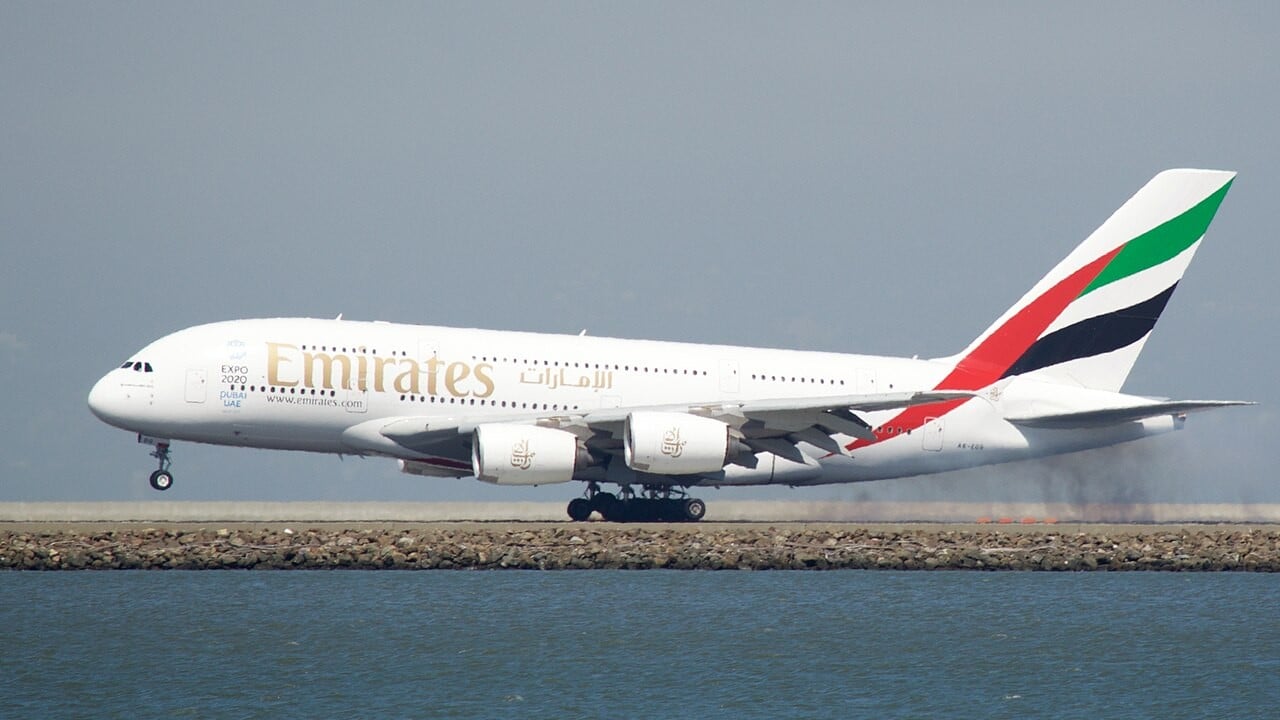
Watch an Airbus A380 land and, for a fraction of a second, a puff of blue-grey smoke trails from its main gear. Twenty tyres that were sitting still a moment earlier have just been slammed onto the runway and dragged up to touchdown speed, well over 100 mph, in the blink of an eye. The smoke is rubber.
Then the same tyres have to carry hundreds of tonnes down the runway while the brakes behind them turn the aircraft’s energy into heat. Some of those brakes are made of carbon, glow orange in a hard stop, and wear out faster when you use them gently.
Aircraft tyres and brakes are some of the least glamorous parts of an airliner and some of the most cleverly engineered. Here is how they work, why they are full of nitrogen rather than air, and why a tyre can be worn out, sent away and come back to fly again.
Kurzinfo
- Typical airliner tyre pressure: Around 200 psi
- Deflection rating: 32 to 35 per cent (FAA AC 20-97B)
- Typical speed ratings: 190 to 225 mph
- Inflation gas: Dry nitrogen; no more than 5 per cent oxygen
- Nitrogen required: Transport aircraft above 75,000 lb take-off weight (14 CFR 25.733)
- Main tyre life: About 300 to 450 landings per tread (Air Canada)
- Retreads: Up to seven per casing (Michelin)
- Carbon vs steel brakes: About 700 lb lighter on a 737NG; up to twice the landings per overhaul (Boeing)
Not a big car tyre
An airliner tyre looks like an oversized truck tyre, but it lives a completely different life. According to the FAA’s advisory circular on tyre maintenance, AC 20-97B, aircraft tyres are rated at high deflections of 32 to 35 per cent and inflated to high pressures so they can carry huge loads with the smallest and lightest possible tyre. Airline mechanics typically inflate them to around 200 psi, several times the pressure of a road car tyre.
Their working life is short and violent: taxi and take-off, then landing and taxi, with long rests in between. The speed ratings show what they are built for. Michelin’s Air X radial tyres for business jets and trainers, for example, are listed with speed ratings of 190 to 225 mph.
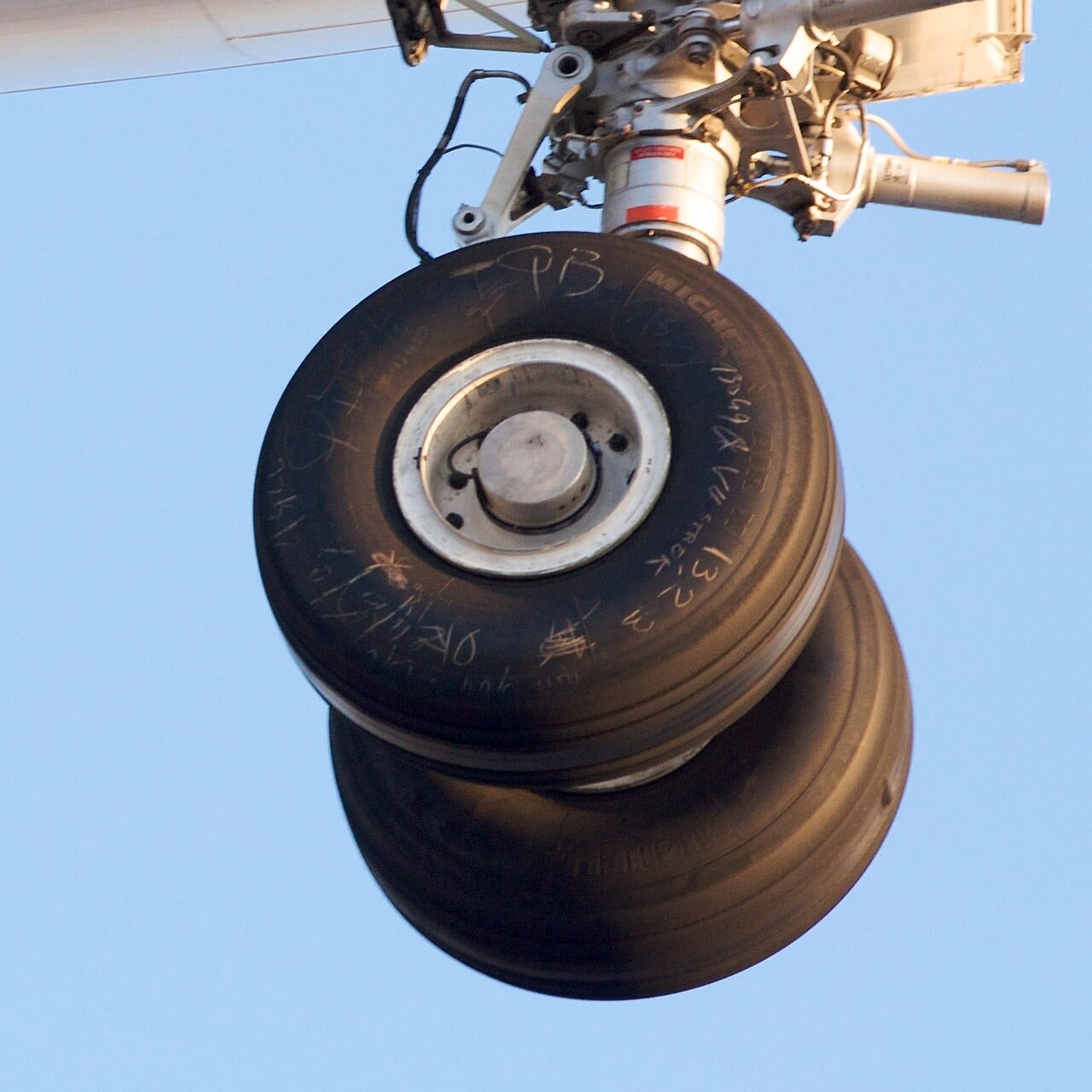
Speed brings a force cars never face. Goodyear’s aviation tyre manual calculates that on a 30-inch tyre at 200 mph, each ounce of tread rubber is pulled outwards at about 2,000 g. Spread over an eight-pound tread, that is an effective 16,600 pounds trying to fling the tread off the casing.
Why the tyres are full of nitrogen
The big safety idea in an aircraft tyre is about fire, not air pressure. When brakes get very hot, heat soaks into the wheel and the tyre. The FAA has warned of potential explosive chemical reactions in tyres caused by atmospheric oxygen mixing with volatile gases released from the hot tyre. The fix is to take the oxygen away.
For large aircraft that is the law. Under the US certification rules for transport aircraft, any aircraft with a maximum take-off weight above 75,000 pounds must have its braked-wheel tyres filled with an inert gas.
Nitrogen has other benefits. Goodyear points out that it will not sustain combustion and that it reduces oxidation of the tyre liner, casing plies and wheel. AC 20-97B tells mechanics to inflate new tyres in a safety cage with dry nitrogen so the tyre contains no more than 5 per cent oxygen by volume.
Pressure is checked every day, and ideally cold. Goodyear notes that tyre temperatures can rise more than 200°F above ambient during operation, and that every 5°F change moves pressure by about 1 per cent. A cold reading after a long taxi in the sun would be meaningless.
The fuse plug: a tyre that deflates instead of exploding
Even nitrogen cannot stop physics. After a hard stop, the gas inside a tyre heats up and its pressure climbs. So wheels on large aircraft carry thermal fuse plugs: small plugs of metal that melt at a set temperature and let the tyre go flat in a controlled way, rather than burst.
Boeing showed what that looks like in its maximum brake energy test for the 737-10 in 2026. The aircraft, loaded to its maximum take-off weight of 197,900 pounds and fitted with brakes machined to within 2 per cent of their wear life, accelerated to 180 knots at Edwards Air Force Base and stopped on brakes alone. Brake temperatures went past 2,500°F and, as designed, the fuse plugs melted.
Boeing’s maximum brake energy certification test on the 777-9: a full-weight rejected take-off on worn brakes, with fuse plugs releasing as designed.
After a stop like that, the tyre is finished. AC 20-97B says tyres that have been through high-energy rejected take-offs or overspeed landings where the fuse plugs released should be removed and scrapped, and Goodyear adds that if the plug released while rolling, the mate tyres should come off too.
Leased by the landing, retreaded again and again
Many airlines never own the tyres on their aircraft. They lease them from the manufacturer per landing. Air Canada has said main gear tyres last between 300 and 450 landings on average, depending on runway conditions and debris, and nose gear tyres even less.
When the tread wears out, the tyre is not thrown away. It goes back to the supplier, the old tread is buffed off the casing, and new tread is bonded on. Michelin has said it can retread an aircraft tyre up to seven times. Goodyear marks every retreaded tyre with its retread level, the date and the plant that did the work.
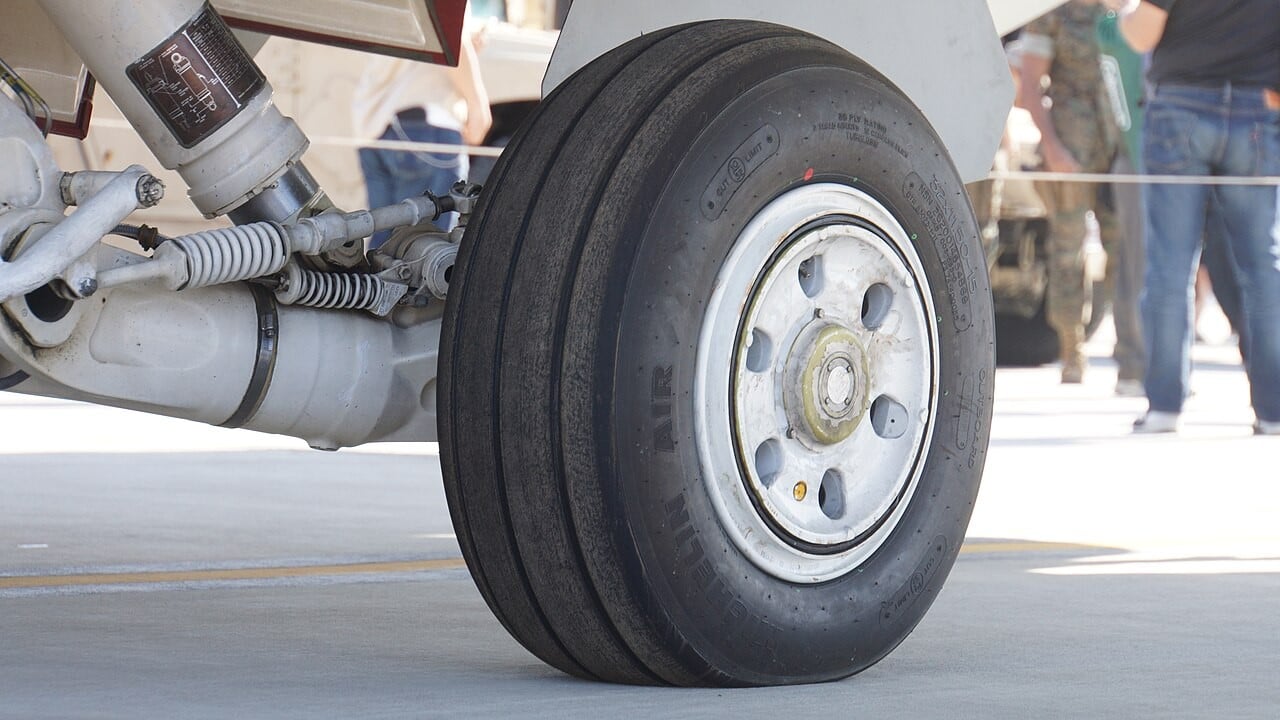
That is why the inspection rules are so strict. A casing that has been overheated, run underinflated or cut into its plies is no longer fit to be retreaded. AC 20-97B even sets hard limits: a tyre found operating below 90 per cent of its service pressure comes off, and below 80 per cent its axle-mate comes off with it.
Carbon brakes: the stack that gets hot
Behind each main wheel sits the brake, built around a heat sink: a stack of alternating discs, some keyed to the turning wheel and some to the stationary axle. Hydraulic pistons squeeze the stack and the kinetic energy of the aircraft becomes heat inside it. On a large airliner that heat sink is often made of carbon rather than steel.
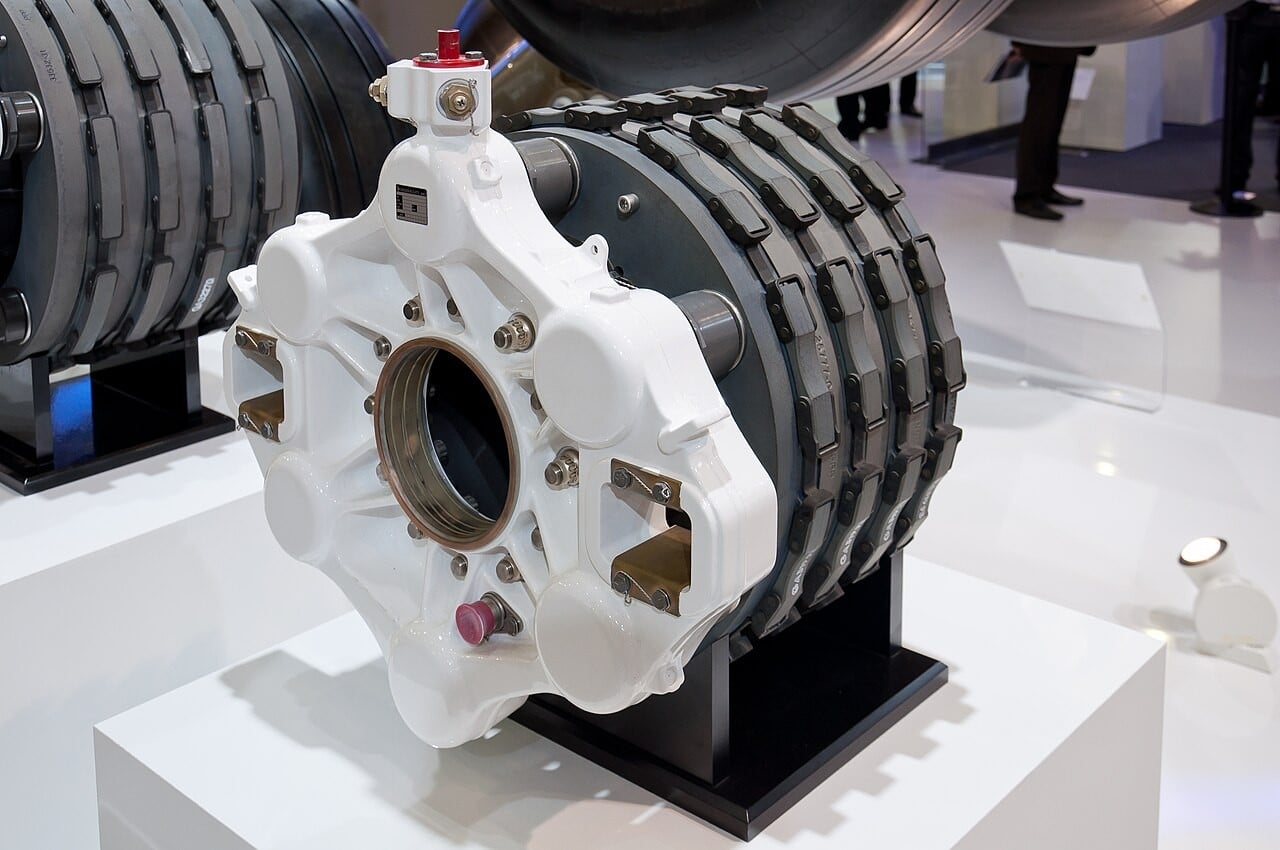
Carbon brakes began in high-performance military aircraft, according to Boeing’s AERO magazine, because they were lighter and could absorb more energy. On the 737 Next-Generation, carbon brakes save about 700 pounds compared with high-capacity steel brakes, and Boeing says they offer up to twice as many landings per overhaul.
The surprise is how they wear. Steel brake wear is directly proportional to the energy absorbed, so gentle, frequent dabs are kindest to steel. Carbon is the opposite.
So the pilot’s best friend for a carbon brake is a single firm application: let the taxi speed build, brake once, release fully, repeat. Riding the brakes is the worst habit of all. Heat matters too. A separate AERO article notes that brakes approaching their wear limits can run up to 30 per cent hotter than new ones, simply because there is less carbon left to soak up the heat.
Animagraffs’ animated cutaway of how airliner brakes work, from the hydraulic pistons to the stack of rotors and stators.
The worst day a brake can have
Every new airliner must prove its brakes on the worst day imaginable: maximum weight, the highest decision speed, worn-out brakes and no thrust reversers. Boeing’s 737-10 stopped in about 11,000 feet of a 15,000-foot runway. Then the crew had to wait five minutes, the time a fire crew at a commercial airport would need to arrive, before anyone could touch the glowing wheels.
It is a stunning thing to watch. Brakes glow orange, tyres hiss flat on cue, and the airplane sits there in a cloud of heat haze, perfectly safe. Boeing’s 747-8 went through the same ordeal.
Boeing’s 747-8 performs its ultimate rejected take-off test, stopping on brakes alone.
Next time you hear that thump and squeal at touchdown, spare a thought for the hardware doing the work. A tyre filled with nitrogen so it cannot burn, plugs designed to melt before it bursts, and a stack of carbon discs that prefer one hard squeeze to a hundred gentle ones. Not glamorous. Just very, very clever.
Sources: FAA Advisory Circular AC 20-97B, 14 CFR 25.733 (eCFR), Goodyear Aviation Tire Care & Maintenance manual, Boeing AERO magazine, Boeing (737-10 brake test feature), Michelin, Jalopnik

0 Comments