
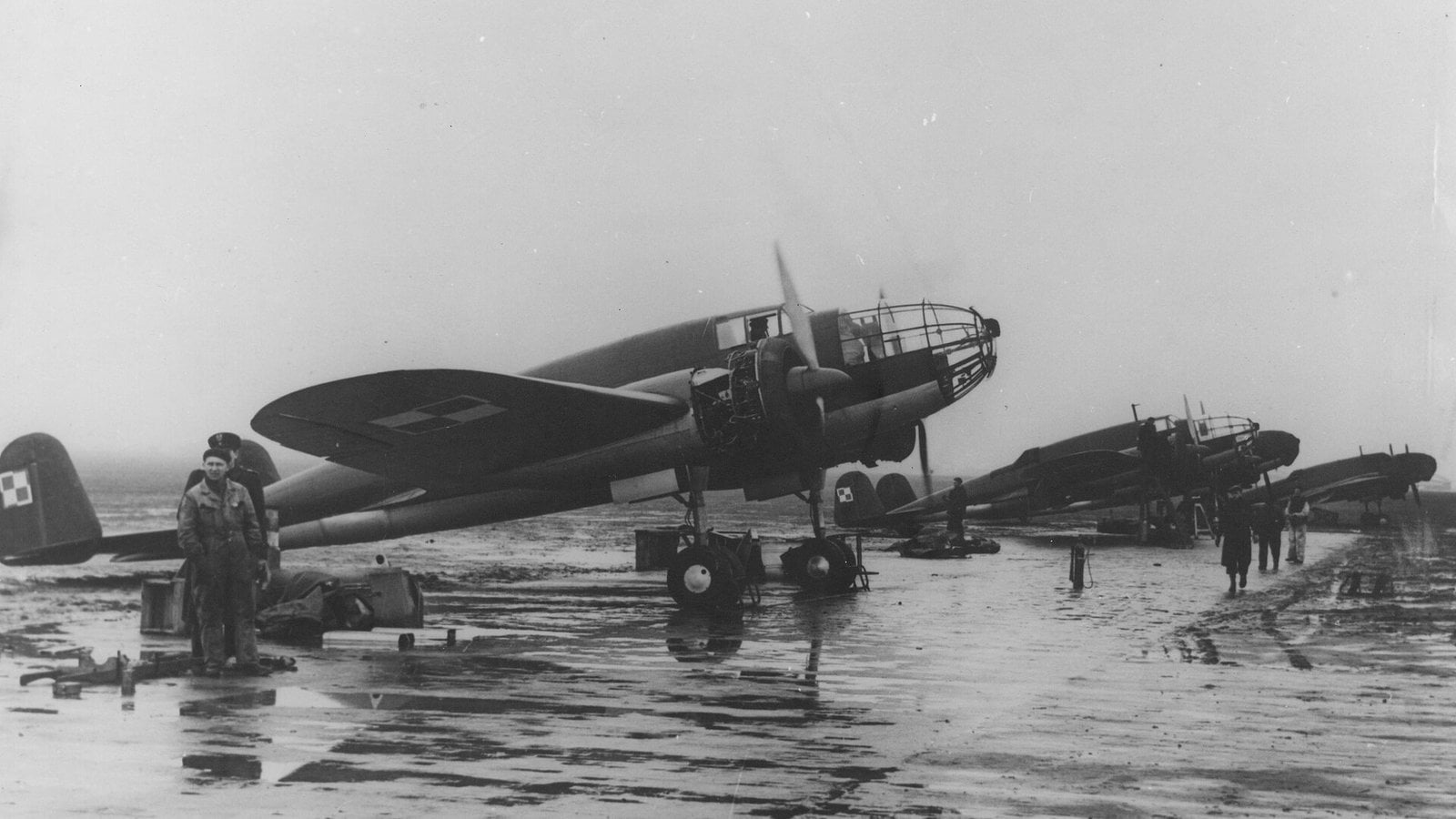
On the last day of August 1939, the crews of four Polish bomber escadrilles flew their aircraft out of Warsaw’s Okęcie airfield and scattered them across improvised fields near Dęblin. The machines they dispersed were PZL.37 Łoś bombers: slim, twin-engined, all-metal and, by most measures, the most modern aircraft Poland had ever built. Within days, their crews would be flying them against German tanks.
There were never enough of them. Roughly 90 had reached the air force by the outbreak of war, yet only 36 stood ready in front-line squadrons on 1 September. Many of the young men who flew them had had months, not years, to master a demanding new aeroplane. What they did with it over the next two weeks, and where the survivors ended up, is one of the quieter and more poignant stories of the September campaign.
Kurzinfo
- Typ: Twin-engined medium bomber with a crew of four
- Designer: Jerzy Dąbrowski and his team at PZL, Warsaw
- Erster Flug: 1936; Polish accounts give 13 December 1936, some British references mid-1936
- Produktion: About 90 delivered before the war, with more still on the line; totals vary by source
- 1 September 1939: 36 combat-ready in four Bomber Brigade escadrilles
- September campaign: Roughly 45 to 47 flew in combat; between 26 and about 30 were lost, depending on the count
- Romania: Around two dozen escaped there; 22 or 23 later served with the Romanian air force, including against the USSR from June 1941
- Überlebende: No complete original is known to survive; a full-scale replica was unveiled in Mielec in 2012
Jerzy Dąbrowski’s Elk
The story begins in 1934, when the aviation department of Poland’s Ministry of Military Affairs went looking for a modern bomber to replace its ageing Fokker F.VII machines. At the state aircraft works, PZL, a design team led by Jerzy Dąbrowski answered with a preliminary design submitted in July 1934. His deputy was Piotr Kubicki, and Franciszek Misztal worked on the wing structure.
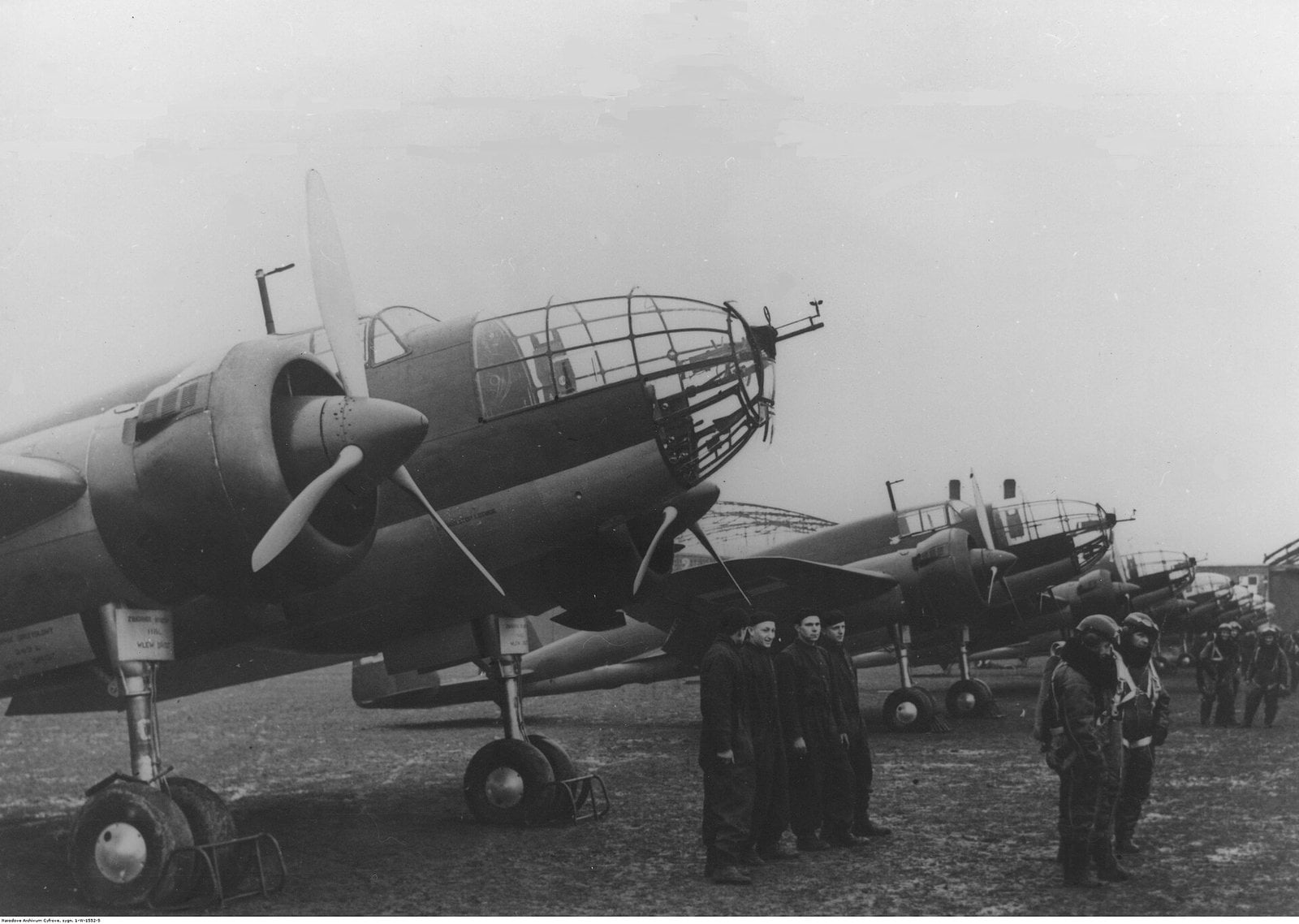
What they drew was startlingly clean for its day: an all-metal, stressed-skin, low-wing monoplane with a retractable undercarriage, powered by two Bristol Pegasus radials that PZL built under licence as the Pegaz. The fuselage was remarkably slim. Bombs went into a bay in the fuselage and into bays built into the wing centre section, so the aircraft could carry a heavy load without fattening its profile.
Kubicki reworked the undercarriage into an unusual twin-wheel main gear, two wheels side by side on each leg, meant to cope with soft and rough fields. The second prototype introduced the twin-fin tail that became the type’s signature. The first prototype’s maiden flight is dated differently depending on whom you read: Polish sources, including the Institute of National Remembrance (IPN), give 13 December 1936 with test pilot Jerzy Widawski at the controls, while some British references place it in mid-1936.
A Bomber Ahead of Its Time
On paper, the Łoś (Polish for elk) was a match for anything in its class. The most commonly quoted top speed for the main production PZL.37B is 412 km/h at 2,800 metres, with some sources giving higher figures. That was faster than the PZL P.11 fighters then defending Polish skies. Its maximum bomb load was more than 2.5 tonnes, and the British historian J. Rickard notes that it could carry twice the payload of the contemporary Dornier Do 17Z at higher speeds.
Foreign air forces noticed. Before the war, Yugoslavia, Bulgaria, Romania and Turkey all placed orders for export versions with French Gnome-Rhône engines, and other countries were negotiating. None of those aircraft was delivered before Germany invaded. The Institute of National Remembrance has even suggested that Poland might have made the best use of the design by building it for export.
Archive film of the PZL.37 Łoś and the PZL P.11, posted by the archive channel PATHE 1939.
Growing Pains
The first production batch, the PZL.37A, had a single fin. It was followed by the twin-finned A bis and then the definitive PZL.37B with Pegaz XX engines, which squadrons received from the second half of 1938. The early months were hard. Eight aircraft were lost in accidents before the war, with 21 airmen killed according to the IPN, and many of the problems were traced to the tail controls before modifications made the B model dependable.
Money and priorities were tight too. The original order for 180 aircraft was cut back more than once, in early 1939 General Józef Zając, soon to command Poland’s aviation, tried to halt Łoś production altogether, according to the historian J. Rickard. His assessment of the whole air force that year was blunt.
By September 1939 the Łoś had come through its troubles. The Polish Aviation Museum in Kraków, which today describes it as the most modern aircraft designed in Poland before the Second World War, sums up its arc in a single sentence.
Thirty-Six Bombers
When war came, the front-line Łoś force was tiny. Four escadrilles, numbered 211, 212, 216 and 217, each with nine PZL.37Bs, flew within the Bomber Brigade commanded by Colonel Władysław Heller, alongside squadrons of lighter PZL.23 Karaś bombers. The brigade answered directly to the Polish commander-in-chief as his own air reserve.
Most of the remaining aircraft, many of them older A and A bis models, sat with a training squadron, in reserve or in repair. Many were destroyed when the Luftwaffe bombed the reserve base at Małaszewicze and the factory airfields in the first days of the war; estimates range from about 18 to roughly 30 aircraft. The crews also faced practical limits. Operating from grass fields, the bombers usually took off with around a tonne of bombs or less, far below what the brochure promised.
Against the Panzers
Pre-war plans to bomb targets inside Germany were abandoned. Instead, from around 4 September, the Łoś crews were sent in daylight against German armoured columns pouring into central Poland, near Częstochowa, Radomsko, Kamieńsk and Piotrków Trybunalski, and later on other fronts. They flew in small formations of three aircraft or fewer, often low, and with little or no fighter cover.
It was brutally dangerous work. Formations were met by Messerschmitt Bf 109 Und Bf 110 fighters and heavy flak, and Polish troops, who had learned to fire at anything overhead, sometimes shot at their own aircraft too. Between 45 and 47 Łoś bombers took part in the brigade’s operations, including replacements drawn from reserve units. Polish accounts credit them with about 135 sorties, including reconnaissance flights, and roughly 120 tonnes of bombs dropped; their gunners were credited with five or six German fighters.
Did it change anything? The IPN is frank that the attacks on German armour achieved little against such a fast-moving enemy. The price was heavy: between 26 and about 30 aircraft were lost, to fighters, anti-aircraft fire, bombing on the ground and accidents, and many airmen were killed, wounded or captured. The last combat sorties were flown around 16 September.
An English-language overview of the PZL.37 Łoś from The Grand Archive.
Flight to Romania
On 17 September 1939, the Soviet Union invaded Poland from the east, and the surviving bombers were ordered to Romania. Accounts of how many made it differ. The most commonly cited total is 26 or 27, made up of 17 to 19 Bomber Brigade aircraft plus a group from training units, although one British account suggests it may have been considerably more. Their crews crossed the border into internment.
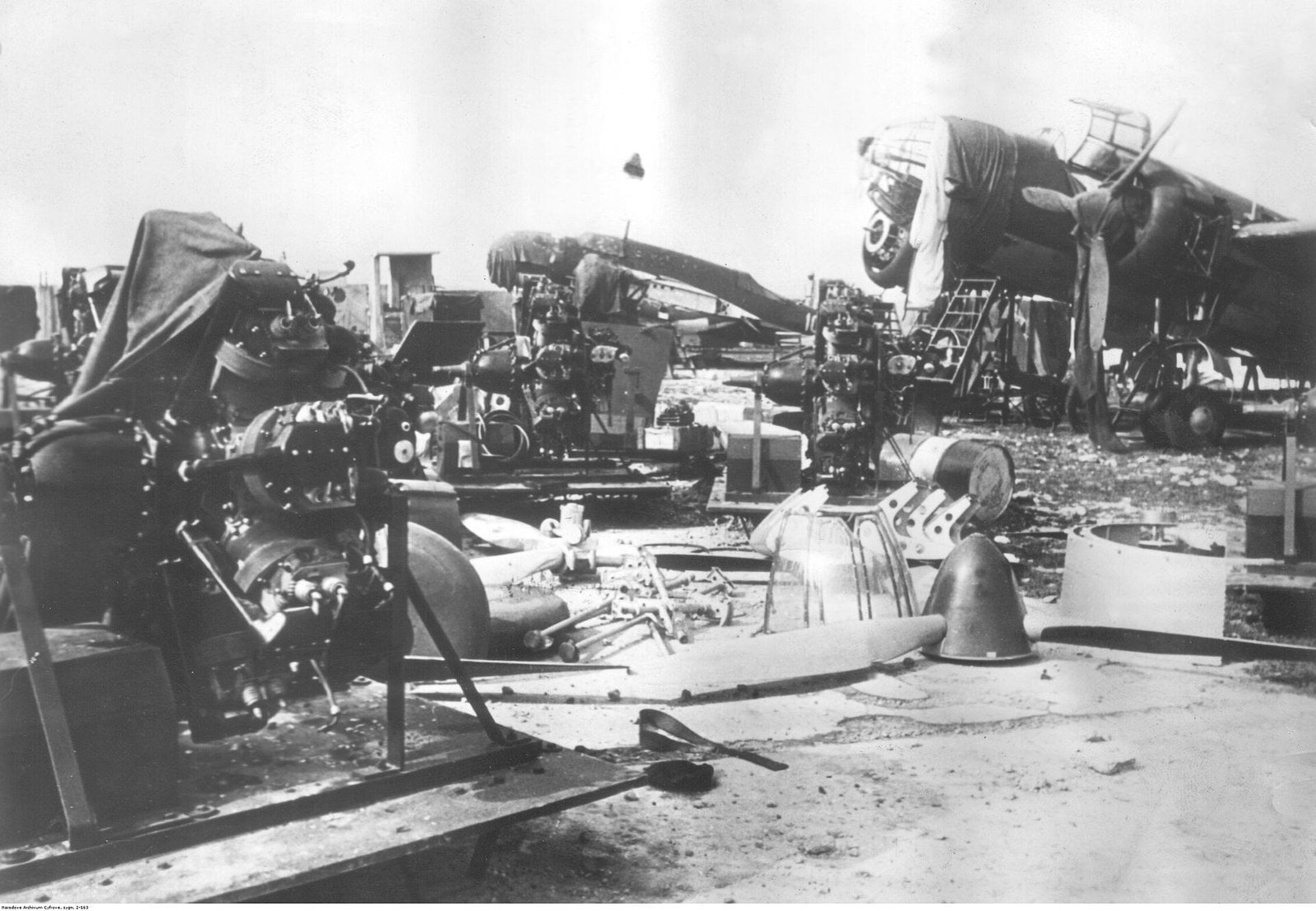
What stayed behind had a grimmer fate. The Germans captured somewhere around 40 to 50 Łoś bombers, most of them wrecks or incomplete airframes, and Polish workers broke up many of them before the occupiers grasped what they had. Two were repaired and flown in Germany for evaluation.
A Second Life in Romanian Colours
Romania took the interned bombers into its own air force in 1940. Twenty-two or twenty-three of them, depending on the source, went to the 76th and 77th Bomber Squadrons of the 4th Bomber Group. Romanian crews struggled with the type. Without Polish instructors, flight manuals or experience of its handling and high wing loading, they suffered a string of crashes, and roughly a third of the aircraft were written off in accidents.
When Romania joined the German invasion of the Soviet Union on 22 June 1941, the 4th Bomber Group went to war with its Polish-built bombers. About 15, by most accounts, flew with the Romanian air arm supporting the advance into Bessarabia and the push towards Odessa. By the autumn of 1941 a shortage of spare parts had pulled them from the front, and the survivors became trainers.
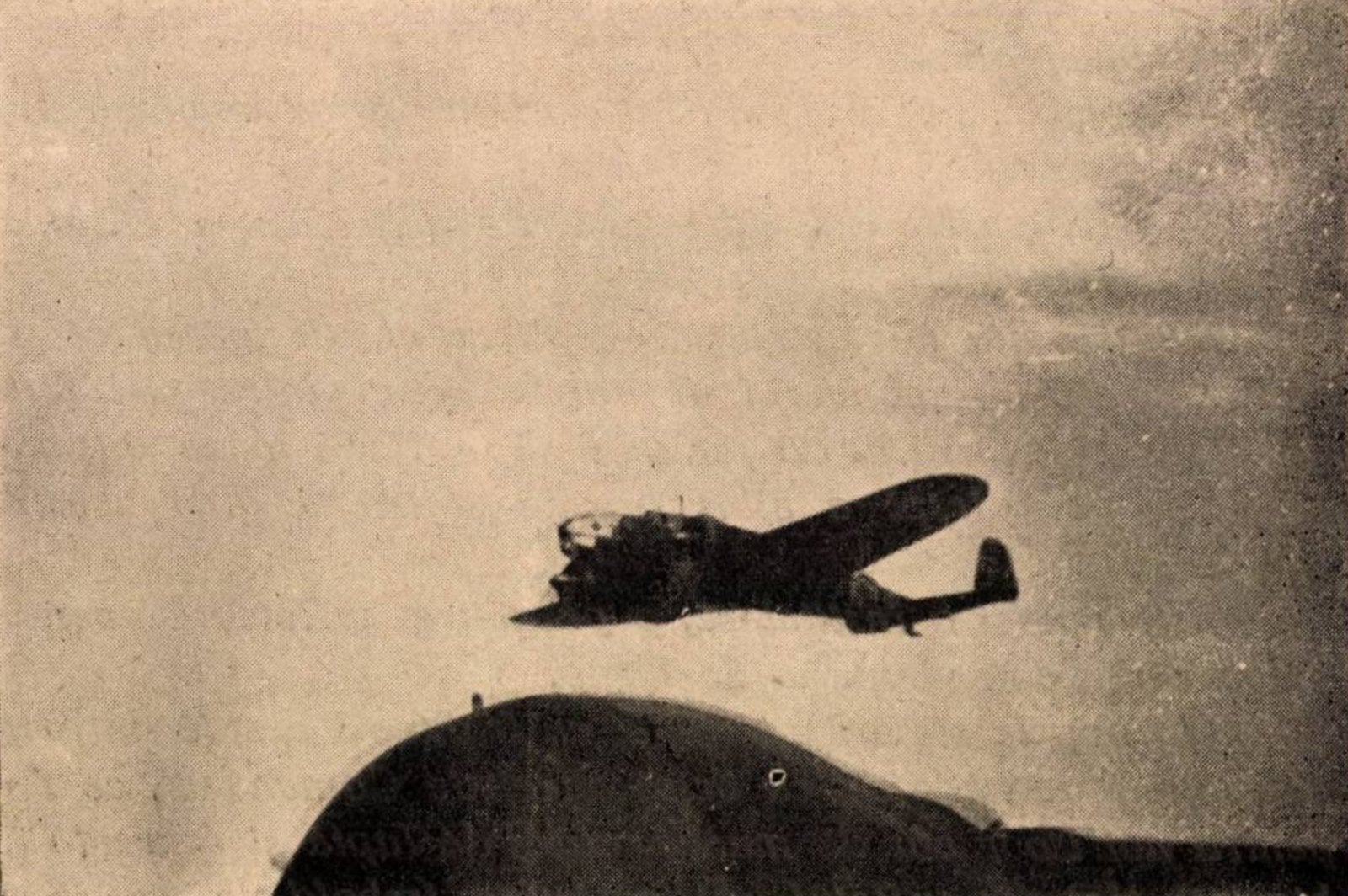
They had one more act. In April 1944, the 76th Squadron went back into action with a handful of the old bombers as the Red Army pushed into Romania. Several more were destroyed on the ground in air raids later that year, and none is known to have survived the war.
What Remains
No complete PZL.37 Łoś is known to have survived. The Polish Aviation Museum in Kraków keeps a licence-built Pegaz XX engine of the kind that powered the B model, along with the rim of a main undercarriage wheel recovered from one of the bombers. Small things, but they are what is left of the aircraft itself.
In September 2012, a group of enthusiasts led by employees of the aircraft works at Mielec, where a second Łoś production line had been set up in 1939, unveiled a full-scale replica built from scratch over two years. It was rolled out of a pre-war factory hall that had survived the war.
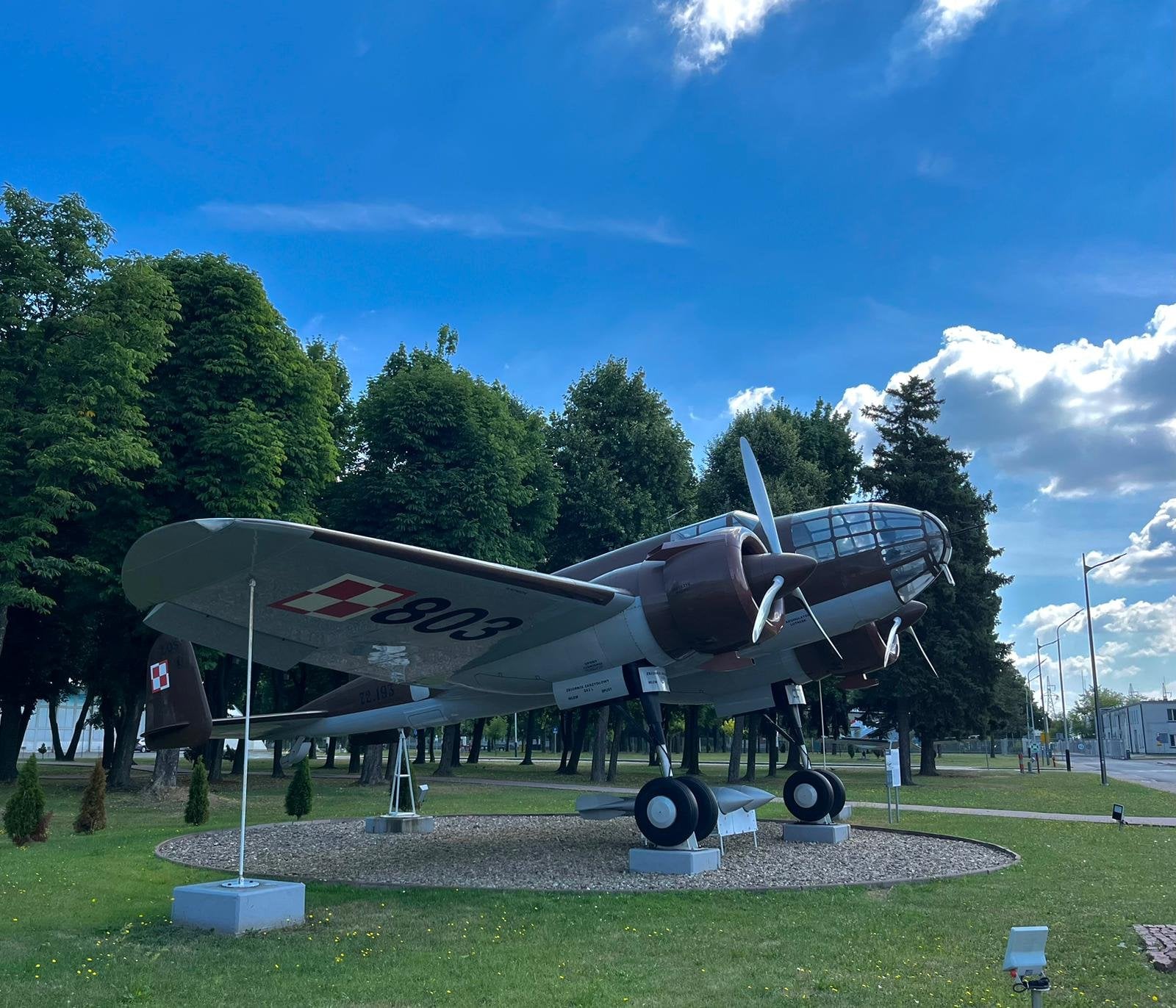
The Łoś arrived just in time to fight and far too late to matter. Like Poland’s fighter pilots in their P.11s and the PZL.50 Jastrząb that never reached them, its crews went to war with what they had and paid for it. The aircraft was among the best of its generation. The tragedy was that there were only 36 of them on the morning it mattered.
Polskie Radio’s Polish-language programme on the PZL.37 Łoś, Poland’s most modern aircraft of September 1939.
Sources: Institute of National Remembrance (IPN) via Dla Pilota, Polish Aviation Museum, Kraków, History of War (J. Rickard), Polot.net, worldwar2.ro, Kuryer Polski, Defence24, The National Interest, Narodowe Archiwum Cyfrowe.
Header photo: PZL.37 Łoś bombers on an airfield, 1939, Narodowe Archiwum Cyfrowe (Polish National Digital Archives), cropped, public domain, via Wikimedia Commons
0 Comments