
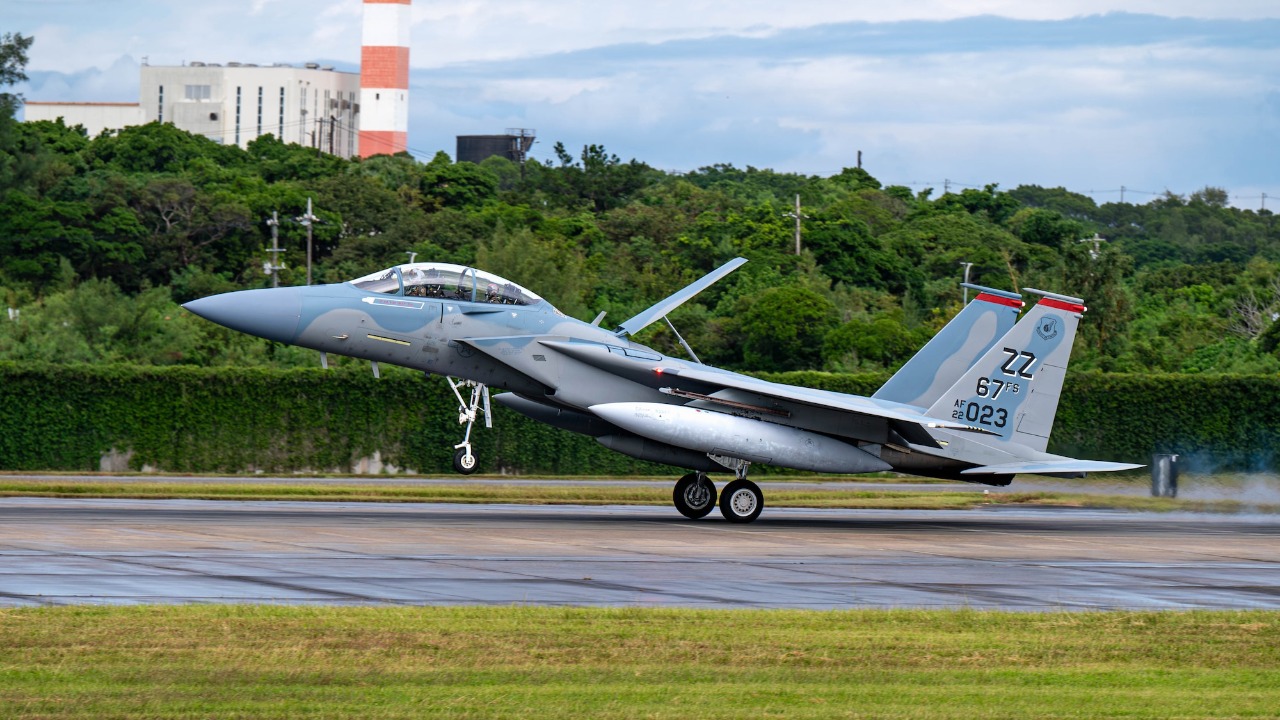
At ten past ten on a damp Sunday morning in Okinawa, an F-15EX Eagle II put its main wheels on Kadena’s runway and stayed. That last word is the whole story. Eagle IIs had visited Kadena before. This one came to live there.
Two jets of the 67th Fighter Squadron, 18th Wing, arrived on 15 November 2026 as the first permanently assigned F-15EXs at any overseas US Air Force installation. Kadena is also only the second Air Force location anywhere to field the type, after the Oregon Air National Guard’s 142nd Wing at Portland.
It has been a four-year wait, filled in the meantime by a rotating cast of other people’s fighters. Okinawa now has its own again.
Kurzinfo
Was ist passiert: The first permanently assigned USAF F-15EX Eagle IIs arrived at Kadena Air Base, Japan
Wann: 15 November 2026
Einheit: 67th Fighter Squadron, 18th Wing
Bedeutung: First overseas USAF base to receive combat-coded F-15EX; second USAF location overall
The plan: 36 F-15EX to replace 48 F-15C/D, announced by the Department of Defense on 3 July 2024
Staffeln: Both the 44th and 67th Fighter Squadrons will operate the Eagle II at Kadena
Nächster Meilenstein: The 18th Wing’s centennial in 2027
A Very Long Way to a New Home
The two fighters had been at Portland Air National Guard Base, Oregon, since late August, finishing their preparations alongside the only other American unit that flies the type. They left as FEUD 41 and FEUD 42, trailed by a pair of KC-135 Stratotankers using the callsigns PETRO 01 and PETRO 02, and staged through Honolulu before the final leg across the Pacific.
None of that is in the Air Force’s own announcement. It comes from the flight-tracking account that followed the movement, filed under the air traffic reservation name Coronet West 421 — the sort of unglamorous logistics detail that tells you a transpacific fighter delivery is less a ceremony than a fuel problem solved four times in a row.
Kadena is the first overseas Air Force installation to receive combat-coded F-15EX aircraft. “Combat-coded” is the phrase doing the heavy lifting: these are not test or training airframes on loan, but jets counted against an operational mission, assigned to a squadron, based forward.
The 18th Wing describes it as a major milestone in its fighter modernization. The wing commander put it in blunter strategic terms.
Four Years Without a Home Team
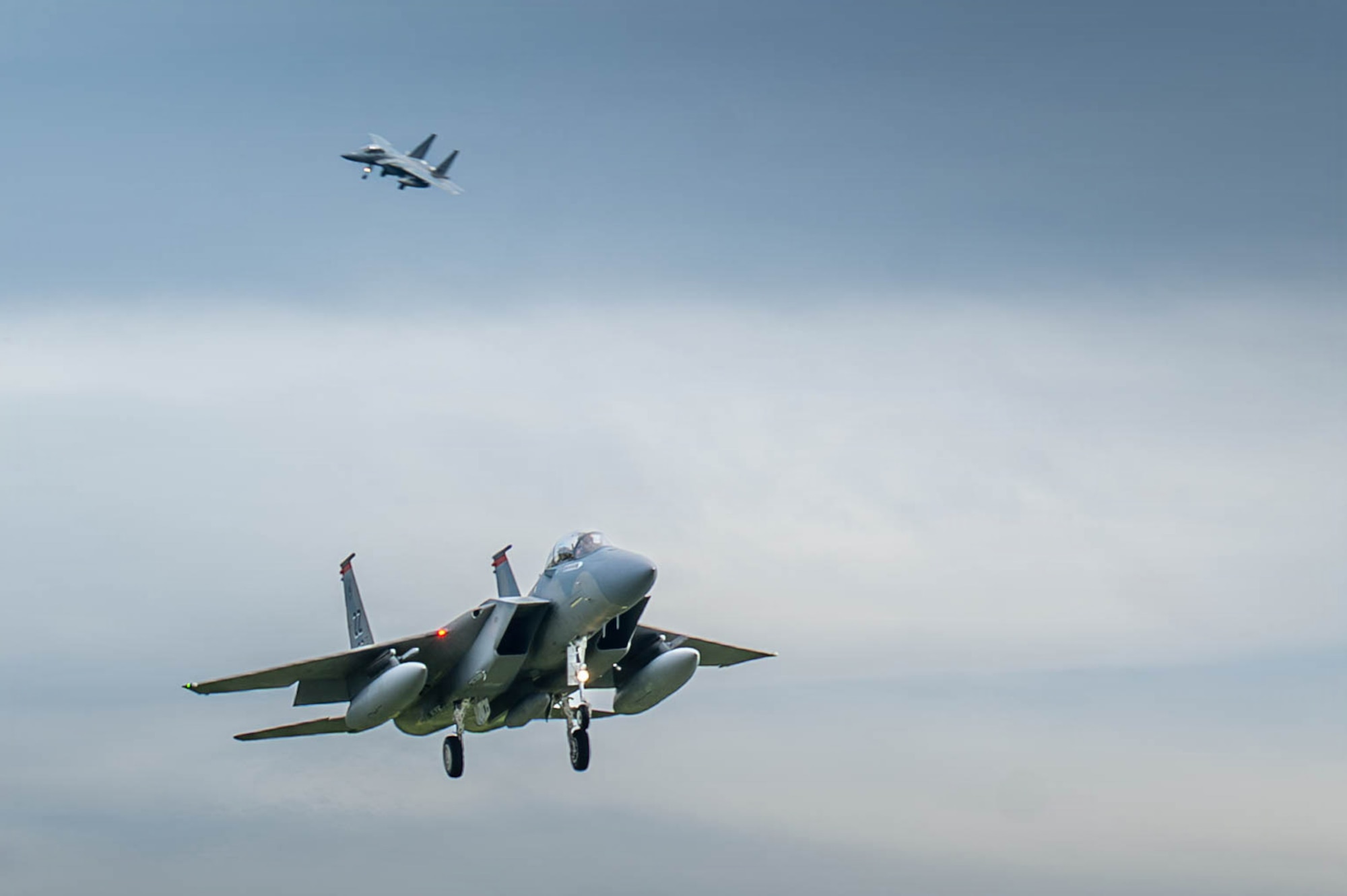
Kadena’s own F-15C/D Eagles began a phased withdrawal in November 2022, after more than four decades flying the air superiority mission from Okinawa. What followed was unusual: the busiest fighter base in the Pacific had no permanently assigned fighters at all.
The gap was filled by rotational deployments of fourth- and fifth-generation types, a continuous presence assembled from squadrons that arrived, flew, and went home again. It worked. It also meant that for four years, the people who actually live and work at Kadena were hosting somebody else’s jets.
The replacement plan was announced by the Department of Defense on 3 July 2024, as part of a tactical aircraft modernization package for Japan the Pentagon valued at over $10 billion. Kadena gets 36 F-15EX in place of 48 F-15C/D. Misawa goes from 36 F-16s to 48 F-35As. The Kadena arithmetic is worth sitting with: twelve fewer airframes, and the Air Force is confident enough in what each one carries to call that an upgrade.
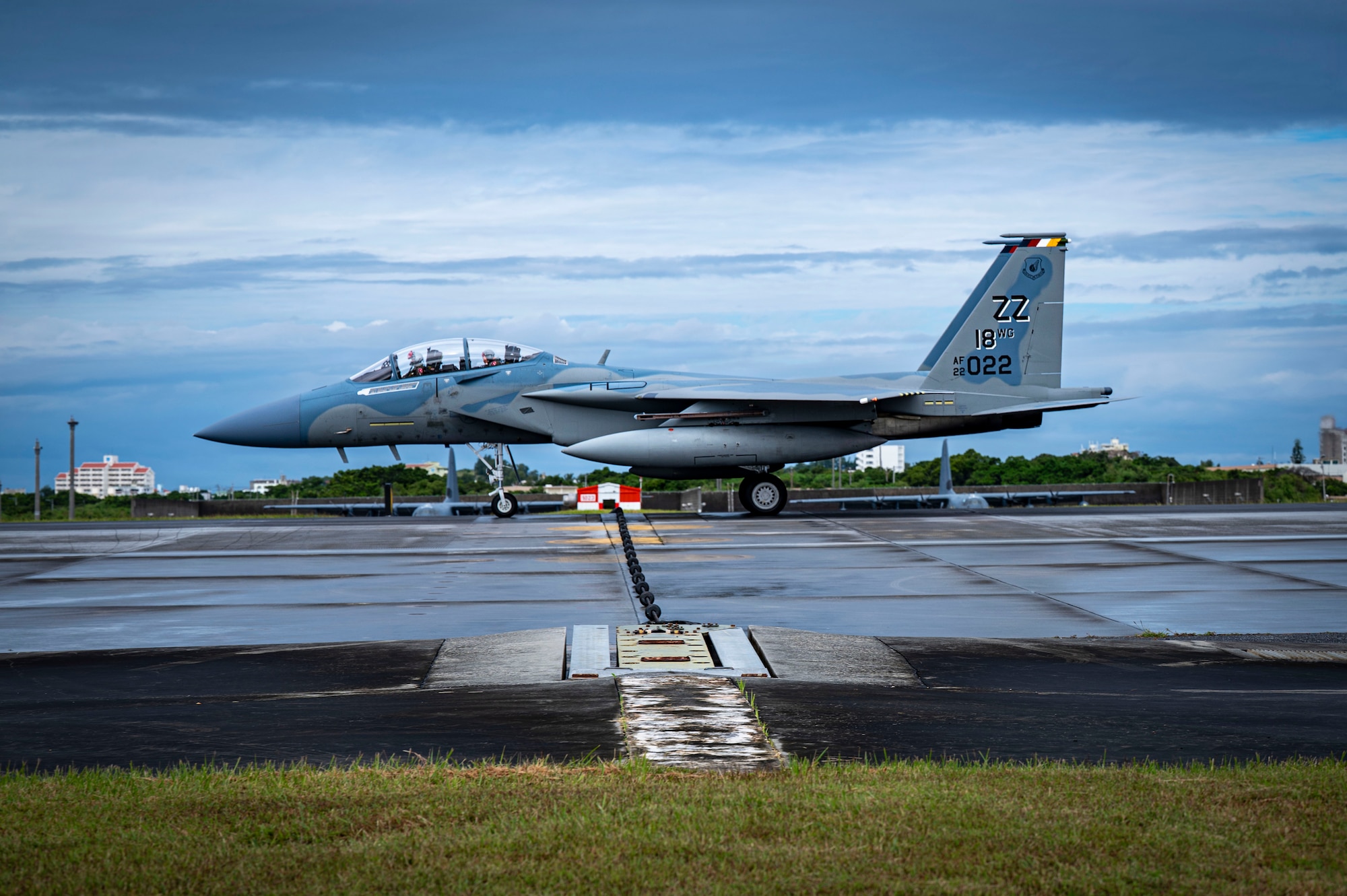
Getting to this morning took years of work done somewhere else. Pilots of the 67th Fighter Squadron travelled to Eglin Air Force Base, Florida, and to Portland to stay current and qualify on the aircraft. Maintainers from the 18th Aircraft Maintenance Squadron worked with Boeing and Air Force teams at both bases, and kept their hands in by supporting F-15E operations at Seymour Johnson and Mountain Home.
What Arrives With the Aircraft
The Air Force lists the headline gains as advanced avionics, modernized electronic warfare systems and increased weapons-carrying capacity. In the Pacific those three things point in the same direction: an aircraft that can hold a lot of missiles, see a long way, and survive being seen.
Both of the 18th Wing’s fighter squadrons, the 44th and the 67th, will fly the Eagle II. Two jets today is not a fleet, and nobody at Kadena is pretending otherwise. But the deliveries now have somewhere to go.
There is a nice piece of timing in it, too. The 18th Wing turns one hundred in 2027, a century after it was activated as the 18th Pursuit Group at Wheeler Field, Hawaii, on 21 January 1927. The wing will mark that anniversary with the newest Eagles the Air Force has.
Footage of the arrival at Kadena.
Sources: 18th Wing Public Affairs; U.S. Indo-Pacific Command; Department of Defense; U.S. Air Force imagery.
Häufig gestellte Fragen
When did the first F-15EX arrive permanently at Kadena Air Base?
Why is the Kadena F-15EX arrival significant?
How many F-15EX will Kadena Air Base receive?
What happened to Kadena’s F-15C/D Eagles?
Which squadrons at Kadena will fly the F-15EX?
Where else does the U.S. Air Force operate the F-15EX Eagle II?
Ähnliche Beiträge
Kadenas erster neuer Adler zeigt seine Farben
F-15EX Eagle II landet erstmals in Kadena
F-15EX Conformal Fuel Tanks: Oregon’s Eagle IIs Finally Bulk Up
F-15EX Eagle II: Die Warnung des Pentagons vor einer Verdopplung der Anschaffungskosten
Keen Sword 27: US Army Soldiers Refuel F-22 Raptors in Japan
0 Comments