
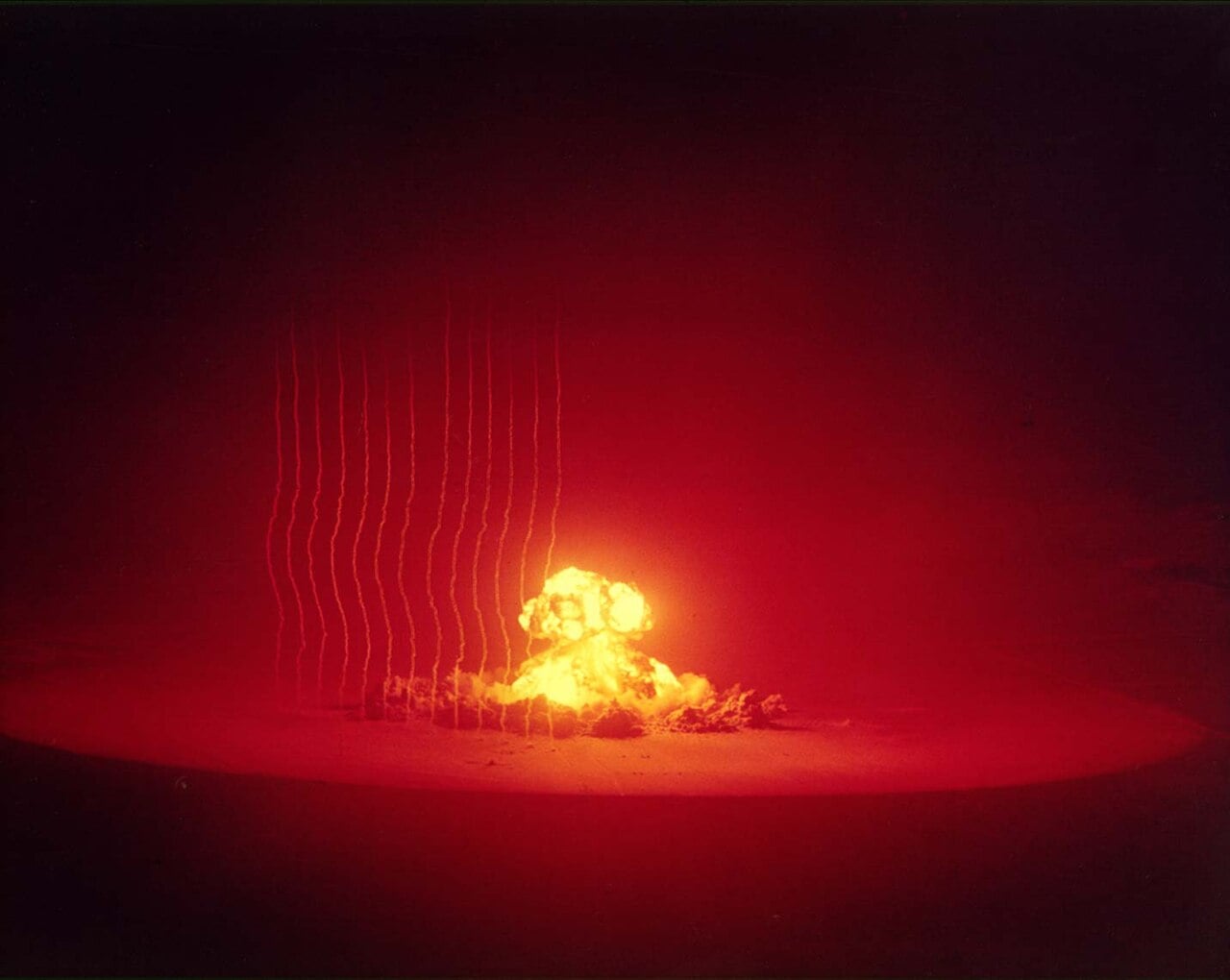
Before dawn on 27 January 1951, cars began to line the roads out of Las Vegas. People had set their alarm clocks. Sixty-five miles to the north-west, over a dry lake called Frenchman Flat, an Air Force bomber was lining up to drop a small atomic bomb. At 5:45 in the morning the sky over the desert flashed white. A truck driver on the Baker grade said the flash blinded him for a few seconds and gave him quite a scare. The next day’s Las Vegas Review-Journal ran a banner across its front page: “VEGANS ‘ATOM-IZED’”.
It was the start of a decade in which a gambling town in the desert sold the nuclear age as a show. Over the next eleven years the United States set off 100 atmospheric nuclear tests in Nevada, and Las Vegas turned out to watch.
Kurzinfo
- Wo: Nevada Proving Grounds, later the Nevada Test Site, about 65 miles north-west of Las Vegas
- First test: Ranger Able, airdropped over Frenchman Flat, 27 January 1951
- Atmospheric tests: 100 in Nevada, 1951 to July 1962
- Airdrops: 19 Nevada shots dropped from aircraft, mostly B-50s; one from a B-36
- Last atmospheric test: Little Feller I, 17 July 1962
- After 1963: Limited Test Ban Treaty; testing moved underground until 1992
The Bombers Overhead
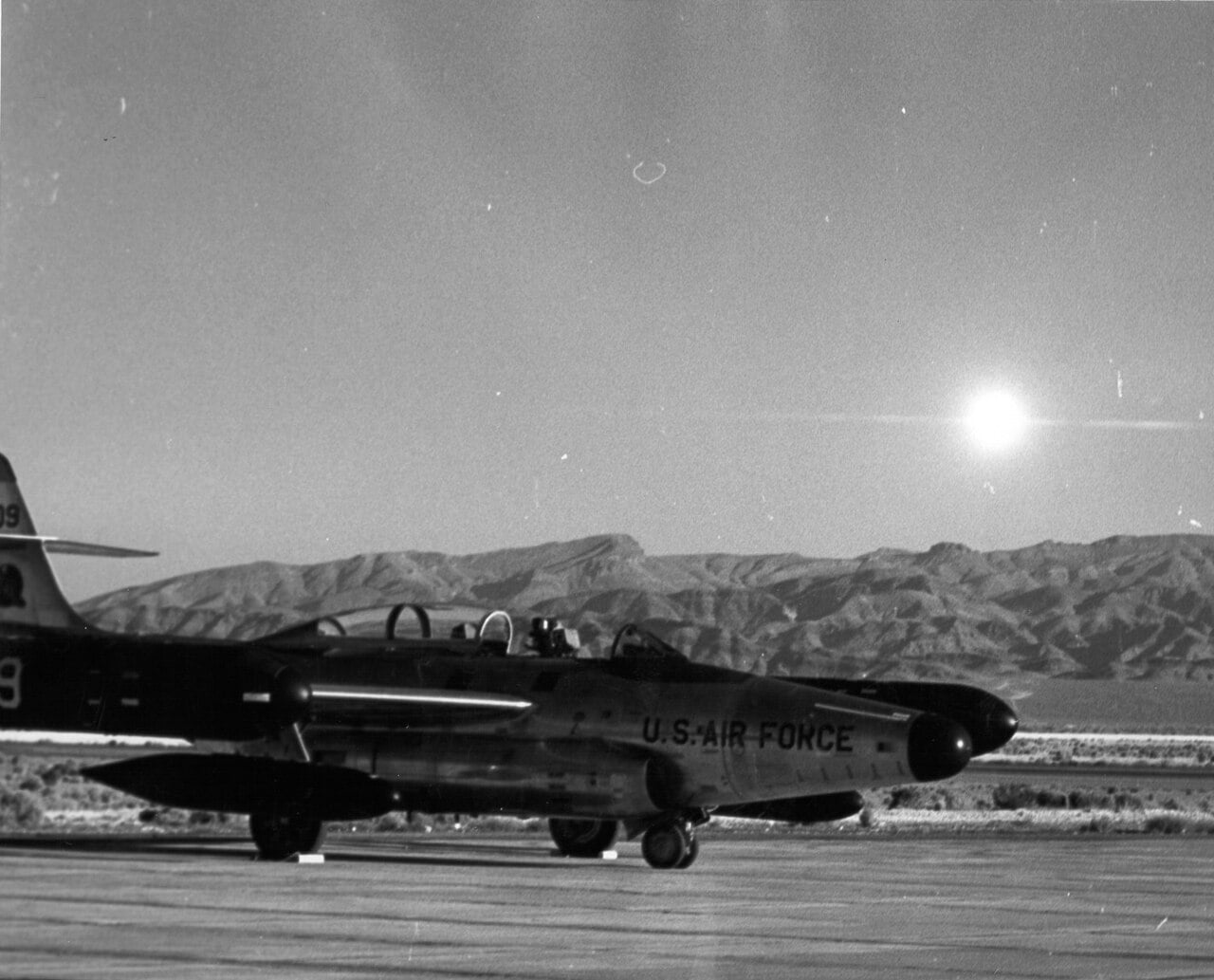
Many of the early Nevada tests came from the air. The Ranger series of 1951 was dropped by B-50s, upgraded B-29s, and so were the four airdrops of Operation Buster later that year. Nineteen Nevada shots in all were airdropped. On 22 April 1952, during Tumbler-Snapper, a B-50 circling clockwise at 30,000 feet released Shot Charlie, its vapour trail visible against the sky as four instrument aircraft flew around it. In April 1955 a B-36 dropped Teapot HA by parachute from 46,000 feet, the only parachute drop ever made at the site, while B-36s, B-57s and F-84Gs flew through the cloud to collect samples and F-86 Sabres laid smoke trails to measure the shock wave.
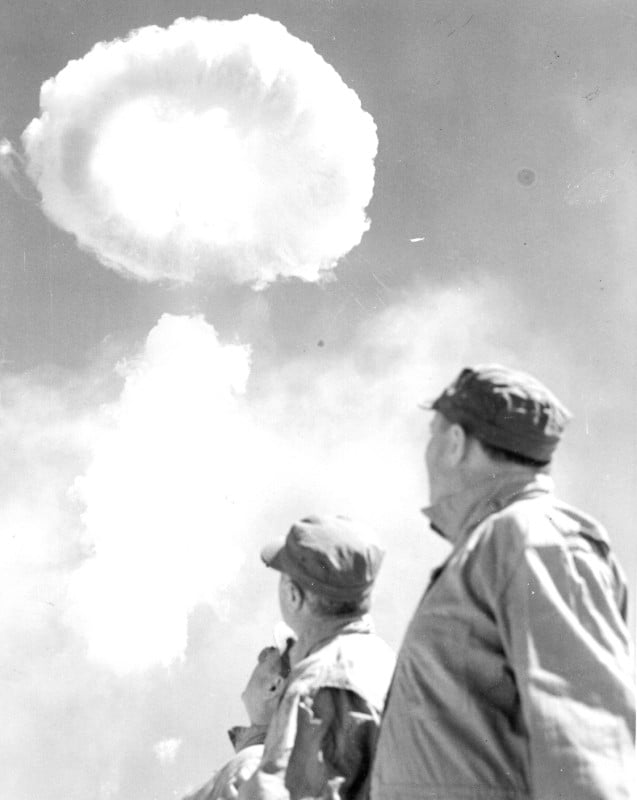
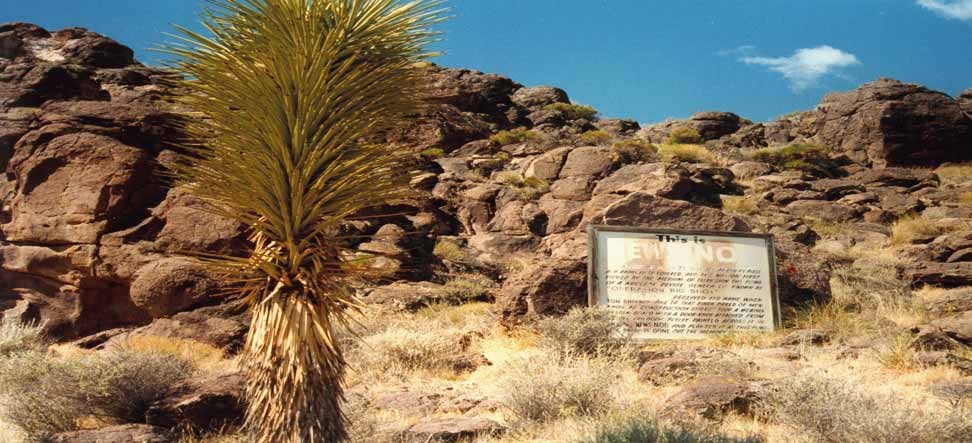
Charlie was also the first nuclear test shown live on television, carried by KTLA to an estimated 35 million viewers. A year later, on 17 March 1953, Walter Cronkite reported from News Nob, the press viewing point, as Shot Annie destroyed a set of test houses full of mannequins. Around eight million people watched it live.
Dawn Bomb Parties
Las Vegas saw a business opportunity. The Chamber of Commerce printed calendars listing detonation times and the best places to watch. Hotels advertised their views; the Desert Inn’s Sky Room became a favourite, and guests stayed up through the night for “dawn bomb parties” that ended with a flash on the horizon. Bars mixed the Atomic Cocktail, salons offered the Atomic Hairdo, and mushroom clouds appeared on postcards. The Atomic Energy Commission’s own chairman, Gordon Dean, noted that the tests brought one of the biggest tourist influxes the city had ever seen.
Greenspun’s point was that a town known for gambling, divorces and doubtful pleasures was now part of the most important work the country was doing. Showgirls helped sell it. In 1952 Candyce King of the Last Frontier became “Miss Atomic Blast”, the first known atomic pin-up. In 1957 the Las Vegas News Bureau photographer Donald English posed Lee Merlin, a Copa showgirl at the Sands, with a cotton mushroom cloud fixed to her swimsuit. “Miss Atomic Bomb” became one of the defining images of the decade. In 2025 historians finally identified her: Lee Merlin was the stage name of Anna Lee Mahoney.
Target Nevada, a 1950s film on Air Force operations at the Nevada Test Site. Video: US Department of Energy.
Five Men Under a Nuclear Rocket
The most extraordinary aviation test came on 19 July 1957. Over Yucca Flat an F-89J Scorpion fired an unguided Genie air-to-air rocket with a nuclear warhead of about two kilotons. It flew for four and a half seconds and exploded high above the desert. Directly below it stood five Air Force officers, without helmets or protective clothing, beside a hand-made sign that read “Ground Zero. Population 5.” The point was to show that the public had nothing to fear.
The Cloud Drifts East
The reassurance was official policy. A booklet the Atomic Energy Commission handed out to people living near the test site in 1955 told them they were active participants in the nation’s atomic test programme.
The wind usually carried the fallout away from Las Vegas, towards Utah and beyond. Decades later the National Cancer Institute found that iodine-131 from the Nevada tests fell over parts of Utah, Colorado, Idaho, Nevada and Montana, and that the greatest risk was to children who drank milk at the time. Congress passed the Radiation Exposure Compensation Act to compensate “downwinders” and test participants; it was reauthorised in 2025, with claims open until the end of 2027.
Atomic Tests in Nevada, the 1950s film the AEC used to reassure people living near the test site. Video: US Department of Energy.
When the Show Ended
The last Nevada test in the open air, Little Feller I, went off on 17 July 1962. A year later the Limited Test Ban Treaty banned atmospheric testing, and the explosions moved underground, where more than 700 more were set off until 1992. Las Vegas found other ways to sell the night sky. The mushroom clouds survive in museum photographs, postcards and one showgirl with a cotton cloud on her swimsuit.
Sources: US Department of Energy, Terrence R. Fehner and F. G. Gosling, Atmospheric Nuclear Weapons Testing 1951–1963 (DOE/MA-0003, 2006); DOE/NV-209, United States Nuclear Tests, July 1945 through September 1992 (Rev. 16, 2015); Nevada National Security Site history; Defense Threat Reduction Agency, Operation Ranger fact sheet; DOE/NV-1024 (2013); PBS American Experience, Atomic Tourism in Nevada; National Cancer Institute, Radioactive I-131 from Fallout; US Department of Justice, Radiation Exposure Compensation Program; US Atomic Energy Commission, Atomic Test Effects in the Nevada Test Site Region (1955); NPR (2012 and 2025); Las Vegas Review-Journal (2025); Smithsonian Magazine.


0 Comments