

Every airliner that pushes back under instrument flight rules is already planning to land somewhere else. Long before the doors close, a second airport has been written into the flight plan, with enough fuel on board to get there. Most passengers never hear its name. On a foggy night, it can decide where they sleep.
In the United States, whether a flight needs that backup, and which airports qualify, comes down to a short list of federal rules. Pilots learn the first one as a mnemonic so simple it fits on a fingernail: 1-2-3.
Kurzinfo
- Regel: 14 CFR 91.169, IFR flight plan alternate requirement
- 1-2-3: From 1 hour before to 1 hour after ETA: ceiling at least 2,000 ft and visibility at least 3 statute miles, or an alternate is required
- Standard alternate minima: 600 ft and 2 miles (precision approach); 800 ft and 2 miles (non-precision)
- Chart symbols: Triangle A: non-standard alternate minima; A N/A: not usable as an alternate
- Fuel (91.167): Destination, then alternate, then 45 minutes at normal cruise
- Airlines (121.619): At least one alternate; a second when destination and first alternate are marginal
- Airline alternate minima: Set by each airline’s operations specifications (121.625)
- Takeoff alternate: Within 1 hour (twins) or 2 hours (three or more engines), one engine inoperative
The 1-2-3 rule
Under 14 CFR 91.169, anyone filing an IFR flight plan must name an alternate airport, with one exception. The alternate can be left out if the destination has a published instrument approach and the forecast shows that, from 1 hour before to 1 hour after the estimated time of arrival, the ceiling will be at least 2,000 feet above the airport and the visibility at least 3 statute miles.
If either number misses, an alternate goes on the plan. A ceiling of 1,800 feet with ten miles of visibility needs one. So does a 5,000-foot ceiling in two miles of haze. The two-hour window around the arrival time is there because forecasts are imperfect and flights run late.
Helicopters get their own version. They need an alternate unless, from the arrival time to 1 hour after it, the ceiling is at least 1,000 feet above the airport or 400 feet above the lowest approach minima, whichever is higher, with at least 2 miles of visibility.
Not every airport can be the backup
Naming an alternate is only half the job. The alternate itself has to be forecast to have good enough weather when the aircraft would get there. Under 91.169(c), if the chart gives no special figures, the standard alternate minima are a 600-foot ceiling and 2 miles of visibility for an airport with a precision approach, and 800 feet and 2 miles for a non-precision approach. Pilots shorten these to “600-2” and “800-2”.
Those numbers are deliberately higher than the minima for actually flying the approach. The logic is simple: you are planning around a forecast made hours in advance, so the alternate needs a margin in case its weather also turns worse than expected.
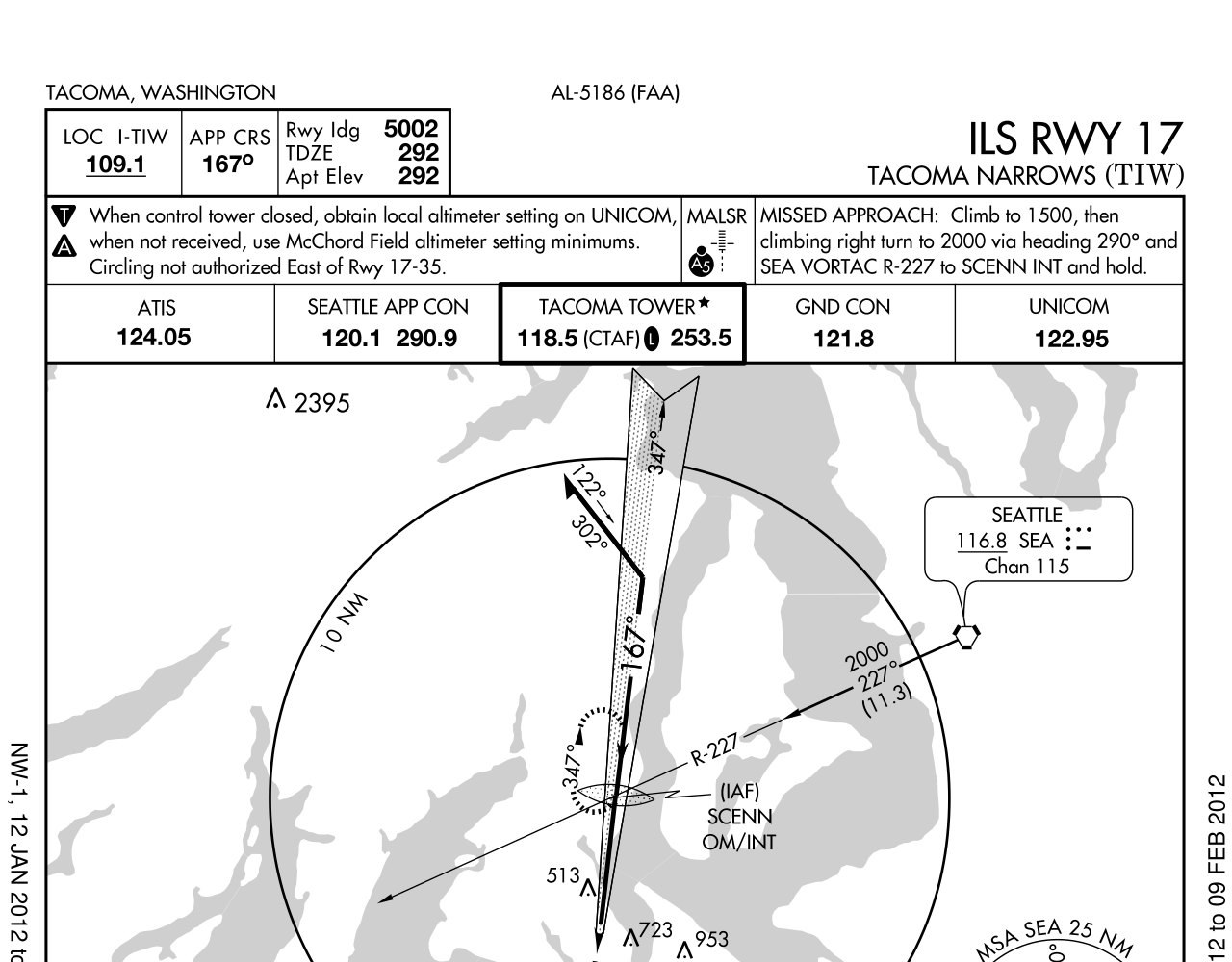
US approach charts carry a code for this. A small triangle with an A on the chart means the airport has non-standard alternate minima, listed at the front of the chart booklet. “A N/A” means the airport cannot be used as an alternate at all, which the FAA says can happen when the navigation aid is unmonitored or the airport lacks weather reporting. Older GPS receivers face extra restrictions too, while aircraft with approach-approved WAAS receivers can use some GPS approaches at an alternate.
And if the alternate has no instrument approach at all? Then the regulation requires weather good enough to descend from the minimum en route altitude, approach and land under basic VFR.
Boldmethod tests your knowledge of IFR alternate minimums, including the 600-2 and 800-2 standards.
The fuel that comes with it
An alternate is meaningless without the fuel to reach it. The companion rule, 14 CFR 91.167, says an aircraft flying in IFR conditions must carry enough fuel to reach its destination, fly from there to the alternate, and then fly for another 45 minutes at normal cruising speed. Afterburner has covered how airlines build up their fuel reserves in more detail.
This is where the 1-2-3 rule earns its keep. When the destination forecast is good, the alternate leg and its fuel can be dropped, which means less weight and lower burn. When the forecast turns, the fuel figure on the release climbs with it.
How the airlines do it
Scheduled airlines fly under Part 121, and the rules get stricter. A domestic airline must list at least one alternate for each destination in the dispatch release, using the same 2,000-foot and 3-mile test as the exemption. When the weather at both the destination and the first alternate is forecast to be marginal, the regulation demands a second alternate.
Flag operations, which cover most international flights by US airlines, have a different test. A flight scheduled for no more than six hours can skip the alternate only if, for an hour either side of arrival, the ceiling is forecast at least 1,500 feet above the lowest published approach minimum or 2,000 feet above the airport, whichever is greater, and the visibility is at least 3 miles or 2 miles more than the lowest approach visibility, whichever is greater.

Airlines do not use the 600-2 and 800-2 figures. Under 121.625, an alternate must meet the minima in the airline’s operations specifications. The FAA’s Instrument Procedures Handbook gives a typical example: at an alternate with one working navigation facility, the dispatcher adds 400 feet to the approach’s Category I height and one mile to its visibility.
There is even a backup for the start of the flight. If the weather at the departure airport is below the airline’s landing minima, the flight needs a takeoff alternate, within one hour’s flying with one engine inoperative for a twin, or two hours for an aircraft with three or more engines.
Who actually picks it
At an airline, the choice is made by a flight dispatcher, who shares legal responsibility for the flight with the captain. Dispatchers work from lists of airports approved as alternates and planning software built around the airline’s routes, weighing aircraft performance, equipment and the route before choosing.
FlightInsight walks through IFR alternate airport requirements, the 1-2-3 rule and standard alternate minimums.
One subtlety catches out student pilots. Alternate minima are planning tools only. If a flight really does divert, the crew flies the alternate’s published approach minima, not the higher planning figures. The extra margin was there to make sure, hours earlier, that the plan was sound.
So the next time a captain announces a diversion, remember that it was not improvised. The backup airport, the fuel to reach it and the weather it needed were all settled before take-off, starting with three small numbers: 1, 2, 3.
Sources: 14 CFR 91.167, 91.169, 121.617, 121.619, 121.621 and 121.625 (eCFR), FAA Instrument Procedures Handbook (FAA-H-8083-16B)



0 Comments