
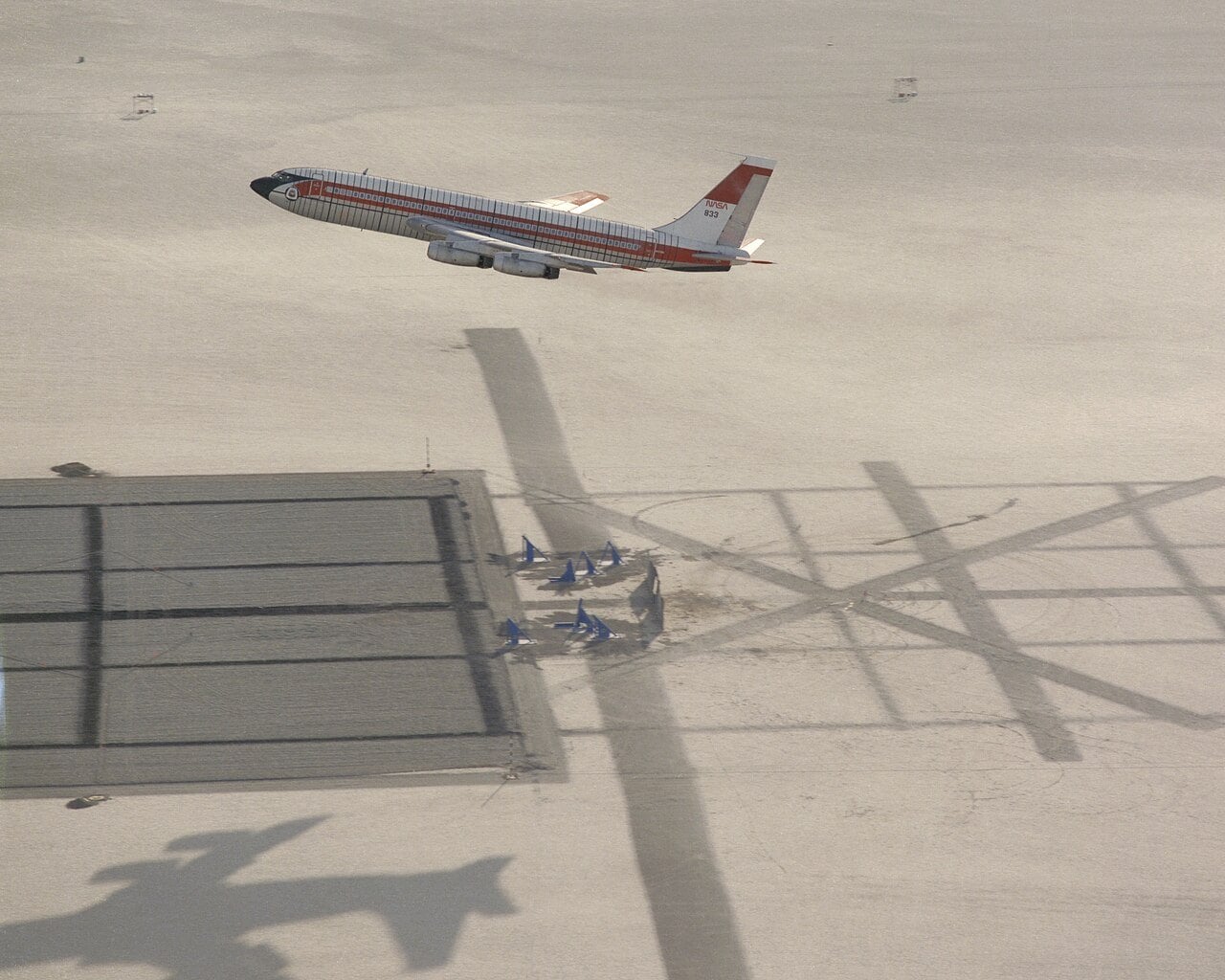
On the morning of 1 December 1984, a four-engined Boeing 720 took off from Edwards Air Force Base in California with 76,000 pounds of fuel in its tanks and a cabin full of passengers. None of them was alive. The seats were filled with instrumented crash dummies, and there was nobody in the cockpit either.
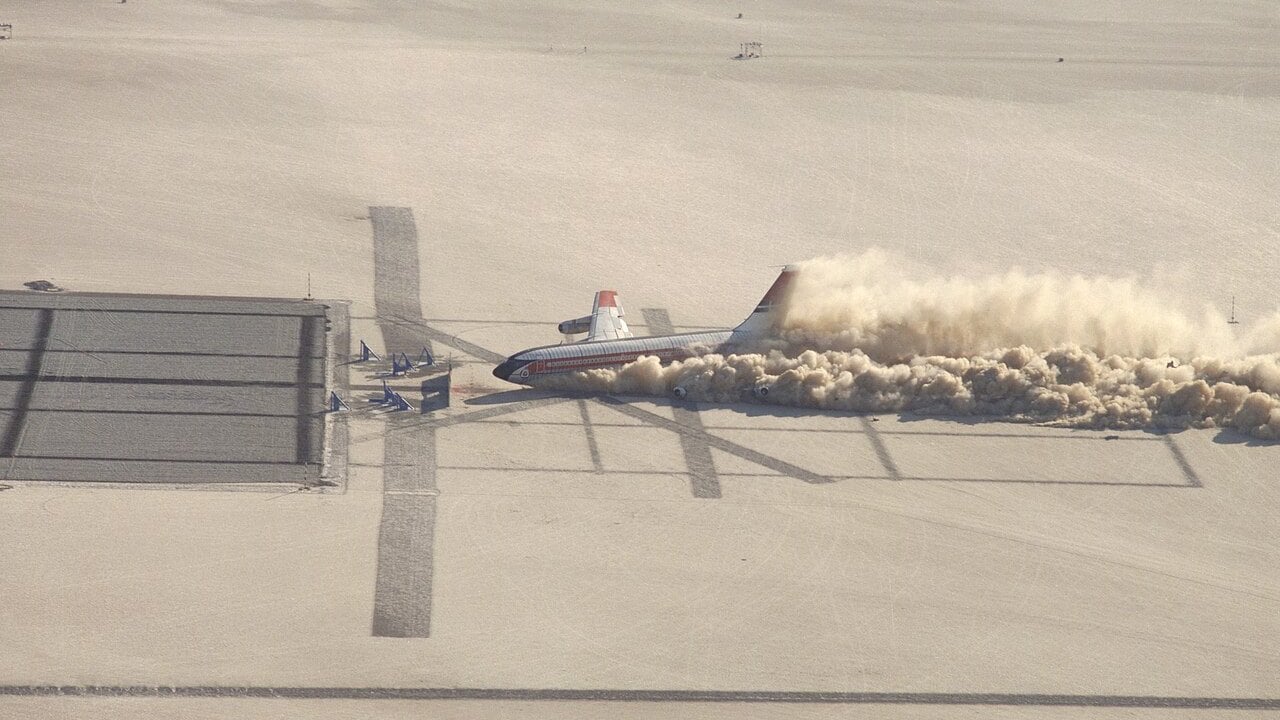
Nine minutes later, the airliner slid wheels-up across Rogers Dry Lake into a row of steel blades, exactly as planned. Almost nothing after that went as planned. Within seconds the jet was engulfed in a fireball that burned for more than an hour.
This was the Controlled Impact Demonstration, a joint experiment by NASA and the Federal Aviation Administration. It was meant to prove that a fuel additive could stop airliners burning after a crash. It proved the opposite, and still made flying safer.
Kurzinfo
- Test: Controlled Impact Demonstration (CID), NASA and FAA
- Datum: 1 December 1984, Rogers Dry Lake, Edwards Air Force Base, California
- Flugzeug: Boeing 720 from the FAA, four Pratt & Whitney JT3C-7 engines
- Pilot: NASA research pilot Fitzhugh Fulton, flying remotely from the ground
- Kraftstoff: 76,000 lb of anti-misting kerosene (Jet-A with FM-9 additive)
- Practice: 14 flights, 69 approaches, more than four years of preparation
- Ergebnis: Fireball that took more than an hour to extinguish
- Vermächtnis: AMK requirement dropped; new fire-safety rules for cabin materials
Fuel that would not burn
The idea was attractive. In a crash that is otherwise survivable, the fire that follows can be the real killer, when fuel from ruptured tanks sprays out as a fine mist and ignites. By the early 1980s, researchers believed they had a cure: anti-misting kerosene, or AMK.
AMK was ordinary Jet-A blended with FM-9, a high-molecular-weight, long-chain polymer additive. In small-scale impact tests, the treated fuel did not form a fine mist when it was released, and it resisted ignition and the spread of flame. If it worked in a real crash, passengers would gain precious seconds to get out.
There was a catch. Thickened fuel could not go straight into a jet engine, because it could clog filters. It had to be turned back into something close to normal Jet-A just before it was burned. General Electric built a device called a degrader for each of the 720’s four Pratt & Whitney JT3C-7 engines to do exactly that.
An airliner with no crew
The aircraft was an obsolete Boeing 720 airliner obtained from the FAA. NASA’s Dryden Flight Research Facility at Edwards turned it into a drone, while NASA Langley Research Center filled the cabin with instrumented dummies and sensors to measure crash loads. The jet also carried new seat designs, flight data recorders, galley and stowage-bin fittings, fire-resistant cabin materials and burn-resistant windows.
The pilot would sit on the ground. NASA research pilot Fitzhugh Fulton flew the 720 from a console in Dryden’s Remotely Controlled Vehicle Facility.
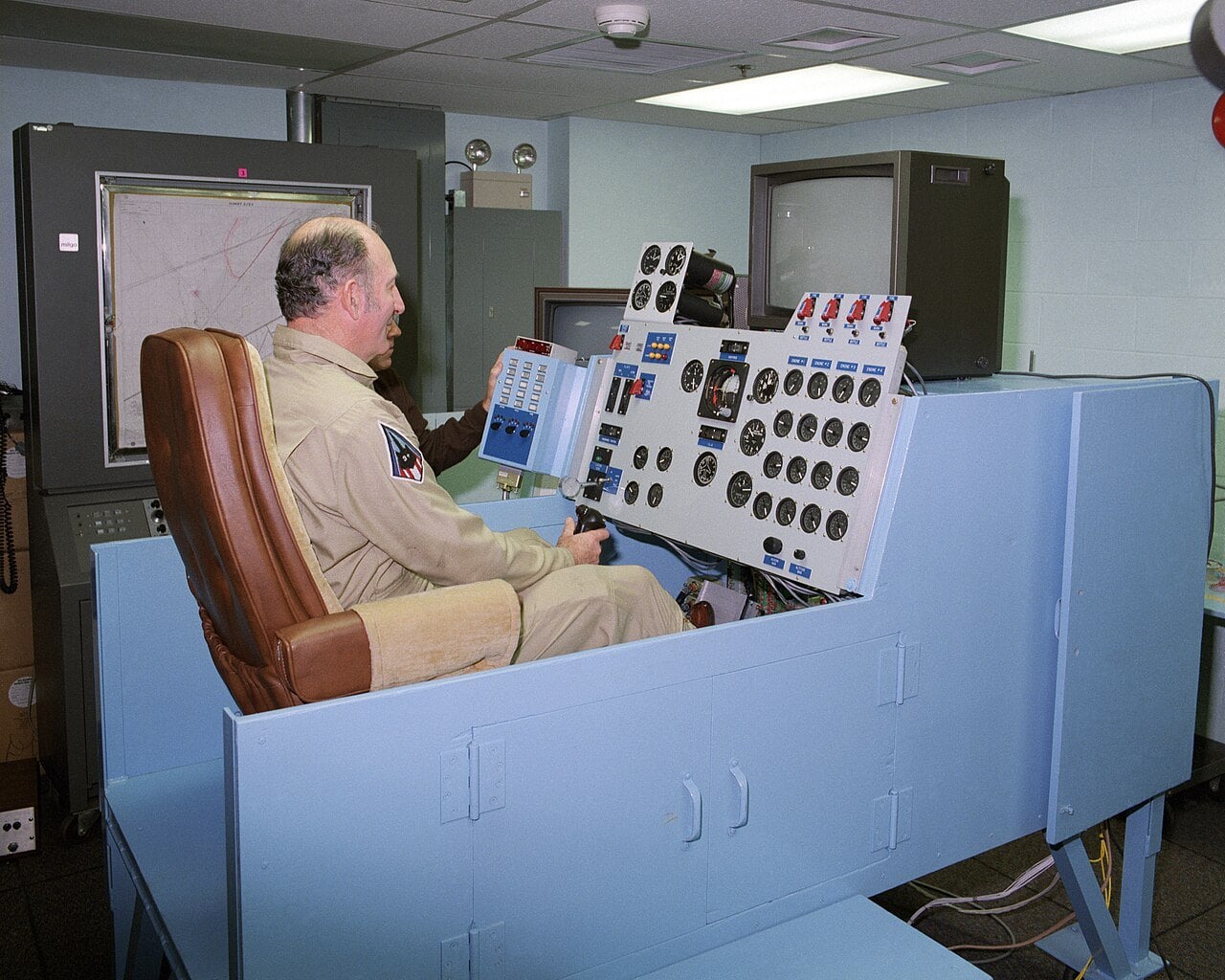
Setting up conditions the FAA would accept as survivable took more than four years. In 14 preliminary flights with safety pilots on board, the 720 was flown remotely for 16 hours and 22 minutes, including 10 takeoffs, 69 controlled approaches and 13 landings on an abort runway. AMK was fed into the tanks and engines one step at a time while engineers watched the engines.
Archive footage of the 1984 FAA and NASA impact demonstration with the Boeing 720.
The plan, and what happened
On 1 December, the 15th and final flight, every tank was full of AMK and all four engines ran on it from start-up to impact. Fulton climbed to 2,300 feet, turned onto a roughly 3.8-degree glide slope and brought the jet down towards a specially prepared runway on the east side of the dry lake.
The plan called for the 720 to touch down wings level and exactly on the centre line, so that eight steel posts cemented into the lakebed would slice open the wing tanks while the fuselage stayed intact. Passing the 150-foot decision height, the jet was slightly right of the desired path, but there seemed to be enough height to correct. The data systems were running, and the aircraft was committed.
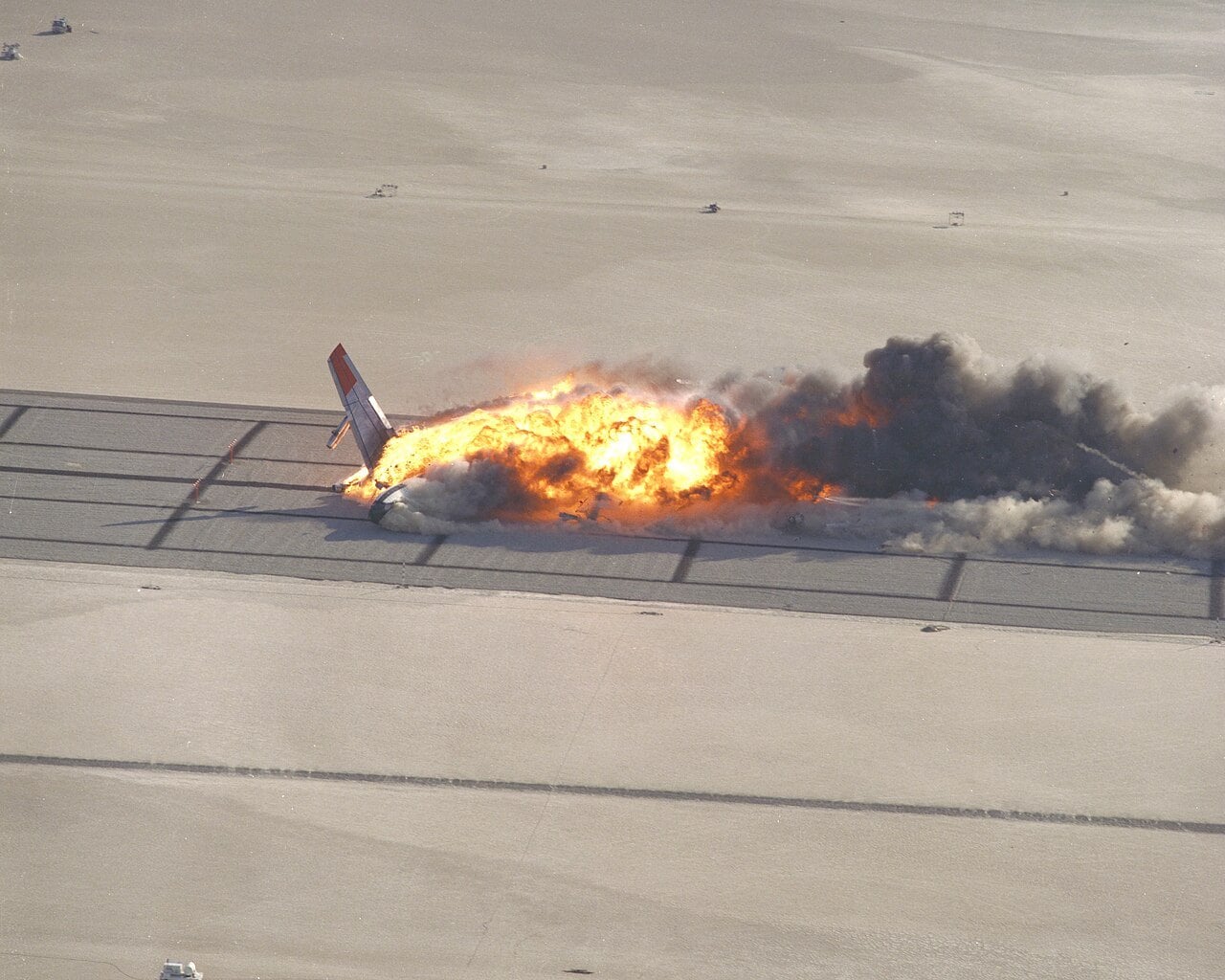
Then the 720 began to wallow in a Dutch roll. Its left wing dropped and hit the ground first, short of the wing cutters, and the nose swung left as it skidded across the lakebed at about 45 degrees. One cutter struck the inboard engine on the right wing, tearing open fuel lines, and the leaking fuel immediately burst into flame. As the jet slewed nearly sideways, the damaged right wing broke off and the fuselage disappeared into a fuel-fed fireball.
Watchers later learned that the engines had been at high power rather than idle when the jet hit, and that the cutter had opened a path for the fire into the cabin. Both were outside the conditions the test had been designed for.
The Controlled Impact Demonstration at Edwards Air Force Base, from approach to fireball.
A failure that taught a lot
For anti-misting kerosene, the result was the end of the road. Supporters argued that AMK had prevented an even hotter fire, but NASA’s own verdict was blunt.
The FAA dropped its plans to require the additive. It was a lesson in how promising small-scale tests can fail in a full-scale, real-world environment.
Yet the crash itself was a goldmine. Cameras inside the airliner showed the dummies being thrown about and small panels falling, but the seats stayed attached to the floor. FAA investigators estimated that roughly a quarter of a full load of 113 people might have escaped before smoke filled the cabin, which took only seconds at the front.
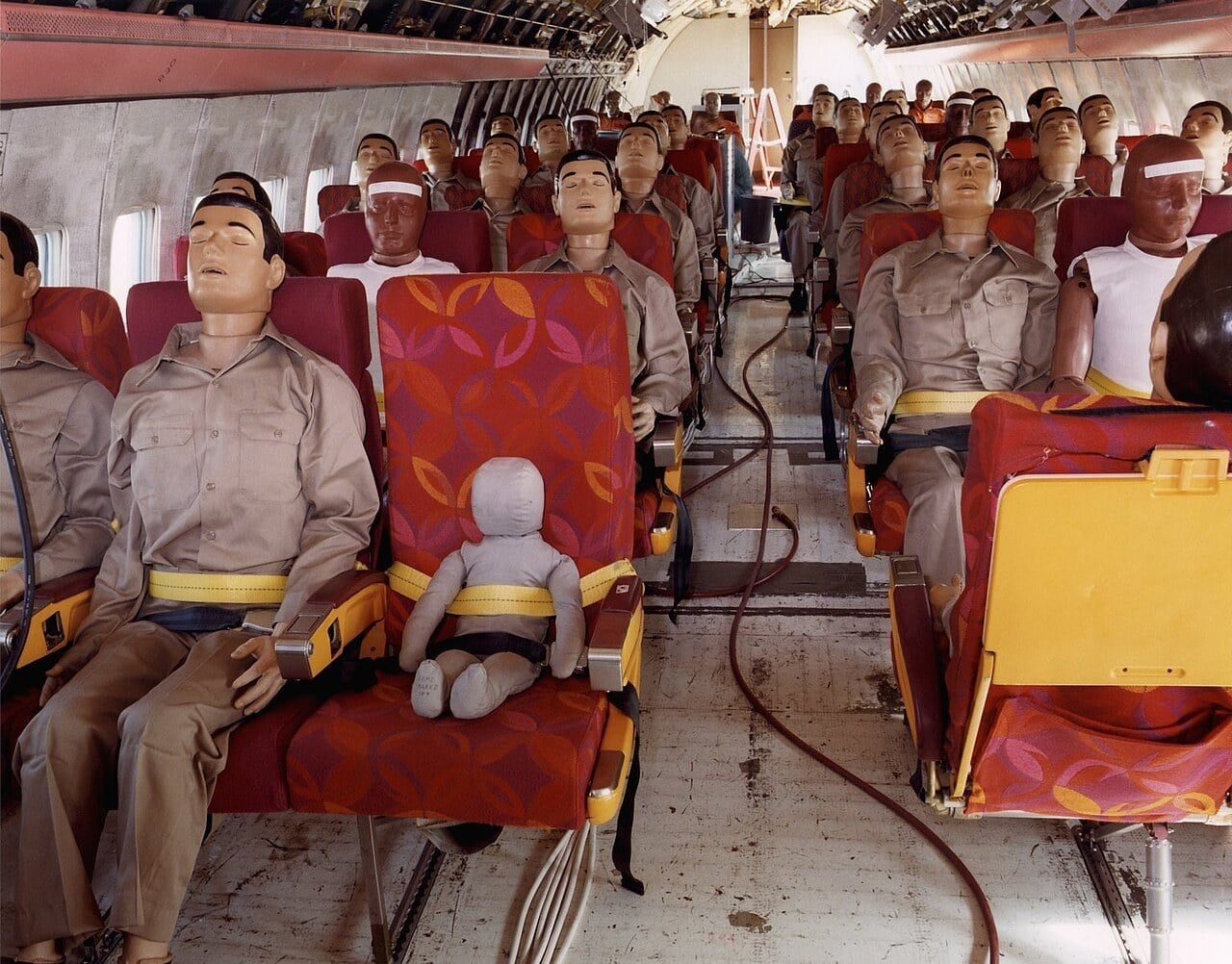
The data helped the FAA write new rules on fire prevention and fire-retardant materials, including fire-blocking layers for seat cushions. The test also showed that flight data recorders needed to sample information such as pitch, roll and acceleration more often.
The impact filmed from a camera on the Boeing 720’s tail.
Some industry observers who watched from the lakebed felt the money would have been better spent preventing crashes in the first place, through better automation, displays and warning systems. In the view of Arnold Reiner, who watched for Pan Am, terrain warning systems later did far more for safety than any fuel project. But the Boeing 720 that burned at Edwards still flies, in a sense, in every airliner seat built to resist fire. Its last flight lasted nine minutes. Its lessons are still in service.
Sources: NASA Dryden Flight Research Center (Controlled Impact Demonstration fact sheet, 2009), Federal Aviation Administration (Full-Scale Transport Controlled Impact Demonstration Program, DOT/FAA/CT-87/10, 1987), Air Facts Journal
0 Comments