

Two accounts of the same night at the same air base went public within a day of each other this week. They do not agree.
The first came from US officials speaking on condition of anonymity to CBS News, to Reuters and to Air & Space Forces Magazine. In their account, the Iranian ballistic missile barrage that struck Muwaffaq Salti Air Base in Jordan overnight on 8 September left one A-10 Thunderbolt II with a wing destroyed, and roughly eight F-15E Strike Eagles lightly damaged but serviceable.
The second came from President Donald Trump, by phone from Doha on Thursday 10 September, speaking to NewsNation correspondent Robert Sherman. Asked whether there was any truth to the reports that Iran had damaged American aircraft, Trump said: “Nope.” Pressed again, he added: “None whatsoever. No damage. No nothing.”
Both cannot be correct. That is worth setting out plainly, with dates and attributions attached, and without guessing at anyone’s motives. It is also worth explaining, because the gap between an early battle-damage assessment and a public statement about it is one of the most ordinary things in air warfare. Understanding why that gap exists is more useful than picking a side.
Quick Facts
Base: Muwaffaq Salti Air Base (MSAB), near Azraq, Jordan
Strike: Iranian ballistic missile barrage, overnight 8–9 September 2026
Reported damage: one A-10 Thunderbolt II with a wing destroyed; roughly eight F-15E Strike Eagles lightly damaged and returned to service
Sourcing: US officials speaking anonymously to CBS News, Reuters and Air & Space Forces Magazine
Air defence: roughly 30 Patriot interceptors fired, according to a US official quoted by Reuters
US casualties: none reported
White House position: Trump told NewsNation on 10 September there was no damage
CENTCOM: did not immediately respond to a request for comment
What the officials actually described
CBS News broke the story on Thursday, citing people with direct knowledge of the matter. Reuters correspondent Idrees Ali then reported that a US official, speaking on condition of anonymity, said the Iranian attack hit one A-10 Thunderbolt II and left it with a missing wing, while roughly eight F-15s sustained light damage and were returned to service.
Air & Space Forces Magazine, reporting the same day, put it in almost identical terms from its own sources: one A-10 with a severely damaged wing, and about eight F-15E Strike Eagles lightly damaged but considered serviceable. A spokesman for US Central Command did not immediately respond to its request for comment.
Several outlets summarised this as “nine US warplanes”. That figure is not a separate claim. It is the same claim added up: one A-10 plus roughly eight F-15Es makes nine airframes touched by the barrage in some way. There is no reporting of a ninth aircraft distinct from the A-10 and the Strike Eagles.

The New York Times also reported damage at the base, though its sources characterised it as minimal. Two unnamed US officials told the paper there were no American deaths in the attack, while acknowledging that some troops may come forward later to report traumatic brain injuries, which is a pattern seen after previous ballistic missile attacks on US installations.
What the President said, word for word
NewsNation broadcast the exchange as an on-screen transcript. Sherman described the call as very brief, and said he pushed back after the initial denial. The relevant passage, as the network rendered it:
Trump has addressed the wider conflict repeatedly this week. En route to a political event in Dallas on Wednesday he told reporters that the war would end shortly after the US midterm elections, arguing that Iran could not hold out much longer. He did not, in that exchange, address aircraft damage.
The White House has not issued a written statement disputing the CBS, Reuters or Air & Space Forces reporting, and CENTCOM has not addressed the aircraft damage on the record. As of Friday 11 September, the only official US position on the question is the one Trump gave by phone.
Why damage reports and statements routinely diverge
This is the part that is genuinely interesting if you care about how air forces work rather than about who is winning an argument.
A battle-damage assessment is not a single document handed down at dawn. After a missile attack on an air base, the first pass is a walk-around by maintenance crews looking for anything obvious: holes, fluid leaks, buckled panels, foreign object debris on the ramp. That produces a rough count within hours. The second pass is a structured inspection against technical orders, and it usually changes the numbers in both directions. Aircraft written off the flying schedule at 04:00 are frequently back on it by lunchtime once a panel is patched. Aircraft that looked fine can go non-mission-capable a day later when a borescope finds something in an engine.
Those passes also use different vocabulary. “Damaged” in a maintenance log is not the same as “damaged” in a headline. An airframe with a dozen fragmentation punctures in non-structural skin and a scuffed radome is damaged, repaired and serviceable, all within the same shift. Someone summarising the night at a policy level may reasonably describe that as no meaningful damage. Someone reading the maintenance log will count it as eight aircraft hit.
Add classification and the timing problem compounds. Detailed damage figures at a forward base are held closely, partly because they tell the side that fired the missiles how well it aimed. That is exactly why the officials talking to CBS and Reuters did so anonymously, and exactly why an on-record confirmation is slow. None of that makes anonymous sourcing automatically true. It does mean that three separate outlets converging on the same two numbers, from separate sourcing chains, is a stronger signal than any one of them alone. It is still not the same thing as an official confirmation, and it should not be treated as one.
What “lightly damaged but serviceable” means on an F-15E
The Strike Eagle is a large, heavy, twin-engine aircraft built around a fighter airframe that was stressed for high-g manoeuvring and then reinforced for the strike role. It is not fragile. But a parked aircraft on an open ramp is a soft target in a way that a flying one is not, and the threat is rarely a direct hit.
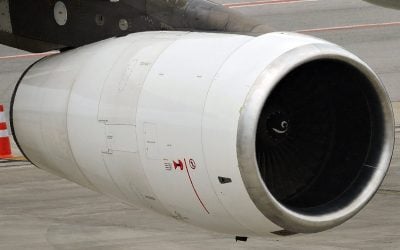
What usually does the damage in a near-miss is fragmentation. A ballistic missile warhead detonating on or just above a ramp throws steel and concrete outward at high velocity. The result on a parked jet is peppering: perforated skin panels, punctured control surfaces, severed hydraulic and fuel lines if the fragment finds one, and damage to the parts that are inherently thin. The radome is a composite cover over the radar antenna and it does not stop much. The canopy is transparency, not armour, and a crazed or punctured canopy grounds the aircraft until it is replaced. Engine intakes sitting open at ramp level will happily swallow debris, and a fan blade nick is a borescope job before anyone flies.
So a Strike Eagle can be genuinely hit and genuinely back in the fight the same week. Panel patches, a hydraulic line, a canopy swap and a clean ramp are squadron-level work. That is what “lightly damaged and returned to service” is describing. It is not a euphemism, and it is not nothing either. Every hour a jet spends in a hangar is an hour it is not generating sorties.
A wing off an A-10 is a different category of problem
The A-10 was designed to absorb damage that would end most aircraft. Redundant flight controls, a manual reversion mode, a titanium bathtub around the pilot, engines mounted high and separated. It has a long service record of coming home with pieces missing.
A wing destroyed on the ground is not that story. In civil aviation language it is the kind of damage that would get an airframe recorded as a hull loss, because the wing is primary structure and its attachment points carry everything. Repairing it is a depot job, not a flight line job, and the aircraft is not flying itself anywhere to get there.
That does not automatically make it a write-off. The A-10 is one of the few combat aircraft with a production line of new wings behind it. Boeing delivered more than 170 enhanced wing assemblies under a US Air Force contract awarded in 2007, and won a follow-on contract in 2019 covering up to 112 more wing sets. A wing is a component the depot system already knows how to build and fit. Whether this particular airframe gets one depends on how far the damage propagated into the centre section, on where it sits in the fleet’s remaining service life, and on whether the Air Force judges the repair worth the slot. None of that has been decided publicly, and anyone telling you the jet is scrapped or anyone telling you it is fine is ahead of the evidence.
Shelters, dispersal and the arithmetic at Muwaffaq Salti
Muwaffaq Salti sits near the Jordanian town of Azraq and has become the main American airpower hub for operations against Iran, hosting dozens of US aircraft. Iran has targeted it repeatedly since the conflict began at the end of February. Three US soldiers were killed there by a ballistic missile strike on 17 July.
Defending it is expensive. A US official told Reuters that roughly 30 Patriot interceptors were fired to counter the 8 September barrage. Open-source analysts watching footage of the same night put the number considerably higher, above 60. The two figures are not necessarily contradictory, since one counts what a US official described and the other counts what analysts believe they can see on video from both US and Jordanian batteries. Either way, the interceptor bill for one night at one base is substantial, at a moment when the Pentagon is openly worried about its air defence magazine depth.

The other half of the arithmetic is what the aircraft are sitting in. A hardened aircraft shelter is a reinforced concrete arch designed to defeat fragmentation and near-misses. It will not survive a direct hit from a large modern warhead, but fragmentation is precisely the mechanism that produces the “eight jets lightly damaged” outcome, and a shelter largely removes it. Dispersal does the complementary job: spreading aircraft across a base means one warhead reaches fewer of them.
That gap has been documented for years and has been a live argument in Washington since an Iranian missile destroyed a US Air Force E-3 Sentry on the ground at Prince Sultan Air Base in Saudi Arabia on 27 March, the first combat loss of an AWACS aircraft. At least ten US service members were injured in that attack; no deaths were reported.
Shugart co-authored a paper with Timothy Walton of the Hudson Institute, “Concrete Sky”, which found that in the Indo-Pacific China more than doubled its hardened aircraft shelters between 2010 and 2020 to around 800, while the United States and its allies built two in the same period. Secretary of War Pete Hegseth has since made hardened shelters in the Middle East a stated priority, and the Pentagon has issued contracting solicitations for bunkers and shelter infrastructure. Concrete takes time.
That is the aviation story underneath the argument over whether nine aircraft were hit. Ramps are targets now. Every jet parked on one is a wager that the interceptors will hold, and the interceptors held well enough on 8 September that nobody died. They did not hold well enough to keep every airframe untouched, and by every published account except one, that is what happened.
Frequently Asked Questions
Did Iranian missiles damage US aircraft at Muwaffaq Salti Air Base?
What exactly did Trump say about damage to US planes in Jordan?
Were nine US aircraft damaged at Muwaffaq Salti, or eight?
What does "lightly damaged but serviceable" mean for an F-15E Strike Eagle?
Can an A-10 fly again after losing a wing?
Were any US personnel killed in the 8 September attack on Muwaffaq Salti?
Sources: Reuters (Idrees Ali), CBS News, Air & Space Forces Magazine, NewsNation, Mediaite, Military Times, The New York Times via Antiwar.com, Boeing, US Air Force / DVIDS.

0 Comments