
McDonnell Douglas · Boeing F-15E
“Strike Eagle”
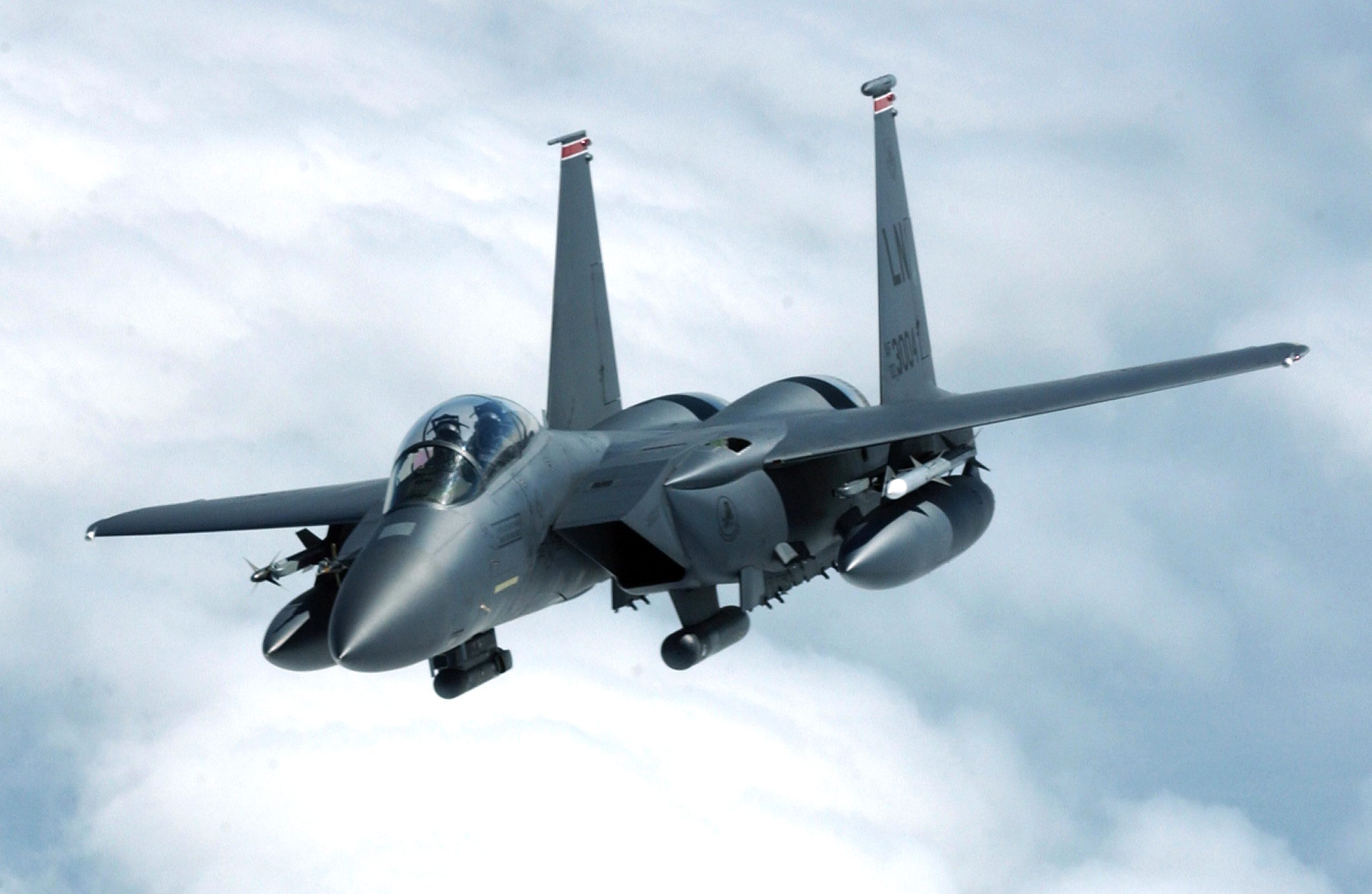
The two-seat, all-weather deep-strike Eagle — a dual-role fighter that keeps the F-15’s air-to-air punch but adds a rear-seat weapons officer, conformal tanks and a bomb load bigger than a WWII heavy bomber. Not to be confused with the single-seat F-15C air-superiority Eagle.
The Eagle that learned to hit the ground
The original F-15 Eagle was built to do one thing better than anything alive: win the air-superiority fight. Its unofficial motto — “not a pound for air-to-ground” — captured a jet designed purely to kill other fighters. Yet McDonnell Douglas engineers could see the airframe had enormous untapped potential as a bomber, and in the late 1970s they began a private-venture project to prove it, rebuilding the two-seat TF-15/F-15B demonstrator into a deep-strike machine they called the Strike Eagle.
Their timing was perfect. The U.S. Air Force was looking for a replacement for the swing-wing F-111 that could strike deep, at night and in bad weather, without a fighter escort. The Dual-Role Fighter competition pitted the Strike Eagle against General Dynamics’ radical cranked-wing F-16XL, and in February 1984 the F-15E won. The production aircraft first flew in December 1986 and reached the 4th Tactical Fighter Wing at Seymour Johnson AFB from 1988, with initial operational capability in 1989.
The result is a genuinely different aircraft from the single-seat F-15C. The E carries a second crew member — a weapon systems officer in the back seat running the sensors and bombs — a strengthened airframe, conformal fuel tanks, terrain-following radar and targeting pods. Crucially it kept the Eagle’s full air-to-air suite, so it can fight its way to the target, destroy it, and fight its way home. Nearly four decades on it remains one of the most heavily worked combat aircraft in the U.S. inventory, its role now extended by the new F-15EX Eagle II.
01How the F-15E Strike Eagle beat the F-16XL to become the Air Force’s deep-strike jet
By the early 1980s the U.S. Air Force needed something to replace the ageing F-111 in the deep-interdiction role — an aircraft able to fly hundreds of miles behind enemy lines at night, in any weather, and hit point targets with precision. Two very different answers competed in the Enhanced Tactical Fighter / Dual-Role Fighter programme. General Dynamics offered the F-16XL, a dramatically re-winged single-seat Fighting Falcon with a cranked delta that could carry far more than a standard F-16. McDonnell Douglas offered the two-seat F-15E, developed largely at company expense.
On 24 February 1984 the Air Force chose the F-15E. The decisive factors were the Eagle’s two-crew cockpit — a dedicated back-seater to manage the growing workload of night, low-level precision attack — its greater growth potential, two engines for survivability, and the fact that it retained a first-rate air-to-air capability rather than trading it away. The F-16XL was shelved; the two prototypes later became NASA research aircraft. The Strike Eagle went on to become the backbone of American tactical strike aviation.
What makes the F-15E Strike Eagle special
Two jobs, one jet: strike and air-to-air
The F-15E is a true dual-role fighter. Unlike a dedicated bomber, it never gives up the Eagle’s air-combat pedigree: it carries AIM-120 AMRAAM and AIM-9 Sidewinder missiles and the internal 20 mm cannon, and can defend itself — or clear the skies — on the same sortie it drops bombs. That means a Strike Eagle package can strike deep without a separate fighter escort, fighting its way in and out. It is the capability that separated the E from every pure attack jet of its generation.
Conformal tanks and a bomber’s payload
The E’s signature feature is a pair of conformal fuel tanks (CFTs) that hug the fuselage sides with very little drag, carrying fuel and adding tangential weapon stations. Freed of the drag and station penalty of underwing tanks, the Strike Eagle can haul a colossal war load — commonly quoted at over 23,000 lb (~11,000 kg) of ordnance — deep into hostile airspace, mixing JDAMs, laser-guided Paveways and air-to-air missiles on the same jet.
All-weather eyes and a rugged back seat
Deep night strike demands seeing the ground in the dark. The E was built around LANTIRN navigation and targeting pods giving terrain-following radar for hands-off low-level flight, and a powerful attack radar that grew from the APG-70 to today’s APG-82(V)1 AESA. About 60% of the structure was redesigned and strengthened for sustained low-level punishment, and a second crew member — the weapon systems officer — runs the sensors and weapons so the pilot can fly and fight.
02The F-15E Strike Eagle’s conformal fuel tanks: range and payload without the drag
Standard fighters trade weapons for fuel: every underwing drop tank is a hardpoint you can’t use for bombs, and a lump of drag that eats range. The F-15E’s conformal fuel tanks solve both problems. Moulded to the contour of the fuselage beneath the wing roots, they add roughly 5,000 kg of fuel with only a small drag penalty, and they carry tangential weapon racks so ordnance sits close against the body rather than hanging in the airstream. The pay-off is a strike fighter that can fly a long, unrefuelled interdiction mission while still carrying a heavy mixed load of air-to-ground and air-to-air weapons — the reason the E can reach targets other tactical jets simply can’t.
03The F-15E Strike Eagle’s back seat: why the WSO changed everything
The single most important difference between the F-15C and the F-15E is the second seat. Flying fast and low at night, hunting point targets while managing radar, targeting pod, defensive systems and weapons, is more than one person can safely do. The Strike Eagle’s weapon systems officer (WSO) sits behind the pilot with four multifunction displays, running the sensors and directing the attack while the pilot flies and handles the air-to-air fight. It is the same crewing philosophy that made the F-4 Phantom and F-111 effective at deep strike — and it lets a single F-15E prosecute complex attacks that would overwhelm a solo pilot.
Full F-15E Strike Eagle specifications
Baseline note: these figures describe the USAF F-15E Strike Eagle of the later production batches, with two Pratt & Whitney F100-PW-229 engines and the conformal fuel tanks fitted, because that is the configuration in which the type has fought every campaign from Desert Storm to the 2026 Iran war and the configuration the USAF flight manual and fact sheet describe. Dimensions and weights come from the flight manual TO 1F-15E-1, the USAF fact sheet and Steve Davies; performance figures are quoted clean and again with the conformal tanks fitted, because the difference is large and is routinely dropped from popular tables. Deltas for the early F100-PW-220 aircraft, for the General Electric F110-GE-129 fitted to most export airframes, for the fly-by-wire Advanced Eagles and for the F-15EX Eagle II, F-15I Ra’am, F-15S/SA, F-15K Slam Eagle, F-15QA Ababil and F-15SG are in grey. The single-seat air-superiority F-15A/B/C/D Eagle is a different aeroplane with its own entry in this encyclopedia and nothing below describes it. Figures reflect sources available on 3 September 2026.
Dimensions & weights
- Crew
- 2 — pilot and weapon systems officer. The rear cockpit has a stick, throttles and full flight instrumentation, unlike the back seat of an F-4 or an F-14, so the WSO can fly the aeroplane home. The F-15EX is flown single-seat by the Air National Guard and two-seat by Air Combat Command.
- Length
- 19.45 m (63 ft 9.6 in). F-15EX 19.43 m (63 ft 9 in).
- Wingspan
- 13.05 m (42 ft 9.6 in). The Advanced Eagle wing is dimensionally the same but structurally new, which is what buys it two more pylons.
- Height
- 5.64 m (18 ft 6 in). F-15EX 5.69 m (18 ft 8 in).
- Wing area
- 56.5 m² (608 sq ft), unchanged from the air-superiority Eagle; aerofoil NACA 64A006.6 at the root and NACA 64A203 at the tip
- Empty weight
- 15,694 kg (34,600 lb) clean, 17,686 kg (38,990 lb) with the conformal fuel tanks fitted — and they are almost never not fitted. F-15EX 16,102 kg (35,500 lb) clean, about 18,144 kg (40,000 lb) with tanks.
- Maximum take-off weight
- 36,741 kg (81,000 lb), the same for the F-15EX (the Dual-Role Fighter fly-off of 1981–83 demonstrated more than 34,000 kg / 75,000 lb, which was already beyond anything the air-superiority Eagle had flown at)
- Internal fuel
- ~5,858 kg (~12,915 lb) in the fuselage and wing tanks (F-15EX ~6,145 kg / ~13,550 lb)
- Fuel with conformal tanks
- 10,100 kg (22,267 lb) — the pair of conformal fuel tanks adds 4,242 kg (9,352 lb). With three 2,270-litre (600 US gal) drop tanks as well, 15,496 kg (34,162 lb). The conformal tanks cannot be jettisoned, so the drag and weight are paid on every sortie whether the fuel is needed or not.
- Hardpoints
- 9 — one pylon under each wing, one centreline, and six tangential stations on the conformal tanks, with further shoulder rails on the wing pylons and corner stations on the tanks for air-to-air missiles (the Advanced Eagle wing raises this to 11; Boeing quotes as many as 25 discrete stations for the F-15EX by counting every rack position)
- Maximum external stores
- ~10,400 kg (~23,000 lb) of fuel and ordnance (F-15EX ~13,400 kg / ~29,500 lb). No operational sortie has flown at the catalogue figure; a real interdiction load is roughly half of it once tanks and pods are on.
- Wing loading
- 650 kg/m² (133 lb/sq ft) at maximum take-off weight, against about 480 kg/m² (98 lb/sq ft) at a clean combat weight — the single number that explains why a loaded Strike Eagle does not manoeuvre like an F-15C
- Unit cost
- ~US$31.1 million in fiscal 1998 dollars per the USAF fact sheet, which is a flyaway number for an aeroplane that stopped being built in 2001 and means little today (the F-15EX is quoted at about US$94 million; the Qatari F-15QA deal of June 2017 came to roughly US$333 million per aircraft once weapons, support and training were included, which is the figure worth remembering when anyone calls the Eagle cheap)
- Airframe life
- 8,000 flight hours as certified, up to 16,000 hours under the depot programme — twice the life of the earlier Eagles, and the reason the USAF is still arguing about how long the F-15E should stay in service
Performance
- Maximum speed, clean
- Mach 2.5, 2,655 km/h (1,650 mph, 1,434 kt) at high altitude
- Maximum speed with conformal tanks
- Mach 2.0, 2,124 km/h (1,320 mph, 1,147 kt) — the honest number, because the tanks are permanent kit on a strike sortie
- Maximum speed, low level
- Mach 1.2, 1,482 km/h (800 kt, 921 mph) clean, falling to 1,296 km/h (700 kt, 806 mph) with the conformal tanks fitted
- Rate of climb
- over 254 m/s (50,000 ft/min)
- Service ceiling
- 18,300 m (60,000 ft)
- Combat radius
- ~1,272 km (~687 nm, ~790 miles) on an air-interdiction profile with conformal tanks (the USAF publishes no standard profile behind this figure, and real Scud-hunting and Afghan sorties were flown far deeper on tanker support)
- Ferry range
- 3,900 km (2,100 nm, 2,400 miles) with conformal tanks and three drop tanks
- Longest recorded sortie
- 15.5 hours, flown by four 391st Fighter Squadron crews over Afghanistan in 2001 with twelve air refuellings and nine hours in the target area — still the longest fighter combat mission on record
- Thrust-to-weight ratio
- 0.93 at a nominal combat weight with F100-PW-229 engines (well under 1.0 at any realistic strike load; the F110-GE-129 gives a few hundred pounds more thrust per engine and no meaningful change to this figure)
- Load factor
- +9 g structural limit, reduced by the flight manual as stores and fuel are added; a fully loaded F-15E is a 5 g aeroplane in practice
- Take-off weight demonstrated
- more than 34,000 kg (75,000 lb) during the Dual-Role Fighter evaluation, which ran from 1981 to 30 April 1983 across more than 200 flights and validated 16 weapons configurations
Propulsion & systems
- Engines
- 2 × Pratt & Whitney F100-PW-229 afterburning turbofans, 79.2 kN (17,800 lbf) dry and 129.7 kN (29,160 lbf) with afterburner each
- Earlier and export engines
- Early F-15Es have the F100-PW-220 at 64.9 kN (14,590 lbf) dry and 105.7 kN (23,770 lbf) in afterburner. The General Electric F110-GE-129, 76.3 kN (17,155 lbf) dry and 131.2 kN (29,500 lbf) reheated, was flight-tested on the F-15E but first entered service on the F-15K; it also powers the F-15SG, the F-15QA and the F-15EX. Saudi F-15S and F-15SA and the Israeli F-15I use the F100-PW-229, and the second batch of Korean F-15Ks switched from the GE engine to it
- Radar
- Hughes/Raytheon AN/APG-70 as built, with the synthetic-aperture ground map that made the aeroplane, replaced under the Radar Modernization Program by the Raytheon AN/APG-82(V)1 active electronically scanned array — the APG-63(V)3 antenna married to the APG-79 processor. Flight tests began January 2010 and initial operational capability came in 2014 (the F-15I flies the APG-70I, export-degraded by about a third in resolution; the F-15S was delivered with a similarly degraded set; the F-15SG and F-15SA use the APG-63(V)3, the F-15K the APG-63(V)1, and the F-15QA and F-15EX the APG-82(V)1)
- Targeting and navigation pods
- LANTIRN — AN/AAQ-13 navigation pod with terrain-following radar under the starboard intake, AN/AAQ-14 targeting pod under the port intake. The targeting half has since been replaced by the AN/AAQ-33 Sniper or the AN/AAQ-28 Litening
- Additional sensors
- AN/ASQ-236 radar pod for stand-off synthetic-aperture imaging; Lockheed Martin AN/AAS-42 "Tiger Eyes" infrared search and track on the F-15K, F-15SA and F-15QA, and the Legion Pod with AN/ASG-34(V)1 IRST21 on the F-15EX (the USAF F-15E has never carried an internal IRST, which several of its export descendants do)
- Cockpit
- Head-up display and three multi-purpose displays plus a colour multi-purpose colour display for the pilot; four multi-purpose displays for the WSO, with two hand controllers to move formats between screens — the four-screen back seat is the defining piece of the conversion. The F-15QA, F-15SA and F-15EX replace it with a large-area display
- Electronic warfare
- Tactical Electronic Warfare System integrating radar-warning receiver, jammer and chaff/flare dispensers, with an external AN/ALQ-131 pod on the centreline when required; replaced from 2022 by the BAE Systems AN/ALQ-250 EPAWSS, which is digital, lighter and genuinely more capable
- Navigation
- Ring-laser-gyro inertial navigation with embedded GPS feeding a digital moving map in both cockpits
- Data link and identification
- BAE Systems MIDS Fighter Data Link Terminal on Link 16; AN/APX-119 identification friend or foe interrogator on later builds
- Flight controls
- Hydromechanical with a control augmentation system, as on the original Eagle. The Advanced Eagle family — F-15SA, F-15QA, F-15EX and the F-15IA to come — replaces it with digital fly-by-wire, which is what unlocks the extra wing pylons
- Internal gun
- One 20 mm General Electric M61A1 Vulcan rotary cannon in the starboard wing root with 500 rounds of M-56 or PGU-28 ammunition, retained unchanged from the air-superiority Eagle
04What does an F-15E Strike Eagle cost to buy and fly?
The U.S. Air Force fact sheet lists a flyaway cost of about $31 million in constant 1998 dollars for the F-15E — but that figure should be read with care. It reflects late-1990s production accounting; in today’s money, and set against the far more expensive new-build F-15EX Eagle II (widely reported at well over $80 million per aircraft), the real cost of a modern Strike-Eagle-class jet is much higher. Operating cost is similarly steep: a twin-engine, two-seat, sensor-heavy jet is expensive per flight hour, with public estimates for the F-15 family generally in the range of tens of thousands of dollars per hour. Treat any single dollar figure as an order-of-magnitude guide rather than a precise price.
Armament & payload
The F-15E was the first American fighter told to carry the bombs and the air-to-air missiles at the same time, and it has never been asked to choose since
The F-15E carries almost everything in the American air-to-ground catalogue, and that breadth is the whole argument for the aeroplane. The Enhanced Tactical Fighter requirement of 1981 asked for something that could go deep at night in bad weather without an escort and without a jamming package, which meant one airframe had to hold a credible bomb load, a targeting sensor, a terrain-following radar and four air-to-air missiles at the same time. The Strike Eagle does. A single jet can leave with eight 2,000 lb JDAMs on the conformal tank racks, four AMRAAM on the tank corners, a Sniper pod and three fuel tanks, and it is still, on the way home, an Eagle.
The interesting recent change is at the small end. Twenty years of counter-insurgency turned the aeroplane into a GBU-12 and Mk 82 delivery van, and then the drone war inverted the problem: the F-15E of 2024 kept running out of missiles before it ran out of targets. On 13 and 14 April 2024, crews of the 335th and 494th Fighter Squadrons destroyed more than seventy Iranian one-way attack drones over Iraq, Syria and Jordan, and one pilot ended the engagement shooting at drones with the 20 mm gun after his rails were empty. The answer photographed at Eglin on 23 May 2025 — six seven-shot pods of laser-guided APKWS II rockets, forty-two shots, alongside eight air-to-air missiles — is the least glamorous and most useful loadout the type has ever been given. Fits vary sharply by operator: Israeli F-15Is carry Rafael Python and Israeli stand-off weapons the USAF has never cleared, Korean F-15Ks carry Taurus KEPD 350 and the KGGB, Saudi F-15S/SA have carried IRIS-T, and the nuclear role belongs to the USAF alone.
Gun
- One 20 mm M61A1 Vulcan six-barrel rotary cannon in the starboard wing root, 500 rounds of M-56 high-explosive incendiary or PGU-28 semi-armour-piercing
- Inherited unaltered from the air-superiority Eagle and untouched by every subsequent upgrade, including the F-15EX
- Effective against aircraft and soft ground targets; strafe is a rare F-15E event but not an unknown one
- Used in anger against Iranian attack drones on 13–14 April 2024 after a crew exhausted its missiles — no kills, and the episode is why the APKWS rocket fit exists
Air-to-air
- AIM-120 AMRAAM — the standard fit, normally four on the conformal tank corner stations, up to eight
- AIM-9M and AIM-9X Sidewinder on the wing-pylon shoulder rails; an AIM-9X killed a drone over eastern Syria on 21 August 2021
- AIM-7M Sparrow on early aircraft, long gone from USAF service
- Export variation: Rafael Python 4 and Python 5 on the Israeli F-15I, cued through the DASH helmet sight from both cockpits; IRIS-T offered on Saudi aircraft
- This card matters more than it looks. The F-15E is the only American strike aircraft that was an air-superiority fighter first, and it has never given up the counter-air role
Air-to-surface guided
- AGM-65 Maverick, up to six — the original 1980s anti-armour answer, now largely retired from the fleet
- AGM-130 rocket-boosted glide weapon and GBU-15 electro-optical glide bomb, both fired in the opening nights of Enduring Freedom and Iraqi Freedom
- AGM-154 JSOW and AGM-158 JASSM for stand-off; AGM-84 Harpoon and AGM-84H/K SLAM-ER for maritime work
- Taurus KEPD 350 on the Korean F-15K, a 500 km German-Swedish cruise missile that makes the Slam Eagle the longest-reaching aircraft in North-East Asia outside the strategic forces
- The Joint Strike Missile is being integrated; the Israeli F-15I carries national stand-off weapons that are not publicly catalogued
Bombs
- Mk 82 and Mk 84 unguided bombs; Paveway laser-guided GBU-10, GBU-12, GBU-24 and GBU-27
- GBU-28 5,000 lb bunker-buster — developed in weeks during Desert Storm and dropped by F-15Es on the H3 airfield complex on 19 March 2003
- GBU-31 and GBU-38 JDAM, up to eight of the 2,000 lb version on the conformal tank racks; GBU-54 Laser JDAM and GBU-39 Small Diameter Bomb
- Cluster and area weapons: CBU-87 and CBU-103, CBU-89 and CBU-104 GATOR, CBU-97 and CBU-105 sensor-fuzed weapon, CBU-107 Passive Attack Weapon, BLU-107 Durandal
- B61 Mod 12 nuclear bombs, up to five — the F-15E is one of the two USAF fighter types certified for the NATO nuclear mission, and no export F-15E derivative carries it
Rockets
- For thirty-five years, effectively none: the F-15E was built for guided weapons and rocket pods were a marginal fit at best
- That changed with APKWS II, the laser guidance kit strapped to a 70 mm Hydra rocket, adopted for counter-drone work in the Red Sea from 2024
- A test F-15E was photographed at Eglin Air Force Base on 23 May 2025 with six seven-shot pods — 42 guided rockets — plus eight air-to-air missiles
- The logic is arithmetic rather than lethality: an AMRAAM costs roughly a hundred times what a Shahed does, and the drone side of that trade can build more of them
Pods & other stores
- LANTIRN: AN/AAQ-13 navigation pod with terrain-following radar and wide-field FLIR under the starboard intake, AN/AAQ-14 targeting pod with laser designator under the port intake — the system that made night interdiction routine
- AN/AAQ-33 Sniper and AN/AAQ-28 Litening advanced targeting pods, which replaced the AAQ-14 and supplied the strike video the Pentagon released from Syria in September 2014
- AN/ASQ-236 radar pod for stand-off synthetic-aperture imaging; AN/ALQ-131 electronic countermeasures pod on the centreline
- Up to three 2,270-litre (600 US gal) drop tanks; the Saudi fleet also flies the DJRP electro-optical reconnaissance pod
- Export-only sensors: AN/AAS-42 Tiger Eyes infrared search and track on the F-15K, F-15SA and F-15QA, and the Legion Pod on the F-15EX
Three typical loadouts
- Scud hunt, western Iraq, January 1991
- Conformal fuel tanks, LANTIRN navigation and targeting pods, a mix of GBU-10 and GBU-12 laser-guided bombs or CBU-87 cluster units, four AIM-9M, gun. Flown at night at low level into the box between H2 and H3 airfields, often on nothing better than a suspected launch point; this is also the load that killed an Iraqi Mi-24 Hind on 14 February 1991 with a 2,000 lb GBU-10.
- On-call close air support, Afghanistan, 2001–2021
- Conformal tanks, three 600-gallon drop tanks, Sniper pod, a mixed rack of GBU-12 and GBU-38 with a GBU-31 or two for hard targets, two AIM-120 and two AIM-9. Endurance, not payload, is the point: sorties of eight to twelve hours with repeated refuelling, holding overhead a ground unit that may need nothing at all.
- Counter-drone combat air patrol, Middle East, 2024–2026
- Conformal tanks, three drop tanks, eight AIM-120 and AIM-9X on the tank corners and wing rails, targeting pod for visual identification, and from 2025 up to six seven-shot APKWS II pods. Magazine depth is the entire design problem, and it is why an air-superiority-derived fighter designed to kill armoured divisions now goes to war carrying 70 mm guided rockets that cost a small fraction of an AMRAAM.
Sourcing caveat: the weapons list above is drawn from USAF fact sheets, Boeing product literature and Steve Davies’ monographs, and no single document covers all of it. Clearance is not the same as carriage — several weapons listed as integrated have never been photographed on an operational sortie, and export clearances differ from American ones in ways neither government publishes. Loadout descriptions are typical rather than authorised configurations.
Variants
The Strike Eagle’s family tree runs the wrong way: the exports paid for the upgrades the United States later bought back
The F-15E exists because McDonnell Douglas ignored its customer. The F-15 Special Project Office had a slogan — "not a pound for air to ground" — and meant it, but the company quietly kept a ground-attack capability in the design and, from 1980, flew the second TF-15A prototype as the Advanced Fighter Capability Demonstrator. When the USAF announced the Enhanced Tactical Fighter programme in March 1981 to replace the F-111, the answer was already in the air. The competition against General Dynamics’ F-16XL ran to 30 April 1983; the F-15E won on 24 February 1984, first flew on 11 December 1986 and reached initial operational capability on 30 September 1989.
What followed is unusual for a Cold War strike aircraft: the export line outlived the domestic one. USAF F-15E production ended in 2001 at 236 aircraft, but Israel, Saudi Arabia, South Korea, Singapore and Qatar kept the St Louis line warm for another twenty-five years, and it was Saudi and Qatari money that paid to develop the fly-by-wire flight controls, the new wing and the large-area cockpit that the USAF then bought back as the F-15EX. That is a rare sequence — the American taxpayer got a cheaper aeroplane because two Gulf states funded the development first.
The dividing line worth keeping straight is between the original F-15E family and the Advanced Eagle. Everything up to and including the F-15SG is an F-15E with different avionics and engines. From the F-15SA onward the aeroplane has digital flight controls, a redesigned wing structure, eleven pylons instead of nine and a different electronic-warfare suite. It is the same shape and a substantially different machine.
- F-15E Strike Eagle (1985–2001, 236 for the USAF)
- The baseline: two-seat, conformal tanks, APG-70 radar, LANTIRN, F100-PW-220 on early batches and F100-PW-229 on later ones. Retrofitted since 2007 with the APG-82(V)1 array and since 2022 with EPAWSS.
- F-15I Ra’am (1996–1998, 25)
- Israel’s answer to the Iraqi Scud campaign of 1991, ordered 27 January 1994 and used as a strategic bomber by 69 Squadron at Hatzerim. F100-PW-229 engines, an export-degraded APG-70I, the Israeli Elisra ASPS electronic-warfare suite in place of the American one, and the DASH helmet sight for both crew members — a capability the USAF F-15E did not have.
- F-15S (1996–1998, 72)
- Saudi Arabia asked for 24 single-seat F-15Fs; Congress refused, and the compromise was a two-seater with a deliberately degraded APG-70, no terrain-following radar at first and a reduced weapons clearance. Most have since been rebuilt to F-15SA standard and are sometimes listed as F-15SR.
- F-15SA (from 2011 contract; 84 new-build plus upgrades of the F-15S fleet)
- The first Advanced Eagle and the origin of everything that follows: digital fly-by-wire, a new wing structure with two extra pylons, APG-63(V)3 array, AN/ALQ-239 DEWS and the AAS-42 infrared search and track. First flight 20 February 2013 under a US$29.4 billion agreement signed 29 December 2011.
- F-15K Slam Eagle (2005–2012, 61 built, 59 in service)
- Selected over the Rafale, Typhoon and Su-35 in 2002. South Korean industry built 40 per cent of the airframe. APG-63(V)1 radar, AAS-42 IRST, and the only F-15 family member cleared for the Taurus KEPD 350 cruise missile and the Korean KGGB glide bomb. The first batch has F110-GE-129 engines, the second F100-PW-229 — two engine types in one fleet, which is an operator’s headache and a procurement politics story.
- F-15SG (2008–2013, 40)
- Singapore’s choice over the Rafale on 6 September 2005, and the first F-15 delivered with an active electronically scanned array from new: APG-63(V)3, F110-GE-129 engines, AAS-42 IRST. Two squadrons at Paya Lebar plus a training detachment inside the USAF 428th Fighter Squadron at Mountain Home.
- F-15QA Ababil (2021–2024, 36)
- Qatar signed for 36 in June 2017 for about US$12 billion, with up to 72 approved by the State Department. The direct predecessor of the F-15EX: APG-82(V)1 radar, large-area display cockpit and the ADCP II mission computer. On 2 March 2026 an F-15QA shot down two Iranian Su-24s approaching Al Udeid and Ras Laffan, the first aerial victories in Qatari history and the first for the Advanced Eagle.
- F-15EX Eagle II (from 2021, 13 to 17 delivered against a programme that has run from 144 to 98 and back to 267)
- The USAF buying its own export aeroplane. F110-GE-129 engines, APG-82(V)1, EPAWSS and the Legion Pod IRST, but not the AN/AAR-57 missile warning set its Gulf cousins carry. Bought to replace the F-15C/D rather than the F-15E, though it has always been the obvious eventual F-15E replacement too — and in July 2026 the 4th Fighter Wing at Seymour Johnson was announced as an EX conversion, with two dozen of its F-15Es going to the Air Force Reserve at Whiteman.
- F-15IA (contract December 2025, 25 with an option on 25 more)
- An Advanced Eagle for Israel, to sit alongside the F-15I and replace the ageing F-15A/C fleet. Israel had asked in 2023 for kits to bring the existing 25 F-15Is up to the same standard; those have not been ordered.
- Proposals that went nowhere (F-15F, F-15G, F-15H, F-15SE, F-15GA, F-15IDN)
- The single-seat F-15F for Saudi Arabia, blocked by Congress. The F-15SE Silent Eagle of 2009, with canted fins and internal weapons bays in the conformal tanks, first flown in July 2010 and never sold. The F-15GA offered to Germany for the Tornado replacement. The F-15IDN for Indonesia, approved by the State Department in February 2022 and declared "no longer active" by a Boeing official in January 2026.
Closing caveat: production totals for this family are quoted inconsistently. The usual figure of 435 F-15E/I/S/K/SG covers the original family only and does not add up exactly against the individual variant totals of 236, 25, 72, 61 and 40; the Advanced Eagles — 84 F-15SA, 36 F-15QA and the continuing F-15EX and F-15IA — are counted separately again. F-15EX delivery counts published in 2026 range from 13 to 17 depending on whether developmental airframes are included, and the programme of record has been revised four times. Treat any single total for "F-15Es built" with suspicion and check which families it includes.
Operators today
Six air forces fly Strike Eagles, and four of the six sit within a thousand miles of a conflict the type has already fought in
Six air forces fly the F-15E and its descendants, and every one of them bought it for the same reason: range with a bomb load, in an airframe that can still defend itself. The counts below are of delivered aircraft nominally in service on 3 September 2026, not of orders or options, which is why Egypt, Poland, Indonesia and India do not appear despite active F-15EX discussions with all four. The chart counts F-15E-derived two-seat strike aircraft, including the Advanced Eagle exports (F-15SA, F-15QA) because those air forces fly them in the Strike Eagle’s role. The USAF F-15EX is counted separately and is not in the bars below: it was bought to replace the air-superiority F-15C/D, it is covered on the F-15 Eagle page, and between 13 and 17 had been delivered by mid-2026 against a programme of record that the FY2027 budget request raised to 267. Japan’s large F-15J fleet is not here either — those are licence-built air-superiority Eagles, not Strike Eagles.
These are estimates, and the American row is the shakiest. United States: the last audited figure is 218 F-15Es in the 2024 USAF almanac; the service sought to divest 21 more in FY2026, and four airframes were lost in the 2026 Iran war — three to Kuwaiti friendly fire on 1–2 March and one shot down over western Iran on 3 April — so roughly 200 is the honest figure and no newer audited count is public. They serve with the 4th Fighter Wing at Seymour Johnson, the 366th at Mountain Home, the 48th at RAF Lakenheath and the test and weapons units at Eglin and Nellis. Saudi Arabia: FlightGlobal World Air Forces 2026 gives 232 F-15s of all marks, which lumps the air-superiority F-15C/D in with the F-15S/SR and F-15SA; subtracting the roughly 78 remaining C/D airframes leaves about 152 strike variants, and that subtraction is ours, not the source’s. South Korea: 61 F-15K delivered, two lost in accidents, 59 flying with the 11th Fighter Wing at Daegu. Singapore: 40 F-15SG across 142 and 149 Squadrons at Paya Lebar, with a training detachment at Mountain Home. Qatar: 36 F-15QA in three squadrons at Al Udeid, with a further detachment agreed in October 2025 to be based at Mountain Home. Israel: 25 F-15I in 69 Squadron at Hatzerim; the IAF total of 66 in World Air Forces 2026 includes the F-15A/C/D fleet. Sources: IISS The Military Balance, FlightGlobal World Air Forces 2026, USAF almanac figures and national air-force statements; entries that could not be corroborated are omitted.
From private venture to frontline workhorse
The Strike Eagle demonstrator
McDonnell Douglas rebuilds a two-seat F-15B into a private-venture strike demonstrator to prove the Eagle can be a deep-attack bomber.
Dual-Role Fighter win
On 24 February the F-15E beats the General Dynamics F-16XL to win the Air Force’s Enhanced Tactical Fighter competition.
First flight
The first production-standard F-15E flies on 11 December, opening flight testing of the new dual-role jet.
Enters service
Deliveries begin to the 4th Tactical Fighter Wing at Seymour Johnson AFB; initial operational capability is declared in 1989.
Desert Storm
The E flies night interdiction and Scud-hunting missions over Iraq — and scores a unique air-to-air kill of a helicopter with a laser-guided bomb.
Export Eagles
Israel receives its first F-15I Ra’am; the strike derivative begins a run of export success with Saudi Arabia, South Korea, Singapore and Qatar.
The anti-ISIS workhorse
F-15Es become a mainstay of Operation Inherent Resolve, flying thousands of precision strike sorties against Islamic State.
Eagle II and beyond
The new-build F-15EX Eagle II first flies in 2021; in April 2024 F-15E units help down Iranian drones bound for Israel.
From the cockpit: twelve Strike Eagle stories
“Not a pound for air-to-ground”
The F-15 was built purely to kill fighters — the Strike Eagle deliberately broke that rule.
Read the full story
Beating the cranked-wing F-16
The two-seat Eagle out-pointed General Dynamics’ radical F-16XL for the deep-strike job.
Read the full story
The back-seater who runs the war
The F-15E’s weapon systems officer manages sensors and bombs while the pilot flies and fights.
Read the full story
Hunting Scuds in the dark
F-15Es roamed western Iraq at night trying to kill mobile Scud launchers before they fired.
Read the full story
A helicopter killed with a bomb
An F-15E crew destroyed an Iraqi Mi-24 helicopter with a 2,000-lb laser-guided bomb — a unique air-to-air kill.
Read the full story
The price of going deep
Two F-15Es were lost in Desert Storm, a reminder that low-level night strike is dangerous work.
Read the full story
Precision over the Balkans
In Operation Allied Force the E delivered guided weapons against Serbian forces in all weathers.
Read the full story
The close-air-support marathon
Over Afghanistan the Strike Eagle became a patient overhead partner for troops on the ground.
Read the full story
Workhorse against ISIS
F-15Es flew a huge share of the precision strikes that dismantled Islamic State.
Read the full story
Downing drones over the desert
In April 2024 F-15E units helped shoot down Iranian attack drones headed for Israel.
Read the full story
Ra’am, Slam Eagle and the rest
The Strike Eagle spawned a family of export jets from Israel to Singapore.
Read the full story
From Strike Eagle to Eagle II
The new-build F-15EX Eagle II carries the Strike Eagle’s DNA into the 2020s and beyond.
Read the full story
The Strike Eagle in pictures
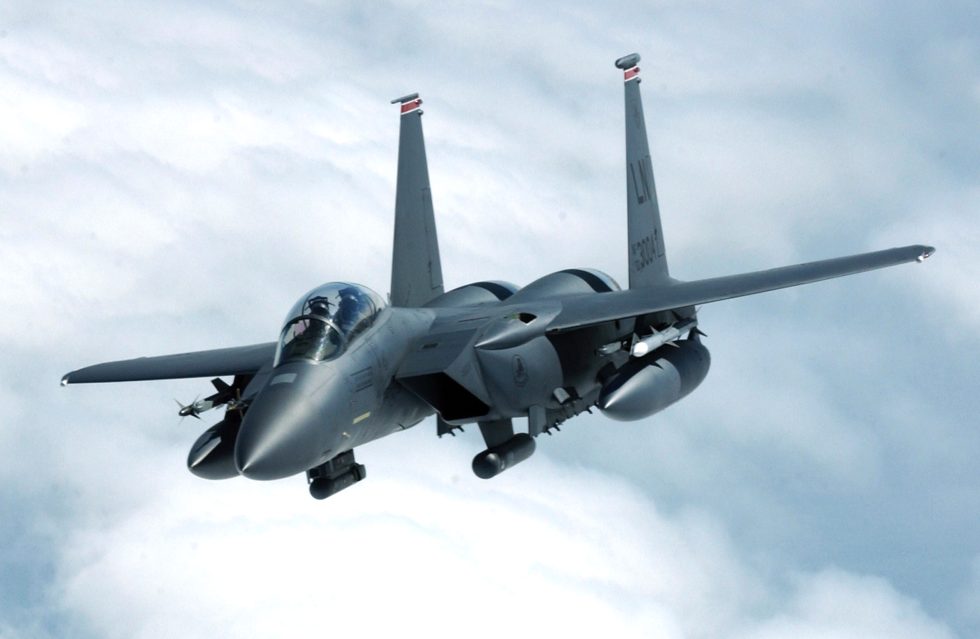
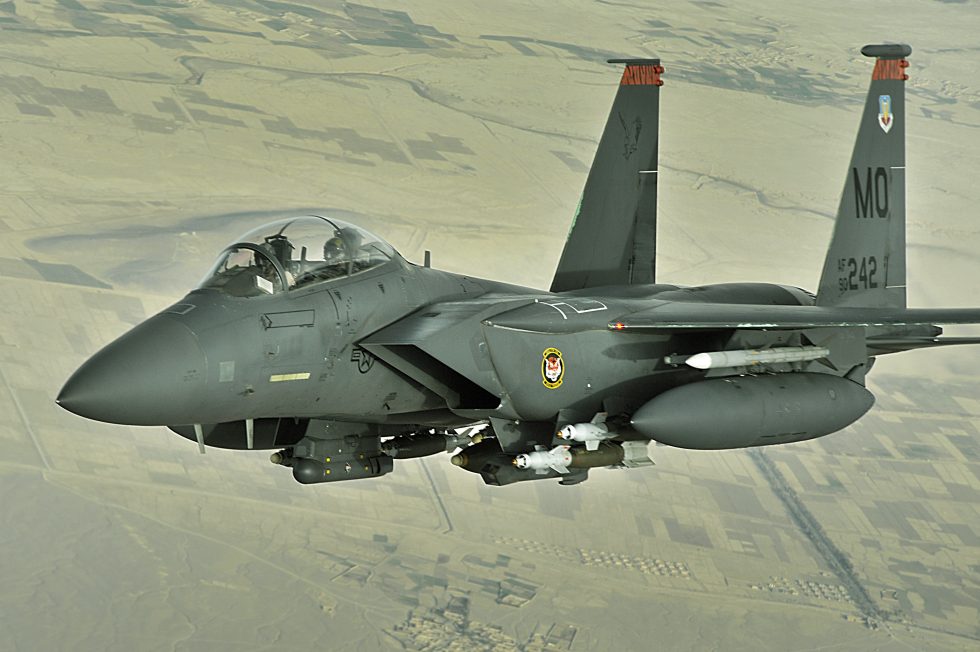
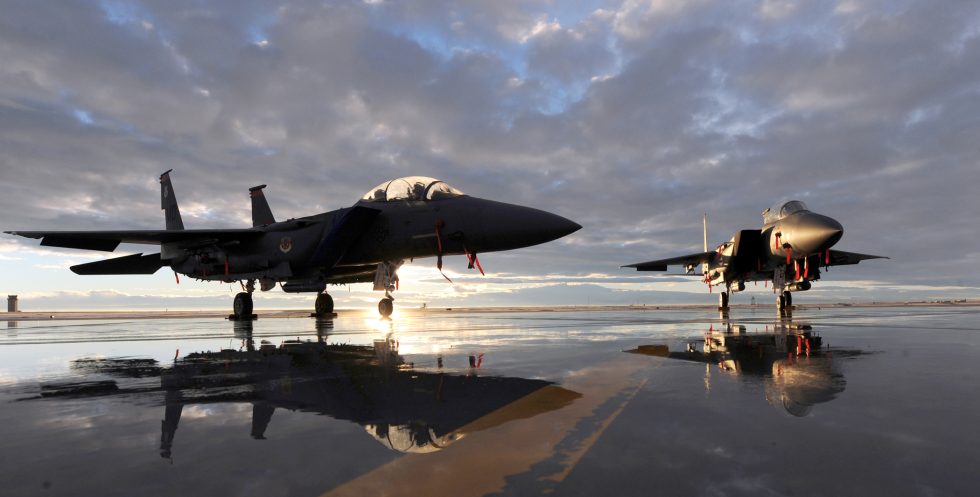
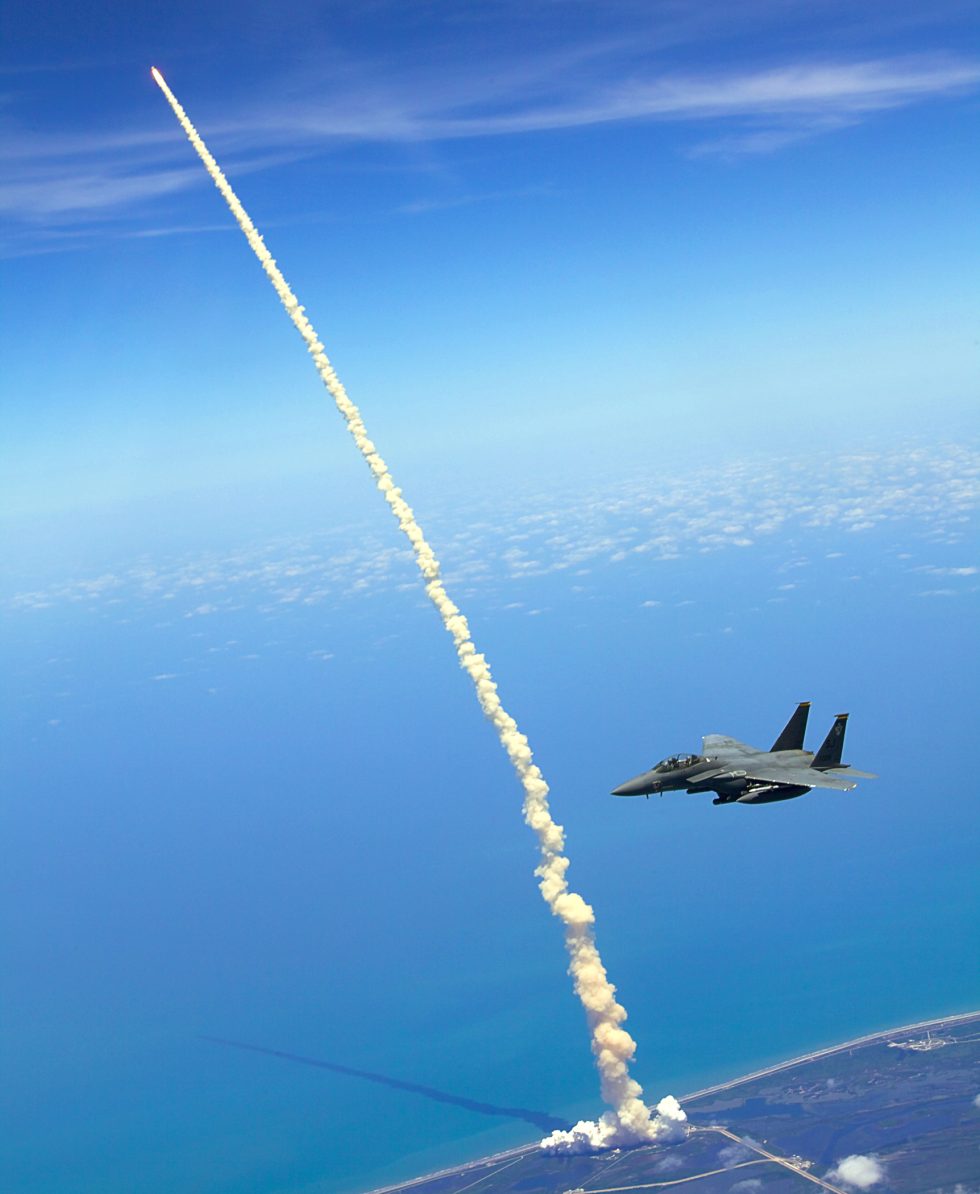
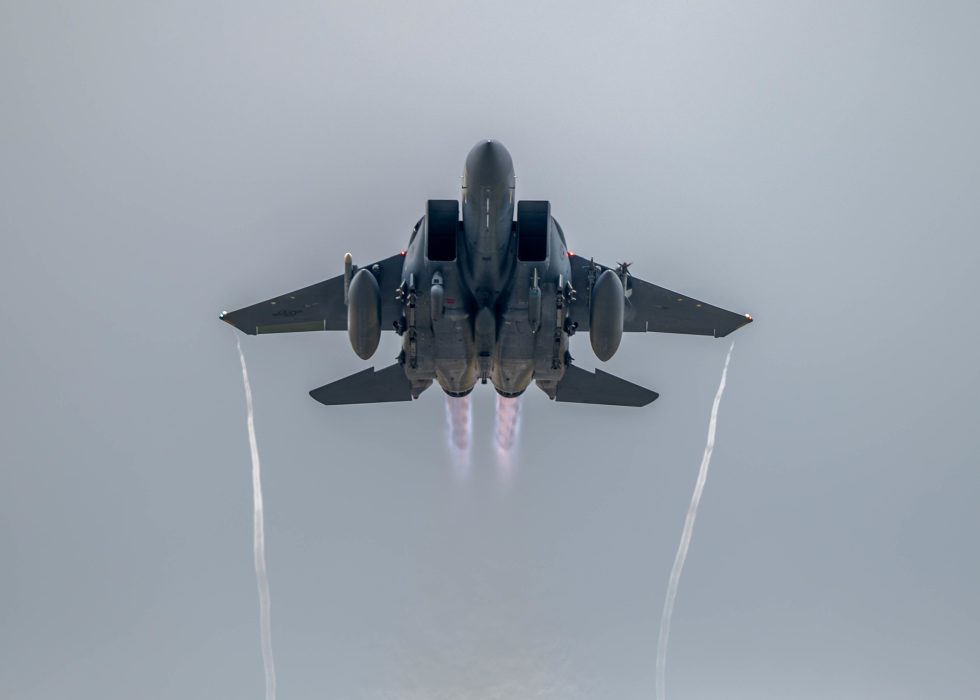
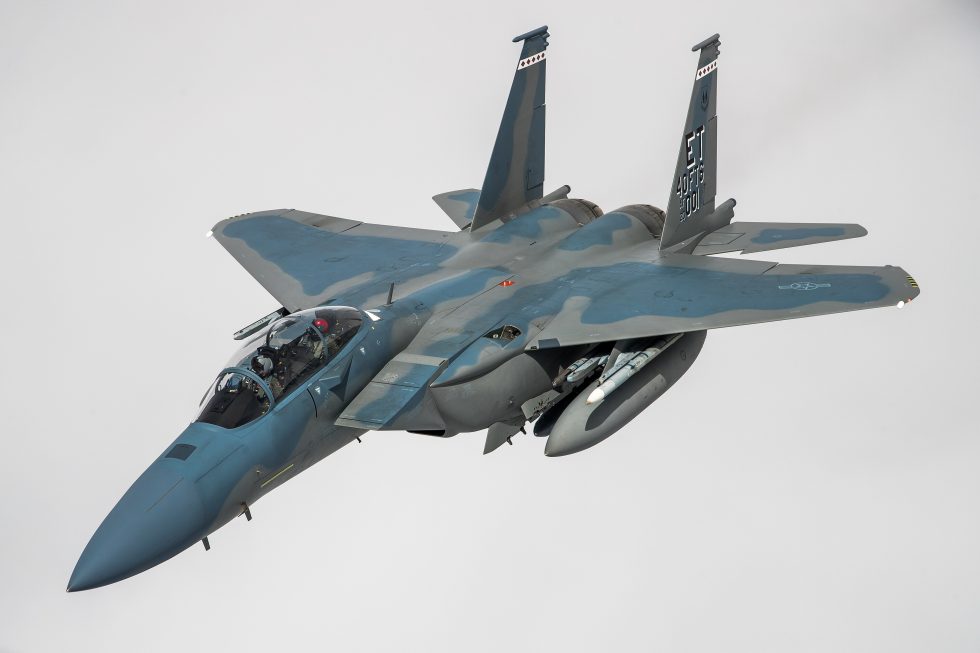
The Strike Eagle in motion
A hand-picked F-15E Strike Eagle video is coming soon. In the meantime, explore the stories, specifications and combat record above — and see where the type flies in the operations map below.
The F-15E Strike Eagle in motion
Megaprojects — one of the most-watched F-15E Strike Eagle films on YouTube.
Where the F-15E Strike Eagle flies
The record that defines the Strike Eagle
The F-15E has been one of the busiest combat aircraft of the past three decades — a precision-strike workhorse from Desert Storm to the anti-ISIS campaign, while never losing the Eagle’s ability to fight in the air. Its record is written in bombs on target, but it also holds one of the most unusual air-to-air kills in history.
Compare the combat record of every military aircraft. Figures as of July 2026.
Everything people ask about the F-15E Strike Eagle
Can I fly in an F-15E Strike Eagle?
What is the difference between the F-15E and the F-15C?
Why does the F-15E have two seats?
Did an F-15E really shoot down a helicopter with a bomb?
How much can the F-15E carry?
Is the F-15E still in service?
What is the F-15EX Eagle II?
You can’t fly the F-15E.
These, you can.
Some legends only live in museums — others are fuelled and waiting. MiGFlug has put civilians in real military jet cockpits since 2004.
 Fly the L-39 AlbatrosThe world’s most-flown jet trainer — aerobatics included
 Fly the F-104 Starfighter“The missile with a man in it”
 Fly the MiG-21The Cold War’s most-produced jet
 Fly the T-33 Shooting StarAmerica’s first jet trainer
 Fly the DH VampireA piece of early jet history
 Fly the S.211Agile Italian jet trainer
 Fly the MB-326The classic Aermacchi jet
 Fly the MiG-15The Soviet legend of the Korean War
Continue the tour
Every fact, checked
- U.S. Air Force — F-15E Strike Eagle fact sheetOfficial specifications, dimensions, cost and service history.
- Air & Space Forces Magazine — F-15EDevelopment, inventory numbers and modernisation programmes.
- Air & Space Forces Magazine — F-15EX Eagle IIThe new-build successor: first flight, deliveries and planned buy.
- The Aviationist — F-15E crews and the April 2024 drone defenceUSAF Strike Eagle units in the defence of Israel against Iranian drones.
- The Aviation Geek Club — the GBU-10 helicopter killThe 14 February 1991 air-to-air kill of an Iraqi Mi-24 with a laser-guided bomb.
- This Day in Aviation — 14 February 1991Detailed account of the Bennett/Bakke Strike Eagle helicopter kill.
- GlobalSecurity — F-15 foreign military salesExport variants: F-15I, F-15S/SA, F-15K, F-15SG and F-15QA.
- National Museum of the U.S. Air ForceReference for F-15E history and preserved airframes.