
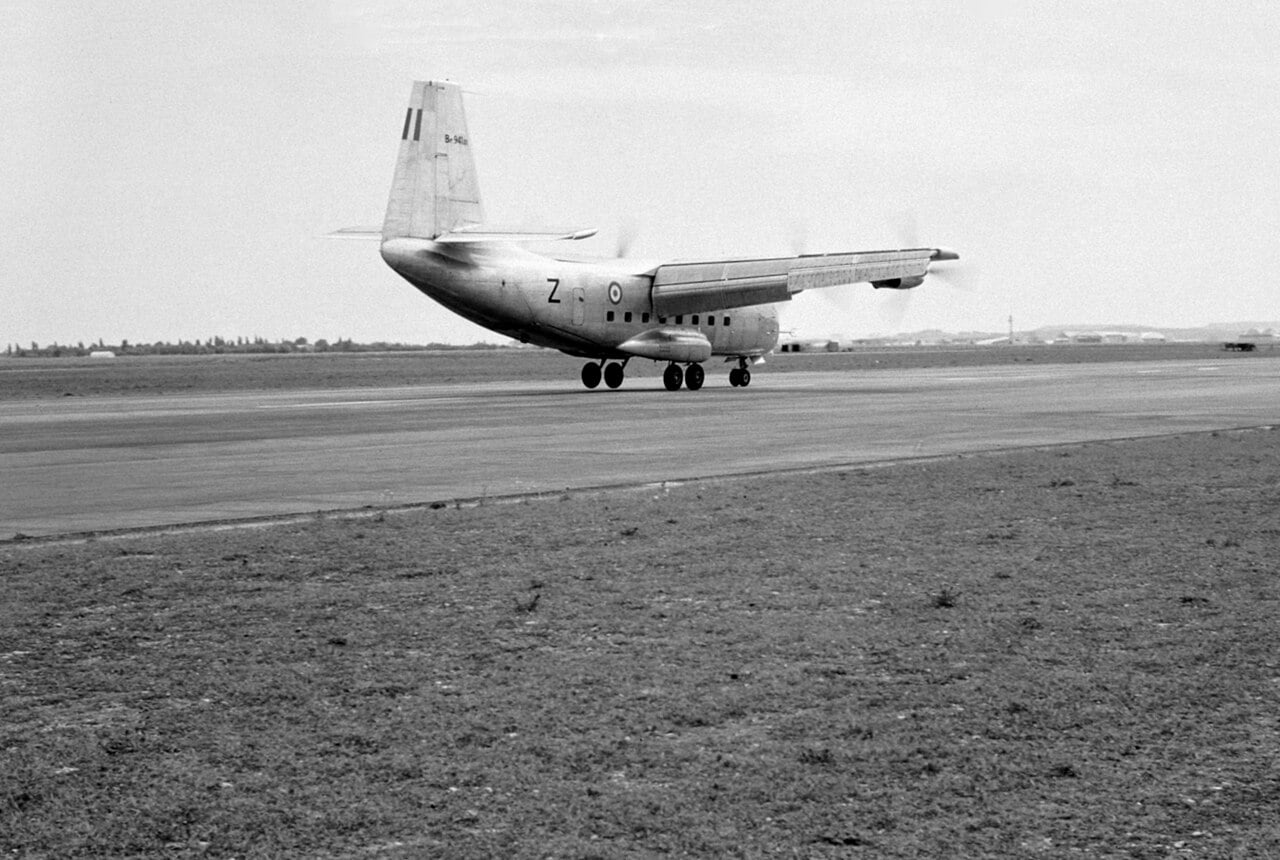
In 1968, for two months, Eastern Air Lines flew fare-paying passengers between cities in the north-eastern United States in a French military transport with four propellers all driven by the same shaft.
The following year American Airlines tried the same aircraft, and then the Federal Aviation Administration used it to test an idea called the STOLport: small airfields close to city centres, served by aircraft that could get in and out of a few hundred metres of runway. Short-hop air travel without the drive to the airport.
It did not happen. The airlines wanted jets and conventional runways. Only five Breguet 941s were ever built.
Datos rápidos
Qué era: A French four-engine turboprop short takeoff and landing (STOL) transport
El truco: Four free-turbine turboshafts driving a common powershaft, which turned four oversize propellers spaced along the wing leading edge, behind full-span slotted flaps
The French name for it: “L’aile soufflée” — the blown wing
Proof of concept: Breguet 940 Integral, four 400 hp Turbomeca Turmo II turboshafts, first flew 21 May 1958
Prototype: Breguet 941, first flight 1 June 1961
Producción: Four Breguet 941S for the French Air Force, first flying 19 April 1967
Total construido: One prototype and four production aircraft
US licensee: McDonnell Aircraft, which marketed it as the McDonnell 188
French service: 1967 to 1974
Why All Four Propellers Share One Shaft
This is the detail that makes the Breguet 941 worth knowing about. Louis Charles Breguet’s idea, developed in the late 1940s and early 1950s, was to blow the entire wing with propeller slipstream and then deflect that slipstream downwards with enormous full-span slotted flaps. Do it properly and the wing generates lift at speeds where it would normally have stalled long ago.
For that to work, the propeller wash has to cover the whole span evenly. So the propellers are oversize and closely spaced along the leading edge, and — critically — all four are connected to a common powershaft driven by all four engines.
The consequence is the elegant part. If an engine fails, you do not lose the thrust on one side and the lift behind it. All four propellers keep turning, just with less power. On a conventional four-engined aircraft with a blown wing, losing an outboard engine at low speed would produce an asymmetric lift loss that no pilot could counter. Breguet designed that failure mode out of existence.
The Concept Worked
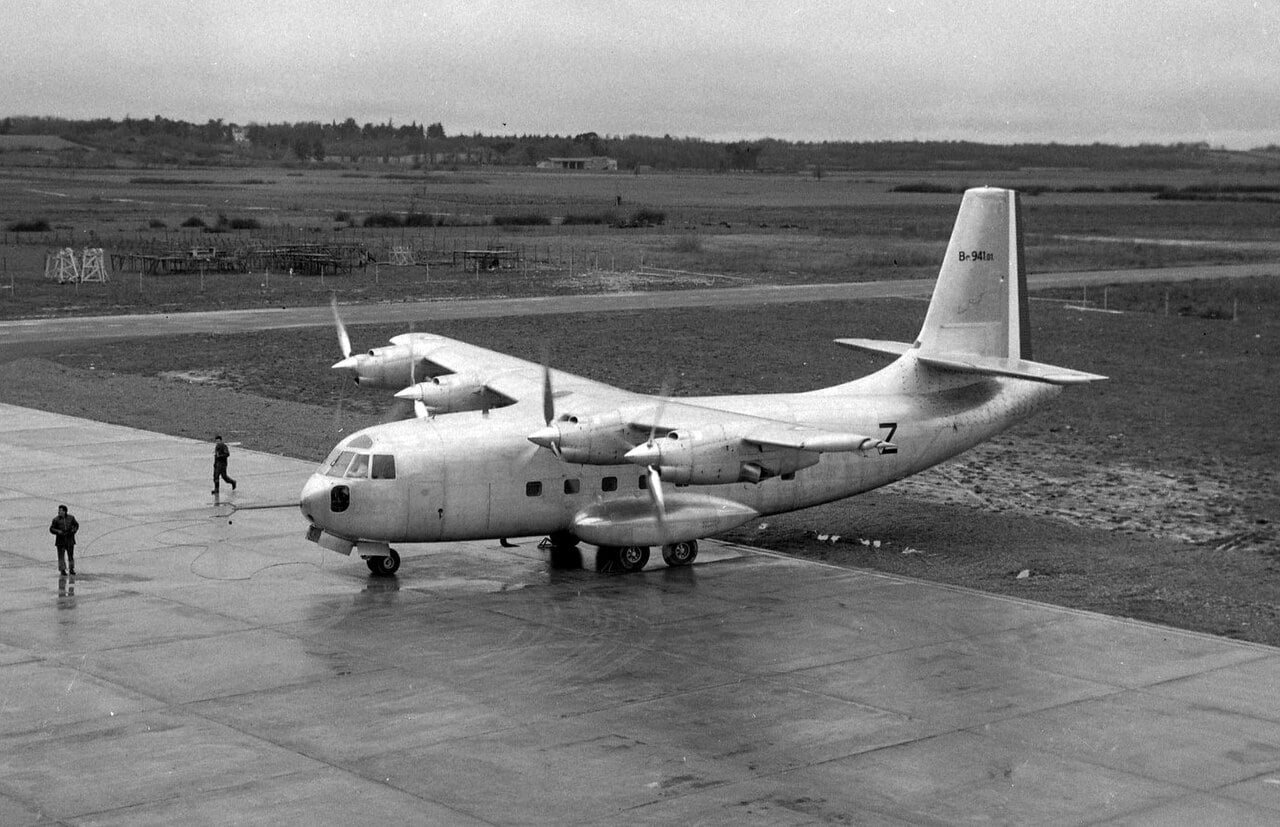
The experimental Breguet 940 Integral first flew on 21 May 1958 with four 400 horsepower Turbomeca Turmo II turboshafts, and demonstrated excellent short-field performance. That was convincing enough that in February 1960 an order was placed for a prototype capable of carrying a useful load.
That aircraft, the Breguet 941, first flew on 1 June 1961. Testing went well enough to produce an order for four improved Breguet 941S aircraft for the French Air Force, with more powerful engines and a modified rear cargo door for air-dropping stores. The first 941S flew on 19 April 1967.
McDonnell’s own promotional film for the aircraft as the Model 188 — worth watching for the short-field demonstrations alone.
America Very Nearly Bought It
McDonnell Aircraft acquired a US production licence and began marketing the aircraft with minimal changes as the McDonnell 188. It also promoted an upgraded 188E with a circular-section pressurised fuselage and uprated engines, and after McDonnell merged with Douglas the combined company proposed something bigger again as the McDonnell Douglas 210.
The prototype was tested extensively in France and the United States. McDonnell ran demonstrations with it in late 1964 and again in early 1965. NASA evaluated it. The US military evaluated it. Nobody ordered it.
Then came the airline trials: two months of limited passenger operations with Eastern Air Lines in 1968, American Airlines the following year, and the FAA using the same aircraft to assess whether STOLports could work.
Why It Failed
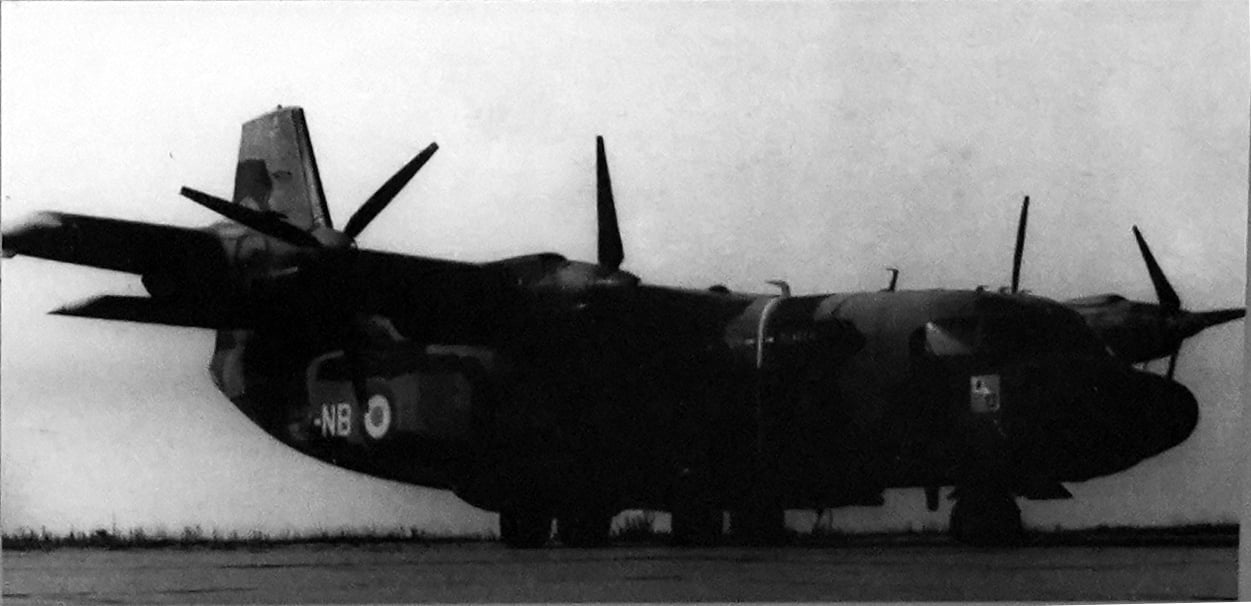
The verdict was commercial, not technical. Airlines were primarily interested in operating jets from conventional airports, and they did not embrace the STOLport concept. No sales resulted. None of the proposed upgraded versions left the drawing board.
Breguet had also intended to go further with a pressurised airliner version, the Br 942, seating 40 in first or business class on a new 3.1 metre diameter circular fuselage. After the limited success of the 941 and 941S, and with expected running costs high, that was abandoned too.
The four French Air Force aircraft served until 1974. Then the whole idea was quietly filed away.
The Idea Came Back
There is a reason this matters beyond curiosity value. The short-field regional market the Breguet 941 was built for did eventually arrive — it just went to far simpler aircraft. The de Havilland Canada Twin Otter and its successors took that business with fixed wings, two engines and no shared driveshaft at all, because adequate short-field performance at low cost beat exceptional short-field performance at high cost.
A Twin Otter doing, more cheaply, the job the Breguet 941 was designed to do.
And the STOLport concept itself never quite died. Every current proposal for electric aircraft and air taxis operating from small sites near city centres is arguing the same case Breguet and McDonnell made in 1968, to the same sceptical audience. The aeroplane was not wrong. The market was just fifty years away.
Preguntas frecuentes
What was the Breguet 941?
Why were all four of the Breguet 941’s propellers connected?
What does l’aile soufflée mean?
Did any airline actually fly passengers in a Breguet 941?
Why did the Breguet 941 fail commercially?
How many Breguet 941s were built and how long did they serve?
When did the Breguet 941 first fly?
Sources: Bréguet company records, NASA, McDonnell Aircraft and McDonnell Douglas programme material, Federal Aviation Administration STOLport evaluations, Musée de l’Air et de l’Espace.
Publicaciones relacionadas


0 Comments