
Ask an aviation enthusiast about Kampfgeschwader 200 and you will probably hear a version of the same story: that the Luftwaffe flew captured B-17 Flying Fortresses in American markings, slid them into USAAF bomber streams, and shot the formations apart from the inside. It is a wonderful story. It is also almost entirely untrue, and the trail of where it came from is more interesting than the myth.
What KG 200 actually did was stranger, better documented, and in places considerably more sinister.
Datos rápidos
Unidad: Kampfgeschwader 200, the Luftwaffe’s special-operations wing
Formed: 20 February 1944 at Berlin-Gatow, out of the Versuchsverband ObdL
Disbanded: 25 April 1945
Unit code: A3
Commanders: Oberst Heinz Heigl (Feb to Nov 1944), Oberstleutnant Werner Baumbach (Nov 1944 to Mar 1945), Major Adolf von Hernier (Mar to Apr 1945)
Captured types flown: B-17, B-24, Short Stirling, Mosquito, Beaufighter, P-38, Spitfire, I-16, Tu-2 and others
Documented B-17s: Around seven airworthy Fortresses, five B-17F and two B-17G
Cover designation: Dornier Do 288, a deliberate reuse of another aircraft’s programme number
A squadron built out of a spy flight
The lineage starts in 1934 with Theodor Rowehl, who had spent four years photographing Poland from a civil-registered aircraft on behalf of the Abwehr before anyone thought to formalise the arrangement. From that grew the Versuchsverband ObdL, the high command’s test formation, and from a piece of that, on 20 February 1944 at Berlin-Gatow, came KG 200.
Its business was the kind of flying nobody writes songs about: dropping agents, supplying people who were not supposed to exist, and going to places no ordinary bomber wing could reach. The agent-insertion side ran through four outstations with cover names that sound like a cabaret bill — Olga, Carmen, Klara and Toska — covering western, southern and eastern Europe respectively. Agents went out by parachute, or in a plywood-and-metal container built to hold three men.
Why the Fortresses wore swastikas
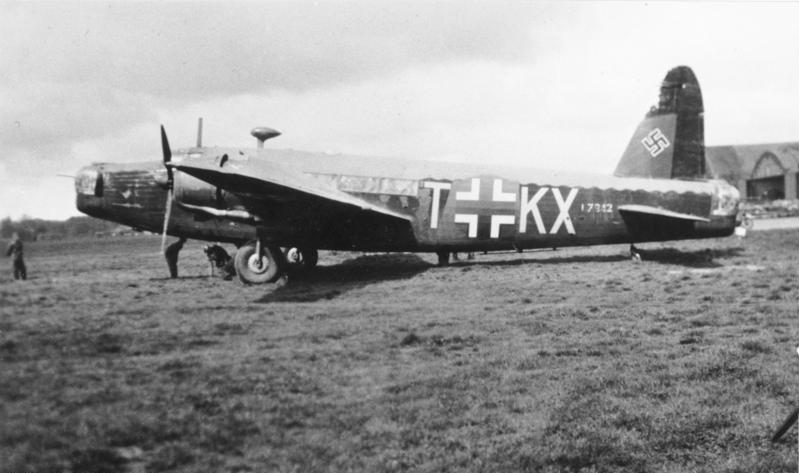
KG 200 did fly captured American bombers. The unit had roughly seven usable B-17s, patched together from battle-damaged aircraft that had force-landed in occupied territory, rebuilt with the vast stock of spares the Germans had salvaged from wrecks. The most famous, a B-17F christened Wulf Hound by its original crew and captured on 12 December 1942, eventually flew with KG 200 under the code A3+AE.
The Germans fitted them with a FuG 101 radio altimeter and a barometric airspeed indicator, based them at Finsterwalde and later Finow and Hildesheim, and painted them in full Luftwaffe markings: Balkenkreuz on the wings, swastika on the fin.
That last detail is the one that demolishes the legend, and the reasoning behind it is almost boringly practical. A German-crewed B-17 flying over German-held territory in American colours would have been attacked by German flak and German fighters within minutes. Crews on these missions were required to report their exact position and altitude precisely so the Luftwaffe would not shoot them down. Disguise would not have been clever. It would have been suicide.
They used Fortresses and Liberators for the same reason anyone would: they were the best long-range transports available, and Germany did not have enough of its own.
Where the myth actually comes from
The story has a traceable pedigree, and it is worth following because it is an object lesson in how aviation folklore hardens into fact.
It begins honestly. Roger Freeman’s B-17 Fortress at War, published in 1977, recorded what American crews had believed during the war — rumours of strange Fortresses shadowing their formations. Freeman reported them as rumours, which is what they were. What did happen were occasional Fühlungshalter sorties, contact-keeping flights that trailed a formation at a distance and radioed its position. Real, useful, and nothing like the legend.
The same year, J. D. Gilman and John Clive published a book called KG 200. It was subtitled “A Novel”. It took Freeman’s rumours and built an invented operation around them. From there the story escaped into general circulation, was dramatised again in a 2022 feature film, and — this is the part that should give any researcher pause — the novel ended up cited as a source in the reference list of the unit’s Wikipedia article.
There is a similar problem with the designation. You will often read that the captured bombers were redesignated “Dornier Do 200”, presumably echoing the unit number. The documented cover designation is Do 288, a deliberate reuse of the programme number belonging to the Junkers Ju 288 in order to confuse anyone reading a manifest. “Do 200” appears to be a garbling that escaped from an anonymous comment on an aircraft database and was then laundered into apparent fact by repetition.
Footage and photographs of captured B-17s in German hands.
Two units, constantly confused
Half the muddle around KG 200 comes from conflating it with Zirkus Rosarius, and the two are genuinely different things.
Zirkus Rosarius — formally 2. Staffel of the Versuchsverband ObdL, code T9, formed in 1943 under Theodor Rosarius — was an evaluation and demonstration outfit. It test-flew captured Allied aircraft, then toured them around operational fighter airfields so German pilots could see what they were fighting and learn how to beat it. KG 200, code A3, was operational: agents, supply, special missions.
The connection that causes the trouble is that KG 200 was carved out of the Versuchsverband in February 1944, and aircraft moved between the two. Wulf Hound is the perfect illustration. Captured in December 1942, tested at Rechlin as DL+XC, toured with the Rosarius circus, displayed at the captured-aircraft exhibition at Lärz in June 1943 alongside a B-24, a P-47, a Mustang, a Lightning, a Lancaster, a Mosquito, a Typhoon and a Spitfire — and only then transferred to KG 200. Most famous photographs captioned “the KG 200 B-17” actually show it during its test career. Date the airframe, not the unit.
Mosul, by moonlight
The mission that best captures what KG 200 was for has no captured aircraft in it at all.
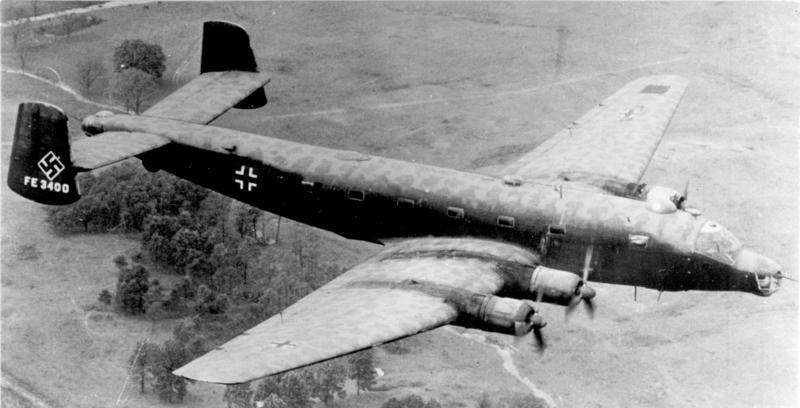
On 27 November 1944 two pilots named Braun and Pohl took a Junkers Ju 290 out of Vienna and flew it to a point just south of Mosul, in Iraq, where they dropped five Iraqi parachutists in bright moonlight. They then continued to German-occupied Rhodes, dealt with engine trouble on the ground, loaded around thirty casualties, and flew them out. They were back in Vienna two nights later.
Other operations were less romantic. From October 1944 the unit flew supplies to Kampfgruppe Scherhorn, a stranded German force of some two thousand men behind Soviet lines. The force did not exist. “Colonel Scherhorn” was a Soviet operative, and the whole thing was a deception that ran until April 1945. And in September 1944 an Arado Ar 232 carried two agents towards Moscow with 428,000 roubles and 116 real and forged rubber stamps, on a mission to kill Stalin. The aircraft crashed on landing. The assassins set off by motorcycle and were arrested at a checkpoint when a guard noticed their uniforms were dry on a rainy day.
The suicide squadron that mostly did not
KG 200 absorbed the Leonidas Staffel, the unit formed to fly one-way missions. Around seventy to a hundred volunteers signed a declaration that left nothing to interpretation.
The manned V-1 they were meant to fly never flew a combat mission. Werner Baumbach, who took over the wing in November 1944, cancelled it as a waste of pilots. The self-sacrifice attacks that did happen, against the Oder bridges between 17 and 20 April 1945, were flown in ordinary aircraft. The Luftwaffe claimed seventeen bridges destroyed. Antony Beevor’s assessment is that only the Küstrin railway bridge was definitely destroyed, for the loss of thirty-five pilots.
The reckoning that never came
Peter Wilhelm Stahl, who commanded Outstation Olga and later wrote the insider memoir of the unit, said he had written it specifically to deal with the postwar mythology of KG 200 as Hitler’s spy wing, spiriting Nazis out of Europe. His defence of his former colleagues rested on a single observation.
Make of that what you will. What is beyond argument is that the unit’s real history — agents in the Iraqi desert, a two-year deception run by Soviet intelligence, volunteers signing their own death warrants, and a handful of American bombers flying under the swastika because that was the only safe way to fly them — never needed the invention. The novel was superfluous.
Mark Felton on the Leonidas Staffel, the German suicide-mission squadron KG 200 absorbed.
Preguntas frecuentes
Did the Luftwaffe really fly captured B-17s?
Did German-flown B-17s infiltrate American bomber formations?
What markings did KG 200 aircraft wear?
Were the captured bombers called the Dornier Do 200?
What was the difference between KG 200 and Zirkus Rosarius?
Did the Leonidas Staffel ever fly suicide missions?
When was KG 200 formed and disbanded?
Sources: Geoffrey J. Thomas and Barry Ketley, KG 200: The Luftwaffe’s Most Secret Unit; Peter Wilhelm Stahl, KG 200: The True Story; Antony Beevor, Berlin: The Downfall 1945; Andrew J. Swanger in World War II magazine; Michael Holm’s Luftwaffe order of battle records; Warbirds Resource Group.

0 Comments