
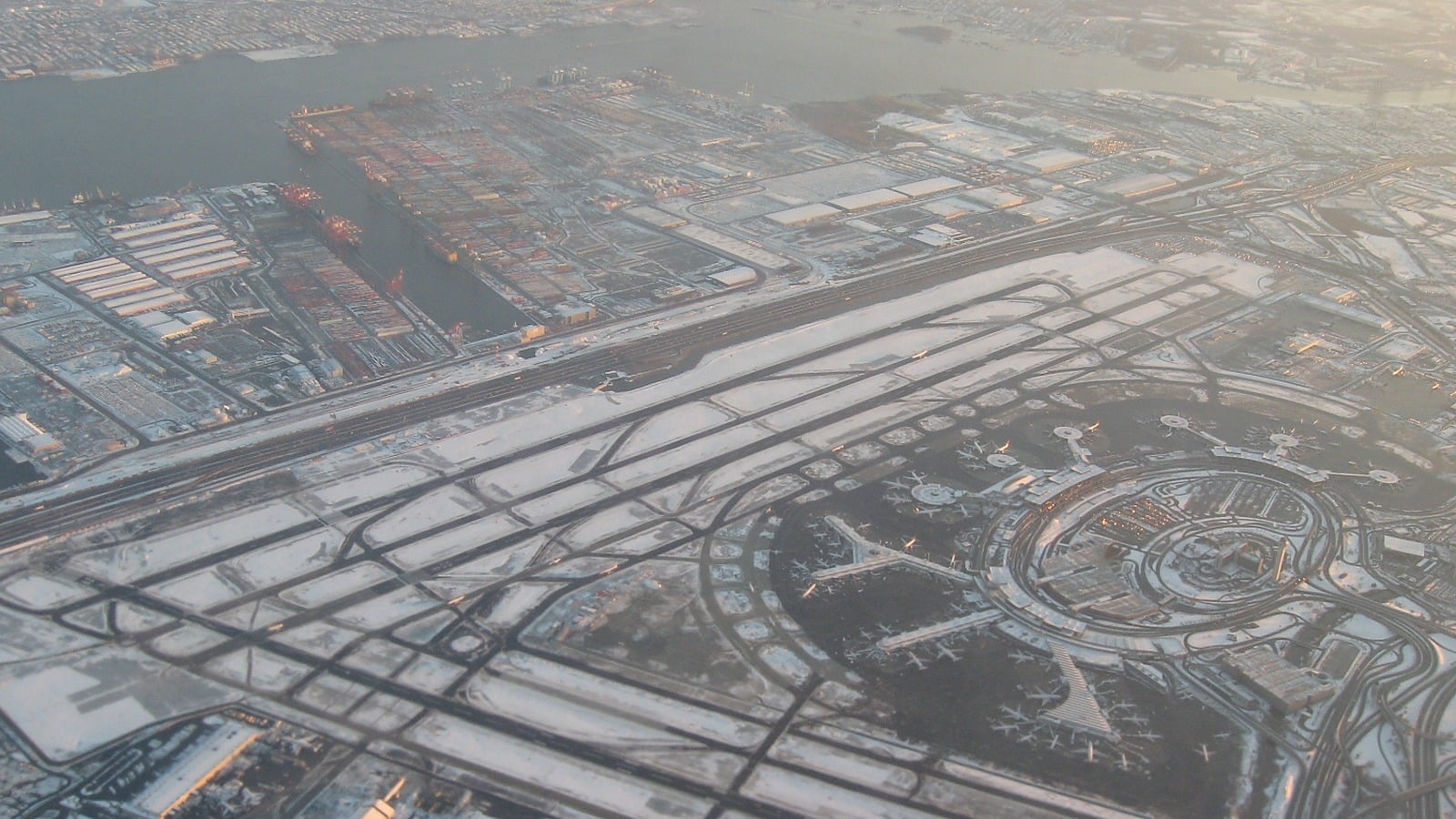
At about ten o'clock on Monday morning, the Federal Aviation Administration stopped Newark Liberty, Teterboro and Philadelphia International. At one in the afternoon it added John F. Kennedy and LaGuardia. Between roughly 09:40 and just after 17:20 local, not one commercial flight landed at Newark, according to Flightradar24.
The cause was not weather, not staffing, not a strike. A telecommunications circuit failed, the system reached for its backup, and the backup had already been cut by a construction crew working next to a railway line in New Jersey.
Dozens of jets queued on a Newark runway, then gave up and taxied back to the gates. On frequency, the people with nothing to control started telling jokes. “Do you guys know what you call an airliner that is going backwards?” one voice asked. “A receding airline.”
Datos rápidos
| Qué pasó | Telecoms failure at Philadelphia TRACON forced FAA ground stops across the New York and Philadelphia airports |
| Cuando | Monday 21 September 2026, from about 10:00 local |
| Airports affected | Newark, Teterboro, Philadelphia, then JFK and LaGuardia |
| Newark arrivals | None between roughly 09:40 and just after 17:20 local, per Flightradar24 |
| Causa principal | An ageing Verizon primary circuit failed; the backup fibre had already been severed |
| Who cut it | A contractor crew on New Jersey Transit’s Delco Lead project, between Newark and New Brunswick |
| Repair estimate | About 13 hours for the fibre, per FAA Administrator Bryan Bedford |
| All clear | Just after 18:00 local, announced by Transportation Secretary Sean Duffy |
What actually broke
FAA Administrator Bryan Bedford put the first failure on an older Verizon circuit serving the Philadelphia TRACON, the terminal radar approach control facility that handles the descending and departing traffic for a large slice of the northeastern United States.
Facilities like that do not sit on top of their own radars or their own radio transmitters. Data and voice travel in and out over leased telecommunications lines, and the design principle is simple: there are two of them, a primary and a backup. When the primary failed on Monday morning, the system tried to fail over to the backup. That was when everyone discovered the backup fibre had been cut somewhere between Newark and New Brunswick.
The fibre runs alongside an Amtrak rail line, and from there the story becomes a corporate relay race.
Verizon said Amtrak construction contractors had cut into the cable. Amtrak replied that the incident had happened on New Jersey Transit property and involved a New Jersey Transit contractor. NJ Transit then confirmed that a crew working on its Delco Lead project had severed a fibre-optic cable, and that it was indeed the backup line the FAA had been talking about.
NJ Transit added the detail that will decide who eventually pays: the utility markings on the site may not have been accurate, and the crew was digging about ten feet from them. The agency said it was still working out whether Verizon or the contractor had put those markings down.
In other words, an airspace serving tens of millions of passengers a year was taken out by a disagreement about where somebody sprayed a line on the ground.
Why Newark’s approach control sits in Philadelphia
This is the part that surprises people who assume Newark's arrivals are worked from somewhere near Newark. They are not. On 28 July 2024 the FAA moved the Newark-area airspace, known internally as Area C, out of the New York TRACON on Long Island and into Philadelphia, in another state.
The reason was staffing. New York TRACON has been chronically short of certified controllers for years, and the FAA's argument was that a smaller, separate facility would be easier to recruit into and train up. The Department of Transportation's Office of Inspector General later opened an audit of the move, looking at exactly the things that failed on Monday: system redundancy, controller staffing and training, and operational resilience.
The move also meant that the data links carrying Newark's radar picture and radio audio now had to travel a long way down leased lines, through New Jersey, to reach the controllers working the traffic. Monday was a demonstration of what that dependency looks like when a backhoe finds the wrong conduit.
Why the FAA stops aeroplanes instead of pressing on
A ground stop looks like an overreaction from a departure lounge. It is the opposite. Terminal controllers separate aircraft that are descending, turning, slowing and configuring in a small volume of busy sky, and they do it on a radar picture refreshed every few seconds and a radio they can rely on. Degrade either, and the only safe response is to reduce the number of aeroplanes in the system until the remaining tools can cope.
That is why the FAA halts departures at the origin airports rather than letting them launch and sort it out later. An aeroplane held at the gate in Chicago is an inconvenience. The same aeroplane holding over New Jersey with no radar and a fuel state is a different category of problem altogether. Six flights already airborne ended up diverting to Bradley International in Connecticut.
The fix that did not take
Bedford's estimate for splicing the severed fibre was about thirteen hours, which would have run the disruption deep into Tuesday. Rather than wait, crews went at the original failed circuit instead and tried to replace it. According to the FAA, the fix did not take, and the delays rolled on through the evening.
The all-clear came just after six in the evening, from the Secretary of Transportation.
Ground stops were lifted, but a full day of cancelled and displaced flights does not unwind in an evening. United said many of its Newark departures had been cancelled outright and issued a travel waiver. Several carriers dropped change fees. The backlog was still being worked through overnight.
Not the first time, and the circuit was already on the list
Philadelphia TRACON has form. In the spring of 2025, controllers working Newark's airspace lost radar and radio contact with their traffic for roughly ninety seconds on 28 April, traced to a burnt copper wire. It happened again on 9 May, that time with failures in both the primary and the redundant communications infrastructure. Those incidents fed straight into the Inspector General’s audit, and into a long argument about whether the move from New York had been thought through.
There is one more detail worth sitting with. The primary circuit that failed on Monday was already scheduled for replacement as part of the national air traffic control overhaul. It had been identified. It was on the list. It simply had not been got to yet, and neither, evidently, had anyone checked that the thing standing behind it was still intact.
Redundancy is not a spare part in a cupboard. It is a promise that two independent things will not fail together, and that promise only holds if somebody keeps testing it. On Monday morning in New Jersey, nobody had, and the busiest airspace in the United States found out the hard way.
NBC News reports the FAA ground stops at Newark, Philadelphia and Teterboro, 21 September 2026.
Sources: NBC New York, Skift, Flightradar24, the Federal Aviation Administration, Verizon, Amtrak, New Jersey Transit, United Airlines, US Department of Transportation Office of Inspector General, Aviation International News.
0 Comments