
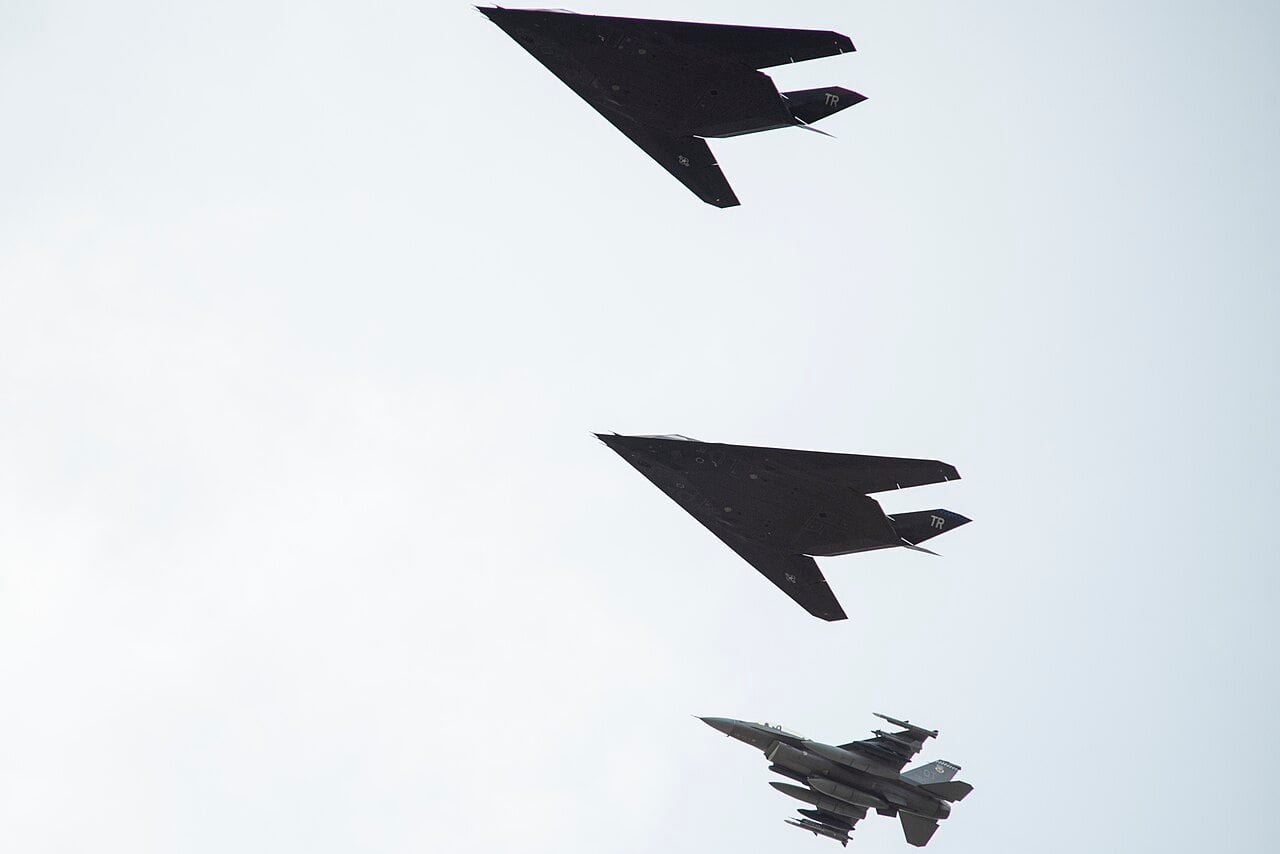
In December 2025 a photographer in the California desert filmed two black diamonds coming through a low-level route at a few hundred feet. In 2026 another one caught them again. The aircraft were F-117 Nighthawks, and the United States Air Force retired them in 2008.
This is not a case of a few airframes quietly slipping through the cracks. Around forty-five of them are deliberately kept in flying condition, seventeen years after a ceremony that described their service as complete, and the reason is written into an Act of Congress.
Datos rápidos
Construido: 64 aircraft — 5 YF-117A prototypes and 59 F-117As
Retirement announced: Program Budget Decision 720, December 2005
Jubilado: In seven waves, 13 March 2007 to 22 April 2008
Last departure: 86-0831 left Palmdale on 11 August 2008
Where they are: Tonopah Test Range Airport, Nevada
Storage category: Type 1000, recallable
Still flyable: Around 45 to 48, depending on the account
Being scrapped: Three a year since 2022, ending in 2034
A Very Final-Sounding Farewell
The retirement was not ambiguous. Program Budget Decision 720 in December 2005 set the date, the aircraft went in seven waves between March 2007 and April 2008, and the ceremonies were held with the usual solemnity.
The final resting place was Tonopah Test Range Airport in Nevada, which is where the F-117 had been based in secret from the beginning. The aircraft went home.
What the ceremony did not mention is what Congress had already required.
The Sentence That Changed Everything
The 2007 National Defense Authorization Act contained a provision about what was to happen to F-117s taken out of service from 30 September 2006 onwards.
That is the whole trick. The aircraft were not scrapped, not sent to the desert at Davis-Monthan to bleach in the sun, and not stripped for parts. They were put into Type 1000 storage: wings removed, airframes inside climate-controlled hangars, everything kept to a standard from which an aeroplane can be brought back.
Keeping something recallable means keeping the people who know how to recall it. It means running the hangars, holding the tooling, maintaining the specialised low-observable coatings knowledge, and — inevitably — flying a few of them now and then to prove all of that still works.
They Never Really Stopped
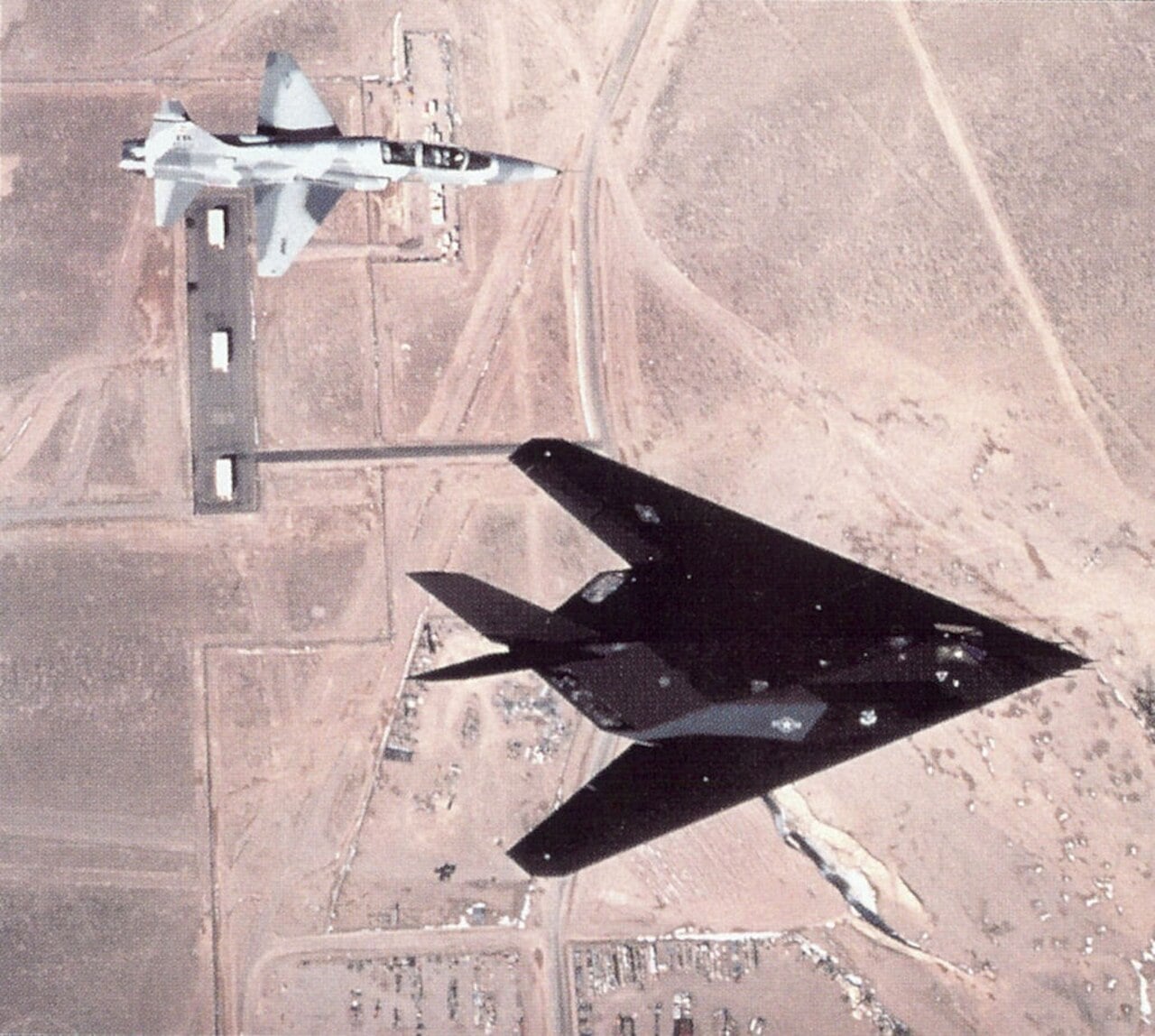
For about a decade the flying was rare enough to be deniable. Then the sightings became routine, and then they became official.
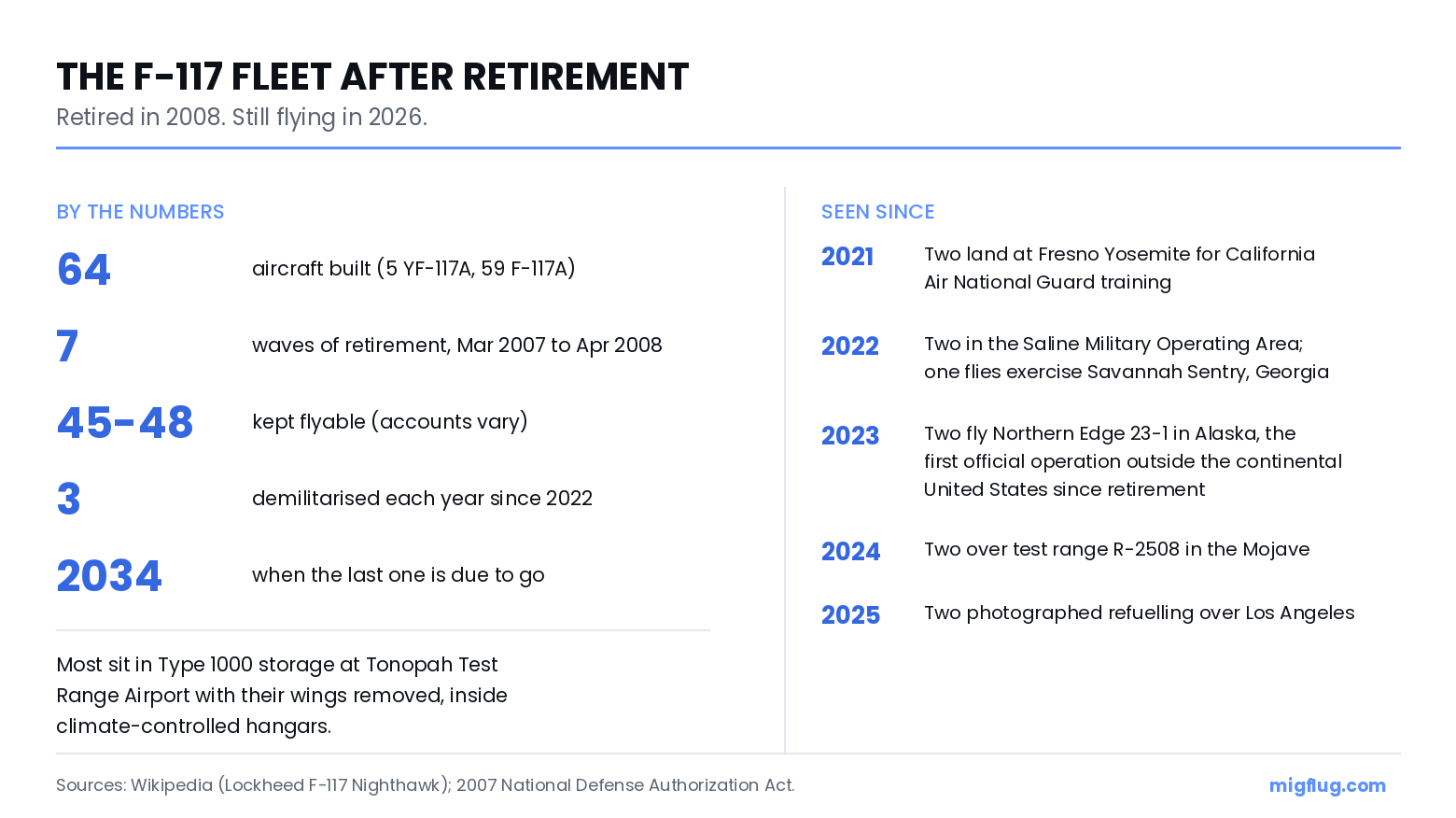
In 2021 two of them landed at Fresno Yosemite International Airport to work with the California Air National Guard. In 2022 a pair appeared in the Saline Military Operating Area and one took part in exercise Savannah Sentry in Georgia. In 2023 two flew Northern Edge 23-1 in Alaska, the first official operation outside the continental United States since the type was retired.
A crew member at Savannah Sentry told reporters that about forty-eight flyable F-117s remained in the inventory and that the aircraft had been brought along in an unclassified capacity — which is a careful way of saying that the interesting parts were left at home.
What Are They Actually Doing?
Three jobs come up consistently.
The first is adversary work. A stealth aircraft flown by people who know exactly how it behaves is an extremely useful training target for crews and for ground radar operators who will one day have to find something similar and less friendly.
The second is cruise missile training. A small, low-observable, subsonic shape coming in at low level is a reasonable stand-in for a threat that air defences genuinely have to solve.
The third is research and development: a flying testbed with a known radar signature is worth a great deal to anyone developing sensors, and unlike an F-22 or a B-2, an F-117 is not needed anywhere else.
An F-117A working a low-level route in Panamint Valley, February 2019, with the radio traffic recorded alongside.
The Countdown to 2034
The arrangement is ending, slowly. As of 2022 the Air Force has been demilitarising around three F-117s a year, a rate that finishes the fleet off in 2034. Each one that goes is stripped of anything sensitive and then disposed of; a handful have gone to museums instead, which is how one of them ended up at the Smithsonian.
Which means there is a window, and it is closing. For a few more years, if you stand in the right part of the Californian desert on the right morning, you can watch an aeroplane that the United States Air Force formally stopped operating before the iPhone had a front camera come down a canyon at 400 feet.
Retirement, it turns out, is a paperwork category rather than a physical state.
Sources: Wikipedia (Lockheed F-117 Nighthawk); 2007 National Defense Authorization Act as quoted therein.
Preguntas frecuentes
Is the F-117 Nighthawk still flying in 2026?
Why were the F-117s not scrapped?
How many F-117s are left?
Where are the retired F-117s kept?
What are the F-117s used for now?
When will the last F-117 stop flying?
Did F-117s ever deploy overseas after retirement?
Can civilians fly in a fighter jet today?
Publicaciones relacionadas
F-117 Nighthawk 85-0818: The Smithsonian Gets The Overachiever


0 Comments