
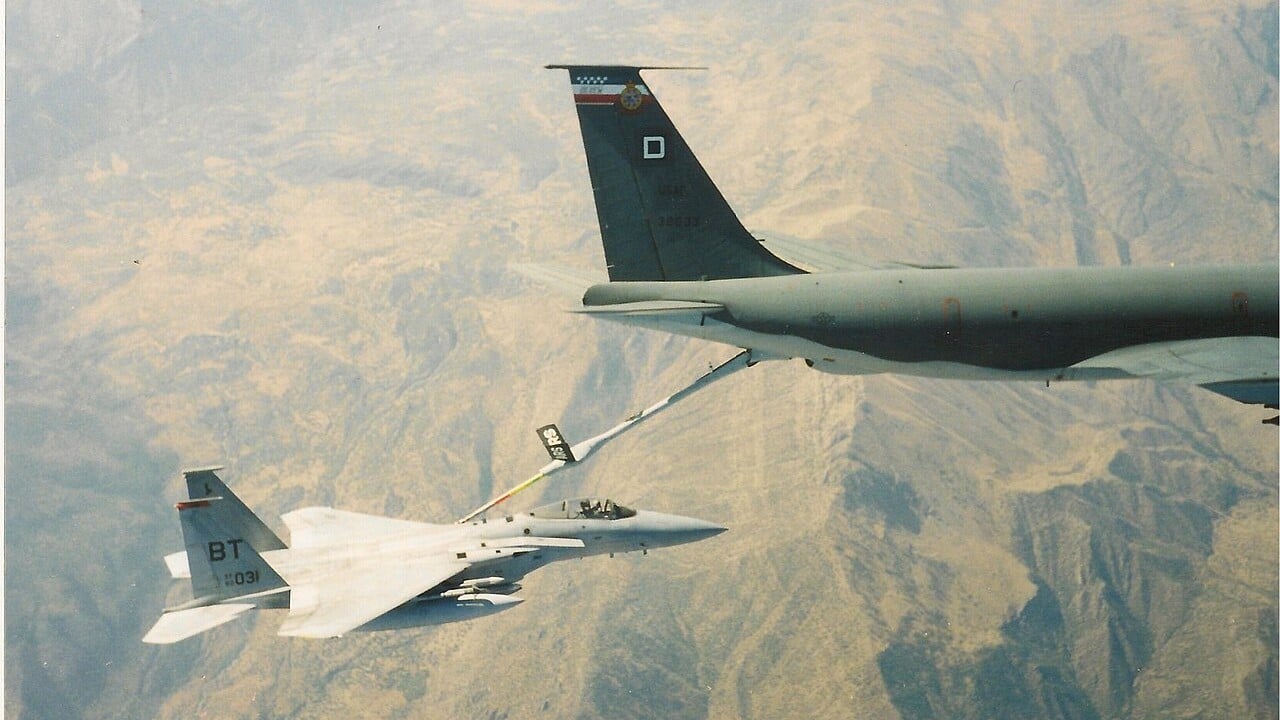
On a radar screen, every aircraft looks much the same: a blip. It might be a friendly fighter coming home, an airliner, or an enemy bomber. Get it wrong one way and an enemy slips through. Get it wrong the other way and you shoot down your own people.
The system that is supposed to settle the question is called IFF, short for Identification, Friend or Foe. It has been around since the Second World War, it is in almost every military aircraft flying today, and its civilian offspring is in every airliner. Here is how it works, and why it is still not a magic answer.
Datos rápidos
- Qué es: An interrogator sends a coded challenge; a transponder on a friendly aircraft sends back a coded reply
- Orígenes: British radar development before and during the Second World War
- Current NATO standard: Mark XII / Mark XIIA, with encrypted Mode 4 and Mode 5
- Civil spin-off: Modes 3/A, C and S are the transponder codes used by air traffic control
- Key limit: IFF can positively identify a friend, but no reply does not prove an enemy
- Target date: Under STANAG 4570, all NATO interrogators and transponders are expected to be Mode 5 capable by 2030
A blip with no name
The problem arrived with radar itself. When Britain's Chain Home stations began watching the skies before the Second World War, operators could see aircraft long before anyone could see them with the naked eye, but they could not tell whose they were. Aircraft were flying too fast and too high to identify visually, and on the screen they were just featureless blips.
The cost of that became clear in the very first days of the war. On 6 September 1939, in what became known as the Battle of Barking Creek, RAF fighters were scrambled against radar plots that turned out to be British aircraft. Spitfires shot down two Hurricanes, killing one pilot, the first British fighter pilot to die in the war.
The Ops Center explains IFF and secondary surveillance radar.
Challenge and reply
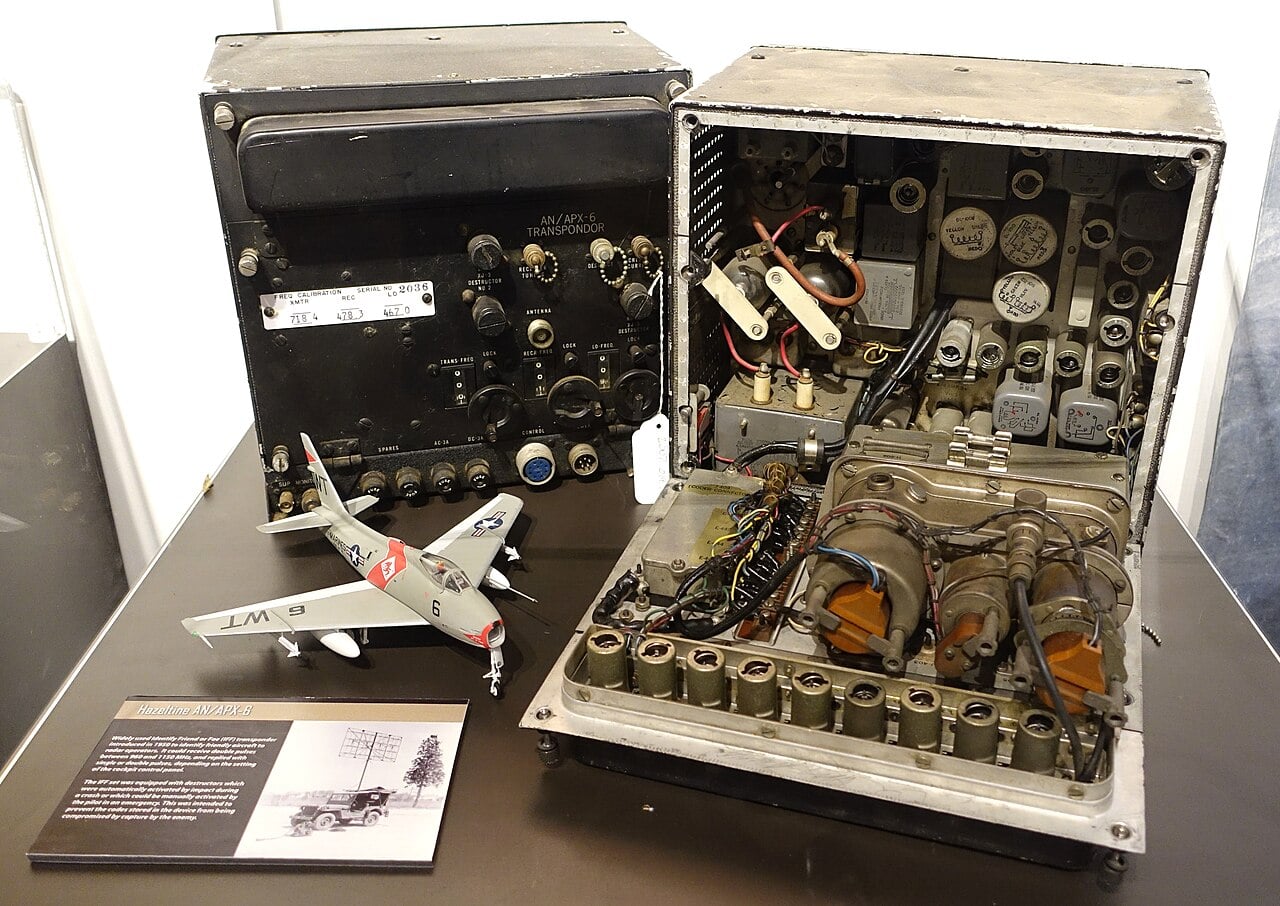
Early British experiments tried to make friendly aircraft simply reflect radar more strongly, which did not work reliably. The answer was an active transponder. The first, the IFF Mark I, was used experimentally in 1939. It picked up the radar pulse and sent a stronger signal straight back, making a friendly aircraft's blip on the screen longer and easy to spot. The Mark II followed in 1940, and the Mark III became the standard for the Western Allies for most of the war.
The principle has not changed since. A ground radar, a ship or a fighter carries an interrogator, which sends out a coded challenge. A friendly aircraft carries a transponder, which hears the challenge and sends back a coded answer. The interrogator links that answer to the radar contact, and the blip gets a label. IFF sets were so secret during the war that many were wired with explosives, to be destroyed if the aircraft came down.
Modes, codes and airliners
After the war, IFF went digital in a modest way. The Mark X system introduced numbered modes. Mode 1 identified the type of aircraft or mission, and Mode 2 returned a code for the individual airframe. As civil aviation boomed in the 1950s, airliners were given slightly modified sets too. Mode 3, known to civilian users as Mode A, returns the four-digit code a pilot sets when air traffic control assigns a "squawk". Mode C added altitude, saving radar stations the cost of measuring height themselves.
That is the hidden military history behind every airliner transponder. Mode S, introduced in the 1980s, carries much more data and is the basis of the collision avoidance systems on modern airliners.
Simple codes have a weakness, though: anyone can send the challenge. An enemy can trigger a transponder and use the replies to locate the aircraft. The current military standard, Mark XII, added Mode 4, an encrypted challenge that only gets an answer when the codes match, with a changing delay on the reply to make tracking harder. Its successor, Mode 5, is an encrypted military version of the Mode S data. Most NATO members began upgrading to Mode 5 around 2016, and the alliance expects every interrogator and transponder to be Mode 5 capable by 2030.
Thales, one of the main IFF manufacturers, on how the system works.
Why IFF cannot prove an enemy
IFF has one fundamental limit, and it has cost lives. It can tell you that a contact is friendly. It cannot tell you that a contact is hostile. A missing or wrong answer might mean an enemy, but it might also mean a broken transponder, a wrong code, or a civilian light aircraft that does not carry one.
The most painful example came on 14 April 1994, over northern Iraq during Operation Provide Comfort. Two US Air Force F-15s, under the control of an AWACS aircraft, intercepted two helicopters in the no-fly zone. The pilots interrogated them on their IFF, got no reliable friendly reply, misidentified them as Iraqi Mi-24 Hinds and shot both down. They were US Army UH-60 Black Hawks. All 26 people on board were killed. The helicopters had been squawking the wrong Mode 1 code for the zone, after being given an incorrect one. The then US Secretary of Defense summarised what went wrong.
That is why IFF is only one part of what the military calls combat identification. Pilots and controllers also use rules of engagement, flight plans, datalinks, electronic signatures and, when possible, a visual look before anyone fires.

Still essential
For all its limits, IFF remains one of the most important boxes in a military aircraft. Without it, a crowded sky full of friendly jets, tankers, drones and airliners would be almost impossible to manage. New aircraft are still being fitted with the latest Mode 5 equipment, and setting the right IFF codes is part of planning every military mission. On a radar screen, being recognised as a friend is a matter of life and death.
Battleship New Jersey explains IFF.
And how the 1994 shootdown was reported at the time.
Archive news footage from the Associated Press.
Sources: Wikipedia (Identification friend or foe, Battle of Barking Creek, 1994 Black Hawk shootdown incident), US Department of Defense, NATO STANAG 4570, The Ops Center, Thales, AP Archive
0 Comments