

Four hours out of Washington, somewhere over the dark North Atlantic, the crew of United Airlines flight UA946 got the message no twin-jet pilot wants: a problem with one of their two engines. They declared an emergency, turned the Boeing 767 around, and headed back west to Newfoundland.
At about 3:30am local time on Monday, 12 October, the 767 touched down safely at St. John's International Airport. Nobody was reported hurt. The passengers, who had boarded at Washington Dulles on Sunday evening expecting breakfast in Amsterdam, ended up in hotels in St. John's waiting for another aircraft.
It is not a dramatic story, and that is exactly why it is worth telling. This is what the system is designed to do.
Quick Facts: United Airlines UA946
Ruta: Washington Dulles (IAD) to Amsterdam Schiphol (AMS)
Fecha: Departed evening of 11 October 2026; landed 12 October
Aeronave: Boeing 767-300ER, registration N644UA (per The Aviation Herald)
Motores: Two Pratt & Whitney PW4060 turbofans
Problema: Engine issue at 37,000 ft over the North Atlantic
Diverted to: St. John's International Airport, Newfoundland
Landed: About 3:30am local time, 12 October 2026
Lesiones: No se han reportado casos
What Happened Over the Atlantic
UA946 left Dulles at around 8:30pm Eastern time on Sunday, according to AirLive. Roughly four hours later, cruising at 37,000 feet, the crew received a cockpit indication of an engine problem. They set the transponder to 7700, the general emergency code, and turned west.
The Aviation Herald, cited by Karmactive, puts the aircraft about 370 nautical miles east of St. John's when the trouble began. The crew descended to 26,000 feet, a typical step for a twin-engine jet with an engine problem, because one engine alone cannot hold the aircraft at its original cruise altitude, and landed on runway 28 about 90 minutes later.
There is one detail the early reports do not agree on. The Aviation Herald reported that the 767 landed with one engine shut down. Aviation A2Z, followed by other outlets, reported that the engine was shut down and later restarted, and that the crew continued the diversion anyway. United had not published a detailed explanation at the time of writing, and the cause of the problem is not known.
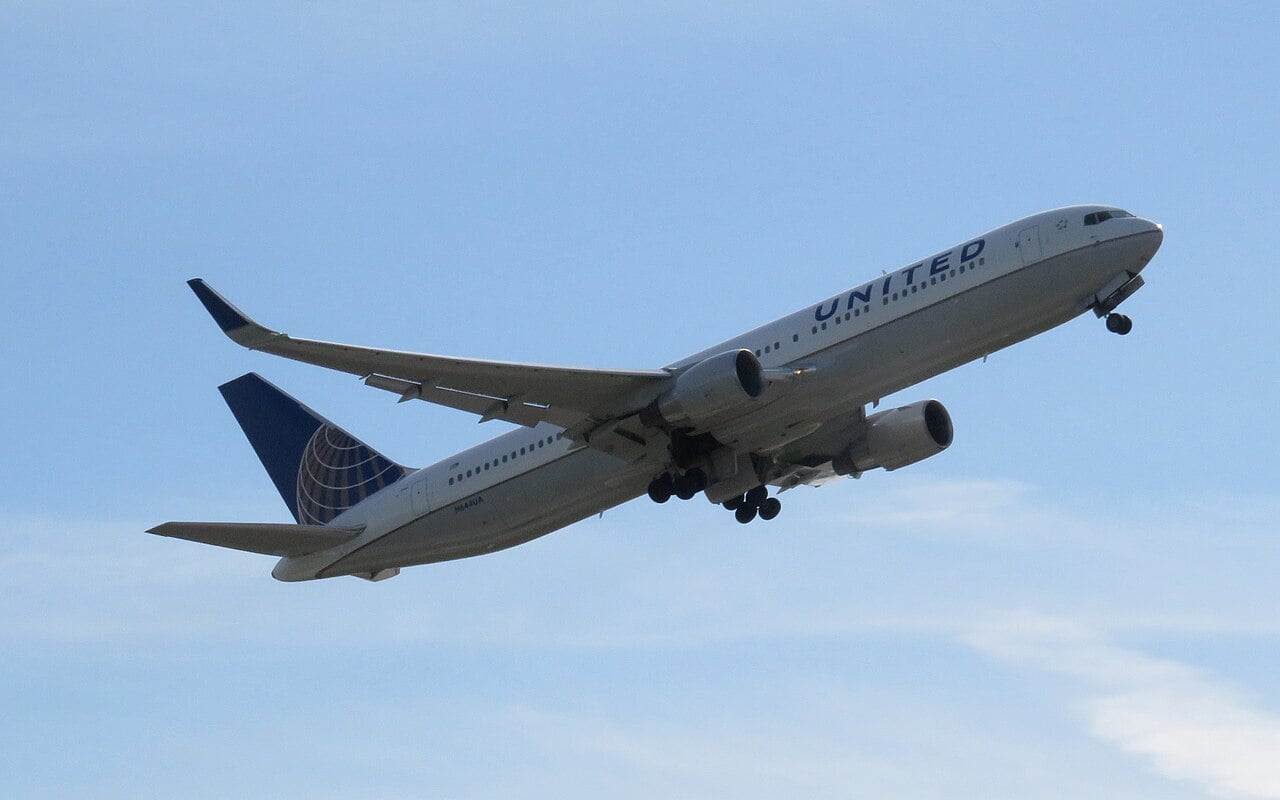
A 35-Year-Old Workhorse
The aircraft is N644UA, a Boeing 767-322ER powered by two Pratt & Whitney PW4060 engines. AirLive describes it as about 35 years old and one of the oldest 767s still in United's active fleet.
Age alone tells you little about safety. Airliners are maintained to strict schedules, and an engine can develop a fault on a new aircraft as easily as an old one. What age does affect is how many more years an operator wants to keep a type flying, and how often it spends a night somewhere unplanned like this.
On the ground in St. John's, the St. John's Regional Fire Department, the Royal Newfoundland Constabulary, NL Health Services and the airport's own fire service were standing by. Emergency services were released within about ten minutes of the landing, and the 767 taxied to Gate 1.
Why a Twin Can Cross an Ocean
Twin-engine airliners are allowed to fly long overwater routes under ETOPS rules, short for Extended-range Twin-engine Operations Performance Standards. The aircraft, its engines and the airline all have to be certified, and every ETOPS flight is planned so that a suitable diversion airport is always within a set flying time on one engine.
On the North Atlantic, the airports that make that possible are mostly in Canada, Greenland, Iceland, the Azores and Ireland. St. John's, Gander and Goose Bay in eastern Canada are the classic westbound bolt-holes. When a crew turns back toward Newfoundland in the middle of the night, it is not improvising. That airport has been in the plan since before the aircraft left the gate.
UA946 is the system working as intended: a warning, a crew that followed the checklist, a diversion field within reach, and an aircraft on the ground. The passengers lost time. Nobody lost anything else.
Wendover Productions explains ETOPS, the rules that let twin-engine airliners like the 767 fly long distances over oceans.
Sources: The Aviation Herald (via Karmactive); AirLive; Aviation A2Z; The Aviation Hub; Flightradar24.

0 Comments