
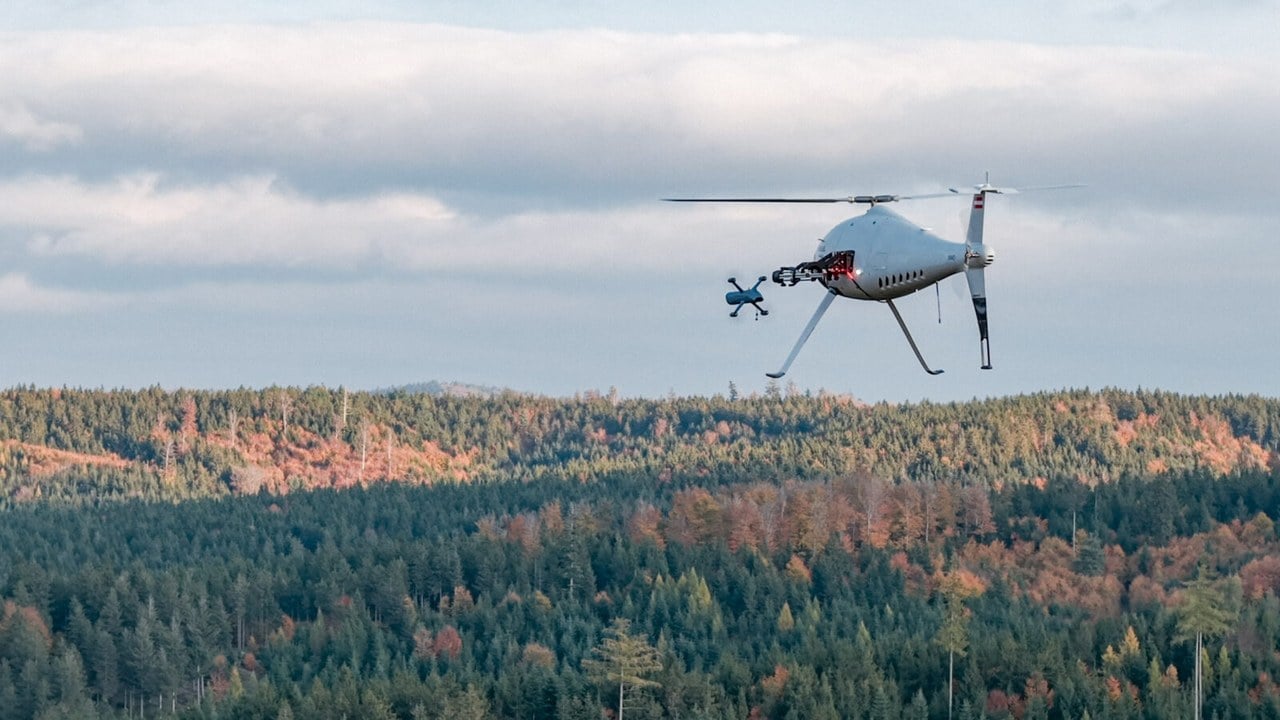
Above a pine forest in Austria, a white unmanned helicopter about three metres long flies forward at speed. Hanging from its side is a second, much smaller drone. A moment later the little machine drops clear, spins up its own rotors and races away, still talking to its pilot through the helicopter above it.
That is the scene Schiebel released on Wednesday 18 November 2026, when the Austrian company announced that it had demonstrated its CAMCOPTER S-100 unmanned helicopter as a “drone mothership”. The proof-of-concept was flown in Austria together with the Polish company OSIRIS Poland. Schiebel did not give the date of the flights in its release.
Datos rápidos
- Qué: CAMCOPTER S-100 unmanned helicopter used as carrier, launcher and relay for a small drone
- Anunciado: Wednesday 18 November 2026, Schiebel press release
- Partner: OSIRIS Poland
- Small drone: OSIRIS HSCD-1 High-Speed Camera Drone, inert variant
- Dónde: Austria; flight date not given
- Main use case: Counter-drone missions, possibly with interceptor drones in future
- Estado: Proof-of-concept; no customer or contract announced
Launch, then relay
According to Schiebel, the S-100 carried an OSIRIS HSCD-1, short for High-Speed Camera Drone, and released it while in forward flight. After the release, the small drone was flown through a communications link relayed via the S-100. The helicopter therefore did two jobs at once: it was the launcher, and it was the airborne control and video relay.
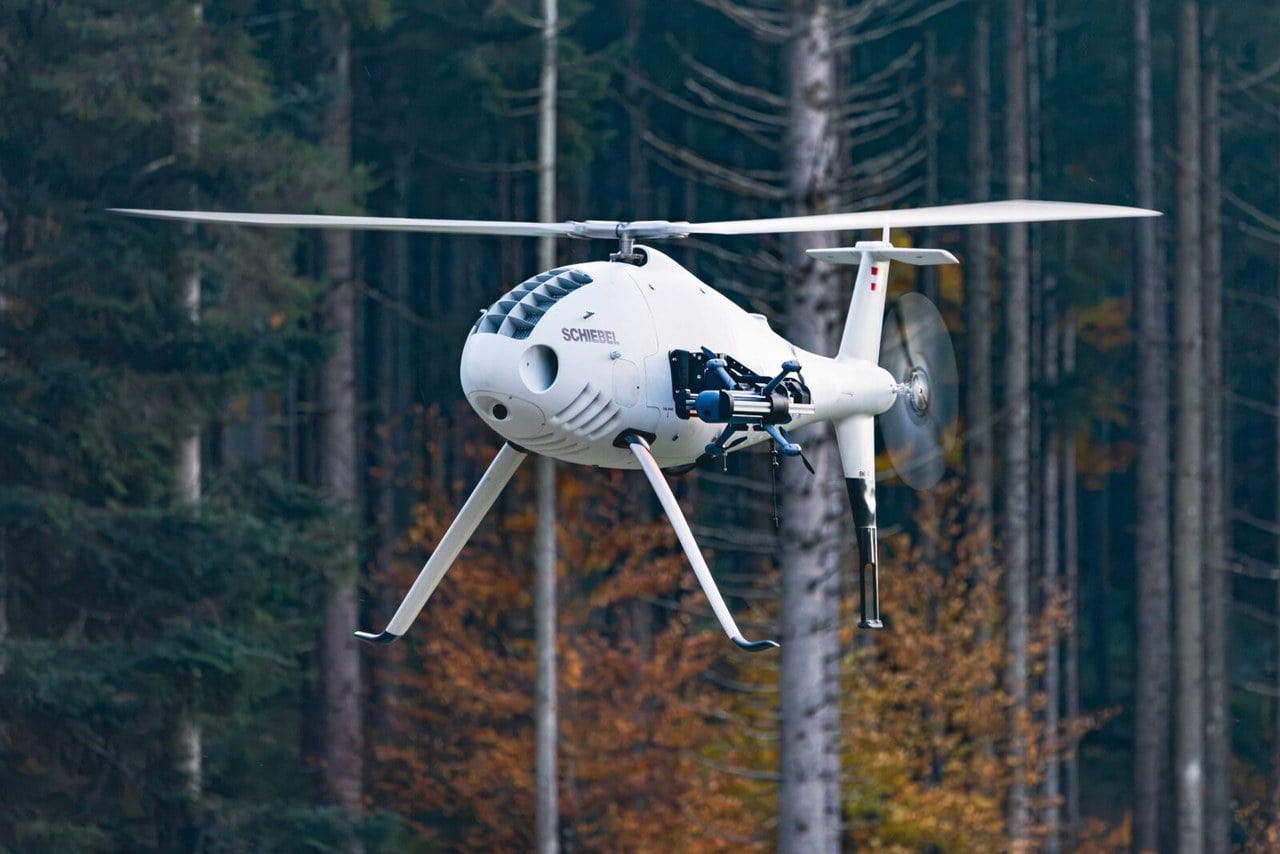
The logic is simple. Small, fast drones are agile but short on range and endurance, and their radio links fade quickly over hills, forests and the horizon. A larger unmanned helicopter can carry one most of the way to where it is needed, release it close to the target area and keep the link alive from altitude. Schiebel says this can “significantly extend the operational reach and endurance” of small drones compared with launching and controlling them from the ground.
Schiebel’s own footage of the CAMCOPTER S-100 carrying and releasing the OSIRIS HSCD-1 during the drone mothership demonstration in Austria.
A counter-drone tool first
Schiebel points first to counter-drone work as the most promising use. The HSCD-1 flown in the demonstration was an inert variant, but the company says the same approach could carry high-speed interceptor drones fitted with effectors. In other words, a patrolling S-100 could in future bring its own interceptors closer to an incoming threat.
The company does not limit the idea to the S-100. Its release names the S-100, S-300, S-101 and S-301 as possible carriers, launch platforms and communications relays for smaller unmanned systems and loitering munitions. No customer, contract or in-service date was announced; at this stage it is a demonstration of a concept.
A proven little helicopter
The choice of carrier is not random. The CAMCOPTER S-100 was developed in Austria between 2003 and 2005 and has become one of the best-known unmanned helicopters in naval service. It has a maximum take-off weight of 200 kg, a Wankel engine and, according to Wikipedia, an endurance of about six hours, extendable to more than ten with optional external fuel tanks.
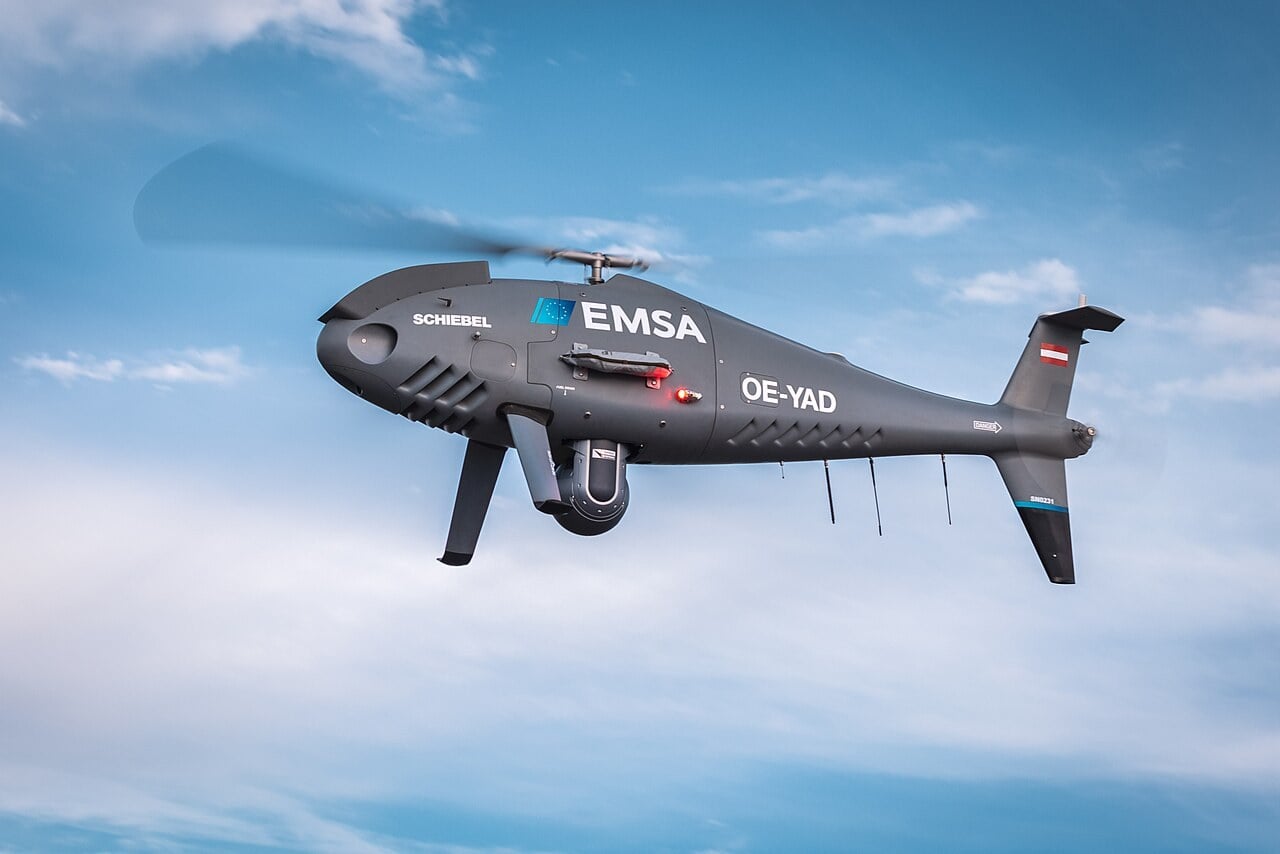
Schiebel says the S-100 has flown operationally from more than 50 different vessels. Its users include the French Naval Aviation and the Italian Navy, and the Royal Navy flies it as Peregrine, which was trialled from the frigate HMS Lancaster in the Gulf of Oman. The European Maritime Safety Agency also uses the type for coastal surveillance on behalf of member states.
Carrying other things is not new for the S-100 either. Schiebel already markets it with a sonobuoy dispenser for anti-submarine work, a cargo box or underslung hook for delivering supplies, and the ability to drop lifebuoys and life jackets in search and rescue. It has also been flown under full control from a manned aircraft, the so-called Level of Interoperability 5 used in manned-unmanned teaming.
BFBS Forces News on the Royal Navy’s Peregrine, its name for the S-100, during flying trials from HMS Lancaster in 2024.
The mothership idea is spreading fast. Afterburner has already covered an Altius-700 drone launched from a Black Hawk and the Petrel AERO Sky concept being tested by US Army Rangers. What makes Schiebel’s demonstration interesting is the platform: a small, unmanned and already widely exported helicopter that navies have bought for surveillance could now become a flying launch rail and relay for the next generation of small drones.
Sources: Schiebel press release and product page, defence-blog, BFBS Forces News, Wikipedia (Schiebel Camcopter S-100)
Header photo: Schiebel
0 Comments