
Here is the sentence that catches more American drone owners than any other, and it is on the FAA’s own website: compensation, or the lack of it, is not what determines whether a flight was recreational.
Almost everybody believes the opposite. Nobody paid me, so I am a hobbyist, so the hobby rules apply. That reasoning is wrong, and the gap between it and the actual law is where a free afternoon with a quadcopter turns into an operation that legally required a certificate you do not hold.
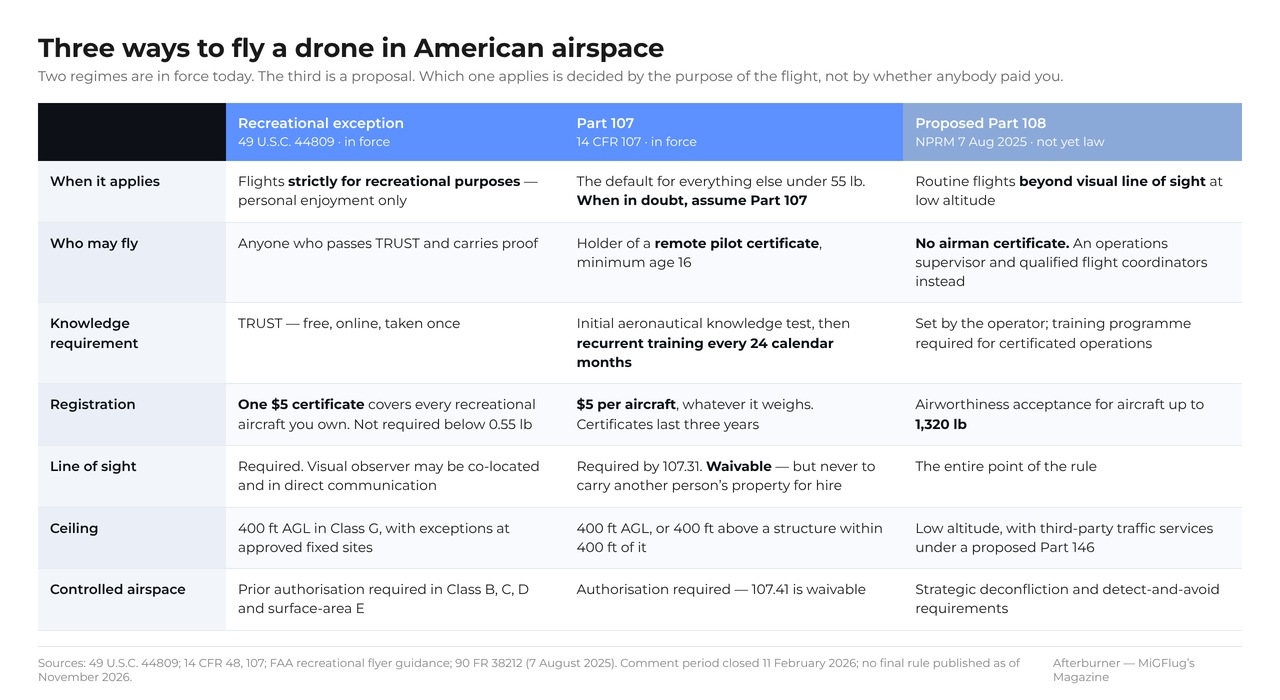
There are two legal regimes for a small drone in the United States today, and a third sitting in a filing cabinet at the Department of Transportation. This is what each one asks of you, and which one you are actually flying under.
Quick Facts
The default rule: 14 CFR Part 107 covers almost all non-recreational flying under 55 lb
The exception: 49 U.S.C. 44809 — the limited recreational carve-out Congress wrote
The test that decides: purpose of the flight, not payment. The FAA’s advice is “when in doubt, assume Part 107”
Part 107 certificate: minimum age 16, aeronautical knowledge test, recurrent training every 24 calendar months
Recreational requirement: TRUST, free and online, with proof carried in flight
Registration: $5 per aircraft under Part 107; one $5 certificate covering all of them if you fly only recreationally and the aircraft is 0.55 lb or more
Altitude: 400 ft above ground level under both regimes, with narrow exceptions
Beyond visual line of sight: waiver or exemption only. Proposed Part 108 would make it routine — NPRM published 7 August 2025, no final rule yet
The Question Is Not Whether Anybody Paid You
The FAA puts the misconception on the page before it explains the rules, which tells you how often it has had this conversation.
The agency then gives examples of flights that are not recreational, and they are deliberately mundane: taking photos to help sell a property or a service, inspecting a roof, photographing a high school football game for the school’s website. All of those are Part 107 operations.
Goodwill counts against you too. The FAA names volunteering to survey coastlines for a non-profit as a non-recreational operation. You are not being paid, you are doing somebody a favour, and you still need the certificate — because the flight has a purpose beyond your own enjoyment.
The agency’s own tiebreaker is four words long: when in doubt, assume Part 107.
The Recreational Carve-Out, in Full
The exception lives in statute rather than in the regulations: 49 U.S.C. 44809, headed Exception for limited recreational operations of unmanned aircraft. It lets you fly without any certification or operating authority from the FAA — provided the flight meets every one of eight conditions.
The aircraft is flown strictly for recreational purposes. It is operated within the safety guidelines of a community-based organisation developed in coordination with the FAA. It stays within the visual line of sight of the operator, or of a visual observer who is co-located and in direct communication. It gives way to crewed aircraft. In Class B, C or D airspace, or the surface area of Class E designated for an airport, prior authorisation is obtained. In Class G it stays at or below 400 feet above the ground. The operator has passed the aeronautical knowledge and safety test and keeps proof available. The aircraft is registered and marked, with proof of registration available on request.
Miss any one of those and the statute is explicit about what happens: operations that do not conform must comply with all the statutes and regulations generally applicable to unmanned aircraft. In other words, you are back under Part 107, whether you hold the certificate or not.
The test in condition seven is TRUST, The Recreational UAS Safety Test. It is free, it is online, it takes a few minutes, and there is no way to fail it permanently — the exam walks you back through anything you get wrong. The legal obligation is not to pass it once but to carry proof of completion every time you fly.
What TRUST covers and how the completion certificate works.
Section 44809 also carries a feature most casual flyers never use: approved fixed sites. The FAA maintains a process to approve and publish the locations of fixed sites for recreational flying. Operating from one inside controlled airspace means the site, or the sponsoring community-based organisation, has an agreed operating procedure with the local air traffic facility. There is even a route to fly above 400 feet in Class G from such a site, with prior authorisation, and a route to fly aircraft of 55 pounds or more under standards a community-based organisation has written and the Administrator has approved.
What Part 107 Asks of You
The remote pilot certificate with small UAS rating is not a pilot licence in the traditional sense. There is no flight test, no medical certificate and no logbook of hours. Section 107.61 asks for four things: be at least 16 years old, be able to read, speak, write and understand English, have no physical or mental condition you know would interfere with safe operation, and demonstrate aeronautical knowledge.
That last item is the initial knowledge test at an approved testing centre — unless you already hold a Part 61 pilot certificate and are current on your flight review, in which case you take a course instead.
The certificate does not expire, but the privilege does. Section 107.65 says you may not exercise the privileges of a remote pilot in command unless, within the previous 24 calendar months, you have passed the initial knowledge test or completed recurrent training. The recurrent training is free and online.
Then come the operating limits in 107.51, and they are tighter than most people assume. Groundspeed may not exceed 87 knots, which is 100 miles per hour. Altitude is capped at 400 feet above the ground, unless you are within a 400-foot radius of a structure, in which case you may go 400 feet above its uppermost limit. Flight visibility from the control station must be at least three statute miles. The aircraft must stay 500 feet below and 2,000 feet horizontally from cloud.
Night flying was unlocked in 2021, but not freely: the remote pilot must have taken the knowledge test or training after 6 April 2021, and the aircraft must carry anti-collision lighting visible for at least three statute miles with a flash rate sufficient to avoid a collision. The same lighting is required during civil twilight. You may dim it in the interest of safety. You may not switch it off.
Flying over people is its own chapter. Section 107.39 prohibits it outright unless the person is participating in the operation, is under a covered structure or inside a stationary vehicle, or the operation meets one of the four operational categories in subpart D.
The Registration Trap
Registration is where the two regimes diverge in a way that costs people money and, occasionally, a letter from the FAA.
Part 48 sets the rule. You must register a small unmanned aircraft unless it is operated exclusively in compliance with 44809 and weighs 0.55 pounds or less on takeoff, including everything on board or attached. Both halves have to be true.
That is the trap. The famous 250-gram threshold is not a weight exemption. It is a weight exemption for recreational flying only. Take the same sub-250-gram drone out to photograph a house that is for sale, and the flight is a Part 107 operation — and a Part 107 aircraft has to be registered no matter what it weighs.
The accounting differs too. Under 48.105, one $5 certificate covers every aircraft you own that is used exclusively for recreational operations. Under 48.100, the certificate is issued to a specific aircraft, and the fee in 48.30 is $5 per aircraft. Both expire three years from the date of issue, and the unique identifier has to be legible on an external surface of the aircraft for the whole flight.
A walk through the rules that apply when you are flying purely for fun.
The Wall at the Edge of Sight
Both regimes share one hard boundary, and it is the one holding back the entire commercial drone industry. Section 107.31 requires that the remote pilot in command, the person on the controls and any visual observer be able to see the aircraft throughout the entire flight with unaided vision — well enough to know where it is, what attitude and altitude it is at, which way it is going, whether other traffic is nearby, and whether it is endangering anyone.
Section 107.31 is waivable. It appears on the list in 107.205, alongside night anti-collision lighting, operations over people, operations in controlled airspace and the limits in 107.51. But the waiver carries a sentence that stops the obvious business model dead: no waiver of this provision will be issued to allow the carriage of property of another by aircraft for compensation or hire.
So a surveyor can be waived beyond line of sight. A delivery company cannot — not by waiver. Package delivery operators have instead gone the exemption route under 14 CFR Part 11 and the Administrator’s risk-based authority in 49 U.S.C. 44807, seeking relief from the parts of Part 91 and Part 135 that make no sense for an uncrewed aircraft. Zipline, UPS Flight Forward, Amazon Prime Air and the rest all fly on paperwork written for them specifically.
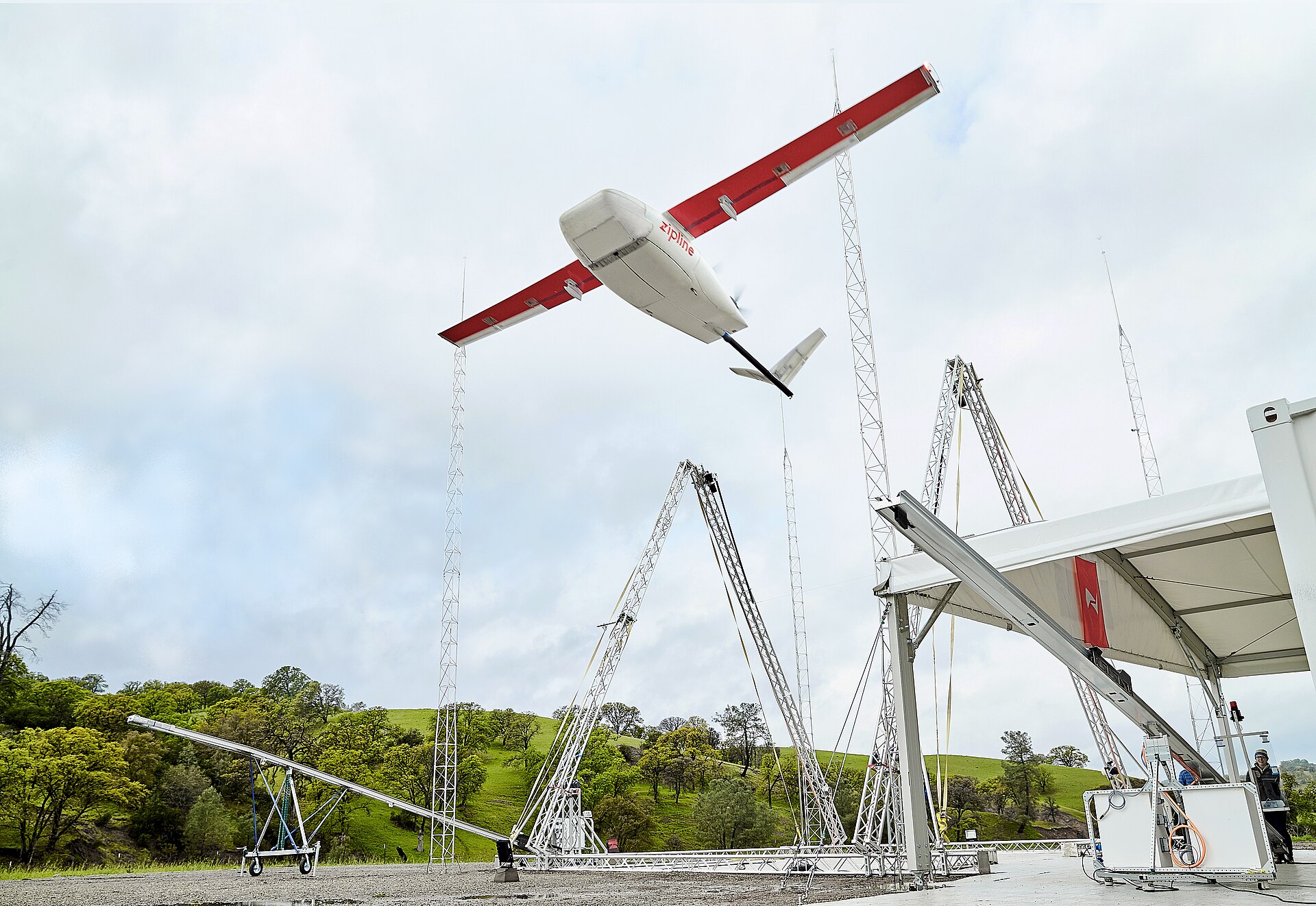
The FAA is blunt about how badly that scales. Exemptions are issued case by case and each petition is individually assessed, which the agency concedes can be time and resource-intensive for operators. Its own summary of where the industry currently sits is the best line in the whole 180-page proposal.
What Part 108 Would Change
The proposed rule is 180 pages long and it rebuilds the structure rather than extending Part 107. Two tiers of authorisation: an operating permit for lower-risk work — package delivery, agriculture, aerial surveying, civic interest, training, flight test, demonstration and recreation, within limits on size and number of aircraft — and an operating certificate for operations above those thresholds, which brings a required safety management system and a formal training programme.
The most startling piece is what it does to the pilot. Under Part 108 as proposed, the FAA would not require airman certificates at all. Instead every operator, permitted or certificated, must have an operations supervisor with operational control of the whole operation, and qualified flight coordinators with tactical oversight of individual aircraft. The agency’s reasoning is that responsibility should sit with the company running the operation rather than with an individual who may have limited control over it and can be removed from the role.
Aircraft would be approved through a new airworthiness acceptance process built on industry consensus standards, for unmanned aircraft weighing not more than 1,320 pounds including anything attached or carried. Maintenance personnel would not be certificated; the manufacturer would set the standards. And a companion Part 146 would certificate Automated Data Service Providers — the third parties supplying strategic deconfliction and conformance monitoring, services the proposal makes mandatory for several categories of BVLOS flight.
What a scaled beyond-line-of-sight delivery operation looks like in practice today.
Where the Rule Actually Is
Here is the honest status, because a great deal of confident commentary gets it wrong. The notice of proposed rulemaking was published on 7 August 2025 at 90 FR 38212. The comment period closed on 6 October 2025 and a request to extend it was denied on 29 September. The FAA then reopened comments on 28 January 2026, narrowly, on electronic conspicuity and right-of-way only, closing them again on 11 February 2026 and denying a further extension the day before.
Since then, nothing. As of mid-November 2026 no final rule has been published in the Federal Register. Part 108 is a proposal, and anyone planning a business on the assumption that it is law is planning on a document that does not yet exist.
Which leaves the two regimes that are real. One of them asks you for a free online test and a $5 registration. The other asks for a knowledge exam and recurrent training every two years. The thing that decides which applies is not your invoice. It is what the flight was for.
Sources: 49 U.S.C. 44809; 14 CFR 48.15, 48.30, 48.100, 48.105 and 48.205; 14 CFR 107.29, 107.31, 107.39, 107.51, 107.61, 107.65 and 107.205, via the Electronic Code of Federal Regulations; FAA Recreational Flyers guidance; 90 FR 38212, 91 FR 3695 and 91 FR 5880, Federal Register.
0 Comments