
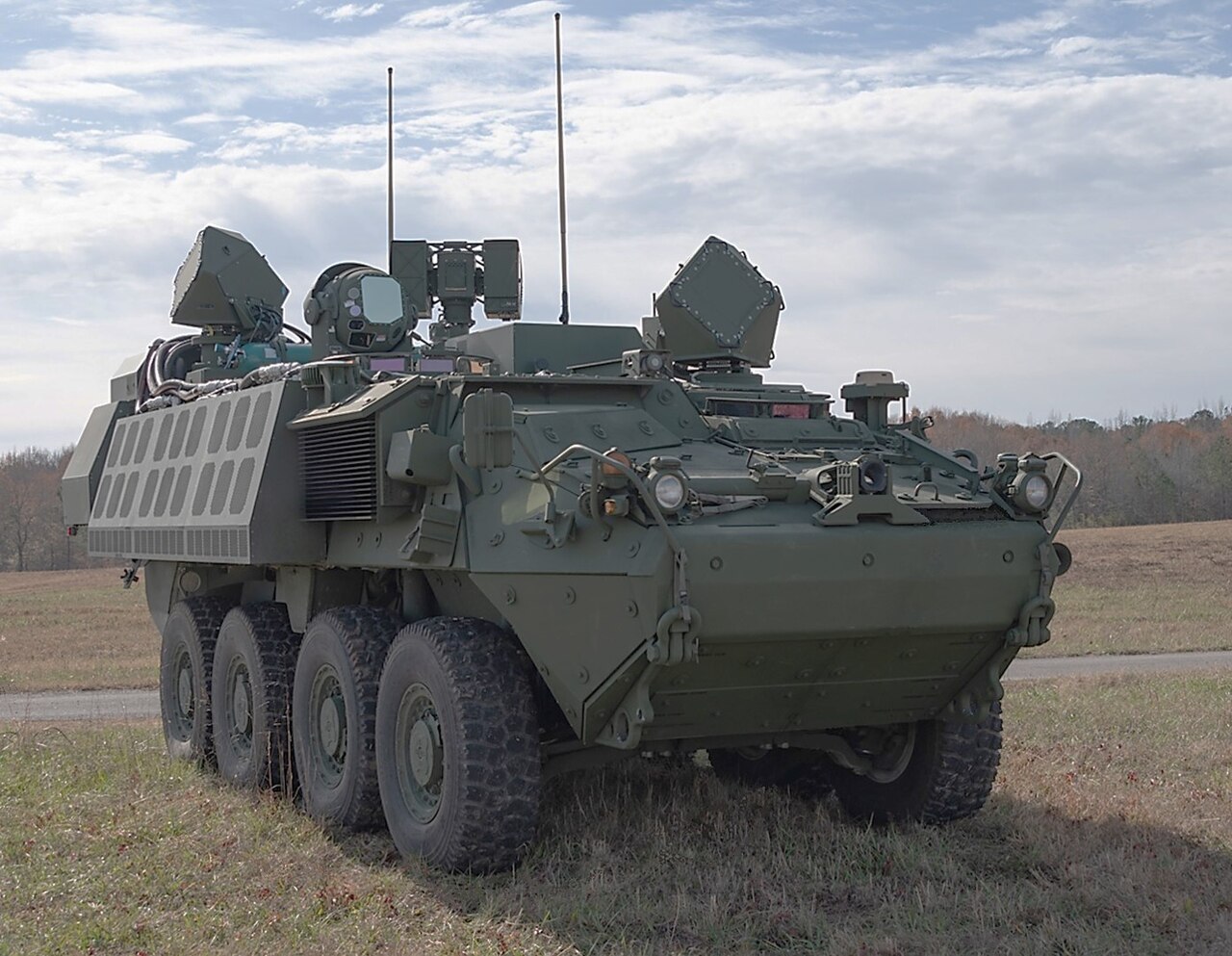
Since 25 August, a US Army laser has been burning cartel drones out of the sky over the Rio Grande Valley. Eleven of them in ten days. Each shot costs about three dollars.
Military officials told CBS News that drone traffic in the sector has since fallen by roughly 75 percent. It is the most striking counter-drone claim made on the southern border this year, and the officer who made it would not say what it is 75 percent of.
Both halves of that matter.
Informations clés
| Système | Army Multipurpose High Energy Laser (AMP-HEL), based on AeroVironment’s LOCUST |
| Mounting | Vehicle-mounted, aimed from inside using a tablet display and an Xbox controller |
| En service depuis | 25 August 2026, Joint Task Force-Southern Border |
| Drones destroyed | 11 between 25 August and early September |
| Cost per shot | About $3, per AeroVironment |
| Cost per unit | $17.4 million to $25 million, per budget documents cited by Laser Wars |
| Production contract | $464.8 million awarded to AeroVironment on 2 September for the 30 kW LOCUST X3 |
| Claimed effect | Cartel drone flights down roughly 75 percent |
| Baseline for that figure | Not published |
Why burning a drone beats jamming it
Joint Task Force-Southern Border has stopped around 300 cartel-linked drones since 1 January, most of them by jamming. Jamming works, in the narrow sense that the drone goes away. The trouble is where it goes.
A jammed quadcopter flies home and comes back tomorrow night. Soldiers tracked one drone passing the same overlook on the Rio Grande three times. These are not weapons; they are spotters, cheap airframes flown repeatedly to map where agents are so that smugglers can be somewhere else.
His point is an accounting one as much as a tactical one. A destroyed drone is a drone the cartel has to buy again. Lt Col Ray Richards of the Massachusetts National Guard’s 211th Military Police Battalion put it in those terms directly, saying that disruption to the cartels is a huge part of the story.
For the first time in this particular fight, the defender is also paying less per engagement than the attacker. A three-dollar shot against a consumer quadcopter inverts the economics that have made small drones so effective everywhere else in the world.

The three dollars is real. It is also the wrong number.
Three dollars per shot is a genuine figure and a slightly misleading one, because it is the marginal cost of the photons rather than the cost of the weapon. Budget documents cited by the directed-energy newsletter Laser Wars put a single unit at between $17.4 million and $25 million.
The Army has decided that is worth it. On 2 September it awarded AeroVironment a $464.8 million production contract for the 30-kilowatt LOCUST X3, the first production contract for a laser weapon in US military history. That is the real story underneath the border numbers, and it is why the border numbers are about to be scrutinised very carefully.
Lasers also have a weather problem that no amount of funding fixes. Rain and water vapour scatter the beam and cut the power reaching the target. Admiral Daryl Caudle, the Chief of Naval Operations, argued in a Washington Post opinion piece published the same day as the Army contract that lasers should be understood as an additional layer with known limits, not a replacement for interceptor missiles.
Seventy-five percent of what
Colonel Felicio declined to give CBS News the daily drone count his brigade recorded before 25 August, or the count after it. Officials also volunteered that the drop might reflect cartels rerouting around the Rio Grande Valley rather than flying less.
The scale of the underlying problem is genuinely unclear. In March 2024, General Gregory Guillot, then commanding US Northern Command, told the Senate Armed Services Committee that border drone incursions probably exceeded a thousand a month while conceding nobody knew the real figure. Border Patrol testimony from 2023 put the Rio Grande Valley sector alone above 10,000 incursions in a year.
A 75 percent reduction from a thousand a month is a transformative result. A 75 percent reduction from a few dozen a night in one sector is a good fortnight. The military has not said which it is measuring, and a command that has publicly said it cannot count the threat is in an awkward position claiming a precise reduction in it.
From shooting balloons to eleven kills
Seven months ago this programme was a liability. In February the FAA closed El Paso International Airport’s airspace after a laser at Fort Bliss fired at what turned out to be metallic balloons. Two weeks later the same system shot down a Customs and Border Protection drone near Fort Hancock, because CBP had not told the Pentagon it was flying.
The route from there to here ran through a joint safety test at White Sands in March and an FAA clearance in April allowing the military to operate anti-drone lasers in US airspace under a signed agreement. Officials now say they check FAA requirements before and after every shot. What that means in practice, and which airspace is restricted for how long, has not been published.
CBS News on the February 2026 incident, when the same programme shot down a Customs and Border Protection drone near Fort Hancock.
One more number gives the programme its justification. A report from the DHS-funded National Counterterrorism Innovation, Technology, and Education Center documented 221 cartel drone attacks inside Mexico between 2021 and 2025, which killed 77 people. Around 8,000 US service members are posted along the border, close enough to the launch points that officers walked reporters to an overlook to show them.
Eleven drones down, and neither Washington nor Mexico City will say which side of the river they fell on.
Foire aux questions
What is the AMP-HEL laser the US Army is using on the border?
How much does it cost to fire a military laser?
Has the laser actually reduced cartel drone flights?
Why destroy a drone instead of jamming it?
Do laser weapons work in bad weather?
Has a military laser ever shot down the wrong thing?
Sources: CBS News; DroneXL; Breaking Defense; AeroVironment; Laser Wars; The Washington Post; National Counterterrorism Innovation, Technology, and Education Center; Senate Armed Services Committee testimony.



0 Comments