
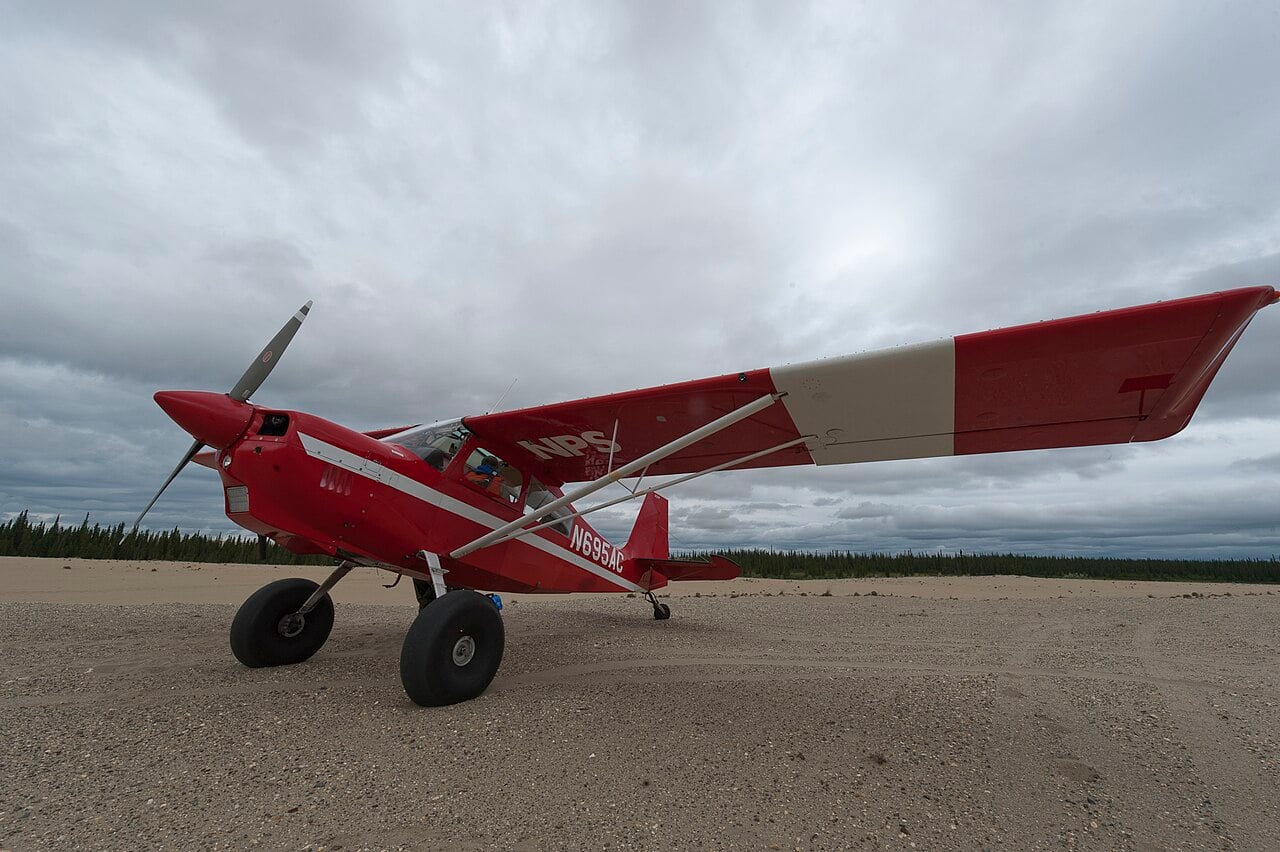
Pioneer Field sits at sea level on the edge of Prince William Sound, and every May a steady breeze rolls in off the water. On 12 May 2018 that breeze was blowing 12 to 15 knots straight down the runway when Frank Knapp lined up a yellow, slat-winged Piper Cub that weighs about as much as a large motorcycle. He opened the throttle. The tail came up. Eleven feet later, the main wheels left the ground.
Eleven feet. That is shorter than a parking space. It is the shortest takeoff ever recorded at the Valdez Fly-In STOL competition, the event a FLYING magazine writer once called the grandfather of every short-takeoff contest since, and it is the number people mean when they ask what plane has the shortest takeoff distance.
The honest answer is more interesting than a single figure, because the question hides three different questions. What can a stripped-down competition aircraft do into a strong headwind? What does a manufacturer promise in the pilot’s handbook, with no wind and a full load? And what does an airliner need, with an engine failure factored in? The gap between those answers runs from eleven feet to more than two kilometres, and understanding why is the whole story.
Informations clés
- Shortest recorded competition takeoff: 11 ft (3.4 m), Frank Knapp, Valdez 2018, in a heavily modified 1939 Piper Cub weighing roughly 800 lb (360 kg)
- Shortest recorded competition landing: 9 ft 6 in (2.9 m), Dan Reynolds, Valdez 2018, in a Birdman Chinook
- Shortest factory ground roll on this list: Zenith STOL CH 701, 50 ft (15 m) with a 100 hp Rotax, at 1,100 lb gross, sea level, no wind
- Cessna 172S for comparison: 960 ft (293 m) ground roll, 1,630 ft (497 m) to clear a 50 ft obstacle
- Airbus A220-100: roughly 1,500 m (4,900 ft) of takeoff field length at maximum weight
- Headwind rule of thumb (FAA): a headwind equal to 10 percent of takeoff speed cuts the takeoff distance by about 19 percent; a headwind of 50 percent cuts it by about 75 percent
Eleven feet at Valdez
Knapp’s aircraft is called Lil Cub, and calling it a Piper Cub is a courtesy. The fuselage started life as a 1939 J-3. Everything else has been rethought: leading-edge slats, oversized flaps, tundra tyres on custom gear, and a 180-horsepower Lycoming O-320 in an airframe that Knapp told AOPA now weighs about 800 lb. It began, he said, at 685 lb with an 85-horsepower engine, and he has been adding power and shedding compromise ever since.
The same weekend, Dan Reynolds of Dawson City in the Yukon put a Birdman Chinook down in 9 ft 6 in, breaking Knapp’s own landing mark of 10 ft 5 in from the year before. Knapp’s 2017 performance, a 14 ft 7 in takeoff and 10 ft 5 in landing, still stands as the lowest combined score in the event’s history. A takeoff figure of 13 ft 8 in circulates in video titles as a record; it was in fact one of his 2017 landings, and it belongs in the landing column.
The judging is deliberately low-tech. The competition rules measure a takeoff from a reference line to the point where the furthest main wheel leaves the ground for the last time; the tailwheel has not counted since 2017. Landings are measured from the line to the main gear after a full stop. Each pilot gets two cycles and the best combined takeoff-plus-landing distance wins. There are no lasers or timing gates, just painted lines and officials with quick feet.
Joe Prax, the president of the Valdez Fly-In, has been candid about why the records fall here and nowhere else. Pioneer Field is at sea level, the air is cool, and there is a reliable sea breeze that pilots can fly in. In 2017 it blew a steady 15 knots. In 2018 it was slightly weaker, and AOPA noted at the time that this could have affected the results even as two records fell.
That last point matters more than any engine modification. For an aircraft whose stall speed is well under 30 mph, a 15-knot headwind is more than half of its takeoff airspeed. The FAA’s own performance handbook says a headwind equal to half your takeoff speed reduces the ground roll by roughly three quarters. An eleven-foot takeoff is not a trick; it is physics doing exactly what the handbook says it will do, in an aeroplane built to exploit it.
Why a headwind is worth more than horsepower
Takeoff distance is governed by one stubborn relationship: it scales with the square of liftoff speed. The FAA Pilot’s Handbook of Aeronautical Knowledge puts it plainly: assuming acceleration is unaffected, ten percent excess airspeed increases the takeoff distance by 21 percent. Halve the speed you need and, all else being equal, you quarter the runway you need.
Liftoff speed, in turn, is set by wing loading and lift coefficient. That is why every serious STOL machine looks the way it does. Slats and drooping ailerons let the wing keep flying at absurdly high angles of attack. Enormous flaps add lift. Everything that can be removed from the airframe is removed, because the handbook also notes that a ten percent increase in gross weight costs at least a 21 percent increase in takeoff distance. Lil Cub’s 800 lb is not vanity; it is the design.
Then comes wind, which is free speed. The handbook’s rule of thumb is that a headwind equal to ten percent of takeoff airspeed reduces takeoff distance by about 19 percent, while a tailwind of the same size adds about 21 percent. Push the headwind to 50 percent of takeoff speed and the ground roll shrinks to about a quarter of its zero-wind length. This is the quiet reason competition figures and factory figures can never be compared directly: the factory quotes still air, and the competition prays for a gale.
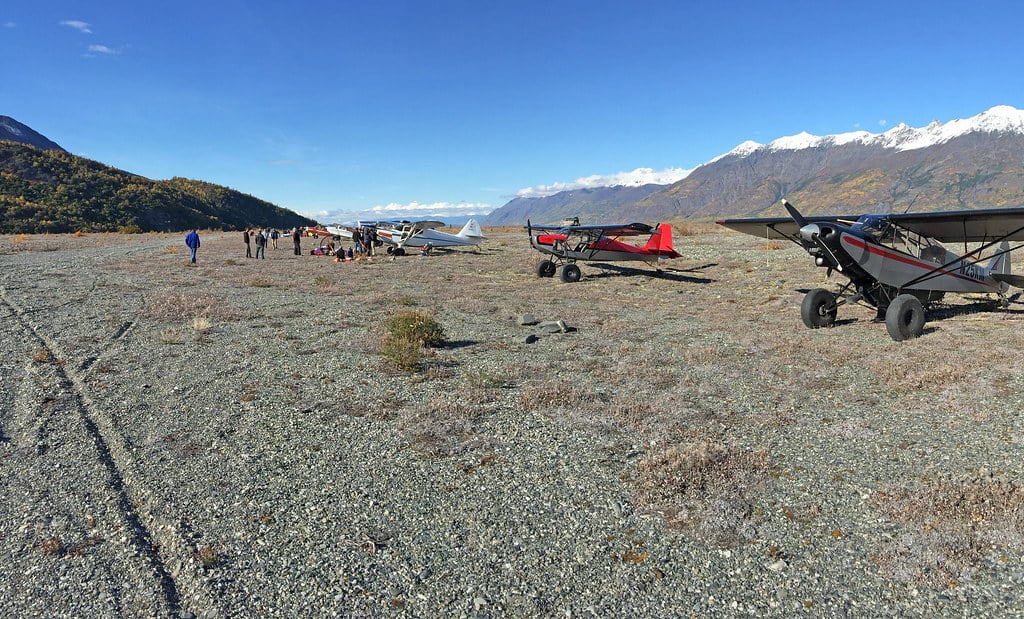
Surface matters too. The FAA notes that any surface that is not hard and smooth lengthens the ground roll. That is why Alaska’s bush pilots run tundra tyres the size of tractor wheels: they are not for show, they are for rolling over river rock that would otherwise eat the acceleration a short strip cannot spare.
The factory numbers, and why they disagree with each other
Manufacturers publish takeoff figures in one of three currencies, and mixing them is how most internet comparisons go wrong. Ground roll is the distance from brake release to wheels-off. Distance over a 50-foot (15 m) obstacle adds the climb to clear a tree line. Takeoff field length, used for airliners, includes the margin to stop or continue after an engine failure at the worst possible moment. Each is a bigger number than the last.
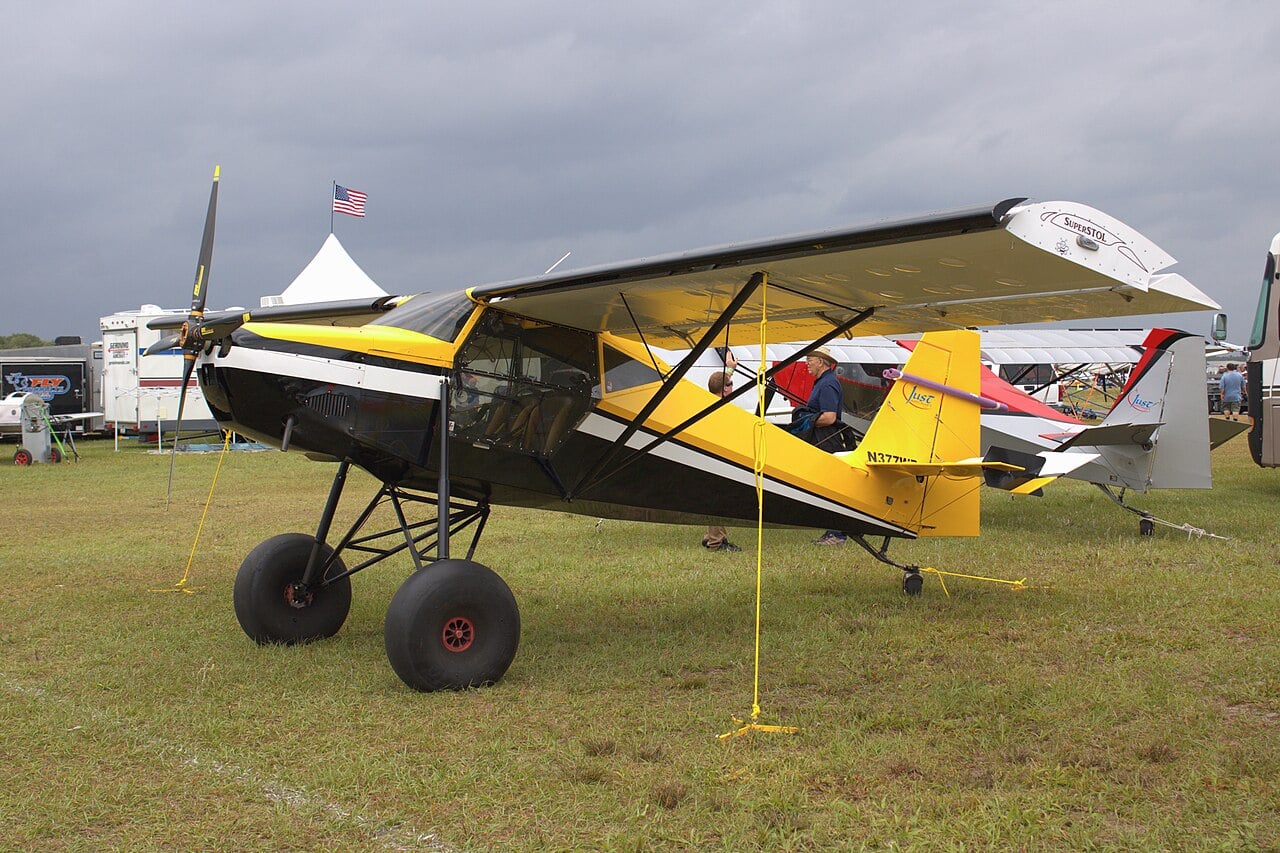
In the ground-roll league, the kit and light-sport STOL designs sit at the bottom. Zenith quotes a 50 ft (15 m) takeoff roll for its STOL CH 701 with a 100 hp Rotax 912S at 1,100 lb gross weight, sea level, standard atmosphere and no wind. CubCrafters lists a 60 ft takeoff for the Carbon Cub SS at 1,320 lb in what it calls optimal conditions, and a demonstrated 90 ft for the more powerful FX-3, though that figure comes with half fuel and a single 190 lb pilot aboard, well below gross. Just Aircraft says its SuperSTOL can take off or land in as little as 150 ft, and Kitplanes reported ground rolls of 200 ft or less as routine at gross weight.
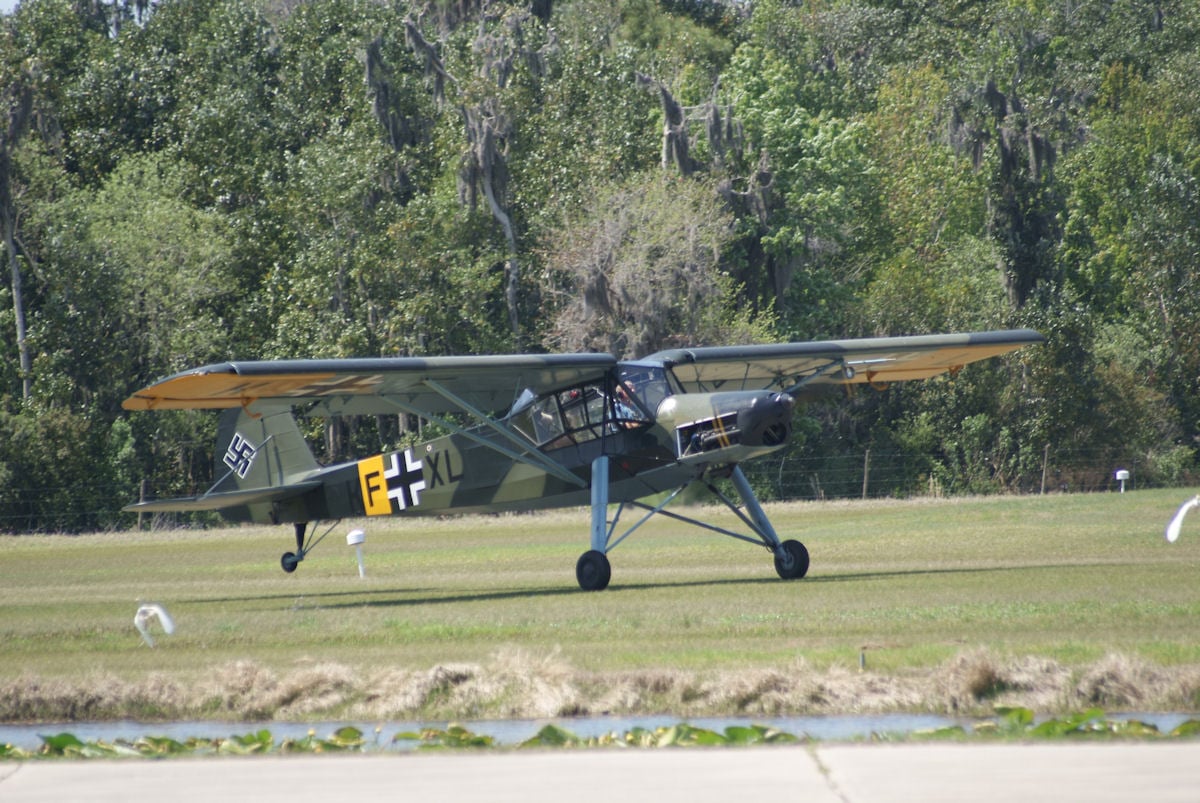
The grandfather of all of them is the Fieseler Fi 156 Storch, the German Second World War liaison aircraft with full-span slats and a stall speed the National Museum of the US Air Force puts at 32 mph. Published figures of around 50 m into a headwind for takeoff are widely repeated and plausible for such a wing, though they come from secondary sources rather than a surviving factory handbook, so treat them as approximate. The Storch is why every modern bush plane has slats: the idea has been proven since 1936.
Move up to certified utility aircraft and the numbers grow, partly because the metric changes. Pilatus quotes 440 m (1,444 ft) for the PC-6 Porter to clear a 15 m obstacle at its 2,800 kg maximum weight. Viking lists 366 m (1,200 ft) to 50 ft for the DHC-6-400 Twin Otter in STOL configuration at 12,500 lb, or 454 m under the stricter certification rules most operators fly to. A stock Cessna 172S needs 960 ft of ground roll and 1,630 ft over the obstacle at 2,550 lb, which makes it a useful yardstick: the Zenith 701 leaves the ground in about five percent of the distance a Skyhawk uses.
Jets are a different sport again. Cirrus publishes 1,910 ft (582 m) of takeoff distance for the Vision Jet and 2,815 ft (858 m) over the 50 ft obstacle at its 6,000 lb maximum weight. Airbus brochure data for the A220-100 puts its takeoff field length at roughly 1,500 m (about 4,900 ft) at maximum weight, which is why the type has become the airliner of choice for short-runway city airports. An A320neo at maximum takeoff weight needs on the order of 2,000 m. The A220 is a short-field airliner in the way a Twin Otter is a short-field bush plane: relatively, and impressively, but nobody is landing one on a gravel bar.
Where a short takeoff is not a hobby
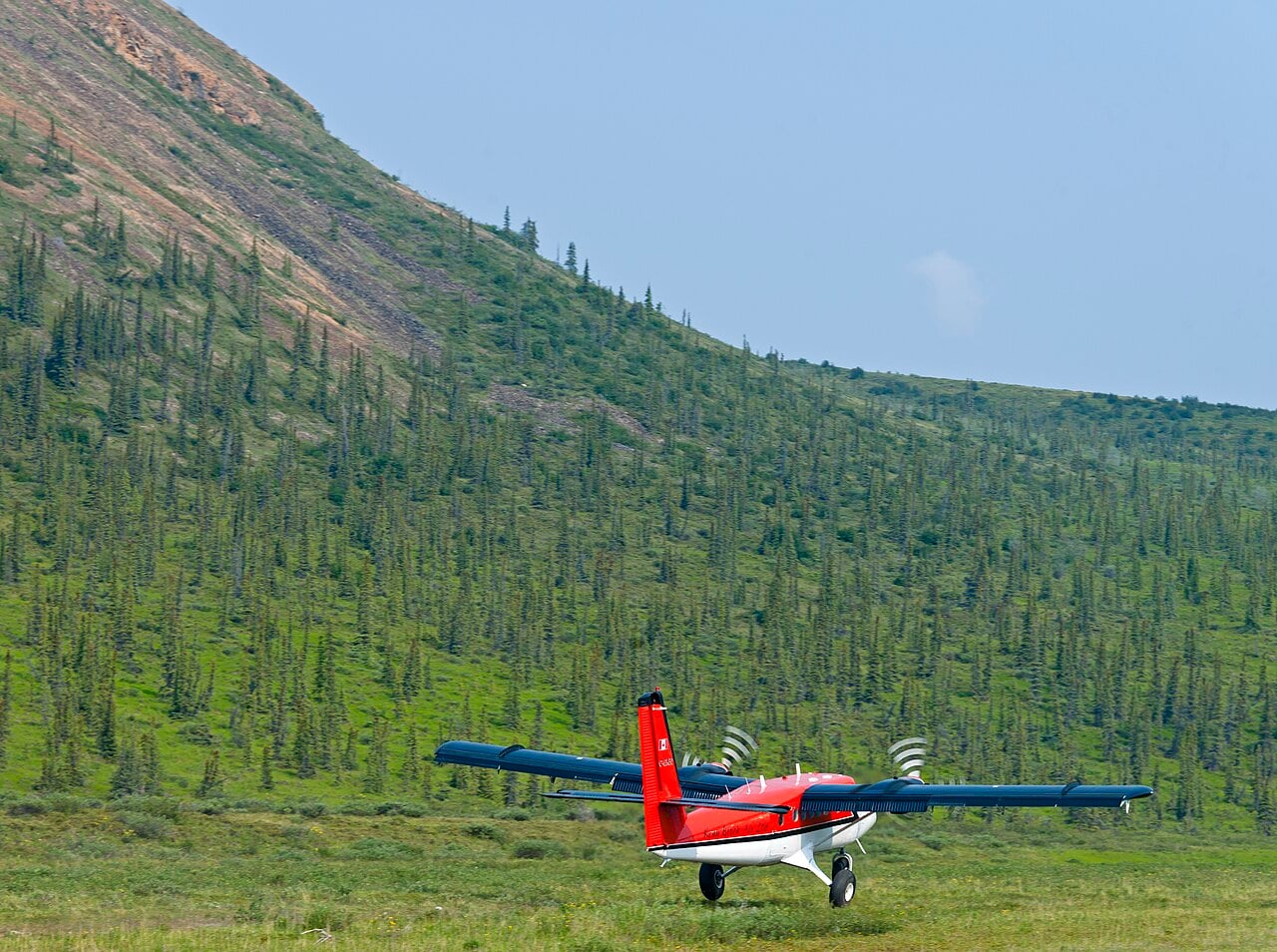
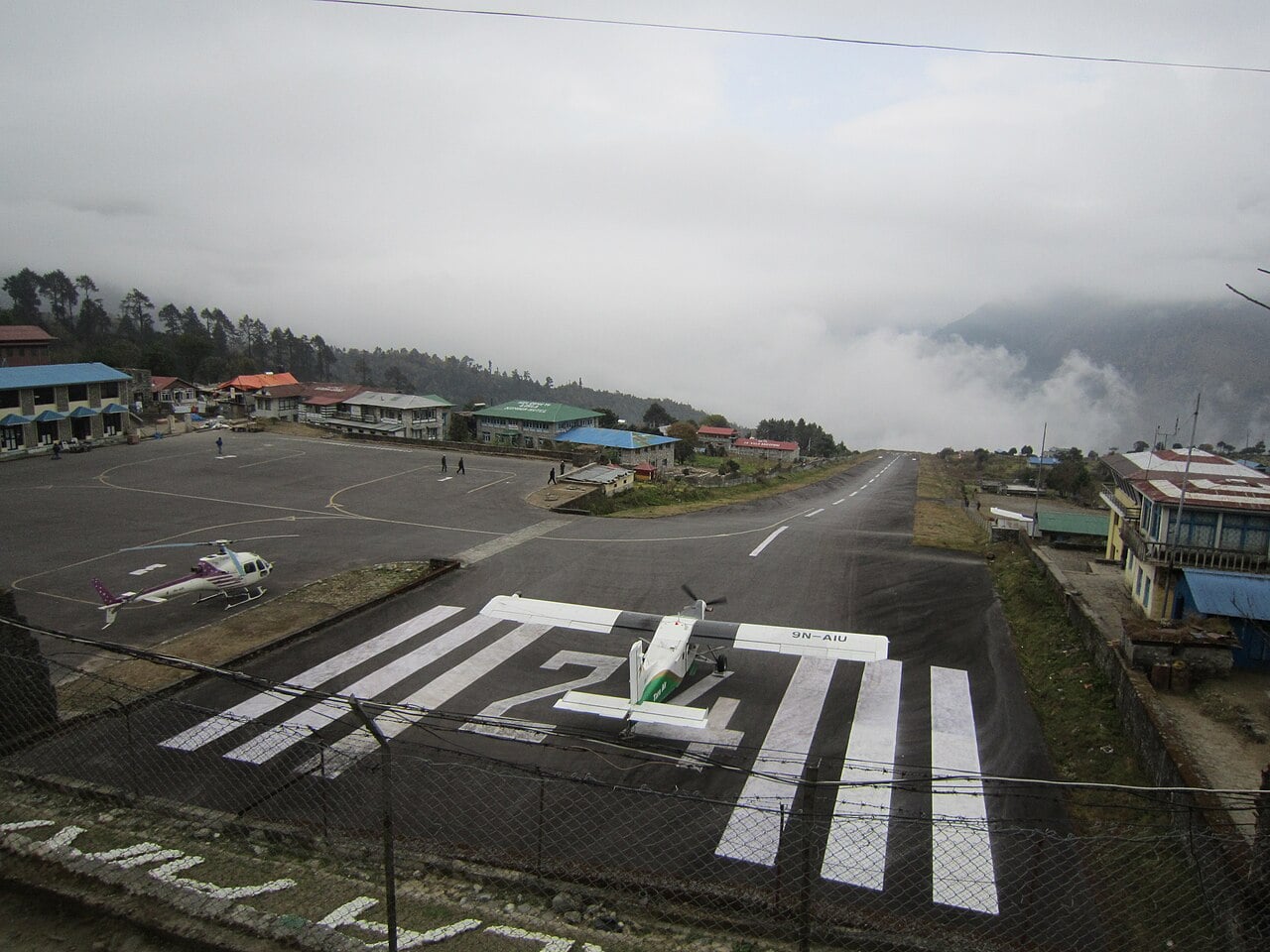
Outside Alaska, short takeoff performance is what keeps whole regions connected. Lukla’s Tenzing-Hillary Airport in Nepal, the gateway to Everest, has a runway of about 527 m with an 11.7 percent slope, high terrain at one end and a drop at the other. Its traffic has been Twin Otters, Dornier 228s and PC-6 Porters, because little else can use it. In the Canadian Arctic, the Twin Otter is still the aircraft that lands on sea ice and gravel bars to move people and fuel. In Papua New Guinea, PC-6 Porters fly into strips carved out of hillsides.
In Alaska, it is the ordinary texture of life. Paul Claus, who runs a wilderness lodge deep in the Wrangell mountains and has flown at Valdez for years, told Air & Space magazine that the competition is the only time all year he lands on pavement. Bush pilots like Kirk Ellis, with around 20,000 hours, described making 50 takeoffs and landings in a single day. The contest is a performance, but the skills it rewards are the skills that put hunters, geologists and groceries onto sandbars every week of the summer.
The community has also learned the cost of chasing the edge. Mike Patey’s Draco, a PZL Wilga rebuilt around a 680-horsepower turboprop, was the most spectacular STOL aircraft of its era and a crowd magnet at Oshkosh. It was destroyed in a September 2019 takeoff accident in gusting crosswinds at Reno-Stead. Patey and his passengers walked away, and the aircraft became a cautionary tale about the fact that short-field performance is only useful when the wind is doing what you expect.
STOL has meanwhile grown into a spectator sport of its own. Kevin Quinn’s STOL Drag format puts two aircraft side by side on a 2,000 ft course: take off, land past a line, stop with the tail down, turn around, fly back, and stop again. The first aircraft to come to a complete halt wins. In 2020 it became the first new class added to the Reno National Championship Air Races in about two decades.
So which aircraft has the shortest takeoff distance?
If the question means the shortest takeoff ever recorded under competition rules, the answer is Frank Knapp’s Lil Cub, eleven feet at Valdez in May 2018, into a 12 to 15 knot sea breeze, in an aircraft flown far below any gross weight a manufacturer would quote. If it means the shortest factory-published ground roll for something you can actually buy and build, the Zenith STOL CH 701 at 50 ft and the Carbon Cub family at 60 to 120 ft lead the field, with the caveat that CubCrafters’ demonstrated figures use light loads.
If it means the shortest takeoff for a certified aircraft that earns its living, the Twin Otter and the PC-6 Porter are the practical answers, and Lukla is their proof. And if it means airliners, the A220-100 at around 1,500 m is the short-field champion of the jet age, which tells you how differently the word short is used once you add passengers and a second engine to lose.
The thread running through all of them is the same equation. Distance goes with the square of speed; speed goes with weight and wing; wind is free speed. Get all three on your side, on a cool morning at sea level with the breeze in your face, and the runway you need is shorter than the aeroplane.
Above: a Fieseler Fi 156 Storch demonstrates the short-field takeoff and landing that made it the template for every STOL design since, filmed at an airshow display in 2014.
Foire aux questions
What plane has the shortest takeoff distance?
Is the 13 ft 8 in Valdez takeoff record real?
Why are Valdez STOL distances so much shorter than manufacturer figures?
How much does a headwind reduce takeoff distance?
What is the difference between ground roll and takeoff distance over a 50 ft obstacle?
What is the shortest takeoff airliner?
How short a runway can a Twin Otter use?
What is STOL Drag racing?
Sources: Valdez Fly-In Association competition rules; AOPA (Mike Collins, 2017 and 2018 Valdez reports); Air & Space/Smithsonian; FAA Pilot’s Handbook of Aeronautical Knowledge, Chapter 11; Zenith Aircraft; CubCrafters; Just Aircraft; Kitplanes; Pilatus Aircraft; Viking Air; Cessna (Textron Aviation); Cirrus Aircraft; STOL Drag; Reno Air Racing Association; National Museum of the US Air Force.
0 Comments