
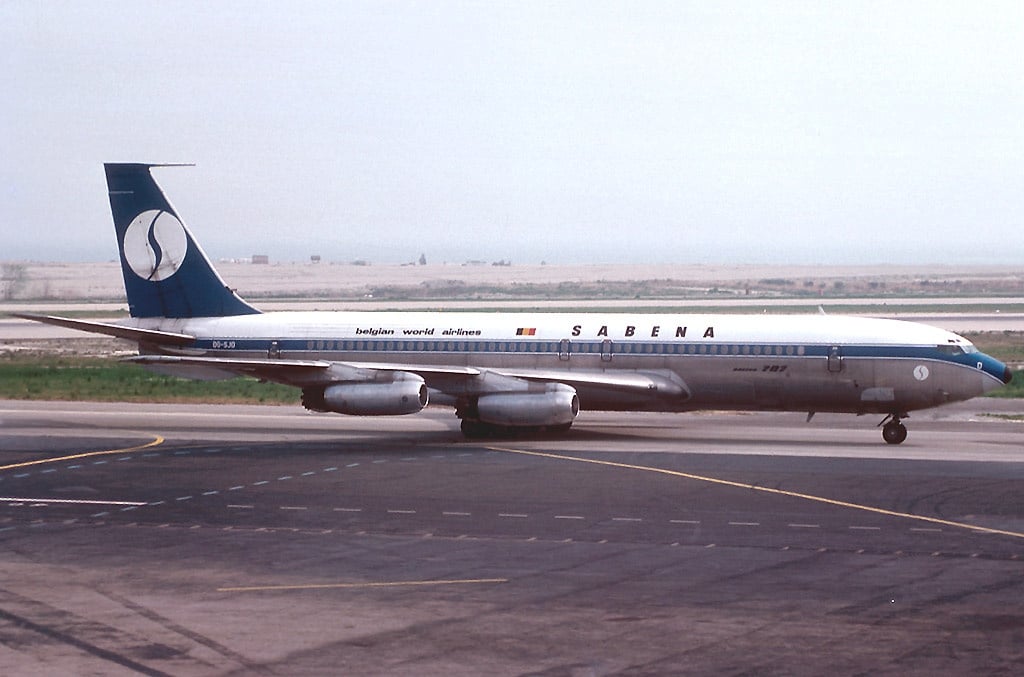
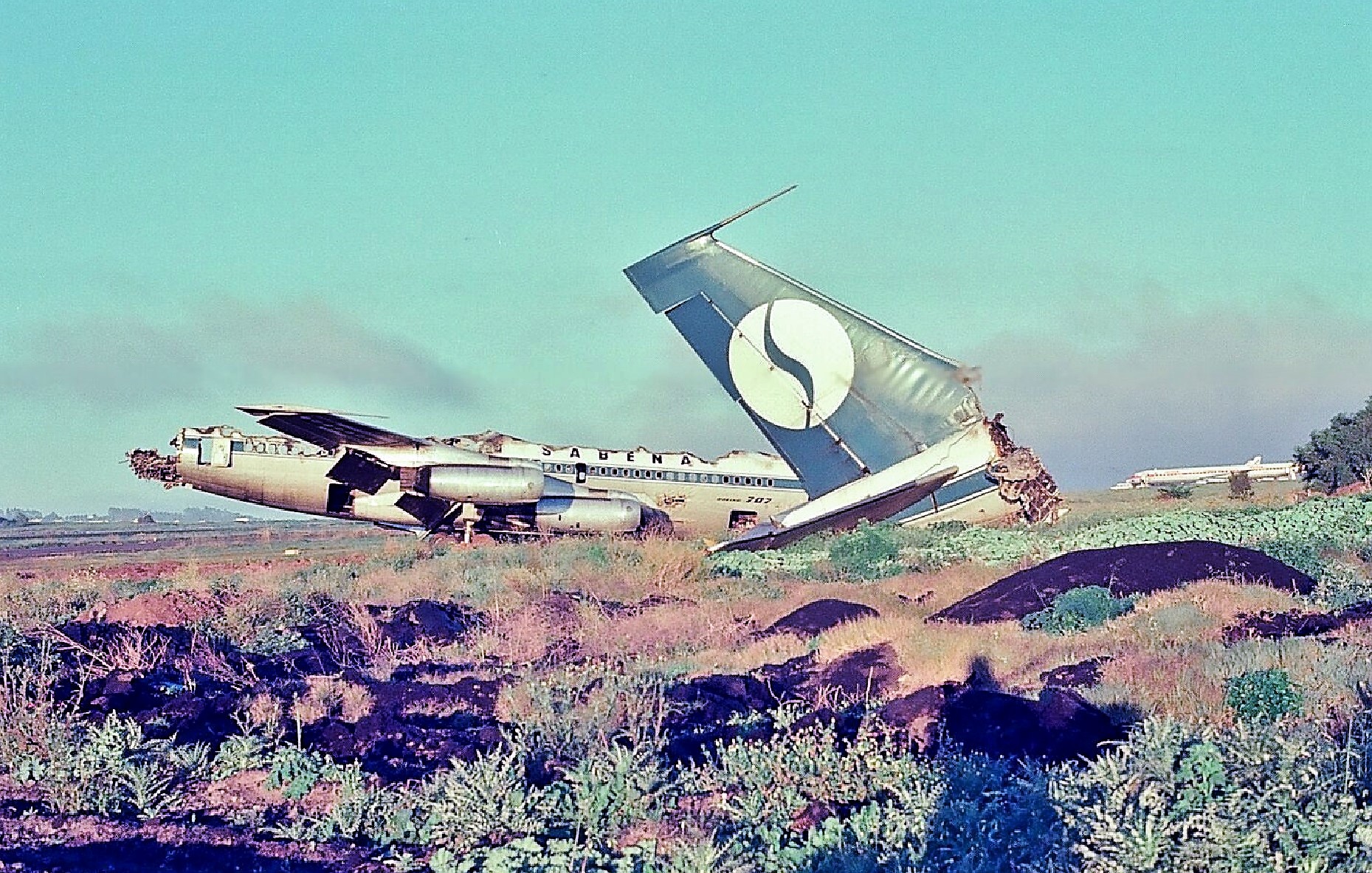
On the morning of 15 February 1961 a Sabena Boeing 707 came out of a clear sky over Belgium, circled Brussels airport three times while its crew fought it, and fell into a field at Berg, less than two miles short of the runway.
Seventy-two people on board were killed, and a farmer working in the next field was killed by flying debris.
Among the dead were eighteen young Americans who made up the entire United States figure skating team.
Informations clés
Vol: Sabena 548, Idlewild Airport, New York, to Brussels Zaventem
Aéronef: Boeing 707-329, registration OO-SJB
Date and time: 15 February 1961, impact at 10:05 Brussels time
À bord : 72 — 61 passengers and 11 crew. There were no survivors
Par terre: one man killed by debris, a second seriously injured
Flight crew: Louis Lambrechts, 43, with 15,384 flying hours, and Jean Roy, 48, with 16,231 hours — both former military pilots
Weather: clear
Cause: never definitively established. Investigators concluded a flight-control failure was most likely; the FAA favoured a failure of the tail stabiliser-adjusting mechanism
Premières fois : the first fatal Boeing 707 accident in regular passenger service, 28 months after the type entered commercial use, and still the deadliest air crash on Belgian soil
The team: all 18 members of the 1961 U.S. figure skating team died, along with 16 coaches, officials and family members travelling with them
Three circuits of an airport
The transatlantic crossing had been uneventful. Seven and a half hours, no reported difficulties, although the crew lost radio contact with Brussels for roughly the last twenty minutes before the approach.
On a long final to runway 20, close to the threshold and at about 900 feet, the crew added power and raised the landing gear. A light aircraft had not yet cleared the runway, so they went around — an entirely ordinary decision.
From that moment nothing was ordinary. The 707 came round and lined up for the adjoining runway 25, which was not in operational use. That approach was abandoned too. Witnesses on the ground could see the pilots struggling with an aircraft that was not doing what they wanted.
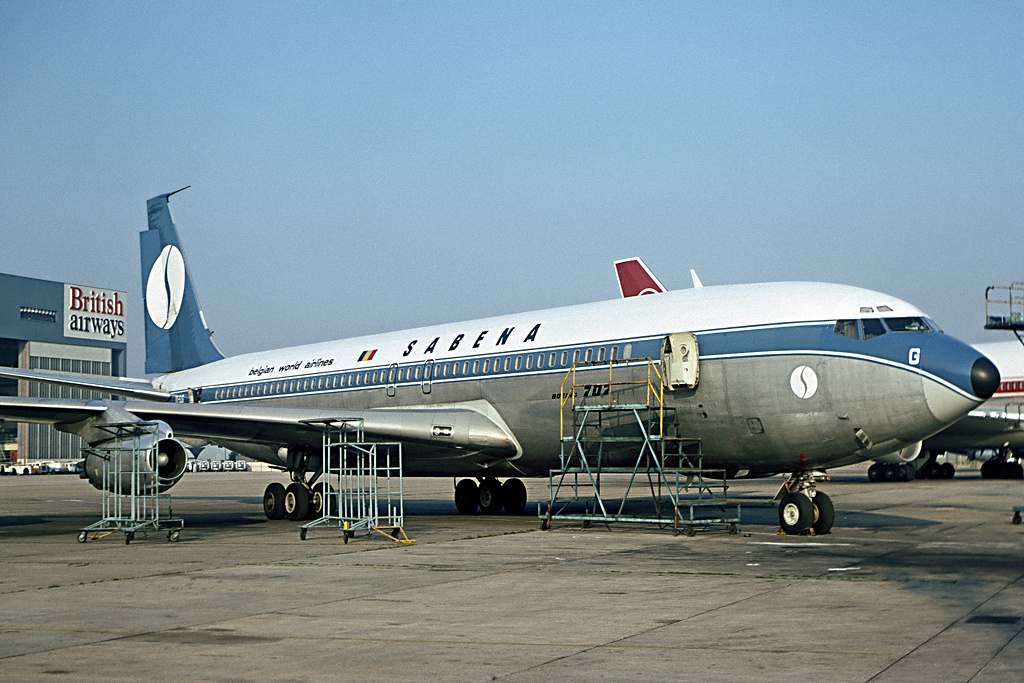
It circled the airfield three times in all. The bank angle grew steeper, the aircraft climbed to about 1,500 feet, and it ended up in a near-vertical bank. Then the wings came level, the nose pitched sharply up, the speed fell away, and the 707 spiralled into the ground nose-first.
King Baudouin and Queen Fabiola came to the site that day. They later provided oak coffins bearing the royal seal to carry the dead home.
British Pathé newsreel footage from Brussels in 1961. Silent.
What probably broke
Belgium ordered an immediate inquiry, joined by the American FAA and by ICAO. Investigators spent months on it. The FBI is reported to have considered terrorism.
No conclusion was ever proved. The consensus that emerged was a mechanical failure in the flight controls, with suspicion falling on either the wing spoilers or the tail stabiliser. The FAA’s view was that the stabiliser-adjusting mechanism had failed, letting the stabiliser run to a 10.5-degree nose-up setting.
If that is what happened, the behaviour witnesses described makes brutal sense. A horizontal stabiliser jammed well nose-up is a standing order to climb that the crew must fight continuously with the control column. You can hold it for a while. You cannot hold it for three circuits of an airport, and when the speed decays the aeroplane wins.
An entire sport, on one aeroplane
The team was flying to the World Championships in Prague. Thirty-four members of the American delegation were aboard: eighteen skaters, six coaches, the team manager, two judges, a referee and six family members. Almost half the people on the aircraft.
Maribel Vinson-Owen, nine times United States ladies’ champion and by then a coach, was travelling with both her daughters. Laurence, sixteen, was the reigning national ladies’ champion. Maribel, twenty, was the reigning national pairs champion. Both had won their titles in Colorado Springs a fortnight earlier.
Laurence Owen had appeared on the cover of Sports Illustrated dated 13 February. She died two days after it reached newsstands.
The International Skating Union polled its members the following day and cancelled the championships. The telegram from its headquarters was short, and got the number wrong in its haste.
In Washington, a president less than a month into his term issued a statement. John F. Kennedy had a personal connection: the pairs skater Dudley Richards was a friend from summers at Hyannis Port.
What was built afterwards
American figure skating had dominated the 1950s. It did not win a world medal again until 1965, and did not fully return to the top until Peggy Fleming took Olympic gold in 1968.
Fleming’s own coach, William Kipp, had died at Berg. She was twelve, and among the first beneficiaries of the memorial fund the sport set up within days of the crash. Foreign coaches — John Nicks from Britain, Carlo Fassi from Italy — came to America to fill a gap that could not otherwise be filled.
And U.S. Figure Skating issued a rule that still stands: no team travelling to an international competition may fly together. The entire sport had been on one aeroplane once, and would not be again.
A stone monument was unveiled at Berg-Kampenhout on the fortieth anniversary, close to the field where it happened.
A documentary on the 1961 United States figure skating team and the loss of Sabena 548.
A technical breakdown of the accident sequence and what investigators concluded.
Sources: Aviation Safety Network; ICAO Circular 69-AN/61 final report; Flight magazine, 24 February 1961; contemporary Associated Press and United Press International reporting; Time; ESPN; The Washington Post; U.S. Figure Skating.
0 Comments