
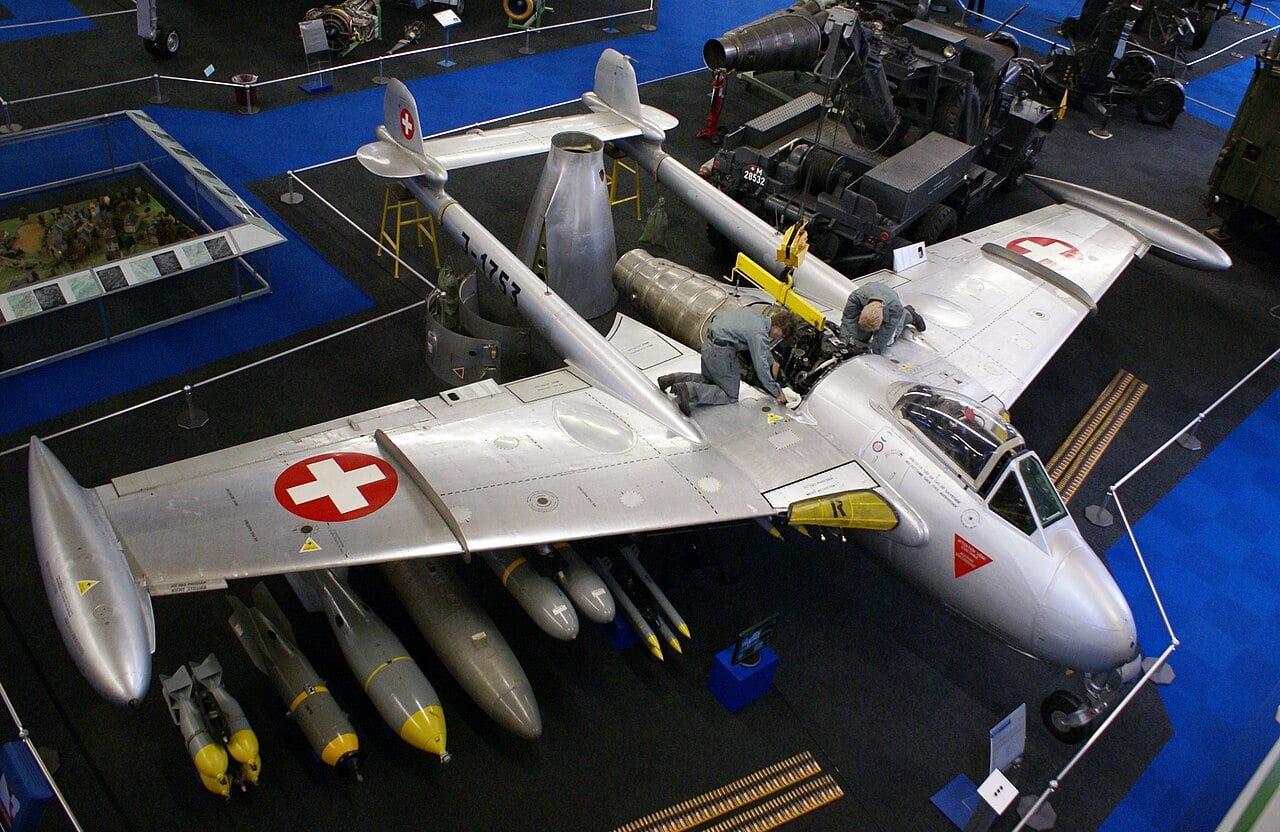
In 1971 a Swiss fighter jet landed on a motorway. Not in an emergency — on purpose, as part of a doctrine that assumed Swiss airfields would be cratered within hours of a war starting, and that the air force would therefore have to operate from public roads.
The aircraft doing it was a de Havilland Venom: a British jet with a twin-boom tail, a partly wooden structure, and a 1948 design origin. Switzerland kept flying them until 1983, long after everyone else had given up, which makes the Swiss Air Force the last military operator of the type anywhere in the world.
It is a strange distinction for an aircraft that was only ever meant to fill a gap.
Informations clés
Ce que c'était : The de Havilland DH 112 Venom, a British single-engined jet fighter-bomber derived from the Vampire
Original designation: Vampire FB 8, before the Venom name was adopted
Built to: Air Ministry Specification F.15/49, explicitly as an interim type
Moteur: de Havilland Ghost 103; the FB.4 version produced 4,850 lbf (21.6 kN)
Armement: Four nose-mounted 20 mm Hispano Mk V cannon, plus two 1,000 lb bombs or eight RP-3 rockets
RAF service: Withdrawn from front-line operations in 1962
Export customers: Iraq, New Zealand, Sweden, Switzerland and Venezuela
Swiss production: Licence-built by a consortium of Swiss manufacturers from 1953, in large numbers
Last military operator: The Swiss Air Force, which retired its final examples in 1983
An Aircraft Designed to Be Temporary
The Venom exists because Britain was caught between generations. The first British jets — the Gloster Meteor and the Vampire — had straight wings and centrifugal-flow engines. The next generation, the Hawker Hunter and the de Havilland Sea Vixen, would have swept wings and axial-flow engines. There was a gap of several years in between, and the Air Ministry wanted something to fill it.
So in 1948 de Havilland proposed a Vampire with a thinner wing and a more powerful engine as a high-altitude fighter, designated Vampire FB 8. The design drifted far enough from the original that it got its own name.
What it kept was the Vampire’s twin-boom layout and its composite wood-and-metal structure — genuinely unusual for a jet, and a direct inheritance from de Havilland’s wooden Mosquito expertise.
The Vampire, the aircraft the Venom grew out of, and the source of that distinctive twin-boom tail.
Better Than It Needed to Be
For an interim aircraft it was surprisingly good. It had a favourable rate of climb and represented a real advance over the Vampire. As a ground-attack machine it was genuinely sound: manoeuvrable, steady, with useful endurance, pleasant handling and a wide range of compatible stores.
Its manoeuvrability was good enough to give it an edge against many dedicated dogfighters of the era. The catch was speed — its limited top speed was a real weakness in air combat, which is precisely why it was an interim type and not a Hunter.
There were teething problems. A rear spar weakness had to be addressed, and under some conditions the engine intakes could ingest vented fuel and cause flash fires. Both were identified and fixed quickly.
The Wingtip Tanks That Made It Roll Better
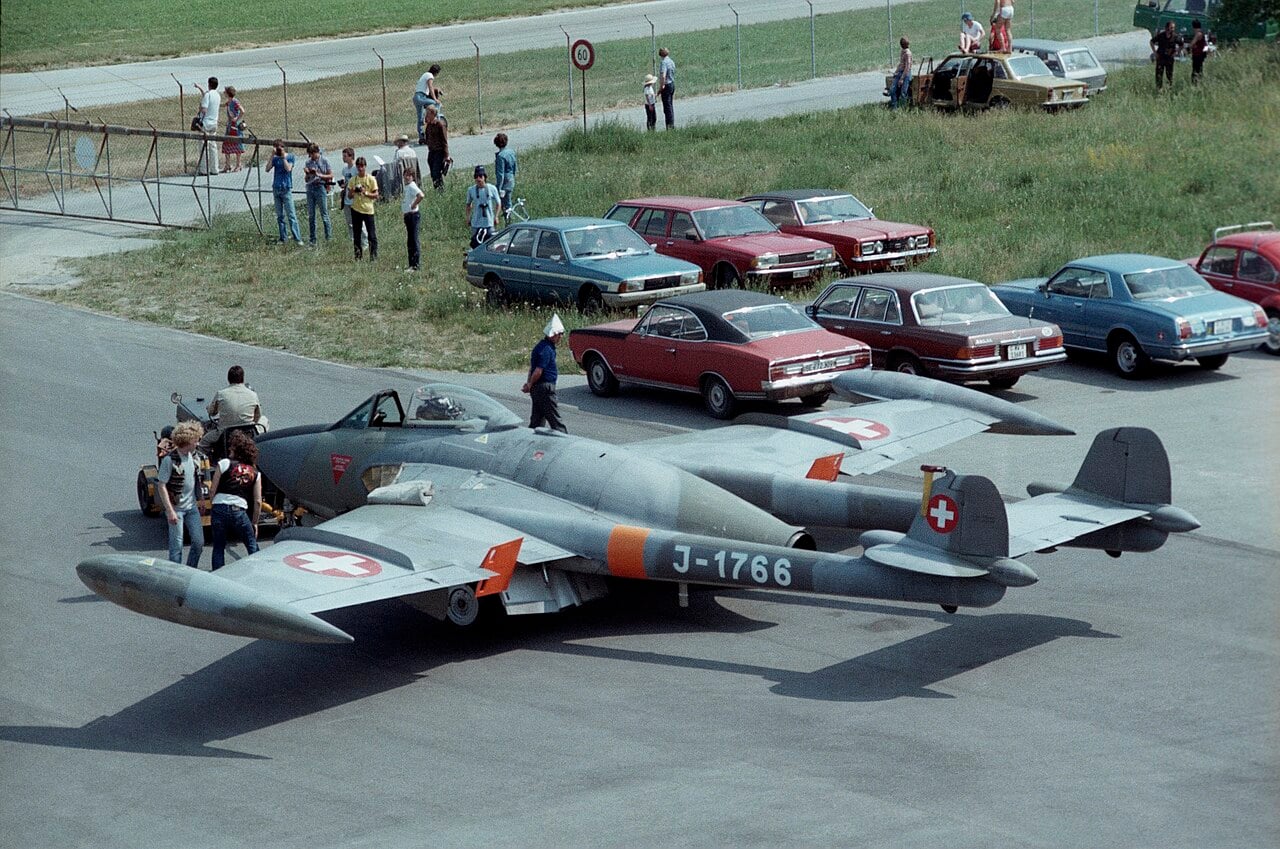
One detail is worth the price of admission. The Venom FB 1 could carry a 75 imperial gallon fuel tank on each wingtip, which freed the underwing pylons for weapons. Those tip tanks could not be jettisoned in flight, so the pilot was committed to carrying them.
You would expect weight out at the wingtips to slow the roll rate dramatically. In fact, when fitted, the tip tanks had the effect of improving the aircraft’s roll rate — the tanks acted as end plates on the wing, reducing tip losses enough to more than offset the added inertia.
Why Switzerland Kept Them for Thirty Years
Britain dropped the Venom from front-line RAF service in 1962. Switzerland flew it for another twenty-one years.
The reasons are geographic and doctrinal. A neutral Alpine country does not need a long-range interceptor; it needs an aircraft that can operate from short, dispersed strips in mountain valleys and hit things on the ground. The Venom, with its good low-level handling and heavy stores load, fitted that requirement well. Licence production at home meant spares and support were not dependent on a foreign supply chain.
The Swiss also kept modernising it. In the early 1970s their Venoms received a new extended nose to make room for a UHF radio, an IFF transponder and a SAAB BT-9K ballistic computer for ground-attack weapon delivery — a 1970s fire-control fit on a 1948 airframe.
Landing on the Motorway
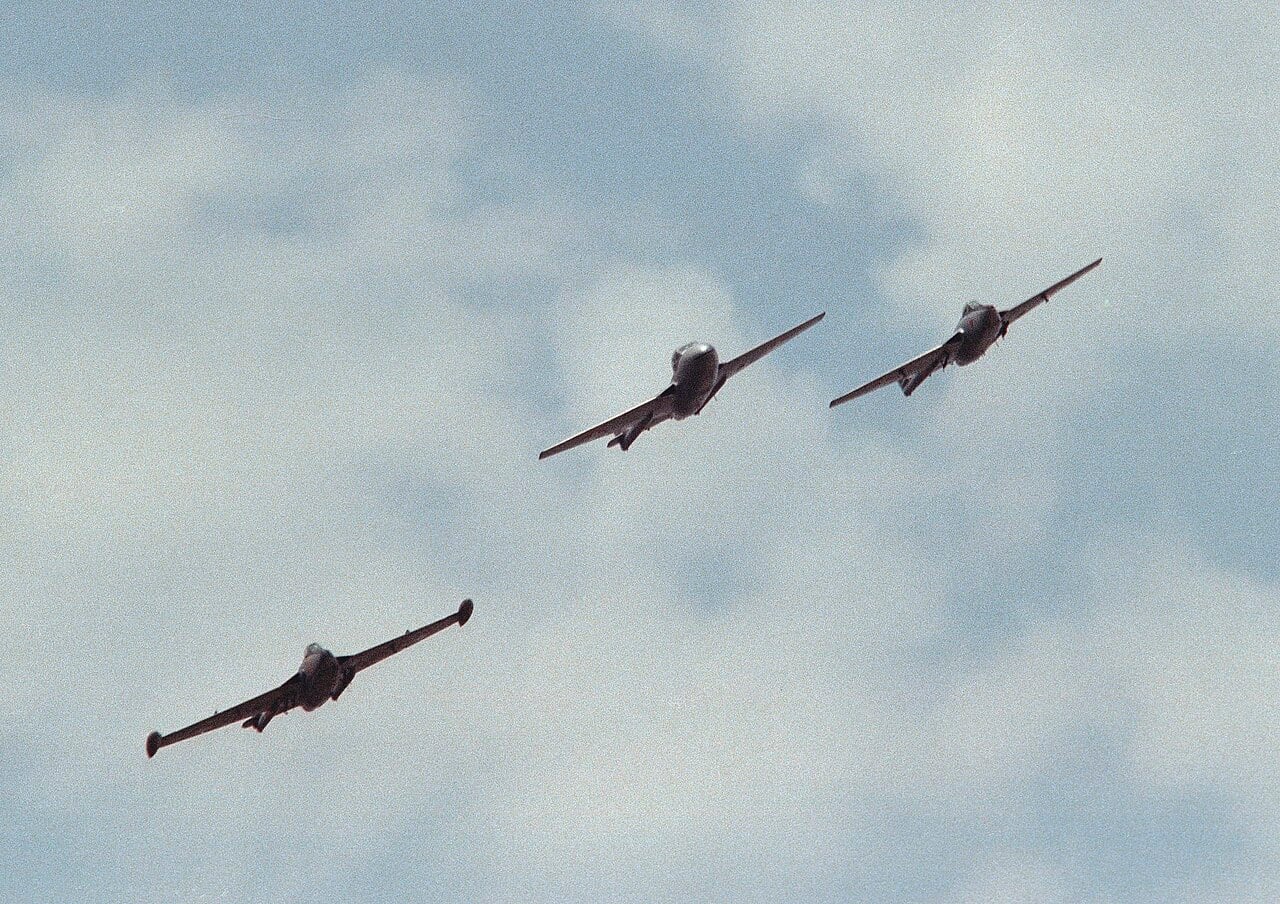
And then there is the autobahn. Swiss defence planning assumed that in a war the country’s airfields would be among the first things destroyed, so sections of motorway were built with removable central barriers and clear approaches so that they could be used as emergency runways.
Venoms practised exactly that. The footage below is from 1971 — a front-line combat jet operating from a Swiss public road, with traffic held back at either end.
Vie après la mort
Large numbers of ex-military Venoms were bought by private owners once the Swiss retired them, and several have kept flying, appearing at airshows. Many more are preserved statically in museums or sit as gate guardians outside air bases.
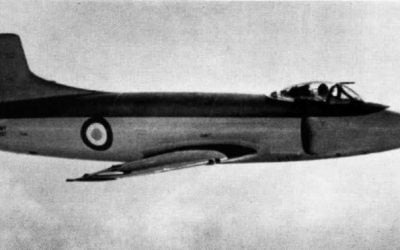
For a type built as a stopgap between two generations of British fighter, that is a considerable afterlife. Here is the world it was born into, at Farnborough in 1950:
Foire aux questions
What was the de Havilland Venom?
Who was the last military operator of the de Havilland Venom?
How did the Venom differ from the Vampire?
Why did Swiss Venoms land on motorways?
What armament did the Venom carry?
Did the Venom’s wingtip tanks affect its handling?
How were Swiss Venoms upgraded?
Do any de Havilland Venoms still fly?
Sources: de Havilland company histories, Swiss Air Force records, Air Ministry Specification F.15/49 documentation, Royal Air Force Museum, Flugmuseum Altenrhein.
Articles similaires
0 Comments