
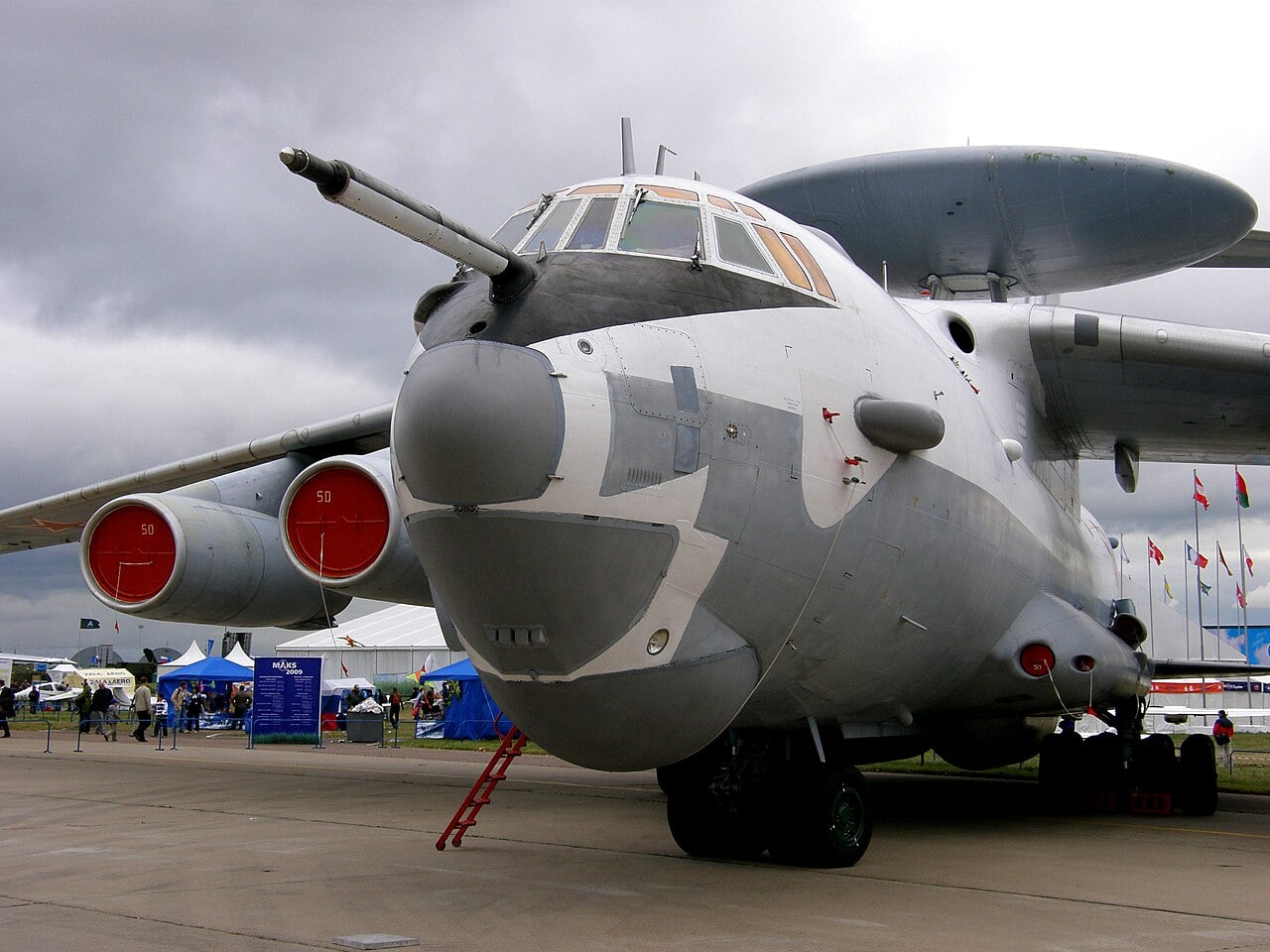
There is a category of military aircraft that never fires a shot and decides the battle anyway. The Beriev A-50 is one of them: an Ilyushin Il-76 transport with a nine-metre radar dish bolted on top, fifteen people inside, and the ability to see six hundred kilometres in every direction.
Russia built about forty. It has lost at least two of them in the air over Ukraine, had more damaged on the ground, and cannot build another one.
Informations clés
Taper: Beriev A-50, NATO reporting name Mainstay, airborne early warning and control
Basis: Ilyushin Il-76MD transport airframe
Premier vol : 19 December 1978
En service : 1985. Production ended in 1992
Construit: Roughly 40 to 42
Radar: Vega Shmel, meaning bumblebee, inside a nine-metre rotodome. The complex is designated Liana
Capability: Around 60 simultaneous tracks. Detection ranges cited between 200 and 650 km depending on target and altitude
Équipage: 15, five flight crew and around ten mission specialists
Confirmed air losses: Two, in January and February 2024
A bumblebee on an airlifter
The A-50 replaced the Tupolev Tu-126 Moss, an earlier and largely unsuccessful Soviet attempt at the same idea. Its existence reached Western intelligence before it flew, leaked by the CIA asset Adolf Tolkachev.
What sits in the rotodome is the Shmel radar, the name meaning bumblebee, within a system designated Liana. It handles roughly sixty simultaneous tracks. Published detection figures vary widely depending on who is doing the publishing and what they are detecting: two to four hundred kilometres against a low-flying fighter, three to six hundred against something at altitude. Endurance is about four hours on station at a thousand kilometres from base, extendable by air-to-air refuelling.
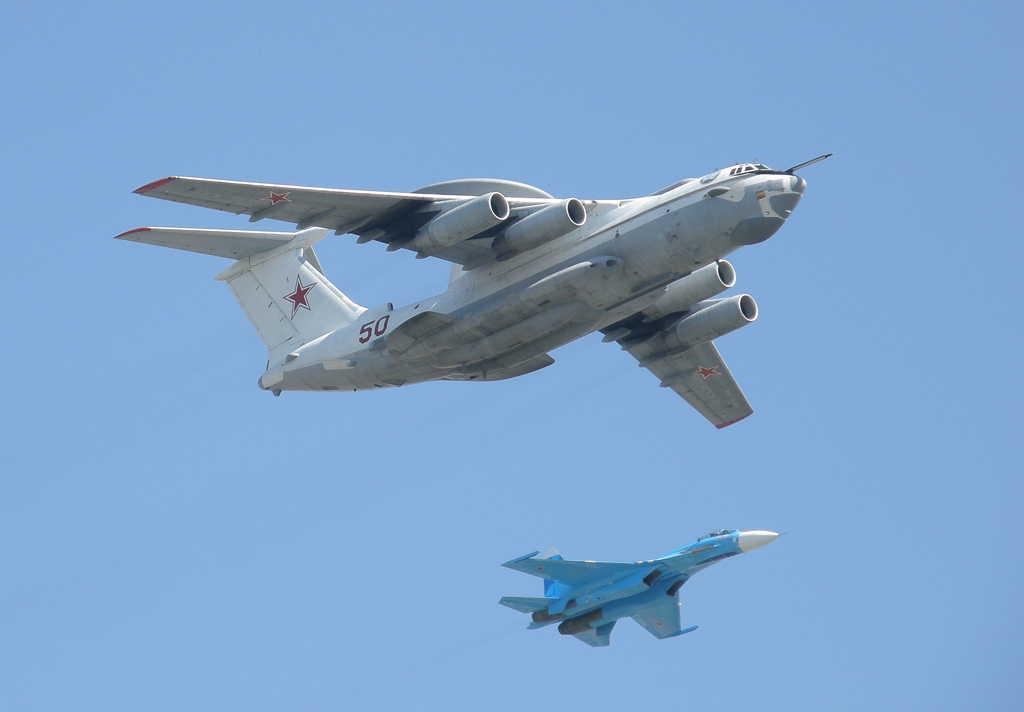
The upgraded A-50U brought digital avionics from NPO Vega, with state testing completed in September 2008 and the first converted aircraft handed over at Taganrog on 31 October 2011. India operates a related but distinct aircraft, the A-50EI, fitted with an Israeli phased-array radar rather than the Russian set.
What it actually does in this war
Three things, mainly. It watches for incoming cruise missiles and low-flying drones, which ground radar struggles with because of the curvature of the earth. It vectors Su-35 and Su-34 fighters onto targets. And it provides the mid-course guidance picture for the R-37M, the very long-range air-to-air missile that has made Ukrainian pilots wary of approaching the front at altitude.
Remove the A-50 and all three degrade at once. That is why Ukraine spent two years trying to kill one.
Background on the A-50 and why it became a priority target.
The losses, and how solid each one is
This is where care is needed, because the claims and the confirmations do not always line up.
26 February 2023, Machulishchy, Belarus. An A-50U was attacked by drones in an operation claimed by the Belarusian partisan group BYPOL. Lukashenko initially admitted an attack, called the damage minor, then conceded the aircraft had gone to Russia for repair. Maxar satellite imagery showed the airframe largely intact. The honest verdict is damage, not destruction.
14 January 2024, over the Sea of Azov. An A-50U was destroyed and an Il-22M command post aircraft badly damaged, the latter reaching Anapa with a dead crew member aboard. Ukraine claimed it. Russia’s Ministry of Defence never commented and the Kremlin said it had no information, but Russian military bloggers confirmed the loss and reported eleven or twelve dead.
What brought it down has never been established. The S-200, the S-300, a Patriot PAC-2 and a Patriot ambush have all been argued, and Ukraine has never named the system. A credible Russian counter-theory, circulated by Rybar and examined by the Conflict Intelligence Team, holds that it was friendly fire. That has not been resolved either. What is not in doubt is that the aircraft was lost.
Contemporary coverage of the January 2024 loss.
23 February 2024, near Kanevskoye in Krasnodar Krai. A second A-50U was shot down, killing ten: five majors, three captains, a sergeant major and a lieutenant. This is the best-evidenced of all of them, and the confirmation came from an unexpected direction. On 17 June 2024 Russia’s Investigative Committee issued an in-absentia arrest warrant for the commander of the Ukrainian surface-to-air missile brigade held responsible. A state does not indict a foreign officer for shooting down an aircraft it says was not shot down.
1 June 2025, Ivanovo Severny, during Operation Spiderweb. SBU footage shows first-person-view drones descending onto two A-50 rotodomes, and satellite imagery afterwards showed at least one scorched airframe. Damage is confirmed. Destruction is not.
25 November 2025, Taganrog. A strike on the Beriev plant destroyed the unique A-60 airborne laser testbed and an A-100LL prototype, both visible as burnt airframes in satellite imagery. The plant has now been hit four times.
17 March 2026, Staraya Russa. An A-50 undergoing maintenance at the 123rd Aircraft Repair Plant was damaged, confirmed by the Ukrainian General Staff three days later. No independent imagery has surfaced.
Why they cannot be replaced
Fleet numbers are genuinely contested and anyone quoting a single figure with confidence is guessing. The IISS Military Balance listed three A-50s and six A-50Us in service at the time of the invasion, so somewhere around nine or ten flyable aircraft out of roughly forty built, the rest stored or unserviceable. Estimates published since the 2024 losses have run as low as two serviceable airframes. Treat all of these as approximate.
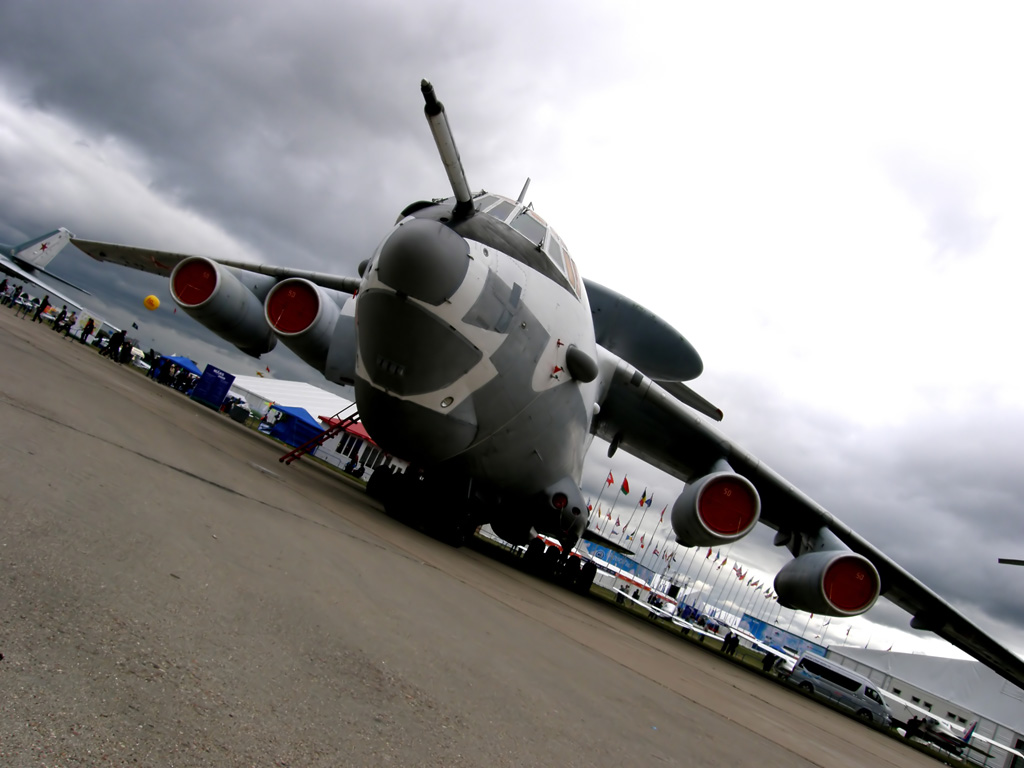
The replacement problem is structural rather than financial. Production ended in 1992. The Il-76MD-90A line at Aviastar turns out a handful of airframes a year against competing demands for transports and tankers. The Shmel and Liana systems depend on components that sanctions have made difficult to obtain. And Beriev is the sole integrator, a company that posted a loss of roughly five billion roubles in 2025 on revenue that had fallen by a factor of nearly four.
The intended successor, the A-100 Premier, uses the newer Il-76MD-90A airframe with an active electronically scanned array. It first flew in 2017, achieved a flight in full mission configuration in February 2022, and is still not in service. Its flying laboratory was one of the aircraft destroyed at Taganrog in November 2025.
The consequence in the air
The practical effect has been to push A-50 orbits much further east, away from the front. That is a rational response to losing two aircraft and it costs Russia exactly what it sounds like it costs: radar horizon. A Mainstay orbiting deep inside Russia sees less of Ukraine, detects cruise missiles later, vectors fighters less precisely and supports long-range missile shots less well.
Ukraine did not need to destroy the fleet. It needed to make flying them near the front unacceptably expensive, and two aircraft and roughly twenty highly trained specialists was enough to do that. In a war full of cheap drones, the most consequential air-defence achievement may have been shooting down something that was never armed.
Sources: IISS Military Balance; UK Ministry of Defence Defence Intelligence; Russian Investigative Committee; Conflict Intelligence Team; Militarnyi; Defense Express; Maxar Technologies imagery; Forbes.

0 Comments