
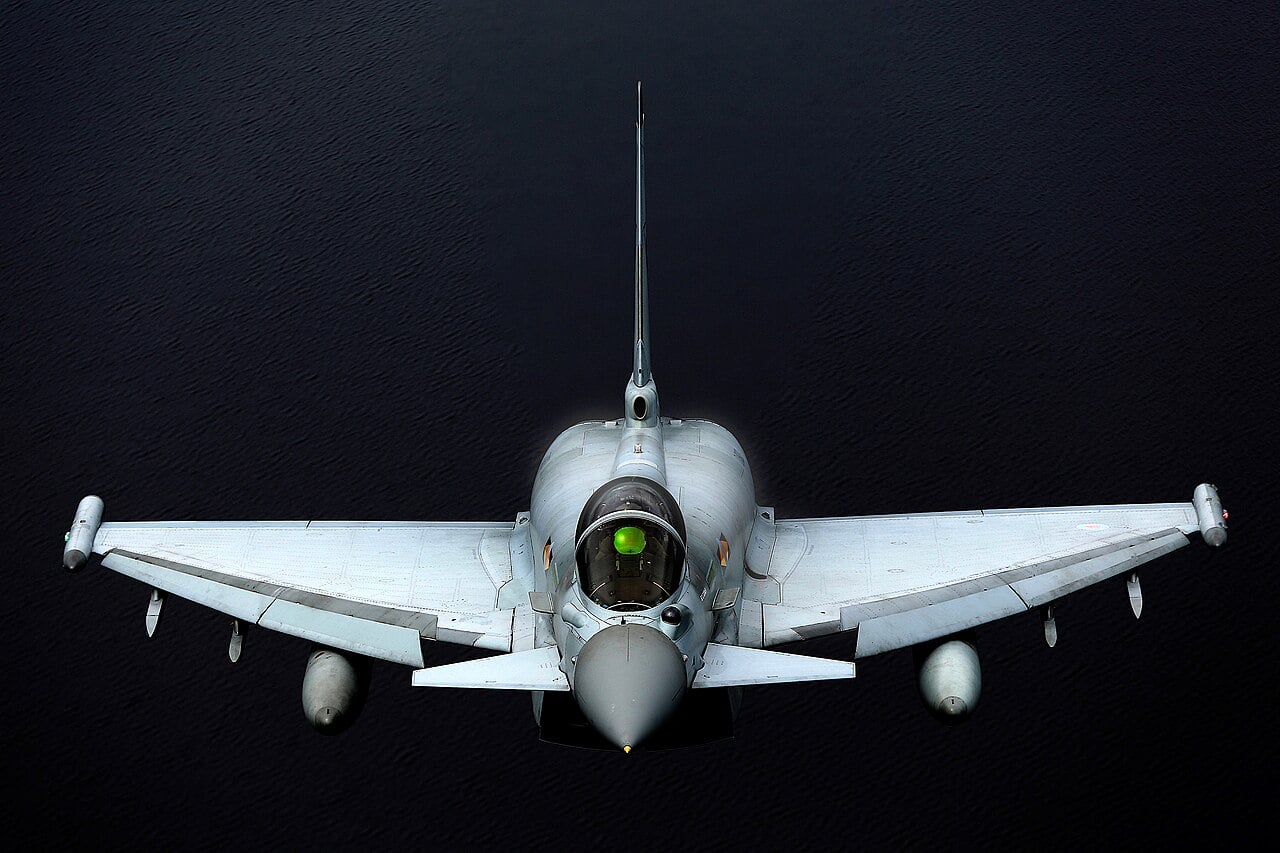
A Russian drone crossed into Lithuanian airspace overnight on 15 September, and NATO fighters shot it down. That part has happened before — by the alliance air commander’s own count, at least six times now.
What is new is that the officer responsible for doing something about it says the current method is working and is also the wrong answer.
Lieutenant General Jason T. Hinds commands US Air Forces in Europe and NATO’s Allied Air Command. Speaking to reporters at the Air, Space and Cyber conference this week, he laid out what the alliance is actually changing, and why using fighter jets to shoot down cheap drones cannot continue indefinitely.
Informations clés
OMS: Lt Gen Jason T. Hinds, Commander, US Air Forces in Europe / US Air Forces Africa and Commander, NATO Allied Air Command
Speaking: media roundtable at AFA Air, Space & Cyber, 15 September 2026
The plan: Standing Defense Plan 12000, a new NATO integrated air and missile defence plan, introduced by SACEUR Gen Alexus Grynkewich in Congressional testimony in March 2026
Alongside: Enhanced Vigilance Activity Eastern Sentry, stood up in September 2025 after a series of Russian airspace violations
Trigger event: a Russian drone shot down over Lithuania overnight, 15 September 2026
Précédent: an AS-23 cruise missile entered Polish airspace in July 2026
The core problem: intercepting one-way attack drones with crewed fighters is effective but economically unsustainable
Air Policing Is Over. Air Defence Has Replaced It.
The most concrete thing Hinds said was about vocabulary, which in a military alliance is never only about vocabulary.
Air policing was an assurance mission. Fighters sat alert, launched to identify whatever appeared, and escorted it away. It reassured 32 nations and, in Hinds’s blunt phrasing, degraded readiness while doing so.
Air defence is positional. Assets move to where intelligence says something is coming, with the authority and the weapons to destroy it. That is a different posture, a different command relationship, and a different answer to the question of what the aircraft are for.
The Cost Curve Is the Whole Argument
Hinds was unusually direct about the economics, which senior officers normally leave to think tanks.
A one-way attack drone can cost a few tens of thousands of dollars. The air-to-air missile fired at it can cost several hundred thousand, and the fighter carrying that missile costs tens of millions and needs a pilot. Win every engagement on those terms and you still lose the exchange.
His stated ambition is lower-cost interceptors, “hopefully ground-based, and in some cases air-based that are cheaper to use.” Europe is already moving that way: RAF Typhoons were fitted with 70 mm APKWS laser-guided rockets in May, and France has completed integration testing of 68 mm laser-guided rockets on the Rafale — less than eight months from contract to initial capability.
What He Is Being Asked to Build
Stripped of the acronyms, Hinds described a four-step chain he wants working before a drone or cruise missile reaches NATO territory: detect it, know where it came from, decide what to do, and have the right weapon to act.
Each of those is a separate problem. Detection means sensors looking outward, not just upward. Attribution means fusing intelligence quickly enough to matter. The decision step means command and control that can delegate authority in minutes across an alliance of 32 nations. Only the last step is about the weapon.
That is what Standing Defense Plan 12000 is for, and it is why SACEUR has handed Hinds the job of implementing both it and Eastern Sentry.
His Read on Why This Is Happening
Asked whether Russia is probing the alliance, Hinds offered an assessment that was more reassuring than the headlines it generated.
In other words: the drones are what is available, not what is preferred. Hinds said he does not know the intent behind the Lithuanian incursion and that intelligence organisations will supply that later — a hedge worth noting, because a great deal of commentary this week has been confident about a motive that the responsible commander says he cannot yet establish.
He was less hedged about the risk. Hybrid activity, he said, could lead to escalation. Which is the reason the plan exists.
Sources: TWZ (Howard Altman, 15 September 2026); NATO SHAPE; DefenseScoop; NATO Allied Air Command.

0 Comments