
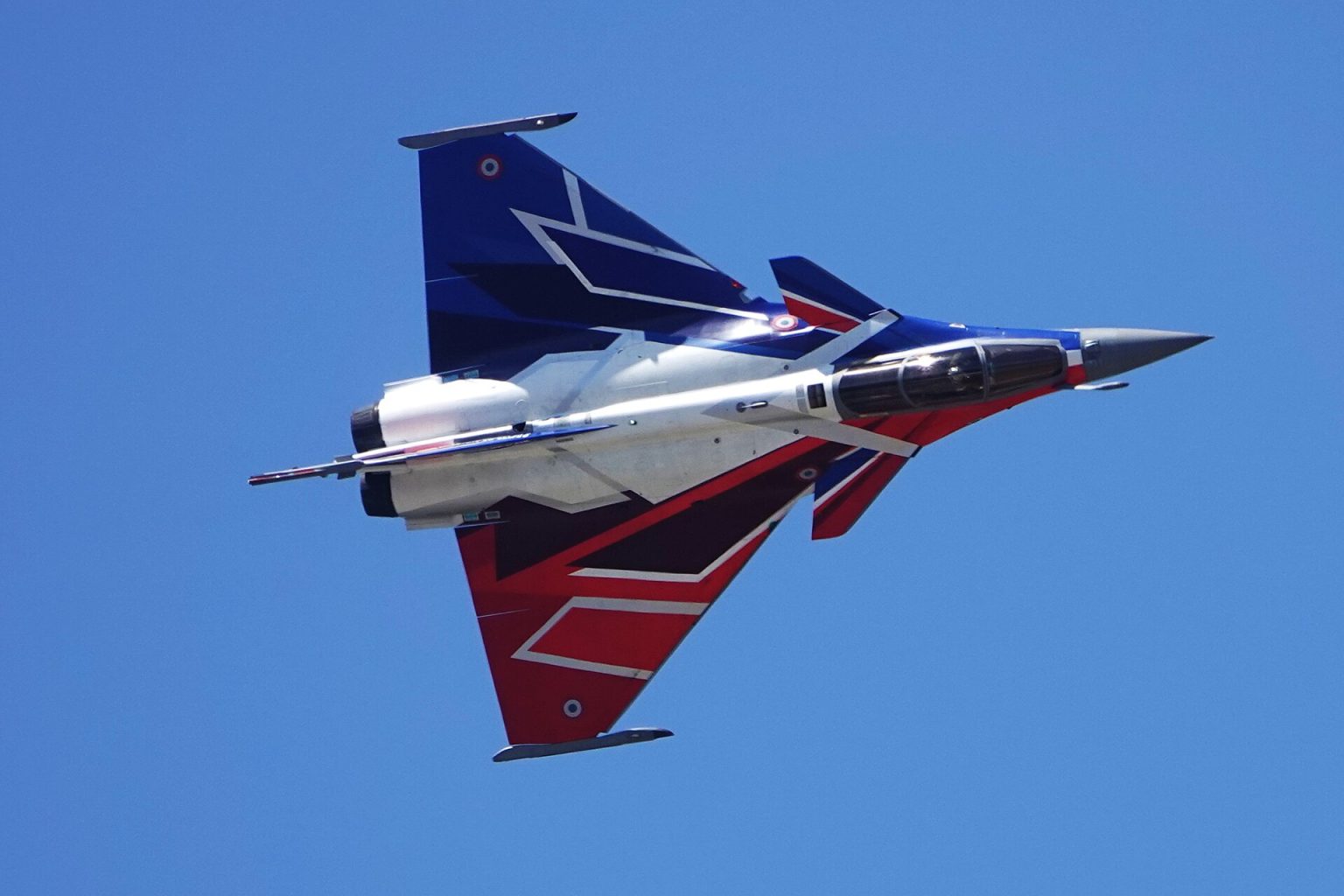
Dassault Rafale
“gust of wind”
France’s sovereign omnirole fighter — a twin-engine canard-delta built to fly every mission from a single airframe, cleared for air defence, deep strike, anti-ship, reconnaissance and airborne nuclear deterrence, and now a runaway 2020s export success.
One jet, every mission
The Rafale is France’s sovereign fighter — the aircraft that lets Paris field one type for every mission and answer to no partner nation for its upgrades or exports. When France walked away in the mid-1980s from the multinational programme that became the Eurofighter Typhoon, it bet on a smaller, carrier-capable, wholly French design. That bet defined the Rafale’s identity: “omnirole.” The Rafale A demonstrator flew on 4 July 1986; the definitive jet reached the French Navy in 2004 and the French Air Force in 2006.
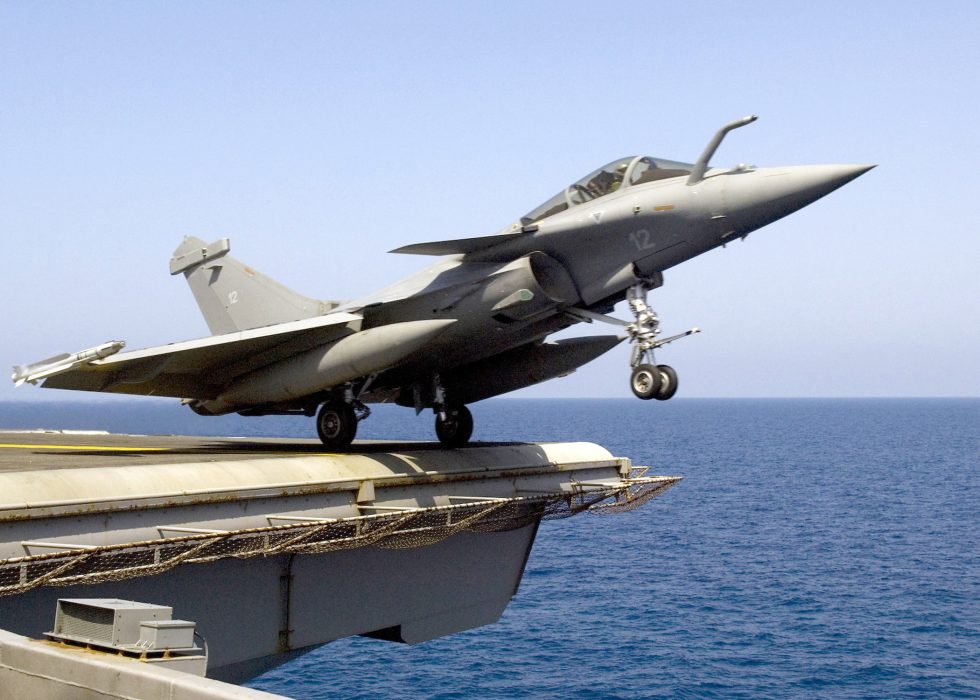
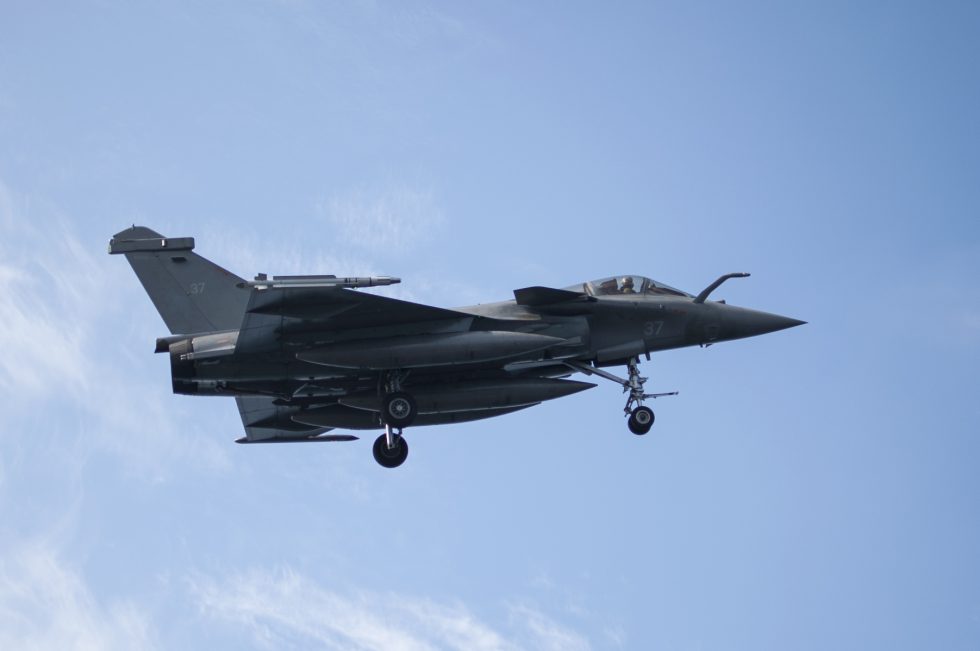
A single Rafale can fly air defence with Meteor and MICA missiles, precision strike with SCALP cruise missiles and AASM Hammer bombs, anti-ship missions with the Exocet, tactical reconnaissance, and — uniquely among current European fighters — France’s airborne nuclear strike with the ASMP-A missile. It operates from land bases and from the carrier Charles de Gaulle. Three variants share around 80% commonality: the single-seat Rafale C, the two-seat Rafale B, and the carrier-capable Rafale M.
After years without a single foreign buyer, the Rafale became a 2020s sales phenomenon — ordered by India, Egypt, Qatar, Greece, Croatia, the UAE, Indonesia and Serbia, and combat-proven over four continents. Dassault delivered its 300th Rafale in October 2025, with more than 500 aircraft on firm order and production climbing toward three to four jets a month.
01The Rafale’s divorce: how France’s exit from Eurofighter created two rival jets
In the mid-1980s France was part of the multinational effort that would become the Eurofighter Typhoon, but it wanted something the partners would not build: a lighter jet, capable of operating from an aircraft carrier, and under complete national control of design, upgrades and exports. Unable to reconcile those demands, France left in 1985 and went its own way. The split produced two competing European fighters where there might have been one.
The cost of that sovereignty was enormous — a whole fighter programme funded alone — but the payoff was total control. Decades on, the Rafale has outsold the Typhoon on the export market and remains the only European fighter cleared to carry a nuclear cruise missile and to fly from a carrier deck. For France, the Rafale is less a product than an instrument of strategic independence.
What makes the Rafale special
Close-coupled canard-delta
The Rafale’s foreplanes sit close to and slightly above the delta wing; their vortices energise airflow over the wing at high angle of attack, boosting lift and control authority. The airframe is deliberately relaxed-stability for agility, tamed by a full digital fly-by-wire system with carefree handling — giving a +9 g / −3.2 g envelope and crisp instantaneous turn without the pilot fighting the jet.
Twin Safran M88 turbofans
Two Snecma/Safran M88-2 engines each deliver roughly 50 kN dry and about 75 kN in afterburner (Dassault quotes “2 × 7.5 t”). Twin engines give combat survivability and single-engine recovery, and the M88 is optimised for the full mix of high-altitude interception and low-level strike — supporting strong sustained performance in a clean configuration.
SPECTRA, AESA radar & sensor fusion
Rather than chasing all-aspect stealth, the Rafale invests in the SPECTRA integrated electronic-warfare suite — threat detection, jamming, decoys and angular threat location — plus the Thales RBE2 AESA radar and the OSF optronic sensor. A multisensor data-fusion core merges it all into one tactical picture. The Rafale is also the only current European fighter cleared to carry an air-launched nuclear missile.
02The Rafale’s SPECTRA: survival by electronics, not shaping
While the F-35 chases a minimal radar cross-section, the Rafale bets on SPECTRA — an integrated electronic-warfare system that detects, locates, jams and decoys threats, and can angularly pinpoint hostile emitters. Combined with the RBE2 AESA radar and optronics, the aim is to let the pilot detect and engage first, then slip away. It is a fundamentally different philosophy of survivability from all-aspect stealth: not being invisible, but always knowing more than the other side — and it keeps a 1980s airframe tactically relevant decades on.
03The Rafale’s nuclear role: Europe’s only airborne nuclear fighter
French Rafales carry the ASMP-A, a stand-off nuclear cruise missile that forms the airborne leg of France’s independent deterrent — the force de dissuasion. Dedicated squadrons train specifically for the nuclear strike mission. No other current European fighter fields such a weapon, which is why the Rafale is best understood not merely as a tactical jet but as an instrument of French strategic sovereignty — a capability France was unwilling to place under any partner nation’s control, and a core reason it built the aircraft alone.
Full Rafale specifications
Baseline note: the figures below describe the single-seat, land-based Rafale C at the F4.1 standard — the version the French Air and Space Force flies today and the one Dassault publishes data for. Deltas for the two-seat B and the carrier-borne M in grey. Where Dassault’s own figures differ slightly from the reference works, the manufacturer’s number is used and the alternative noted.
Dimensions & weights
- Crew
- 1 (2 in the Rafale B)
- Length
- 15.30 m (50 ft 2 in; Jane’s gives 15.27 m)
- Wingspan
- 10.90 m (35 ft 9 in)
- Height
- 5.30 m (17 ft 5 in)
- Wing area
- 45.7 m² (492 sq ft)
- Empty weight
- 10,300 kg (22,700 lb); B and M about 10,600 kg (23,400 lb)
- Internal fuel
- ~4,700 kg (~10,300 lb)
- External fuel
- up to 6,700 kg (14,700 lb) in three drop tanks
- Maximum external load
- 9,500 kg (21,000 lb)
- Maximum take-off weight
- 24,500 kg (54,000 lb)
- Store stations
- 14, five of them heavy and plumbed (13 on the Rafale M)
- Wing loading
- 328 kg/m² (67 lb/sq ft) at typical gross weight
Performance
- Maximum speed, altitude
- 1,912 km/h (1,188 mph), Mach 1.8
- Maximum speed, low level
- 1,390 km/h (864 mph), 750 kn
- Supercruise
- Mach 1.4 dry with four MICA and a centreline tank
- Approach speed
- 222 km/h (138 mph), under 120 kn — a canard benefit
- Service ceiling
- 15,240 m (50,000 ft)
- Rate of climb
- 305 m/s (60,000 ft/min)
- Combat radius
- ~1,850 km (~1,150 mi) penetration profile, three tanks, two SCALP, two MICA
- Ferry range
- 3,700 km (2,300 mi) with three drop tanks
- Take-off run
- 400 m (1,300 ft) at typical intercept weight
- Landing run
- 450 m (1,500 ft) without brake parachute
- Load factor limits
- +9 / −3.2 g (11 g has been reached in emergency)
- Thrust-to-weight
- 0.99 clean, full internal fuel
Propulsion & systems
- Engines
- 2 × Safran M88-2 afterburning turbofans (M88 T-REX, up to 88 kN, planned for the F5 standard)
- Thrust, each
- 50 kN (11,250 lbf) dry, 75 kN (16,900 lbf) with reheat
- Fuel and refuelling
- ~4,700 kg internal; fixed probe to starboard of the cockpit; French Navy jets fly the buddy tanker fit
- Radar
- Thales RBE2-AA active electronically scanned array, roughly a thousand transmit/receive modules, air targets tracked out to about 200 km (passive-array RBE2 on pre-2013 airframes; RBE2 XG from F5)
- Optronics
- Thales OSF front-sector optronics: a passive TV and infrared set that identifies and tracks targets without emitting, and cues MICA IR beyond visual range
- Targeting pod
- Thales Talios (Damocles on earlier French and most export aircraft)
- Defensive aids
- Thales and MBDA SPECTRA — radar, laser and missile warning fused with active jamming and decoys, the reason French Rafales flew unescorted into Libyan air defences in 2011
- Cockpit and sights
- Wide-angle holographic head-up display, three touch-sensitive multifunction displays, voice command, Thales Scorpion helmet-mounted sight from F4.1
- Ejection seat
- Martin-Baker Mk16F, zero-zero
- First flight
- Rafale A demonstrator 4 July 1986; Rafale C01 19 May 1991; Rafale M01 12 December 1991
- Service entry
- French Navy 18 May 2001; French Air Force 27 June 2006
- Delivered
- 313 aircraft to 31 December 2025 (533 on firm order, 220 in backlog; output rising towards four a month by 2028–29)
04The Rafale’s price tag: why there is no single sticker number
The Rafale is often quoted at around US$100 million or more per aircraft, but that figure is misleading if treated as a hard flyaway price. Export deals bundle weapons, spares, training, infrastructure and long support contracts, and the per-jet cost swings enormously with the package, the year and the buyer. India’s 36-jet deal, Egypt’s and Qatar’s orders and Croatia’s ex-French airframes were all priced very differently. Treat any single “Rafale costs $X” headline with caution: the honest answer is that the price is package-dependent, and Dassault does not publish a simple unit figure.
Armament & payload
The Rafale carries an almost entirely French weapons set, and the nuclear part of it only for France
Dassault sells the Rafale as an omnirole aircraft and the weapons list is the argument: the same jet that stands quick-reaction alert with six MICA can be turned round for a SCALP EG cruise-missile strike, an Exocet anti-ship pass, or a nuclear alert with an ASMPA-R on the centreline. Almost every store is European, which is the strategic point rather than an accident — MBDA, Safran and Thales built France a strike package with no American components in it and therefore no American veto over its use, and Dassault went to the trouble of making the export SCALP EG ITAR-free for the same reason. The gun is a real 30 mm revolver cannon rather than a token, and Safran’s AASM Hammer — a guidance-and-propulsion kit bolted to an ordinary bomb body — gives a 15 to 70 km stand-off shot that still works when the satellite signal does not. Clearances vary sharply by aircraft standard and by customer: nuclear weapons are never exported, and export fleets normally sit one or two software standards behind the French ones.
Gun
- 1 × Nexter 30M791 30 mm revolver cannon, buried in the starboard engine trunk root
- 125 rounds, 2,500 rounds per minute, muzzle velocity about 1,025 m/s
- Fitted to every variant including the two-seat B and the naval M — unusual among modern two-seaters
- Used in anger for strafing in Libya, Mali and Iraq; the short burst length that 125 rounds allows is a real limitation
Air-to-air
- MBDA MICA EM (active radar) and MICA IR (imaging infrared) — one airframe, two interchangeable seekers, roughly 80 km
- MBDA Meteor ramjet BVR missile, cleared with the F3-R standard in 2018
- Matra Magic II short-range infrared missile — legacy fit, now largely displaced by MICA IR
- MICA NG, the replacement generation, is in flight test for the F4.3 standard rather than in service
Air-to-surface guided
- MBDA SCALP EG conventional stand-off cruise missile, roughly 250 km class, used over Libya, Syria and Iraq
- Safran AASM Hammer modular kits in 125, 250, 500 and 1,000 kg bodies; GPS, GPS-plus-laser or GPS-plus-infrared seekers
- MBDA Exocet AM39 Block 2 anti-ship missile, principally a Rafale M weapon
- MBDA ASMP-A and the renovated ASMPA-R stand-off nuclear missile with a 300 kt warhead — French aircraft only. No export Rafale is nuclear-capable; the wiring, codes and certification stay in France.
Bombs
- GBU-12 Paveway II, 250 kg class laser-guided — the everyday close-support weapon over the Sahel
- GBU-16 Paveway II, 500 kg class laser-guided
- GBU-24 Paveway III, 1,000 kg class hardened-target penetrator
- GBU-49 Enhanced Paveway II, dual-mode laser and satellite guidance
- Plain Mk 82 and Mk 83 low-drag bombs are cleared but rarely carried; France prefers the AASM kit on the same bodies
Rockets
- No unguided rocket pod has ever been cleared for the Rafale in French service. The type went straight from the gun to guided weapons and skipped the rocket generation entirely
- That changed only in 2026, and only for guided rockets: the LADAC counter-drone fit puts 68 mm laser-guided Thales Aculeus rockets in a twelve-round JF12 pod
- Trials ran from February 2026 and finished on 7 July 2026; initial operational capability was declared the following week, cued by the Talios pod
- The purpose is narrow — shooting down cheap one-way attack drones without spending a MICA on each one
Pods & other stores
- Thales Talios targeting and reconnaissance pod; Damocles on earlier French jets and most export fleets
- Thales AREOS / RECO NG digital reconnaissance pod, a French Air and Space Force fit
- Buddy-buddy air refuelling store, carried by French Navy Rafale M to extend a carrier air wing without a tanker
- 1,250-litre supersonic and 2,000-litre subsonic drop tanks; conformal tanks are planned for the F5 standard
- Two wingtip stations are reserved for missile rails or SPECTRA antennas and cannot take stores
Three typical loadouts
- Quick-reaction alert
- Six MICA in a mixed EM and IR fit, two 1,250-litre supersonic tanks, full gun. Two Meteor replace two MICA EM when the threat is a stand-off shooter rather than an airliner.
- Deep strike, conventional
- Two SCALP EG on the inboard wing stations, four MICA for self-escort, two 2,000-litre tanks, Talios pod. This is the Libya and Syria configuration, flown without a dedicated SEAD escort because SPECTRA is the escort.
- Nuclear alert, French forces only
- One ASMPA-R on the centreline, four MICA, two 2,000-litre tanks. Flown by the Forces Aériennes Stratégiques from Saint-Dizier and by the Navy’s 12F from the carrier; no export operator is cleared for it.
Sourcing caveat: clearances above follow DGA and Dassault statements, MBDA and Safran product data and French parliamentary defence reporting. Manufacturer brochures routinely list weapons that are offered rather than qualified — where a store has been flown but not cleared, it is described that way. Export fleets carry a different subset again; Indian Rafale, for instance, fly Israeli and Indian stores that no French aircraft carries.
Variants
Three airframes, one production line, and a rolling series of software standards
The Rafale exists at all because France walked out of the European Fighter Aircraft talks in July 1985. The disagreements were real rather than merely national: France wanted a lighter multirole aircraft in the 9 to 10 tonne empty class that could be catapulted off a carrier, Britain and Germany wanted a heavier long-range interceptor, and no partner would concede Dassault the design leadership and industrial primacy it demanded. Carrier compatibility was the point that could not be compromised away — a naval variant is not a modification, it dictates the undercarriage, the structure and the approach speed from the first drawing. France left, spent roughly four decades of its own money, and ended up with the only European fighter that flies from a catapult.
What it bought was a close-coupled canard delta that is deliberately unstable in pitch and held there by a triplex digital fly-by-wire system. The canards sit close to and slightly above the wing so that their vortices energise the wing’s upper surface at high angle of attack; the result is a jet that will fly a carrier approach at under 120 knots and still pull 9 g. The three airframes share about 95 per cent of their parts. The M pays roughly 500 kg for a reinforced structure, a jump-strut nosewheel, an arrestor hook and a carrier-grade undercarriage, and gives up one store station in exchange.
The versions that matter operationally are not airframes but standards. F4.1 was qualified by the DGA in March 2023 and is what leaves the Bordeaux-Mérignac line today. Everything beyond it is at various removes from reality, and the difference between contracted and announced is worth watching carefully.
- Rafale A (1986–1994, one built)
- Technology demonstrator, larger than the production aircraft and initially flown on General Electric F404 engines while the M88 matured. Retired to the Musée de l’Air.
- Rafale C (first flight 19 May 1991)
- Single-seat, land-based baseline for the Air and Space Force. Lightest of the three and the reference for the figures above.
- Rafale B (first flight 30 April 1993)
- Two-seat land-based version. Originally a trainer; after the 1991 Gulf War France decided the back-seater earned his keep on strike and reconnaissance work, and the B became the majority Air Force type. Keeps the gun.
- Rafale M (first flight 12 December 1991)
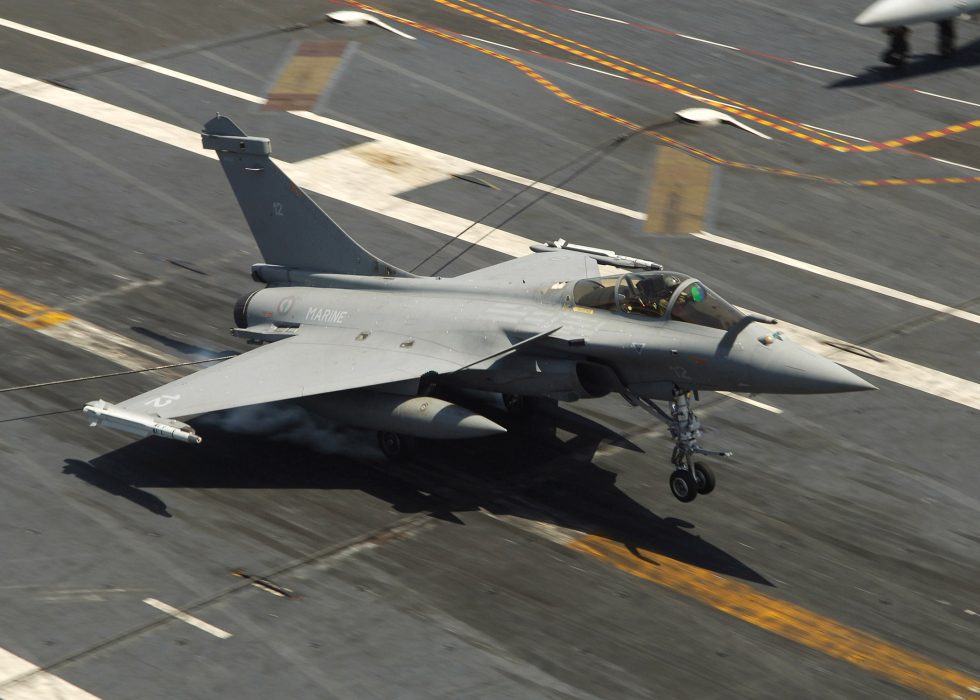
- Carrier variant: reinforced airframe, arrestor hook, telescopic jump-strut nose gear for catapult launch, carrier microwave landing system. About 500 kg heavier, thirteen store stations rather than fourteen, and the only non-American fighter flying from a catapult today.
- Rafale N (cancelled 2004)
- Proposed two-seat naval version, briefly called the Rafale BM. Killed on cost and on the weight penalty a second seat imposed at carrier recovery weights.
- Standards F1 to F3-R (2001–2018)
- F1 was air-to-air only and Navy-only; F2 (2006) added air-to-ground; F3 (2008) added the nuclear role, Exocet and the reconnaissance pod; F3-R (qualified 2018) brought Meteor, the Talios pod and the laser-guided AASM.
- Standard F4.1 (qualified March 2023, current build)
- Scorpion helmet-mounted sight, Talios improvements, upgraded radar and SPECTRA processing, new communications and a predictive-maintenance architecture. This is the delivery standard now, and most French aircraft have been brought up to it.
- Standard F4.2 and F4.3 (later this decade)
- F4.2 adds satellite communications, Link 16 Block 2 and the TRAGEDAC and CAPOEIRA connectivity systems; it is funded and in development but not yet qualified. F4.3 flew its first test campaign in 2025 and brings MICA NG, a further SPECTRA revision and the CONTACT radio.
- Standard F5 (target around 2035)
- More than €4 billion of development contracts have been notified by the DGA. It brings the RBE2 XG radar, a reworked SPECTRA, conformal tanks, the M88 T-REX engine and the ASN4G hypersonic nuclear missile. France now funds it alone: the United Arab Emirates had been expected to contribute up to €3.5 billion and the talks collapsed in December 2025 over technology transfer.
- F5 combat drone (announced October 2024, not contracted)
- A stealthy nEUROn-derived loyal wingman with an internal weapons bay, notionally operational by 2033. Only about €128 million of preparatory work has been funded for 2024–26 and Dassault’s chief executive stated flatly in 2025 that no programme had been launched. The DGA has separately contracted Dassault to return the stored nEUROn demonstrator to flying condition.
- Export designations (2015 onwards)
- Egypt DM/EM, Qatar DQ/EQ, India DH/EH with Indian-specific stores and cold-start modifications, Greece and Croatia flying refurbished ex-French airframes, Indonesia from 2026. All are conventional-only aircraft.
Closing caveat: press coverage frequently blurs the line between a standard that has been qualified, one that is under contract, and one that has merely been announced at an air show. F4.1 is qualified; F4.2 and F5 are contracted and in development; the F5 combat drone is, as of 2026, an intention with seed money attached rather than a programme of record.
Four decades of the Rafale
France goes solo
France leaves the joint European fighter project, choosing to build its own carrier-capable, nationally controlled jet.
Rafale A first flight
The Rafale A technology demonstrator flies for the first time on 4 July, proving the canard-delta concept.
Production prototype
The first production-standard prototype, the Rafale C01, takes to the air.
First delivery
The first series-production Rafale is delivered to France.
Enters naval service
The Rafale M enters service with the French Navy aboard the carrier Charles de Gaulle.
Enters air-force service
The French Air Force declares the Rafale operational.
Combat debut over Libya
Rafales fly among the opening strikes of Opération Harmattan, enforcing the Libya no-fly zone.
Export era begins
Egypt becomes the first export customer, opening a run of foreign orders from Qatar, India and beyond.
300th Rafale delivered
Dassault delivers its 300th Rafale; the Indian Navy orders the Rafale M and the type sees combat in India’s Operation Sindoor.
From the flight line: twelve Rafale stories
The divorce that made two fighters
France went solo — and Europe got two rivals.
Read the full story
One jet, every job
What “omnirole” really means.
Read the full story
SPECTRA: seeing without being seen
Survival by electronics, not stealth.
Read the full story
The carrier Rafale
Built to launch from a pitching deck.
Read the full story
India’s Rafale saga
From bitter tender to biggest-ever deal.
Read the full story
Meteor: the long arm
A ramjet missile that rewrites BVR range.
Read the full story
France’s airborne nuke
The only European fighter with a nuclear cruise missile.
Read the full story
The export boom
From zero sales to a global order book.
Read the full story
Cross-decking with the US Navy
A French jet on an American carrier.
Read the full story
Sahel strike from home soil
Mali targets hit from France.
Read the full story
The canard advantage
Little wings up front, big agility payoff.
Read the full story
F4, F5 and a loyal wingman
Keeping a 1980s design current into the 2040s.
Read the full story
The Rafale in pictures
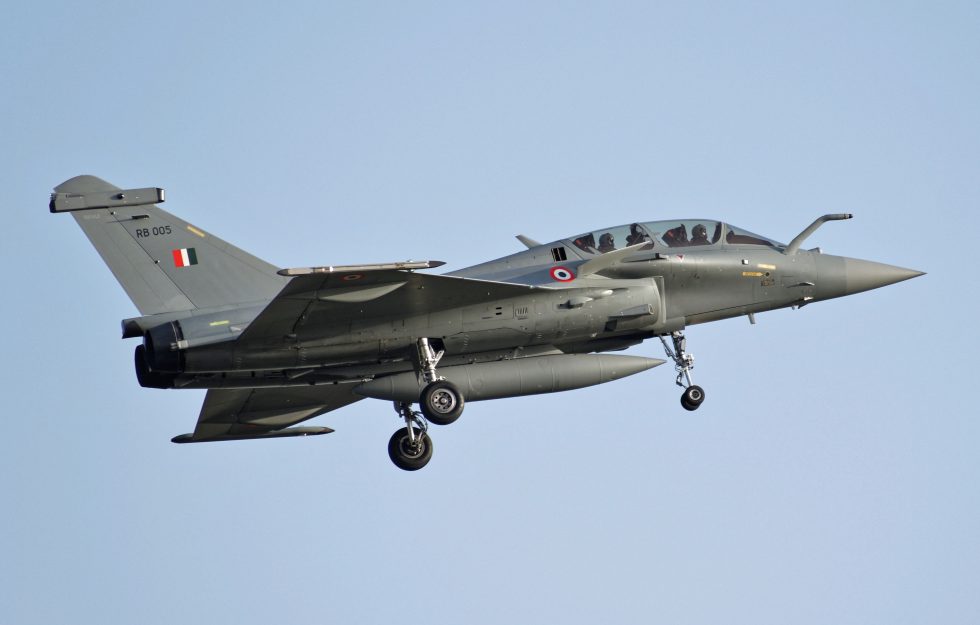
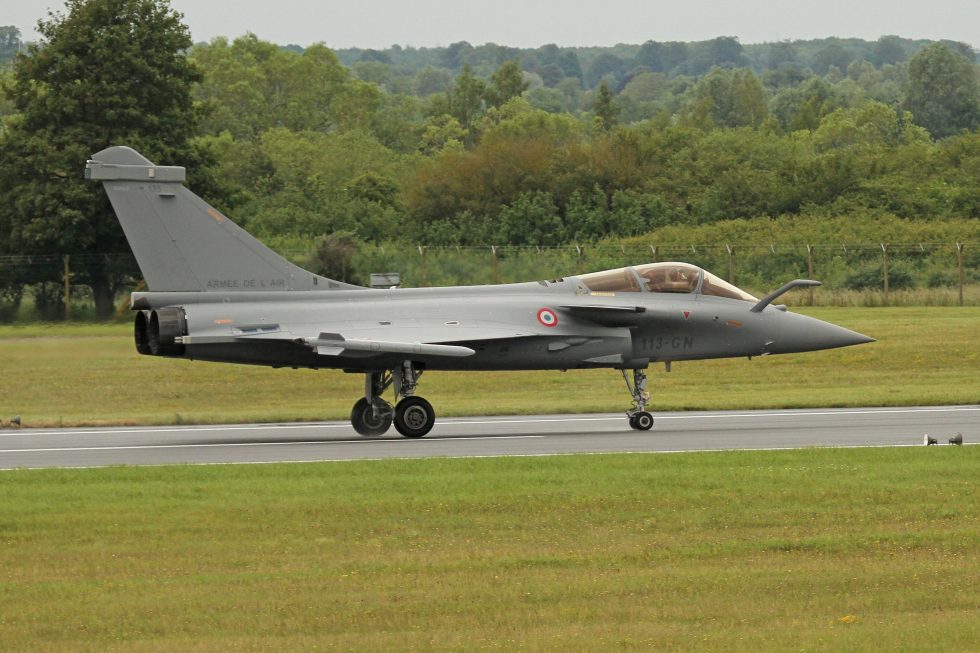
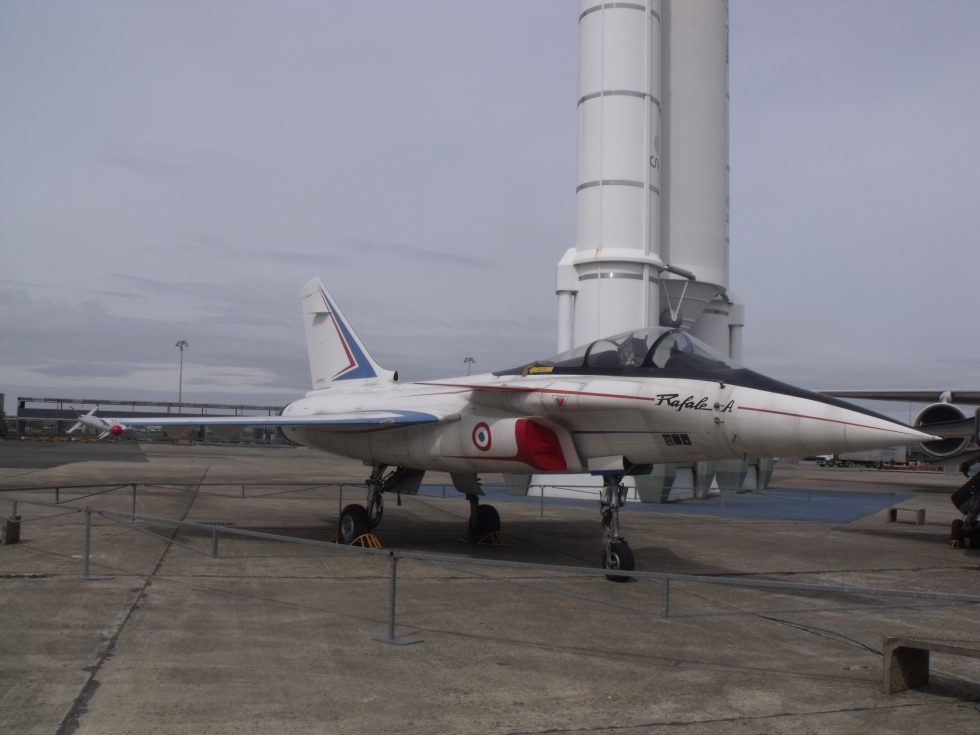
The Rafale in motion
A showcase film of the Rafale in flight is coming soon.
The Rafale in motion
Megaprojects — one of the most-watched Rafale films on YouTube.
Where the Rafale flies
Operators
The Rafale flew for fourteen years as an aeroplane nobody outside France would buy, then sold 323 abroad in eleven and became the fighter of choice for states that want capability without American export controls.
France is still the centre of gravity: 112 Rafale B and C with the Armée de l'air et de l'espace and 41 Rafale M with the Aéronautique navale at 31 December 2025, against a programme target of 225 aircraft — 185 for the air force, 40 for the navy — and 234 ordered — five production tranches, the last of them 42 aircraft in December 2023, plus a 2021 order for 12 to replace the airframes ceded to Greece. Egypt broke the export drought in February 2015 and seven more customers have followed, the 80 aircraft the United Arab Emirates ordered in December 2021 being the largest military export contract France has ever signed. Dassault had taken 533 firm orders in all by the end of 2025 — 234 from France, of which 189 had been delivered, and 323 counted as exports, a figure that includes the 24 second-hand aircraft as well as the 299 new-build export machines — and had built the 300th airframe in October 2025; no air arm has yet retired the type, while France itself is still owed 45 aircraft and Egypt, Indonesia, Serbia, the Indian Navy and the Emirates are all still waiting on aircraft, and a July 2026 Franco-Ukrainian plan for an initial 16 has yet to become a contract — Dassault’s chief executive confirmed on 23 July 2026 that nothing had been signed. Egypt broke the export drought in February 2015 and asked Dassault on 1 September 2026 for a proposal for 24 more. Quantities are airframes on charge at the date given in each note, not aircraft ordered, and the 24 second-hand Rafale France sold on to Greece and Croatia are counted twice here — once as French deliveries, once as exports — so the national figures add up to more than the number of Rafale built.
Current strength, largest fleet first. Where a figure is a range or an estimate the bar is drawn at the middle of it and the number keeps its published form.
In service and on order
- French Air and Space ForceFrance · Rafale B two-seat and C single-seat, all new-build; 112 on strength at 31 December 2025 against an LPM target of 185, first airframes handed over in 2004 and the first operational squadron, EC 1/7 Provence at Saint-Dizier, formed in 2006
- 112 · 2004–
- French Naval AviationFrance · Rafale M single-seat only; 41 at the navy’s disposal of 42 remaining of 48 ordered at 31 December 2025, the 42nd retained by Dassault Aviation for standards development, against an LPM target of 40; first two delivered in December 2000 and flottille 12F converted in May 2001
- 41 · 2000–
- Egyptian Air ForceEgypt · First export customer, all new-build: 24 (8 single-seat EM, 16 two-seat DM) ordered in February 2015 and delivered by 2017, plus 30 F3R ordered in May 2021 whose deliveries began in late 2024; between 30 and 35 on strength in mid-2026 — 24 from the first contract plus six to eleven of the second, the exact figure uncertain because Dassault Aviation does not publish deliveries by customer and the two published tallies differ: The Aviationist counted 30 to 31 airframes at the end of November 2025, while Militär Aktuell reported on 5 January 2026 that ten of the second batch had been handed over during 2024 and 2025; Cairo issued a request for proposals for 24 more on 1 September 2026
- 30–35 · 2015–
- Indian Air ForceIndia · 36 new-build to an India-specific standard, ordered government-to-government in September 2016; first ferry to Ambala in July 2020, the last of the 36 arrived in December 2022, split between No. 17 Squadron at Ambala and No. 101 Squadron at Hasimara
- 36 · 2020–
- Qatar Emiri Air ForceQatar · 36 new-build (27 single-seat EQ, 9 two-seat DQ) — 24 ordered in May 2015 and 12 options exercised in December 2017; delivered between 2019 and 2022 to 61 and 62 Squadrons at Dukhan (Tamim) air base
- 36 · 2019–
- Hellenic Air ForceGreece · 24 aircraft (18 single-seat EG, 6 two-seat DG) of which 12 were transferred second-hand from Armée de l'air stocks and 12 were new-build F3R; ordered in 2021 and 2022, completed with the 24th aircraft in January 2025, flown by 332 Squadron of 114 Combat Wing at Tanagra
- 24 · 2021–
- Croatian Air ForceCroatia · 12 second-hand airframes bought out of French stocks under a 2021 contract and overhauled to F3R standard, no new-build aircraft; deliveries ran from April 2024 until the squadron was complete in April 2025, based at the Colonel Marko Živković barracks at Pleso
- 12 · 2024–
- Indonesian Air ForceIndonesia · 42 new-build F4 ordered in three tranches from February 2022; the first three arrived at Roesmin Nurjadin, Pekanbaru on 23 January 2026 and six had been handed over by the formal induction at Halim Perdanakusuma on 18 May 2026, the remaining 36 carried as a separate order row
- 6 · 2026–
- United Arab Emirates Air ForceUnited Arab Emirates · Not yet in service — 80 new-build Rafale F4 ordered in December 2021 for €16.6bn, the largest military export contract France has ever signed; the first aircraft was presented at Dassault’s Istres flight-test centre on 29 January 2025 and stays there for flight testing, with deliveries to the Emirates themselves due from the end of 2026; none of the 80 has yet reached the UAE
- 80 on order · from 2026
- Serbian Air Force and Air DefenceSerbia · Not yet in service — 12 new-build aircraft contracted in Belgrade on 29 August 2024 for about €2.7bn, Serbia’s first Dassault purchase and its first Western fighter buy; none delivered
- 12 on order · from 2028
- Indian NavyIndia · Not yet in service — 26 new-build Rafale Marine contracted on 28 April 2025 for about US$7.5bn, the first export sale of the naval variant and the only Rafale M order outside France; none delivered
- 26 on order · from 2029
- French Air and Space ForceFrance · Not yet delivered — 45 of the 234 Rafale France has ordered were still outstanding at 31 December 2025, Dassault Aviation having delivered 189 of them; they are outstanding against the five French production tranches (13 in 1993, 48 in 1999, 59 in 2004, 60 in 2009 and 42 at the end of December 2023) plus the 12 ordered in January 2021 to replace the airframes ceded to Greece, and the bulk of the balance is the fifth tranche of 42 Rafale F4 for the Armée de l’air et de l’espace; the Aéronautique navale has none on order, all 48 of its Rafale M having been delivered and a sixth tranche of naval aircraft not yet contracted; only one Rafale is scheduled for delivery to France in 2026, French slots having been given over to export customers
- 45 on order · from 2026
- Indonesian Air ForceIndonesia · Not yet delivered — 36 of the 42 Rafale F4 contracted in three tranches from February 2022 were still outstanding after the sixth aircraft was handed over at the induction ceremony at Halim Perdanakusuma on 18 May 2026; the first three had arrived at Roesmin Nurjadin, Pekanbaru on 23 January 2026
- 36 on order · from 2026
- Egyptian Air ForceEgypt · Not yet delivered — the balance of the 30 Rafale F3R ordered in May 2021, deliveries of which began in late 2024 and were still running through 2026; the figure is a range because Dassault Aviation publishes no per-customer split and its order book shows only that Egypt and the United Arab Emirates between them had taken 16 new Rafale to 31 December 2025 and 20 to 30 June 2026; a request for a proposal for a further 24 aircraft went to Dassault on 1 September 2026 but is not a contract and is not counted here
- 19–24 on order · from 2024
Formerly operated by
- None recorded
- —
14 operators, 8 in service and 6 on order. Dates are first delivery to last retirement, and the basis of the quantity column is stated above. Air forces with a MiGFlug Order of Battle page are linked (14 so far); the rest follow as the database grows.
Combat-proven across four continents
The Rafale is genuinely combat-tested: close air support in Afghanistan, the opening strikes over Libya in 2011, long-range strike across the Sahel from Mali (2013) and a sustained precision campaign over Iraq and Syria (2014+). Its record is overwhelmingly air-to-ground and strike; it has no confirmed air-to-air kill against a peer manned fighter documented in neutral open sources, so there is no meaningful “kill ratio” to quote.
Indian Rafales operated during the May 2025 India–Pakistan clashes (Operation Sindoor); loss and kill claims from that episode are heavily disputed between Indian, Pakistani and third-party sources and should be treated as unverified. Compare the combat record of every military aircraft. Figures as of July 2026.
Everything people ask about the Rafale
Can I fly in a Rafale?
How fast is the Rafale?
What does “omnirole” mean?
Rafale vs Eurofighter Typhoon — what’s the difference?
Is there a carrier version?
Can it carry nuclear weapons?
Who flies the Rafale, and how many are built?
Is the Rafale combat-proven?
You can’t fly the Rafale.
These, you can.
Some legends only live in museums — others are fuelled and waiting. MiGFlug has put civilians in real military jet cockpits since 2004.
 Fly the L-39 AlbatrosThe world’s most-flown jet trainer — aerobatics included
 Fly the F-104 Starfighter“The missile with a man in it”
 Fly the MiG-21The Cold War’s most-produced jet
 Fly the T-33 Shooting StarAmerica’s first jet trainer
 Fly the DH VampireA piece of early jet history
 Fly the S.211Agile Italian jet trainer
 Fly the MB-326The classic Aermacchi jet
 Fly the MiG-15The Soviet legend of the Korean War
Continue the tour
Every fact, checked
- Dassault Aviation — Rafale specifications & performanceOfficial manufacturer figures for dimensions, weights and powerplant.
- Dassault Aviation — Rafale programme overviewThe manufacturer’s “omnirole” concept and variant descriptions.
- European Security & Defence“300th Rafale delivered” (October 2025) — production milestone and output plans.
- Flight GlobalHow France’s Rafale evolved into an export champion.
- Shephard MediaUpgrades and fresh orders reinforcing Rafale demand (updated 2026).
- AirpowerAsiaIndia’s proposed Make in India Rafale deal and production-hub ambitions.
- GlobalMilitary.netRafale combat aircraft specs and operator list (2026).
- MiGFlug BlogThe Dassault Rafale in combat — every operation from Mali to Syria.