
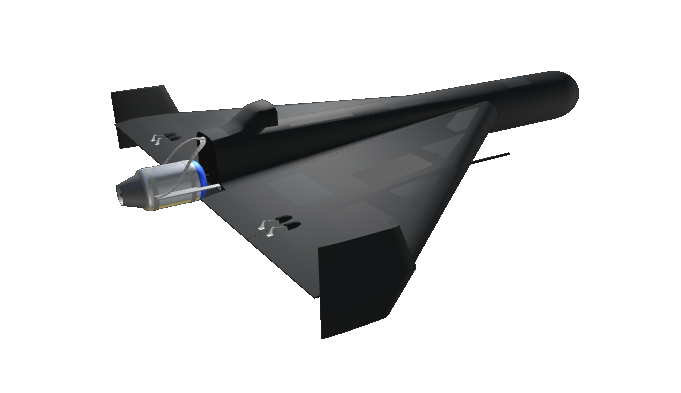
Radio Free Europe/Radio Liberty has taken a Russian Geran-4 apart on camera, and what spills out of the airframe is less a Russian weapon than a catalogue of global supply chains. The jet-powered successor to the Shahed carries around 55 foreign-made components from seven countries, according to Ukraine’s Defence Intelligence, and most of them could be bought on the open market.
The four-minute teardown, published on 24 September 2026 by RFE/RL’s Ukrainian Service and its investigative team Schemes, walks through the drone piece by piece: the engine, the camera, the radios and the navigation hardware that make it faster and harder to stop than the propeller-driven Geran-2.
Informations clés
- Taper: Russian jet-powered one-way attack drone, Shahed family
- Moteur: Chinese Telefly turbojet (LX-WP-160, per HUR)
- Taille: 3.6 m long, 3.05 m wingspan, 450 kg max take-off weight
- Ogive: 50 kg (HUR)
- Vitesse: 350 km/h max, 320 km/h cruise (HUR); up to 500 km/h in other estimates
- Gamme: About 770 km (HUR)
- Foreign parts: About 55 components from 7 countries
- Production: Around 3,000 jet Gerans a month (HUR, 2026)
A hobby jet in a war machine
The heart of the Geran-4 is a small turbojet from the Chinese firm Telefly, identified by Ukraine’s Defence Intelligence (HUR) as the LX-WP-160. It is a commercial engine of the kind sold for large models and target drones, not a military powerplant. Reporting on the RFE/RL teardown by DroneXL puts the retail price of engines in this class at about $20,000 to $25,000 in China, with a service life measured in tens of hours. For a one-way weapon, that is all it needs.
The engine is what changes the tactical picture. The piston-engined Geran-2 cruises at roughly 185 km/h. HUR lists the Geran-4 at 350 km/h maximum and 320 km/h cruise, and other Ukrainian estimates quoted by Militarnyi go as high as 500 km/h. Either way, it is fast enough to leave behind the cheap propeller-driven interceptor drones Ukraine has built its defence around. We covered the jet Shahed’s arrival in Le Shahed vient de recevoir un moteur à réaction.
Fifty-five parts, seven countries
HUR’s War & Sanctions portal lists roughly 55 identified foreign components in the Geran-4, sourced from manufacturers in China, the United States, Taiwan, Japan, Switzerland, Germany and the United Kingdom. According to Militarnyi, most of them are Chinese. Among the items named:
- a UC9810 satellite-navigation receiver from China’s Unicore Communications, manufactured in October 2025;
- Texas Instruments power controllers and amplifiers, including the LM5176, LM5117 and LM258, plus a TI logic transceiver;
- a Micron Technology memory chip (USA);
- Infineon transistors (Germany);
- Nichicon electrolytic capacitors (Japan);
- components from STMicroelectronics and Analog Devices, and a camera from the Chinese firm Honpho.
None of these are exotic military parts. They are the building blocks of consumer electronics, industrial controllers and cars, produced by the million and resold through distributors, which is exactly why export controls struggle to keep them out.
“Thousands of electronic components, originally intended to improve lives and fuel development, are perversely repurposed by aggressors into instruments of violence.”
War & Sanctions portal, Defence Intelligence of Ukraine (HUR)
Eyes, ears and a way home
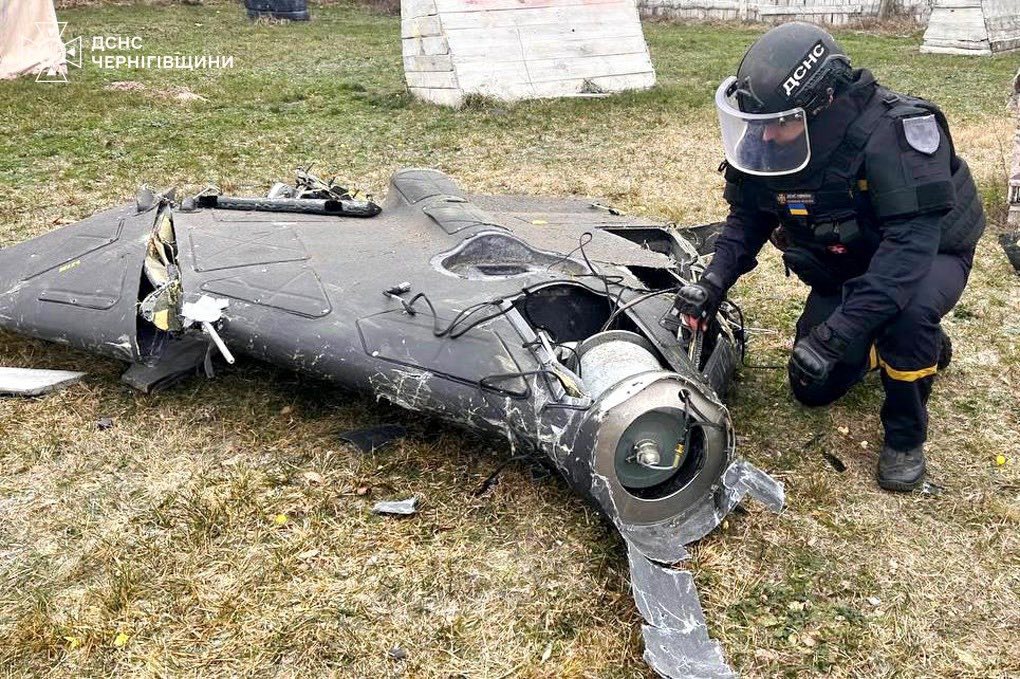
The teardown also shows why the Geran-4 is more than a faster Shahed. According to DroneXL’s account of the RFE/RL video, it carries a day-and-night camera with optical zoom, a Chinese mesh-network modem that can relay video and commands over long distances, and two cellular modems with SIM cards that report the drone’s position over mobile networks. A multi-element controlled reception pattern antenna, a CRPA, helps its satellite navigation shrug off jamming.
Put together, that turns a fire-and-forget weapon into something operators can watch and redirect in flight. It is the combination of speed and connectivity, rather than any single component, that makes the Geran-4 hard to counter.
Mass production, imported parts
HUR reported in 2026 that Russia was building around 3,000 jet-powered Gerans a month, more than its output of about 2,800 piston-engined Geran-2s, with the main factory at the Alabuga special economic zone in Tatarstan. Every one of those airframes needs an engine, a navigation receiver and a handful of chips that Russia does not make itself.
That is the uncomfortable conclusion of the RFE/RL teardown. Ukraine is racing to field faster interceptors, from jet-powered drones such as the Alexa Spatium to adapted air-to-air missiles. But the drones it is shooting down are assembled in Russia from parts that, for the most part, are still being manufactured and sold elsewhere.
Foire aux questions
What is the Geran-4 drone?
How fast is the Geran-4?
What foreign components are in the Geran-4?
What engine does the Geran-4 use?
How does the Geran-4 avoid jamming?
How many Geran-4 drones does Russia build?
Sources: RFE/RL Ukrainian Service and Schemes, “Geran-4 Unpacked”, video, 24 September 2026; Defence Intelligence of Ukraine (HUR), War & Sanctions portal, Geran-4 entry; Militarnyi; DroneXL, 28 September 2026.


0 Comments