
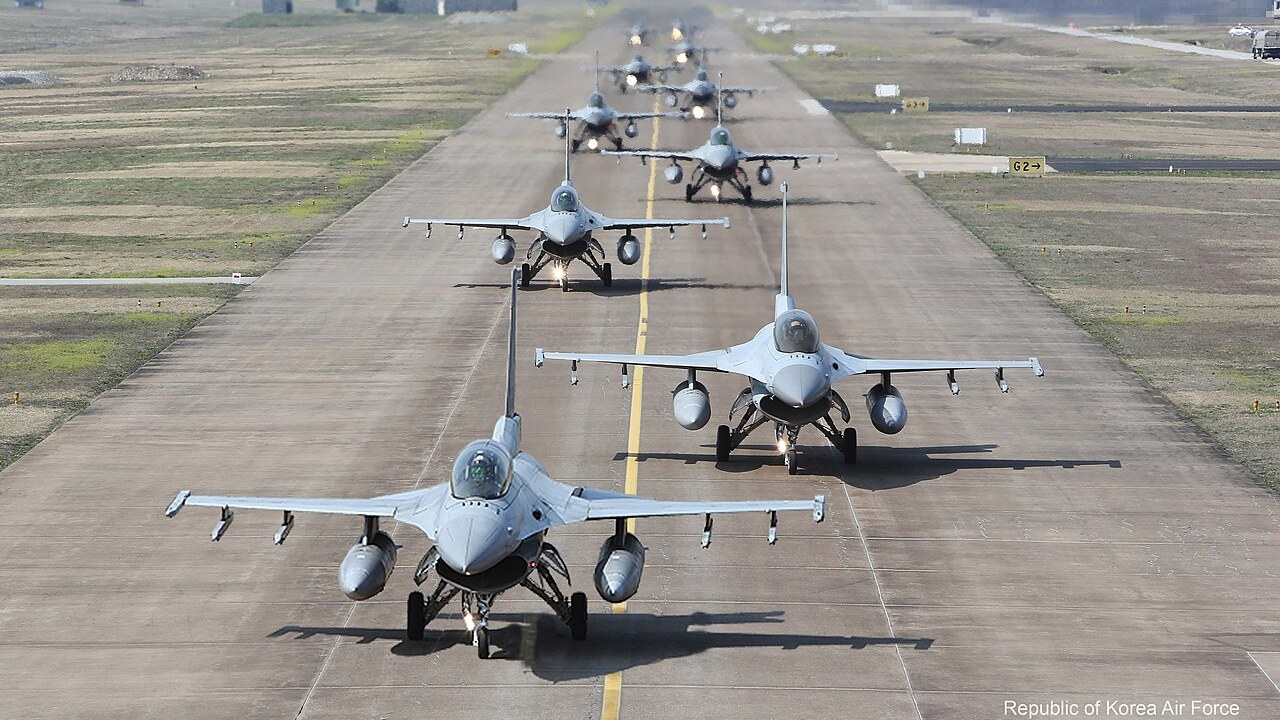
The part cost about 1.2 million won to make, roughly 900 US dollars. By the time it reached a South Korean KF-16, it was being billed as a genuine American component at around 100 million won. According to South Korean prosecutors, that markup ran for more than a decade, and the bill came to 12.8 billion won.
On 8 October 2026, prosecutors indicted five people over a scheme to fit counterfeit parts to Republic of Korea Air Force KF-16 fighters during maintenance. Three were arrested and charged, including the head of an aircraft parts company and the head of a subcontracted maintenance firm. The case was reported by Yonhap, Chosun Ilbo, JoongAng Ilbo, Seoul Shinmun and other Korean outlets.
Informations clés
- Annoncé : 8 October 2026, by South Korean prosecutors
- Charged: 5 people, 3 of them under arrest
- Aéronef: Republic of Korea Air Force KF-16
- Part: a down-converter in the jet's identification friend-or-foe (IFF) system
- Cost to make: about 1.2 million won per unit; billed at about 100 million won
- Period: 2014 to February 2025
- Total obtained: about 12.8 billion won in maintenance payments
How the Scheme Worked
The part in question is a down-converter, a component of the KF-16's identification friend-or-foe system, the equipment that tells friendly radars and fighters who the jet is. Under the rules, a replacement must be a genuine part made to the original American manufacturer's specification, or a substitute approved in advance by the Air Force.
According to Seoul Shinmun's account of the indictment, the 70-year-old head of a parts company had counterfeit down-converters made in Korea, copying the look and the part numbers of the real thing. The units were then exported to the United States and imported back, so that they appeared to be genuine American parts. Prosecutors say he held about 90 per cent of a US partner company that handled the distribution.

A mechanic at a subcontracted maintenance firm is accused of fooling Air Force quality inspectors and fitting the counterfeits as if they were genuine. The firm's 62-year-old chief and two employees allegedly knew the parts were fake and kept collecting maintenance payments from Korea's Defense Acquisition Program Administration. Prosecutors also say unrepairable parts were reused on other fighters, bringing in about 850 million won in extra payments.
A Yacht and a Private Plane
Prosecutors say the parts company chief spent some of the proceeds on a personal yacht and a private aircraft, and that they will ask investigators to pursue the recovery of the money.
Korean reports do not describe any accident or in-flight failure linked to the counterfeit parts, and none of the coverage says how many aircraft carried them. That is reassuring, but it is not the point. An IFF system that fails at the wrong moment can turn a friendly jet into a target, which is exactly why the rules demand certified parts in the first place.
An Old Problem in a New Case
The KF-16 is South Korea's licence-built version of the F-16 Fighting Falcon, and it remains one of the Air Force's most important combat jets while the KF-21 Boramae enters service. Keeping an ageing fleet flying depends on a long chain of suppliers and contractors, and every link in that chain has to be trusted.
This case suggests that one link failed for more than ten years. The defendants have been charged under Korea's special law on crimes involving military supplies, and the case now goes to court.
Yonhap News TV's report on the indictment is below (in Korean).
Sources: Seoul Shinmun, Gokorea, Yonhap News TV, Chosun Ilbo, JoongAng Ilbo, Kyunghyang Shinmun


0 Comments