
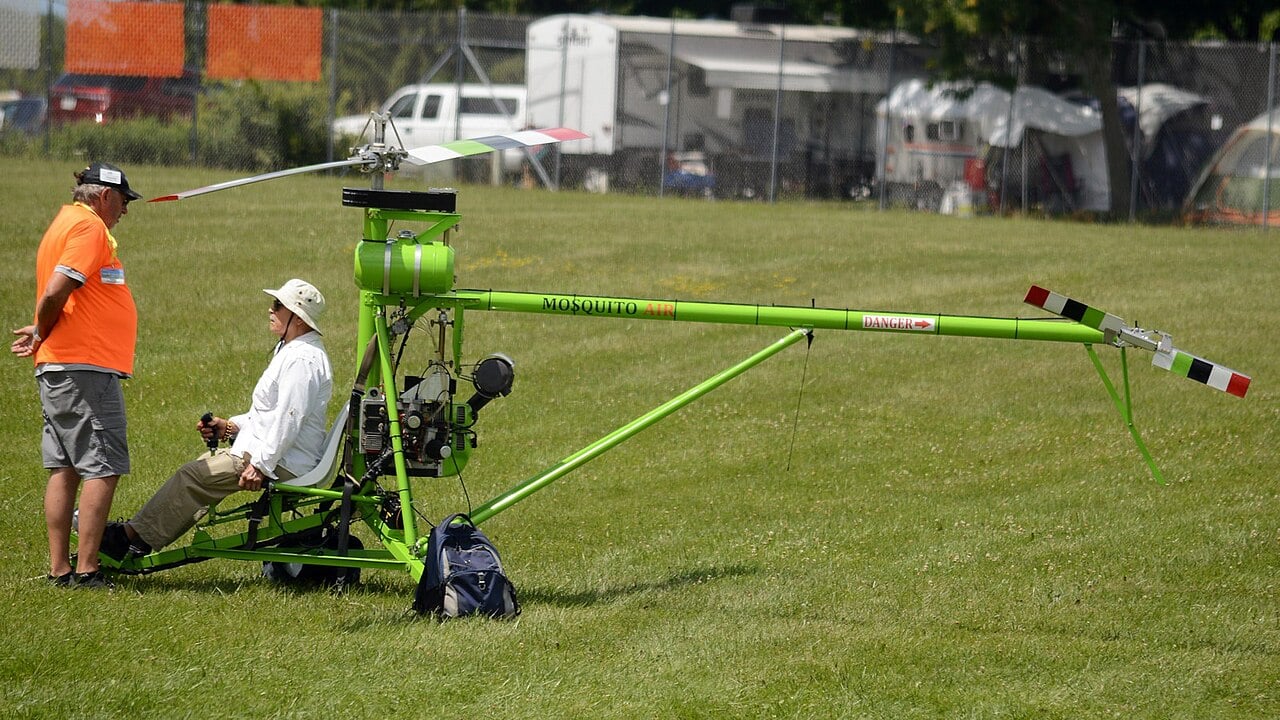
There is a helicopter you can buy, fly away from your own field, and operate in American airspace without a pilot certificate, without a medical, without registration, and without any airworthiness approval whatsoever. It is not a loophole and it is not a grey area. It is 14 CFR Part 103, written in 1982, and it is still the most permissive piece of aviation regulation in the developed world.
The catch is a single number. A powered ultralight vehicle has to weigh less than 254 pounds empty. For a fixed-wing aeroplane descended from a hang glider, that is tight but achievable. For a helicopter, which has to carry a rotor head, a transmission, a driveshaft running the length of the tail boom, a tail rotor gearbox and enough structure to react all of it, 254 pounds is close to the edge of what is physically buildable. The engine alone accounts for about a quarter of it.
And yet the machines exist. They are sold, they are flown, and almost everything written about them repeats the same 254-pound figure without mentioning that the real ceiling is higher, that the extra allowance comes from a 1984 advisory circular about seaplanes, or that the single most popular model on the American market would be illegal without it.
Quick Facts: 14 CFR Part 103 ultralight vehicles
| Regulation | 14 CFR Part 103, in force since 1982 |
| Maximum empty weight | Less than 254 lb, excluding floats and safety devices |
| Float allowance | Up to 30 lb per float (FAA AC 103-7, 1984) |
| Parachute allowance | Up to 24 lb (FAA AC 103-7) |
| Effective ceiling | 338 lb with floats and a parachute system |
| Fuel capacity | 5 US gallons maximum |
| Maximum speed | 55 knots CAS at full power in level flight |
| Occupants | Un |
| Pilot certificate | None required (14 CFR 103.7) |
| Registration and markings | None required (14 CFR 103.7) |
The four numbers, and the ones a helicopter cannot answer
Part 103 does not certify anything. It defines a category by exclusion, and then declines to regulate what falls inside it. Section 103.1 lists what a powered ultralight vehicle must be: used for manned operation in the air by a single occupant, used for recreation or sport only, holding no airworthiness certificate of any kind, and meeting four hard limits.
Less than 254 pounds empty weight, excluding floats and safety devices intended for deployment in a potentially catastrophic situation. Fuel capacity not exceeding five US gallons. Not capable of more than 55 knots calibrated airspeed at full power in level flight. And a power-off stall speed not exceeding 24 knots calibrated airspeed.
Three of those a helicopter can be measured against. The fourth cannot. A helicopter does not have a power-off stall speed, because it does not stall in the fixed-wing sense; with the engine shut down it autorotates, trading height for rotor energy. The rule was drafted around weight-shift and three-axis ultralight aeroplanes, and the question of how a rotorcraft satisfies 103.1(e)(4) is one the text simply never anticipated.
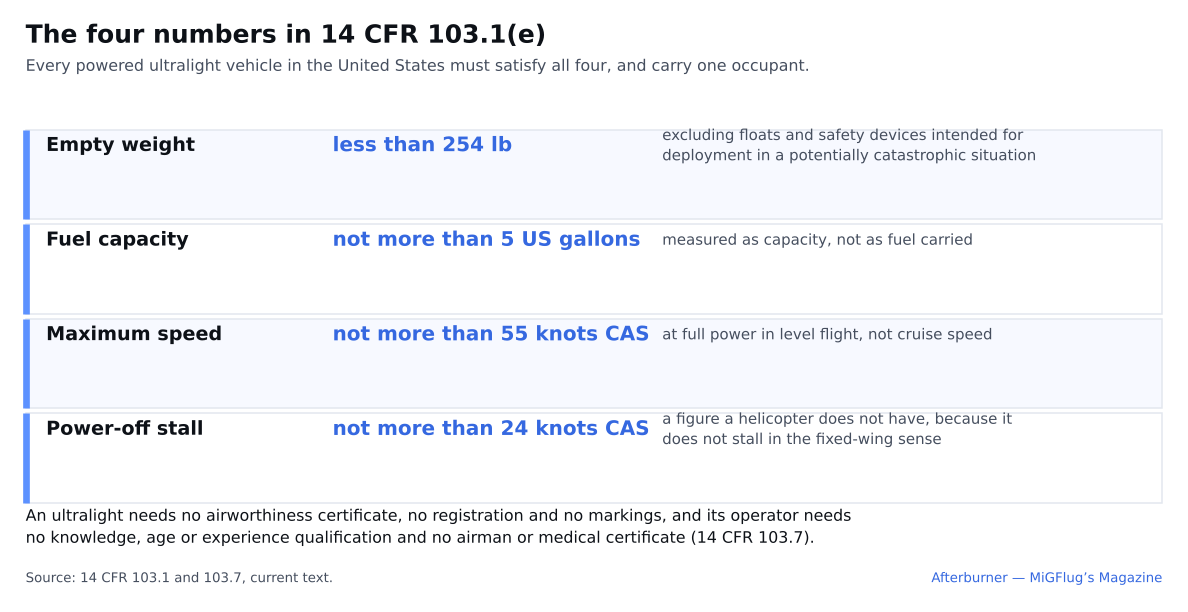
What Part 103 then withholds is more striking than what it demands. Section 103.7 says that ultralight vehicles and their parts are not required to meet airworthiness certification standards or to hold certificates of airworthiness. It says operators are not required to meet any aeronautical knowledge, age or experience requirements, or to hold airman or medical certificates. And it says the vehicles need not be registered or bear markings of any type.
No N-number. No annual inspection. No logbook. No instructor sign-off. A person who has never flown anything can legally buy a single-seat helicopter and go flying, and the United States government has no record that either the machine or the pilot exists.
The 254-pound rule is really a 338-pound rule
Here is the part that almost never makes it into the coverage. The 254-pound figure in 103.1(e)(1) is a base, not a ceiling, because the same sentence excludes floats and safety devices from the calculation. The FAA then put numbers on those exclusions in Advisory Circular 103-7, issued on 30 January 1984 and never superseded.
Up to 30 pounds per float may be excluded without the operator having to substantiate what the floats actually weigh. Up to 24 pounds of parachute-system weight may be excluded on the same terms. Everything else that gets bolted on counts: the circular is explicit that seatbelts, roll cages, instruments and wheel brakes are part of the airframe and go into the empty weight.
Run the arithmetic and a float-equipped, parachute-equipped powered ultralight can weigh 338 pounds empty and still be a Part 103 vehicle. A float-equipped one without a parachute gets 314.
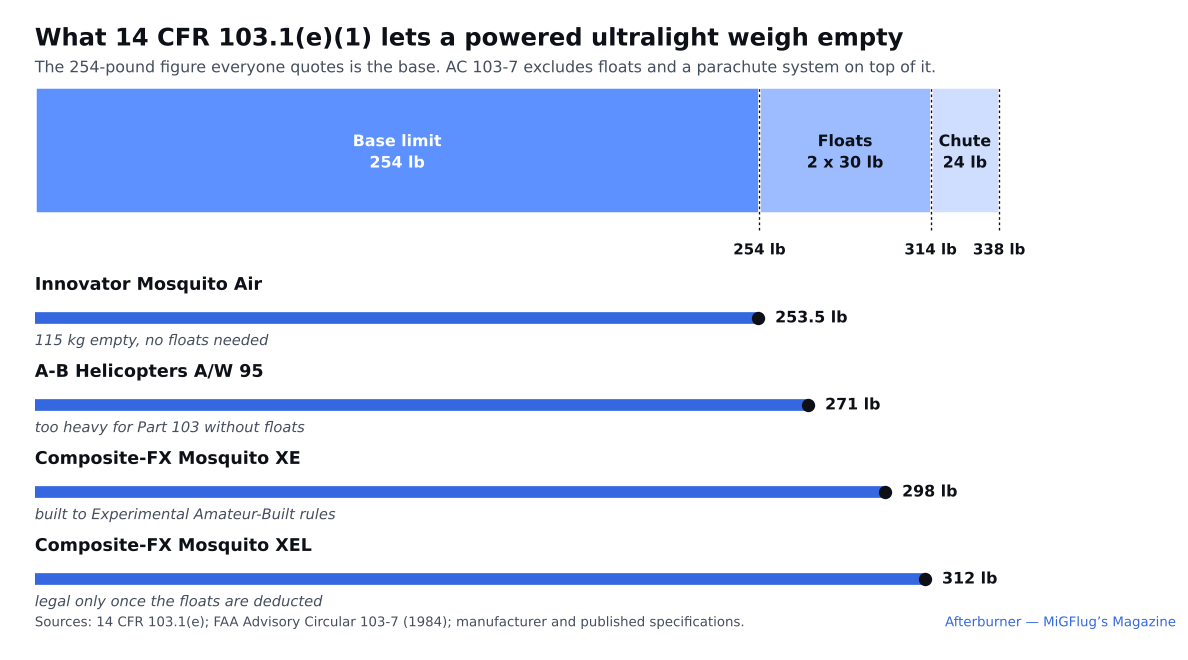
That 314-pound figure is the one that matters, because it is the number the American ultralight helicopter industry is built on. The Composite-FX Mosquito XEL, the most visible Part 103 helicopter on the market, has a published empty weight of 312 pounds. The manufacturer states plainly on its own specification page that the XEL qualifies as an ultralight aircraft in the United States under Part 103. Both of those statements are true at the same time, and only because of the float allowance.
Composite-FX does not hide the mechanism. Asked about the floats at AirVenture, the company described them as one of the features that allows the machine into the ultralight category. The floats are not a seaplane option bolted onto a land helicopter as an afterthought. They are load-bearing, in the regulatory sense: remove them and the aircraft is 58 pounds over a limit it cannot otherwise approach.
The rationale the FAA wrote down in 1984 is worth reading against that. The circular explains the float allowance on the grounds that float-equipped ultralights would not usually be operated in the vicinity of airports and large concentrations of people, and would therefore pose even less of a hazard than machines with conventional landing gear. The concession was made for aircraft expected to live on water, away from everyone. Four decades later it is what keeps a land-operated helicopter inside the category.
The one that did it without the allowance
There is a machine that met the limit honestly, and it is the ancestor of everything Composite-FX now sells. The Innovator Mosquito Air, designed in Canada by John Uptigrove and first flown in 2002, has a published empty weight of 115 kilograms, which is a touch under 254 pounds. Its fuel capacity is five US gallons. Its maximum speed is quoted at 102 km/h, which is 55 knots, sitting precisely on the regulatory line rather than comfortably below it.
It is an open-frame machine with no fuselage, no doors, no instrument panel to speak of, and a pilot sitting in the airflow under a 5.5-metre rotor. The engine is a Zanzottera MZ 202, a two-cylinder air-cooled two-stroke of about 64 horsepower that weighs roughly 60 pounds on its own. Nearly a quarter of the entire weight budget goes to the powerplant before a single rotor blade is accounted for.
Compare that with what happens the moment a designer stops optimising for the number. The Composite-FX Mosquito XE, the enclosed-fuselage development of the same aircraft, weighs 298 pounds empty, carries 12 US gallons and cruises at 75 mph. It fails the fuel limit outright and its cruise speed alone is above the Part 103 maximum. That is why it is built to the Experimental Amateur-Built rules instead, and why the manufacturer's page for it names no regulatory category at all. The A-B Helicopters A/W 95 tells the same story from the other direction: at 271 pounds empty it is only 17 pounds over, and 17 pounds is enough to put it outside Part 103 entirely.
What you give up to get there
Every pound saved comes out of something. There is no second seat, which means there is no way to be taught to fly the aircraft in the aircraft. Instruction has to happen in a different helicopter, usually a Robinson R22, and the transition is made alone. There is no autopilot, no stability augmentation and very little inertia in a rotor system that light, which makes the machine quick in response and unforgiving of a slow one.
And because Part 103 asks for no training, no checkride and no medical, nothing in the regulation requires the buyer to have done any of that. Composite-FX has offered a discount to customers who arrive with logged dual instruction, which tells you what the company thinks of the alternative.
The hazard that actually kills people flying these machines is not the regulation. On 15 July 2018, John Uptigrove took off from his property north of Indus, Alberta, in his own Mosquito XE to visit a friend. He was following the Highwood River when the helicopter struck an unmarked 14.4-kilovolt power line strung roughly 80 feet above the water. The aircraft departed controlled flight and struck the river bank. He was killed.
The Transportation Safety Board of Canada examined the wreckage and found no pre-impact failures in the flight control system; damage to the main and tail rotors was consistent with the engine producing power at the moment of impact. The machine was working. The wires were not marked, and under Canadian regulations they were not required to be, because catenary spans over a river only trigger the marking requirement above about 300 feet. They were not depicted on either the Calgary visual navigation chart or the terminal area chart.
Uptigrove was not an untrained enthusiast. He held both an aeroplane and a helicopter private licence and a valid medical, and had roughly 250 hours on type. His aircraft was a Canadian amateur-built with a special certificate of airworthiness, not a Part 103 ultralight. None of the permissions this article is about applied to that flight. What killed him was low-level flying along a river, which is the single most dangerous thing anyone does in a light helicopter, and which Part 103 neither causes nor prevents.
What the rule still forbids
The absence of a certificate requirement is not an absence of rules. Subpart B of Part 103 is short and it bites. No operation over any congested area of a city, town or settlement, or over any open-air assembly of people. No operation in Class A, B, C or D airspace, or in the surface area of Class E airspace designated for an airport, without prior authorisation from air traffic control. Daylight only, with narrow exceptions. No operation without visual reference to the surface. Specific flight-visibility and cloud-clearance minima by airspace class. And a blanket prohibition on operating in a manner that creates a hazard to another person or property.
Which is the honest summary of the whole category. The United States will let you fly a helicopter you built, with no licence and no inspection, as long as you do it alone, in daylight, in sight of the ground, away from everybody. The 254 pounds was never really about weight. It was about keeping the consequences of an accident confined to the person who chose to accept them. The float allowance, the parachute allowance and the 338-pound ceiling are all downstream of that single idea, and so is every ultralight helicopter flying today.
Sources: 14 CFR Part 103 (103.1, 103.7, Subpart B), current text; FAA Advisory Circular 103-7, 30 January 1984; Composite-FX published specifications for the Mosquito XE and XEL; General Aviation News; Plane & Pilot; Transportation Safety Board of Canada investigation report A18W0098; Vertical Magazine; Wikipedia.


0 Comments