
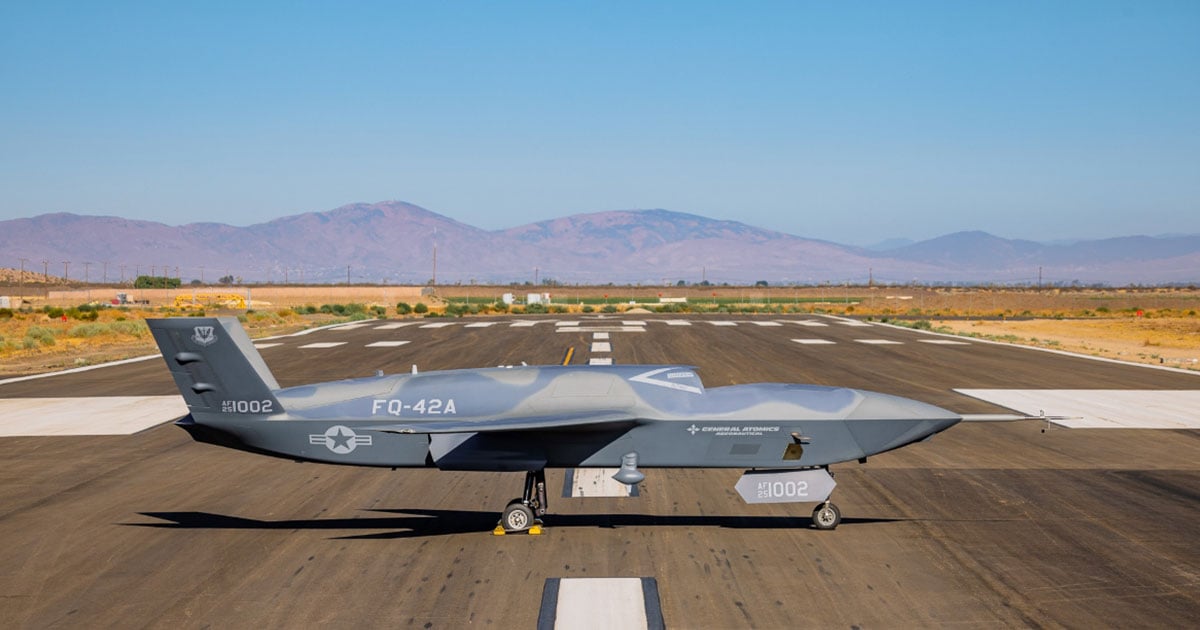
For more than three decades, every Predator, Reaper and Gray Eagle that General Atomics sold was built by General Atomics. On Friday the company broke that habit for its most important new aircraft. The fuselage of the FQ-42 Vengeance, the US Air Force’s new uncrewed fighter, will now also come out of a Boeing-owned factory in Wichita, Kansas.
General Atomics Aeronautical Systems (GA-ASI) announced on 23 October 2026 that Spirit Defense, a Boeing company, is its fuselage design-build partner for the FQ-42. The same morning, Spirit Defense opened a new production hall in south Wichita to do the work.
The reason is simple arithmetic. The US Air Force wants hundreds of these jets in a few years, and one factory is a single point of failure.
Informations clés
- Aéronef: General Atomics FQ-42A Vengeance uncrewed combat aircraft
- New partner: Spirit Defense, a Boeing company, as fuselage design-build partner
- Annoncé : 23 October 2026
- Où: New 50,000 sq ft production hall in south Wichita, Kansas
- Programme: US Air Force Collaborative Combat Aircraft (CCA), Increment 1
- Air Force goal: At least 500 CCAs in inventory by 2032
- Partnership began: 2022, according to GA-ASI
What GA-ASI and Spirit Defense announced
In its release, GA-ASI said Spirit Defense will support FQ-42 airframe production “from design through production”, adding manufacturing capacity and industrial depth to scale Collaborative Combat Aircraft (CCA) output faster. GA-ASI won its Air Force production contract for the FQ-42 in June.
The company stressed that it has been the sole manufacturer of its own line of uncrewed aircraft, including the MQ-9 Reaper, MQ-1C Gray Eagle and MQ-20 Avenger, since it was founded in 1992. Bringing in an outside airframe partner for the FQ-42 is a deliberate break with that model.
Spirit Defense is the defence arm of the former Spirit AeroSystems, now part of Boeing, and describes itself as an independent supplier to the defence industry. It is headquartered in Wichita, a city that has been building aircraft for more than a century.
A 50,000-square-foot hall in south Wichita
According to local station KWCH, the new facility covers 50,000 square feet and was converted from a former tooling and factory support building. Spirit Defense president and CEO Keith Schrader told reporters the empty floor would be “full with production” within a couple of months.

The partnership is not new, only newly public. Mike Atwood, GA-ASI’s vice president of advanced programs, said at the opening that the two companies started working together in 2022, and that the team set itself a 500-day target from the start of design to first flight.
The companies had hoped to show an aircraft at the event, KWCH reported, but every fuselage had already moved on to the next stage of production.
Why the Air Force needs a second production line
The FQ-42A is one of two designs the Air Force ordered into production under Increment 1 of its CCA programme. The other is Anduril’s FQ-44A Fury. The service has said it wants at least 500 CCAs in its inventory by 2032, a mixed fleet of both types, with further designs expected under a follow-on Increment 2.
These jets are meant to fly alongside crewed fighters such as the F-35, carrying weapons or sensors and taking risks a pilot should not. Atwood put the goal bluntly at the Wichita opening: an uncrewed aircraft that can do much of what an F-35 does, at about a quarter of the cost, to augment it rather than replace it.
Five hundred airframes by 2032, shared between two types, is a steep ramp for a brand-new class of jet. Adding Spirit Defense as a second source for FQ-42 fuselages gives GA-ASI more room to grow, and the Air Force a hedge if one line stumbles.
What comes next
GA-ASI also used the announcement to remind foreign customers of its Gambit Series, a family of modular uncrewed combat jets derived from the FQ-42, the XQ-67A and the MQ-20. The company said nations buying Gambit aircraft could add their own manufacturing, sensors and weapons.
For Wichita, the deal is another sign that the Air Capital is moving into the uncrewed era. For the Air Force, it is a hedge. If the CCA bet works, the service will want these jets faster than any single factory can build them.
Sources: General Atomics Aeronautical Systems, KWCH, KAKE, TWZ, Aviation Week


0 Comments