
Somewhere tonight a Boeing 737 will touch down harder than the crew intended. The cabin will jolt, a few people will say something unrepeatable, and everyone will carry on. It happens several hundred times a day somewhere in the world and it is almost never a story.
Except that in 459 American-registered 737s, there is a screen bolted to the ceiling panel above those passengers that the Federal Aviation Administration has now decided is not reliably bolted enough. On Monday 19 October 2026 the agency published four pages of the Federal Register explaining why. The document is called AD 2026-20-13. It applies to the 737-600, -700, -700C, -800, -900 and -900ER, it does not apply to the MAX, and it requires every affected operator to replace monitors that lack what the FAA calls a secondary retention lanyard. An aeroplane may have up to thirty of them.
If you read aviation news at all, you have seen dozens of stories that open with the words "the FAA has issued an airworthiness directive". Hardly any of them explain what one actually is. That is a shame, because the AD is the strangest and most quietly powerful instrument in civil aviation: a legally binding rule aimed at a named list of aeroplanes, which obliges the person who owns them rather than the company that built them, and which is formally part of the Code of Federal Regulations while being deliberately left out of the printed edition.
It is also wrapped in more confident folklore than almost anything else in aviation maintenance. Start with the thing everybody knows: that there are four types of airworthiness directive.
There are not.
Quick Facts: the airworthiness directive
Governing regulation: 14 CFR Part 39, fourteen sections running from 39.1 to 39.27
What it can apply to: aircraft, aircraft engines, propellers and appliances (39.3)
Test for issuing one: an unsafe condition exists in the product, and is likely to exist or develop in other products of the same type design (39.5)
Who it binds: whoever operates the product, not the manufacturer (39.7)
Where it is published: in full in the Federal Register as an amendment to 39.13; not reprinted in the annual CFR edition
Volume: 285 airworthiness-directive final rules so far in 2026, against 491 in 2021
Worked example here: AD 2026-20-13, Amendment 39-23486, effective 23 November 2026
What an airworthiness directive actually is
Part 39 is mercifully short. You can read the whole thing in about eight minutes, which puts it in a very small category of American aviation regulation. It opens by saying what it is for, and the phrasing is unusually plain: the regulations in this part provide a legal framework for the FAA's system of airworthiness directives.
Then it defines them. An AD is a legally enforceable rule applying to a product, and a product means an aircraft, an aircraft engine, a propeller or an appliance. Note what is absent from that list. There is no category for a procedure, a training requirement or an operator. An AD attaches to a thing.
The test for issuing one sits in 39.5, and it has two limbs that matter equally.
That second limb is the whole engine of the system. One hard landing on one aeroplane is an incident. One hard landing that reveals a weakness every other aeroplane of that design shares is a rule for the entire fleet. It is how a single event in a single cabin becomes a bill for 459 operators.
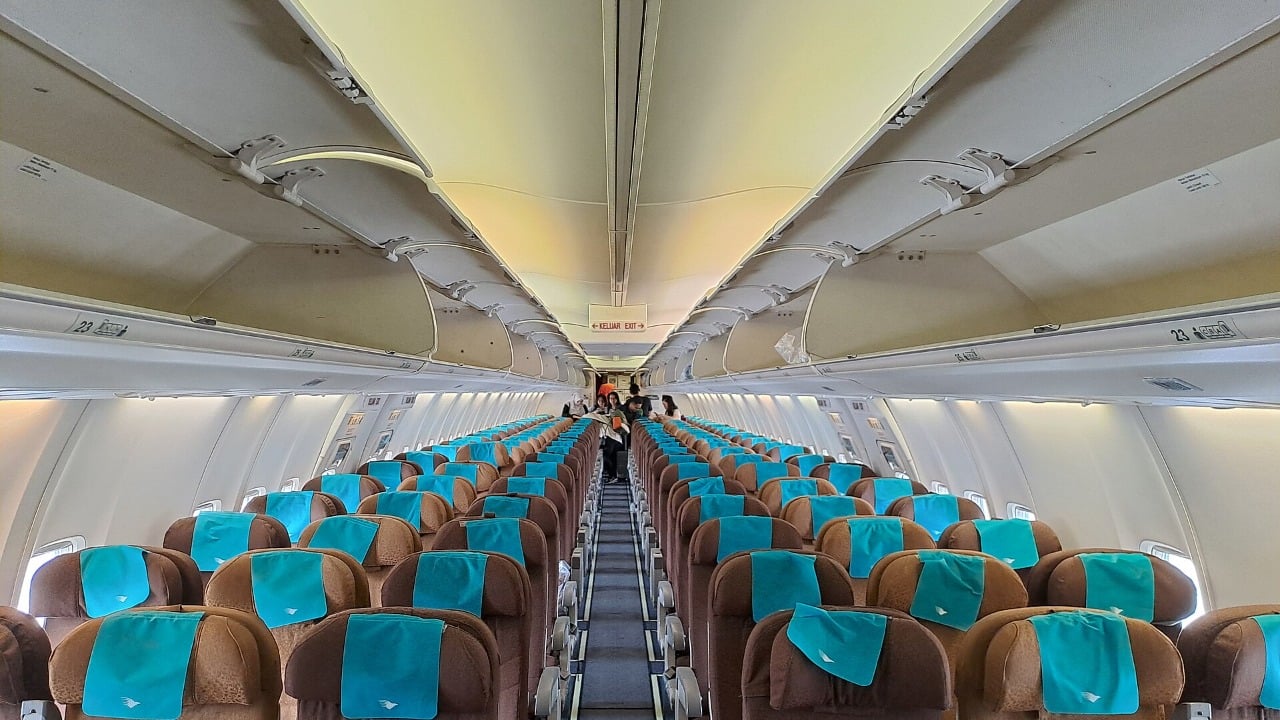
Which is exactly what happened here. The passenger service unit is the strip of hardware above your head: reading lights, air gasper, attendant call button, the no-smoking sign nobody needs any more, and behind a hinged panel the oxygen masks. On many older 737s a video monitor hangs off the rails that carry it. The FAA received a report that some of those monitors came away from the rails during a hard landing. Not a crash. Not an overrun. A hard landing that, in the agency's own careful wording, did not exceed the emergency load requirements the units were built to survive.
Read that last clause again, because it is the part that turns an annoyance into a rule. A screen that falls on someone is bad. A screen that stops halfway, dangling at head height down the length of a cabin you are trying to evacuate in ninety seconds, is a different problem altogether.
Who an AD binds, and it is not Boeing
Here is the first thing almost everyone gets wrong. Boeing does not comply with AD 2026-20-13. Boeing wrote the instructions. The airlines comply.
Part 39 is blunt about it. Section 39.7 says that anyone who operates a product that does not meet the requirements of an applicable airworthiness directive is in violation of that section, and 39.9 adds the sting: if the requirements have not been met, you violate 39.7 each time you operate the aircraft. Not once. Every flight is its own offence.
So the obligation lands on the certificate holder, the operator, the owner of the aeroplane. The manufacturer's role is to produce the document that says how. In this case the FAA mandated two of them, Boeing Special Attention Requirements Bulletins 737-25-1851 RB and 737-25-1858 RB, both Revision 1, both dated 15 July 2025. The first covers Burrana monitors, the second covers Panasonic.
On its own, a service bulletin is advice. A manufacturer can publish one on a Tuesday and no operator anywhere is obliged to act on it. The moment an AD incorporates it by reference, the same document becomes enforceable law, and Part 39 even anticipates the two drifting apart: under 39.27, where a service document and the AD that mandates it conflict, the AD wins.
The FAA's own 57-second explanation of the service bulletin, the document an AD usually points at.
The four types that are not four
Search for the types of airworthiness directive and you will be told there are four. Search again and you will be told there are three. Both answers are delivered with total confidence, by training schools, by exam crammers and by a great many websites, and the two taxonomies disagree with each other about what the categories even are.
Part 39 contains neither. Read all fourteen sections and there is no list of types, no taxonomy, no categories at all. The regulation defines what an AD is, when the agency issues one, what happens if you ignore it, what to do if your aeroplane has been modified, and how to ask for an alternative. It never once sorts them into kinds.
What does genuinely vary is procedural: how a given AD was made, and how much of the usual rulemaking the FAA was willing to wait for. There are three recognisable routes, and each one has a real example from the record.
Route one is the ordinary way. The FAA publishes a notice of proposed rulemaking, invites comments, reads them, and then publishes a final rule. AD 2026-20-13 went this way, and it is worth noticing how long that takes. The NPRM appeared in the Federal Register on 17 January 2025, at 90 FR 5751. The final rule appeared on 19 October 2026. The compliance clock does not start until 23 November 2026. From proposal to effect, that is more than twenty-two months for a problem the agency had already decided was unsafe.
Route two skips the proposal. The FAA publishes a final rule, it takes effect, and comments are invited afterwards, with the agency free to amend it if someone makes a good point. This is the route for problems that will not wait a year and a half. It is not rare: since 1 June 2026 alone the Federal Register has carried thirty-eight airworthiness-directive final rules that invite comments in the same breath, on everything from Lycoming engines to Stemme gliders to Leonardo helicopters. One of them grounded the Elixir trainer fleet on 13 October 2026.
Route three does not wait for the Federal Register at all. When the agency needs an aeroplane fixed this week, it sends the directive straight to the operators and prints it later. The most famous example in modern American aviation is AD 2000-03-51. On 11 February 2000 it went out by individual telegram to every known US owner and operator of the DC-9, MD-88, MD-90-30 and 717-200. Compliance was required within 72 hours of receipt. It was not published in the Federal Register until 28 February, seventeen days after it had already taken effect.
Keep that one in mind. We will come back to what it was about.
The comments are not a formality
Because the monitor AD took the slow route, we can see exactly what the comment stage is for, and the answer is more interesting than either of the usual caricatures. It is not a rubber stamp. It is also not a referendum on whether the rule should exist.
Six parties commented on the proposal. Boeing supported it without change. Delta asked the agency to confirm that it could establish which of its aeroplanes were affected by checking its own cabin layout drawings rather than physically walking every aircraft, and the FAA agreed in writing that either method was acceptable. Aviation Partners Boeing noted that its blended and split scimitar winglets, fitted under a supplemental type certificate, did not interfere with the work, and the FAA confirmed it. All Nippon Airways pointed out that Boeing was about to revise the two bulletins the proposal relied on. An individual noted that the Burrana service bulletins had later revisions too.
And Panasonic, whose monitors are fitted to 342 of the 459 affected American aeroplanes, pushed back on how it was being described.
The point Panasonic was making is a reasonable one. It did not want operators reading the rule as a finding that its hardware had failed a standard it was built to meet. It asked the FAA to insert a sentence saying so. The agency declined, and its reasoning is a small masterpiece of regulatory precision.
In other words: we never said yours came off, and the rule already says some rather than all, so there is nothing to fix. No change.
What the comments did change was the paperwork, and that matters more than it sounds. The FAA swapped the mandated documents from the December 2023 originals to the July 2025 Revision 1 versions, which add instructions for installing retention brackets where the PSU rail has no holes or the wrong shaped holes, and which drop converted freighters from the list. It added credit for operators who had already done the original work, so nobody has to redo a job they finished two years ago. And it recorded, flatly, that none of the changes would increase the economic burden on any operator.
That is what the comment process is. Not a debate about whether the screens are dangerous, but a negotiation about which revision of which bulletin, who gets credit for work already done, and whether a records check counts as an inspection.
What it costs to comply
ADs carry a cost estimate, and they are usually the only place you will find a regulator stating in public what a piece of maintenance is worth. The FAA puts the labour at two work-hours per monitor at 85 dollars an hour, so 170 dollars of time per screen. The parts are where it gets strange. A replacement Burrana monitor is costed at 2,734 dollars. A replacement Panasonic monitor is costed at 354 dollars.
Multiply that by up to thirty monitors on an aeroplane and the agency arrives at up to 5,401,440 dollars for the 62 aircraft with Burrana units, up to 5,376,240 dollars for the 342 with Panasonic units, and up to 4,791,600 dollars for 55 aircraft that are not listed in either Boeing bulletin and will have to find another way. Call it fifteen and a half million dollars, across 459 aeroplanes, to stop a screen falling on somebody.
Note the arithmetic quietly embedded there: the cheap monitor is fitted to five times as many aeroplanes as the expensive one, and the two totals come out almost identical.
How many of these are there?
More than most people imagine. Query the Federal Register for final rules on airworthiness directives and the count runs between roughly 280 and 490 a year for the last decade. One document normally carries one directive, so that is the rough order of magnitude: somewhere between five and ten new ADs every week, year in and year out, spread across every certificated aeroplane, engine, propeller and appliance on the American register.
Resist the temptation to read a safety trend into that shape. The count tracks how much certification work is flowing through the system, how many foreign authorities have issued directives the FAA is mirroring, and how many ageing fleets happen to be reaching an inspection milestone. A quiet year is not a safer year. It is usually a year when fewer problems happened to reach the end of a long paperwork pipeline.
When you cannot do what the AD says
Every operator eventually runs into an AD that does not quite fit its aeroplane, because the aeroplane has been modified, or because the part the directive names is no longer the part that is fitted. Part 39 has an answer, and it is the single most useful thing in the regulation for anyone who works on aircraft.
Section 39.17 says that if a change to your product affects your ability to do what the AD requires, you must request approval of an alternative method of compliance. Section 39.19 opens that door to everyone: anyone may propose an alternative method, or a change to the compliance time, if the proposal provides an acceptable level of safety. You send it to your principal inspector, who may add comments and forwards it to the office named in the directive. And then the sentence that decides everything: you may use the alternative you propose only if the manager approves it.
Section 39.21 adds a detail that saves a great deal of work, and that a surprising number of operators never use. The office responsible for approving alternatives can tell you which alternatives it has already approved. Somebody has usually asked before.
The monitor AD shows the mechanism in the open. Paragraph (g)(3) tells operators whose aeroplanes appear in neither Boeing bulletin that they must do the work through an approved alternative method. Panasonic, seeing that coming, asked the FAA to bless its own service bulletin as an accepted method so that those operators would not each have to file separately. The agency said it did not have enough data to do that, partly because Panasonic had not actually supplied the bulletin it was asking to have approved.
There is a second escape hatch for the aeroplane that is out of compliance and in the wrong place. Under 39.23, operators whose operations specifications allow it may fly to a repair facility to have AD work done; everyone else can apply for a special flight permit under 21.199. The FAA can attach conditions, and can refuse if it decides the aeroplane cannot be moved safely.
The FAA on what a directive requires of the person holding the spanner.
The rule that is in the regulations and not in the regulations
This is the detail that catches people out, and it is sitting in plain sight in section 39.13. Are airworthiness directives part of the Code of Federal Regulations? Yes. Are they printed in it? No. The FAA publishes each one in full in the Federal Register as an amendment to 39.13 itself, and the annual bound edition of the CFR does not reproduce them.
Which is why, if you open 14 CFR Part 39 looking for the directives that apply to your aeroplane, you will find fourteen short sections of procedure and not a single actual AD. The rules exist, they are binding, they are legally part of the code, and the code does not contain them. You have to go to the Federal Register, or to the FAA's own searchable database, and look up the directives that apply to your make, model and serial number.
It is an odd arrangement, and a sensible one. There are many thousands of live airworthiness directives. Printing them annually would produce a document nobody could lift and that would be out of date in a week.
Born out of something that already went wrong
Which brings us back to the telegram.
AD 2000-03-51 went out eleven days after an Alaska Airlines MD-83 came down in the Pacific a few miles north of Anacapa Island, California, with eighty-eight people on board. The directive itself is almost mundane to read. It told operators to look at the grease on the horizontal stabilizer jackscrew assembly, and at the area directly below it, for metal shavings and flakes, and to replace the assembly before further flight if they found any. The FAA's stated reason was that an operator had reported two instances of metallic shavings near a jackscrew, and that metallic shavings there indicate excessive wear.
That is the shape of almost every airworthiness directive ever written. A thing wore out, or cracked, or came loose, on one aeroplane. Somebody worked out that the same thing could happen on every other aeroplane of that design. And a document went out telling several hundred owners to go and look.
The 737 monitors are a gentler version of the same story, and that is the point. Nobody has been hurt by one. The FAA is not waiting to find out whether somebody will be. A report came in, the two limbs of 39.5 were satisfied, twenty-two months of paperwork followed, and from 23 November every one of those screens needs a lanyard.
Next time you read that the FAA has issued an airworthiness directive, you now know what has actually happened. Something broke on one aeroplane. Somebody decided it could break on all of them. And the bill has landed on the people who own them, not the people who built them.
Gold Seal Flight Training on why the system exists at all.
Sources: 14 CFR Part 39, Electronic Code of Federal Regulations; AD 2026-20-13, Amendment 39-23486, Federal Register vol. 91 no. 200, 19 October 2026, pp. 65941-65944; Federal Register document 00-4337, 28 February 2000, and document 00-19671, 8 August 2000; Federal Register API document counts, queried 24 October 2026; 14 CFR 21.199.



0 Comments