
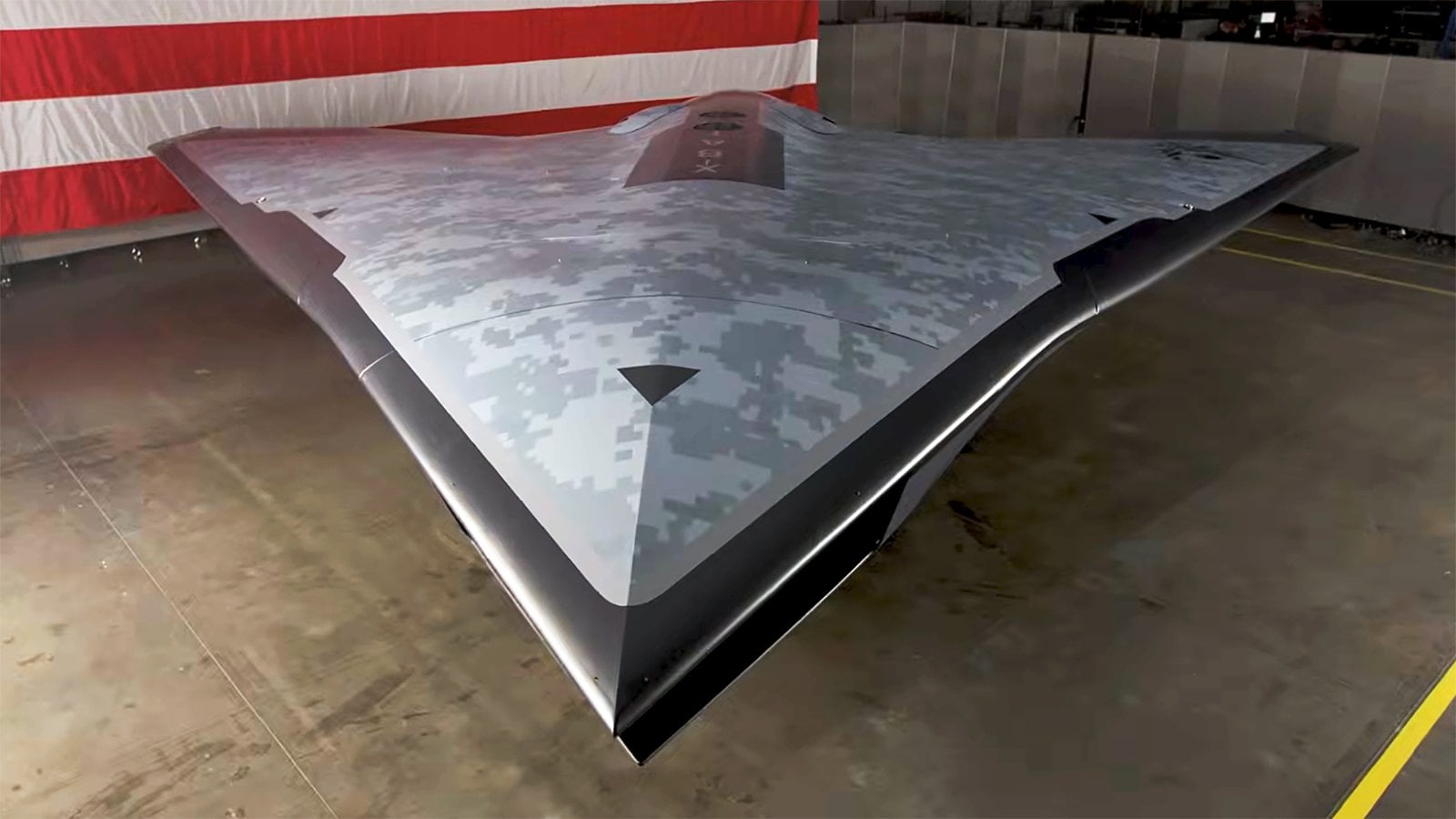
No runway. No cockpit. No landing gear. Shield AI has finally pulled the covers off the real thing: X-BAT 001, the first full-scale prototype of the jet-powered, tail-sitting combat drone the Texas company has been promising since it unveiled the concept in October 2025.
The short clip, released on Tuesday, 3 November 2026, shows a big, flat, arrowhead-shaped airframe in grey digital camouflage, lying on ground supports under dramatic hangar lighting. It is not flying yet. It is not even standing on its tail yet. But for a programme that has lived on renderings and scale models, a full-size airframe with a real engine bay is the moment the conversation changes from "can they draw it" to "can they fly it".
Informations clés
- Aéronef: Shield AI X-BAT, first full-scale prototype "X-BAT 001"
- Révélé: Video released 3 November 2026
- Concept: Jet-powered, tailless combat drone that takes off and lands vertically from a tail-sitting position
- Moteur: GE Aerospace F110-GE-129E with Axisymmetric Vectoring Exhaust Nozzle (AVEN)
- Prototypes: Two full-scale aircraft planned
- Prochaine étape : Flight test site at Newton, Kansas ("X-Forge 2"), moving from Frisco, Texas
- Advertised range: More than 2,000 nautical miles with a full mission payload (Shield AI figure)
What the X-BAT 001 Video Shows
According to Shield AI, X-BAT 001 is the first of two full-scale prototypes. It is being moved from the company’s main hub in Frisco, Texas, to its flight test facility at Newton, Kansas. Shield AI calls the two sites X-Forge 1 and X-Forge 2.
The airframe carries "X-BAT 001" and "Powered by Hivemind" markings, a nod to the autonomy software that is meant to fly it. Under the nose sits a broad intake. At the back is a round exhaust nozzle with overlapping metal petals, which is consistent with the F110 engine and the thrust-vectoring nozzle Shield AI has already tested with GE Aerospace.
What the clip does not show is just as telling. There is no engine run, no nozzle movement and no sign of the aircraft being raised into its vertical launch position. Aerospace Global News, which asked Shield AI to confirm the prototype’s status, noted that the footage alone cannot prove the engine installation is operational.
Shield AI’s own reveal clip of X-BAT 001, released on 3 November 2026.
A Design That Keeps Changing
The X-BAT has already been redrawn once. In April 2026 a half-scale model at the Navy League’s Sea-Air-Space exposition showed that the original “cranked kite” planform had given way to an arrowhead shape with a straight, more sharply swept leading edge. X-BAT 001 broadly follows that newer layout.
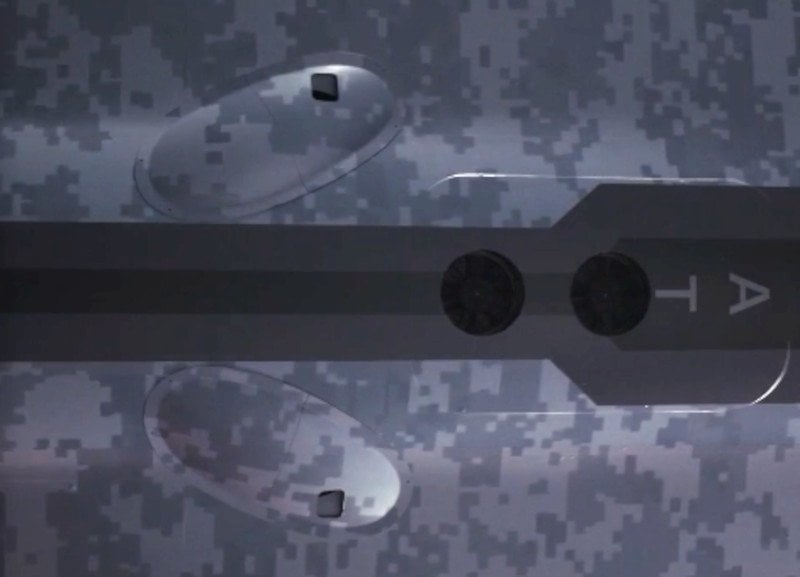
There are fresh surprises, though. As TWZ pointed out, the exhaust nozzle now sticks out well behind the wing trailing edges, while earlier models had it tucked into the rear fuselage. Two bulges flank the dorsal spine, each with a small opening at the front, and two circular openings covered with mesh screens sit on top of the spine. Shield AI declined to say what they are for.
The company is relaxed about the changes. A spokesperson told TWZ:
How a Fighter-Sized Drone Stands on Its Tail
The whole concept hangs on one piece of hardware: the Axisymmetric Vectoring Exhaust Nozzle, or AVEN. GE first developed it in the 1990s for an experimental thrust-vectoring F-16, and Shield AI has been using the original test nozzle, which had sat in storage for decades. The nozzle handles pitch and yaw. For roll, Shield AI has said it will bleed air through thrusters in the wings.
In July 2026, Shield AI and GE Aerospace completed integration, actuation and engine light-off testing of the AVEN on an F110-GE-129E at GE’s Peebles test site in Ohio. Shield AI announced it on X:
The guidance and control side draws on Shield AI’s much smaller V-BAT, a tail-sitting drone with an internal combustion engine. The payoff is a fighter-class aircraft with no need for landing gear or a runway, which the company pitches for ships, remote islands and austere bases. Shield AI advertises a range above 2,000 nautical miles with a full mission payload and internal weapons bays.
Armor Harris, who runs Shield AI’s aircraft division, told TWZ in October that the prototype is far more than a mock-up:
Harris has also compared the gap between the prototypes and a production X-BAT to the difference between the X-35 demonstrator and the F-35: broadly similar, but not the same aircraft.
What Comes Next for X-BAT
The planned test sequence, as reported by Interesting Engineering, is cautious and stepwise: horizontal engine runs on a launch-and-recovery vehicle, then vertical engine runs, then flights held by a crane, and only then untethered flight. Shield AI’s published schedule still has flight testing starting before the end of 2026, with development flying at Newton.
Further out, Shield AI plans to build production aircraft at Des Moines, Washington, from 2029. The U.S. Navy has already put money into the programme, as Afterburner reported in August and October, and it wants an operational capability on an aggressive timeline.
So, is this the moment the runway-free fighter becomes real? Not yet. A jet that hovers on its own exhaust is one of the hardest tricks in aviation, and X-BAT 001 has not lit its engine in public. But the drawings now have a body, and the clock on Shield AI’s promise is ticking loudly.
Sources: Shield AI, TWZ, Aerospace Global News, Interesting Engineering, Defense One



0 Comments