
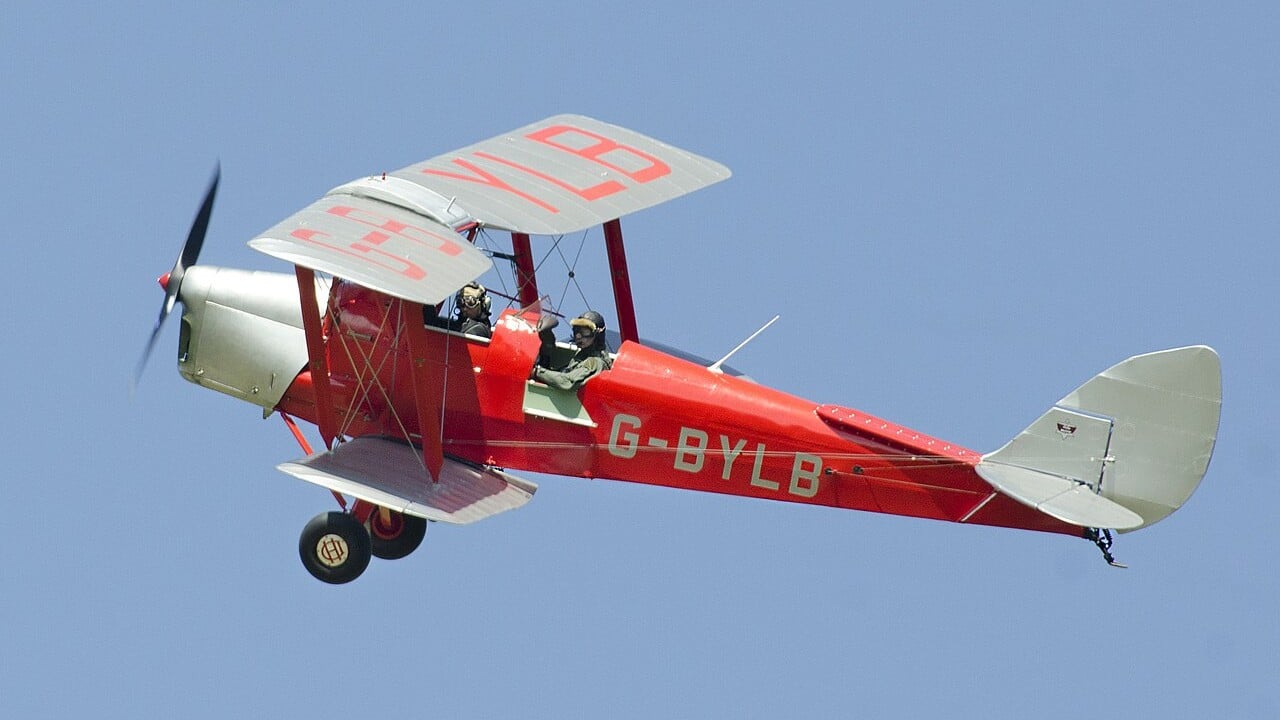
On Remembrance Day 1942, a 20-year-old trainee named Reg Harrison took a biplane up alone for the first time over Virden, Manitoba. He went on to fly 19 operations with Bomber Command and survive four crashes, which earned him the nickname “Crash”. Seventy-three years later to the day, aged 93, he climbed back into the same type of aircraft and flew it again.
L'avion était le de Havilland DH.82 Tiger Moth. Harrison was one of tens of thousands of young men, and a small group of pioneering women, whose first hours in the air were spent in its open cockpits. For a whole generation of Commonwealth airmen, the road to the Spitfire, the Lancaster and the Mosquito started with this fabric-covered de Havilland.
Informations clés
- Taper: Two-seat primary trainer biplane, single engine, tandem open cockpits
- Premier vol : 26 October 1931, Stag Lane, Edgware (prototype E6)
- Entré en service : February 1932, RAF Central Flying School
- Engine (DH.82A): de Havilland Gipsy Major, 130 hp
- Top speed (DH.82A): 109 mph (175 km/h)
- Construit: More than 8,800 (BAE Systems), in the UK, Canada, Australia, New Zealand, Sweden, Portugal and Norway
- Utilisateurs : More than 25 air forces
- Replaced in RAF: By the DHC-1 Chipmunk in the early 1950s
A Moth built for parachutes
The Tiger Moth grew out of de Havilland’s hugely successful DH.60 Moth family. The RAF wanted a primary trainer, and it had one demand the old Moth could not meet: the occupant of the front seat had to be able to get out quickly, wearing a parachute. On the DH.60, the fuel tank and the struts holding up the top wing sat right above that cockpit.
De Havilland’s fix gave the Tiger Moth its signature look. The upper wing was moved forward, and both wings were swept back slightly to keep the centre of lift in the same place. The prototype, E6, made its first flight from Stag Lane Aerodrome in Edgware, north London, on 26 October 1931, flown by chief test pilot Hubert Broad.
The de Havilland Aircraft Museum explains why the Tiger Moth’s wings are swept back, and how the design evolved from the DH.60 Moth.
The type entered service with the Royal Air Force Central Flying School in February 1932. The first machines used the 120 hp Gipsy III engine; the DH.82A, the Tiger Moth II, switched to the 130 hp Gipsy Major and became the definitive version. Export orders followed quickly, and the type eventually served with more than 25 air forces.
Easy to fly, hard to fly well
Instructors loved the Tiger Moth for a reason that sounds like a criticism. It was forgiving enough for a beginner, with benign stall and spin behaviour, but it would not hide mistakes. Its ailerons sit only on the lower wing and are heavily differential, so it needs active rudder in turns. Sloppy flying showed up immediately, and a botched aerobatic manoeuvre ended in a stall or a spin.
That made it a sorting machine. Air forces needed to know quickly which students had the touch for fighters, which belonged on bombers or transports, and which should not be pilots at all. With no electrical system, the Tiger Moth also had to be started by swinging the propeller by hand, a ritual every wartime cadet learned on day one.
The aircraft that trained an empire
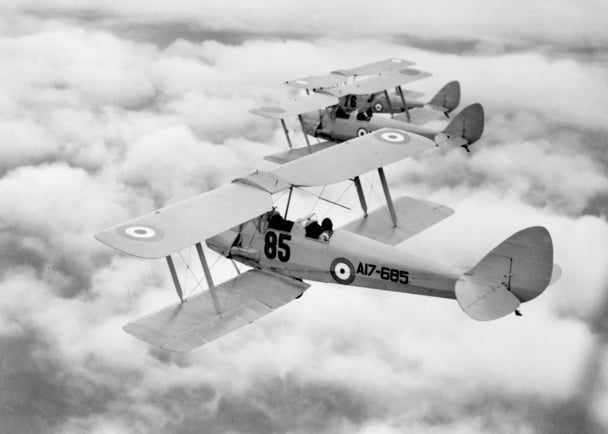
By the outbreak of war in September 1939, the RAF had around 500 Tiger Moths, and civilian examples across the Commonwealth were quickly pressed into military service. The real surge came with the British Commonwealth Air Training Plan, agreed by Britain, Canada, Australia and New Zealand on 17 December 1939.
By the time the plan closed on 31 March 1945, it had graduated 131,553 aircrew, including 49,808 pilots, according to the Royal Canadian Air Force. Elementary flying training in Canada was usually done on Tiger Moths, Fleet Finches and Fairchild Cornells, and across the Commonwealth the Tiger Moth became the standard primary trainer.
To feed that machine, Tiger Moths were built on three continents. Royal Canadian Air Force machines came from de Havilland Canada at Downsview, Ontario, which built 1,548 of all versions, including about 200 ordered under US Lend-Lease as the PT-24 and passed to the RCAF. Canadian Tiger Moths got a sliding canopy and cockpit heating for the winters. De Havilland Australia built 1,070 for the Force aérienne royale australienne and others.
In Britain, de Havilland moved Tiger Moth production from Hatfield to Morris Motors at Cowley, Oxford, in 1941. Smaller batches were built in New Zealand, Sweden, Portugal and Norway. BAE Systems, which holds de Havilland’s heritage, puts total production at more than 8,800.
British Movietone newsreel from December 1940: a factory in Sydney turning out Tiger Moths as trainers.
First flights in Kenya, first women in the ATA
Not every Tiger Moth student trained in Canada. In November 1939, a Shell Oil trainee named Roald Dahl joined 15 other would-be pilots at a flight school in Nairobi, Kenya. HistoryNet’s account says flying often began only after zebras had been chased off the airfield, and that Dahl, very tall, had his head sticking out well above the tiny windscreen. He soloed after 7 hours and 40 minutes and later flew Hurricane in Greece.
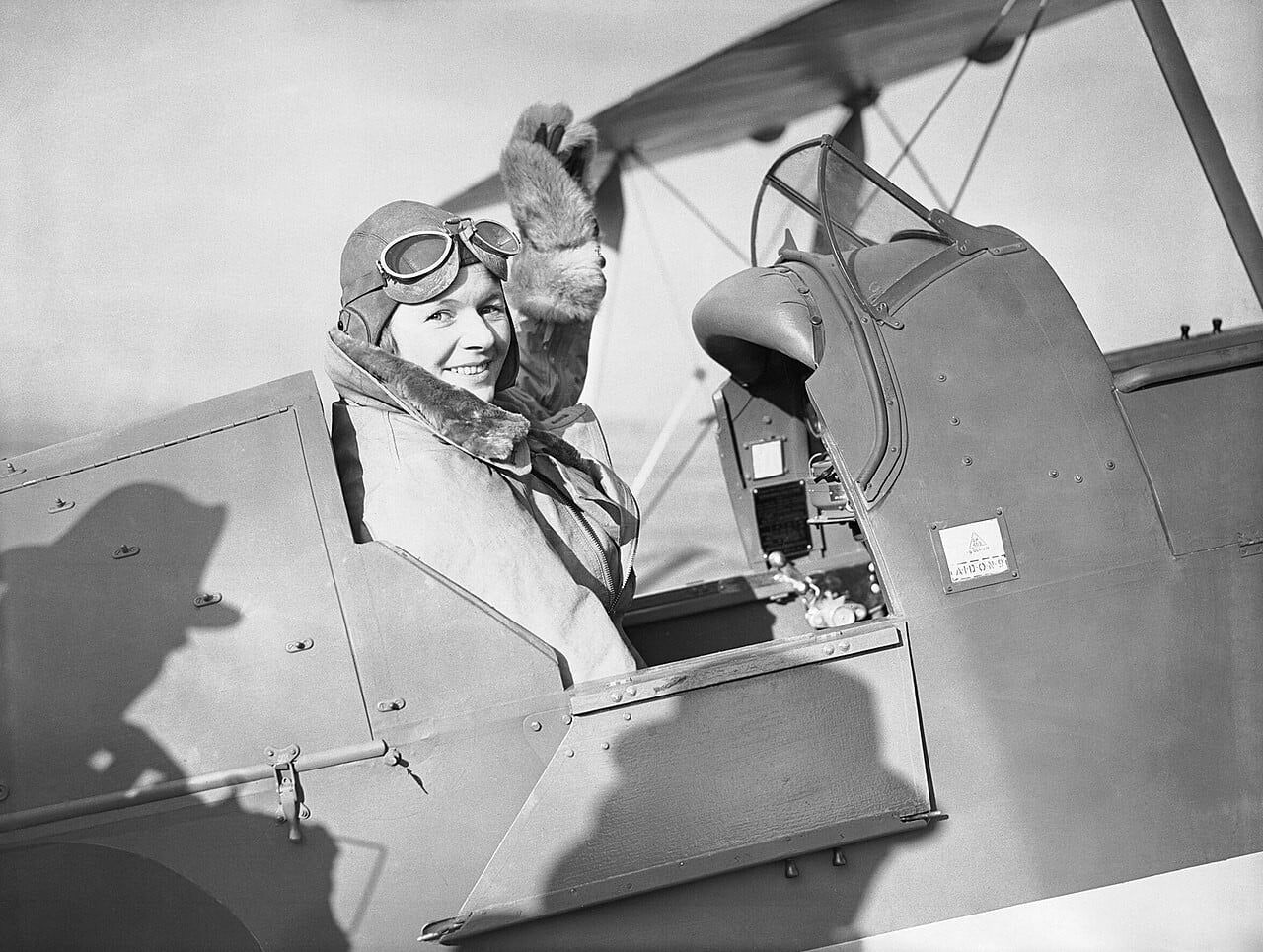
Back in England, the Tiger Moth opened another door. On 1 January 1940 the Air Transport Auxiliary took on its first eight women pilots, led by Pauline Gower, at Hatfield. At first they were cleared to ferry only Tiger Moths. By July 1941 one of them, Winifred Crossley, had flown a Hurricane, and according to the ATA Museum some of the original eight went on to fly four-engined bombers.
The Queen Bee and a new word
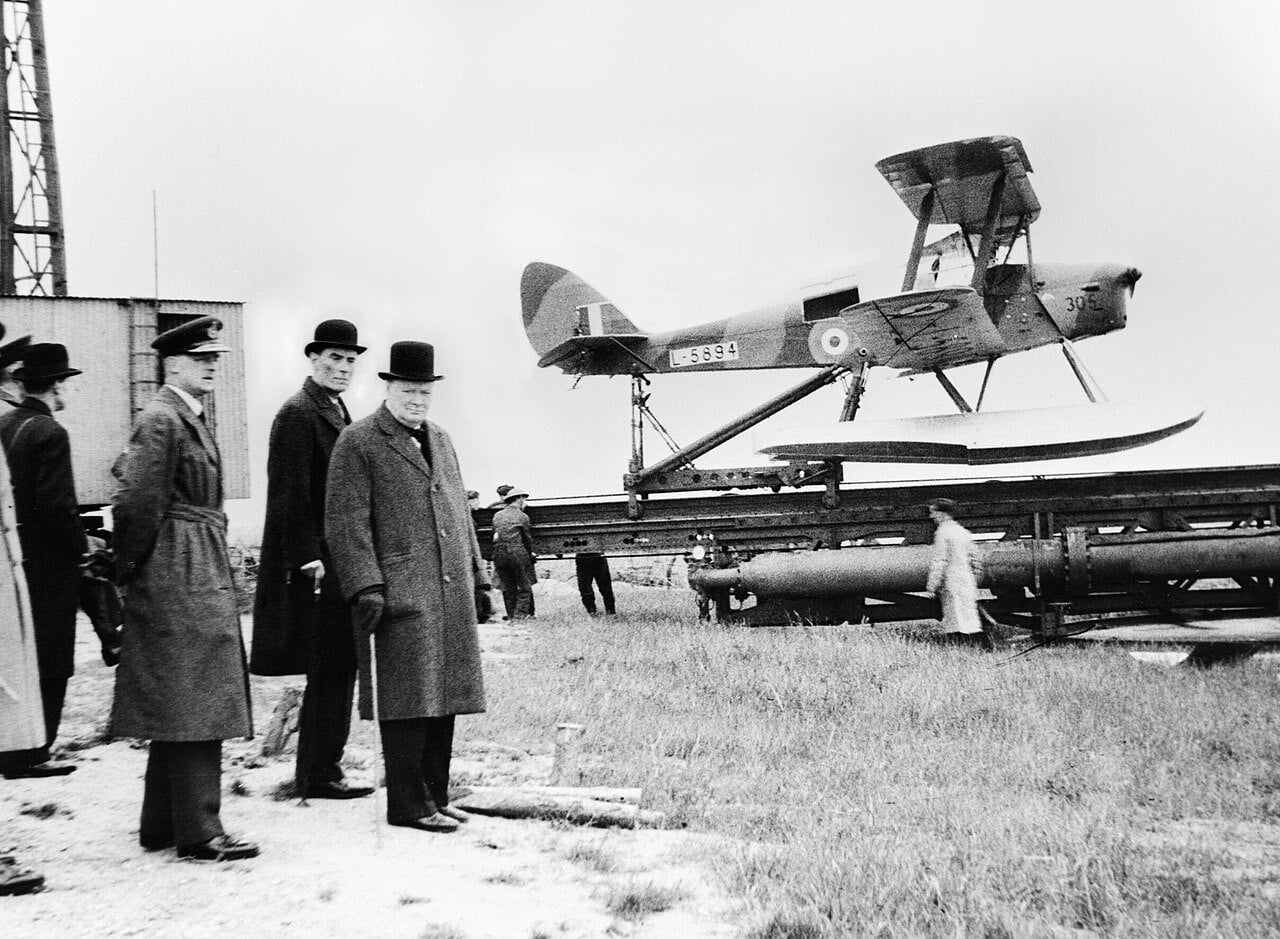
The Tiger Moth’s strangest offspring had no pilot at all. In 1935 de Havilland produced the DH.82 Queen Bee, a radio-controlled target for training anti-aircraft gunners, using Tiger Moth wings on a wooden Moth-style fuselage. It is widely credited as the origin of the word “drone” for unmanned aircraft: the male bee to the Queen Bee. BAE Systems says the term is thought to have been coined at this time.
After the war, the RAF replaced the Tiger Moth with the de Havilland Canada Chipmunk in the early 1950s, and thousands of surplus aircraft flooded the civil market. They towed gliders, sprayed crops, trained club pilots and flew aerobatics. The Shuttleworth Collection says upwards of 50 are still flying in Britain alone.
Reg Harrison’s 2015 flight was in a Tiger Moth that a Saskatchewan pilot had bought from a museum and restored. When he landed, he told reporters it was “a great feeling to be here.” Ninety-odd years after Hubert Broad first lifted it off at Stag Lane, the biplane that taught the Commonwealth to fly is still doing exactly that.
Sources: BAE Systems Heritage (DH.82 Tiger Moth and Queen Bee), Royal Canadian Air Force (BCATP), Shuttleworth Collection, ATA Museum, CTV News, HistoryNet, Imperial War Museum, Australian War Memorial, Wikipedia (de Havilland Tiger Moth; British Commonwealth Air Training Plan; Air Transport Auxiliary; Going Solo)
Header photo: John Fielding / Wikimedia Commons, CC BY 2.0
0 Comments