
One nuclear explosion in low Earth orbit would not need to hit anything to empty it. A study posted in November 2026 by researchers from the University of Wisconsin–Madison and Princeton modelled a 1-megaton detonation 500 kilometres above the South Atlantic and found that it would disable about 98 percent of the satellites in low Earth orbit within a week. The flash of the explosion is not the main killer. The radiation belt it leaves behind is.
Informations clés
- Study: “Effects of a Nuclear Detonation in Low Earth Orbit”, arXiv, submitted 6 November 2026 (not yet peer reviewed)
- Authors: Zachary Petersen, Hong Qin, Sarah Thiele, Sébastien Philippe
- Scenario: 1 megaton at 500 km altitude, over the South Atlantic Anomaly
- Satellites modelled: About 13,300 active satellites in low Earth orbit (up to 2,000 km), January 2026
- Prompt X-ray damage: About 3 percent disabled at once
- After the radiation belt forms: 25% after one day, 78% after three days, 98% after one week
- Historical precedent: Starfish Prime, 9 July 1962: 1.4 megatons at about 400 km
The Belt, Not the Blast
According to the paper, the burst of X-rays from the explosion would disable 383 satellites, just under 3 percent of those modelled. The real damage comes afterwards. Electrons released by the radioactive decay of fission products would be trapped by Earth’s magnetic field, creating an artificial radiation belt. Satellites in low orbit pass through it again and again, and each pass adds to the dose their electronics have absorbed. In the authors’ central case, half the satellites are gone within about two days, 90 percent within about four, and 98 percent after a week.
The figure applies to satellites in low Earth orbit, not to every satellite: geostationary communications satellites and navigation constellations higher up were not modelled. Harder satellites would last longer. If their electronics could take three times the dose, about 72 percent would be disabled after a week and more than 99 percent after a month. Even a much smaller, 100-kiloton weapon would disable about 90 percent within a month.
It Has Happened Before
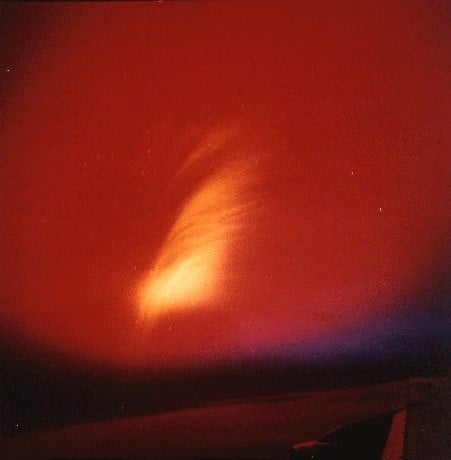
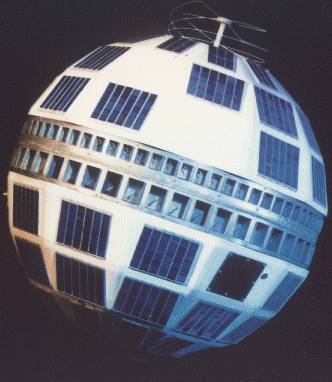
The study builds on a real experiment. On 9 July 1962, the United States detonated Starfish Prime, a 1.4-megaton warhead carried about 400 kilometres above Johnston Island in the Pacific. It lit up the sky over Hawaii, about 1,300 kilometres away, and created an artificial radiation belt that, according to a NASA Goddard analysis, caused the loss of seven satellites within months. The first was Telstar, the pioneering communications satellite launched the day after the test. There were only a few dozen satellites in orbit then.
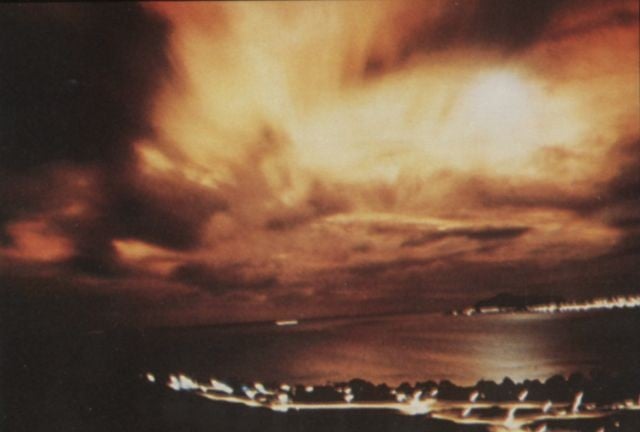
The US government’s 1962 film report on Starfish Prime. Video: atomcentral (archive upload).
Pourquoi c'est important maintenant
Low Earth orbit now carries well over ten thousand active satellites, many of them broadband constellations at 500 to 600 kilometres. The study also models collisions as dead satellites drift: about 20 within two years and some 3,900 new fragments after a decade. It sets no date for recovery. Starfish Prime’s electrons persisted for years, and replacement satellites launched into the belt would face the same radiation.
The scenario is not purely academic. In February 2024 the White House said Russia was developing an anti-satellite capability, which a Pentagon official later described as a new satellite carrying a nuclear device. Placing nuclear weapons in orbit is banned by the 1967 Outer Space Treaty, and in April 2024 Russia vetoed a UN Security Council resolution reaffirming that ban.
How scientists are recovering data from the films of 1950s and 1960s nuclear tests, including high-altitude shots. Video: Lawrence Livermore National Laboratory.
What the Viral Post Gets Right
The post summarises the study accurately: 1 megaton, 500 km above the South Atlantic, 98 percent within a week, and trapped fission electrons rather than the X-ray flash as the main cause. Two clarifications: the 98 percent refers to satellites in low Earth orbit, not all satellites, and the work is a preprint that has not yet been peer reviewed.
Sources: Z. Petersen, H. Qin, S. Thiele and S. Philippe, “Effects of a Nuclear Detonation in Low Earth Orbit”, arXiv:2611.09827 (6 November 2026); New Scientist (16 November 2026); E. G. Stassinopoulos, NASA Goddard Space Flight Center, on the Starfish radiation belt (NASA Technical Reports Server); SpacePolicyOnline (15 February 2024); Defense One (1 May 2024); Arms Control Association (May 2024).



0 Comments