
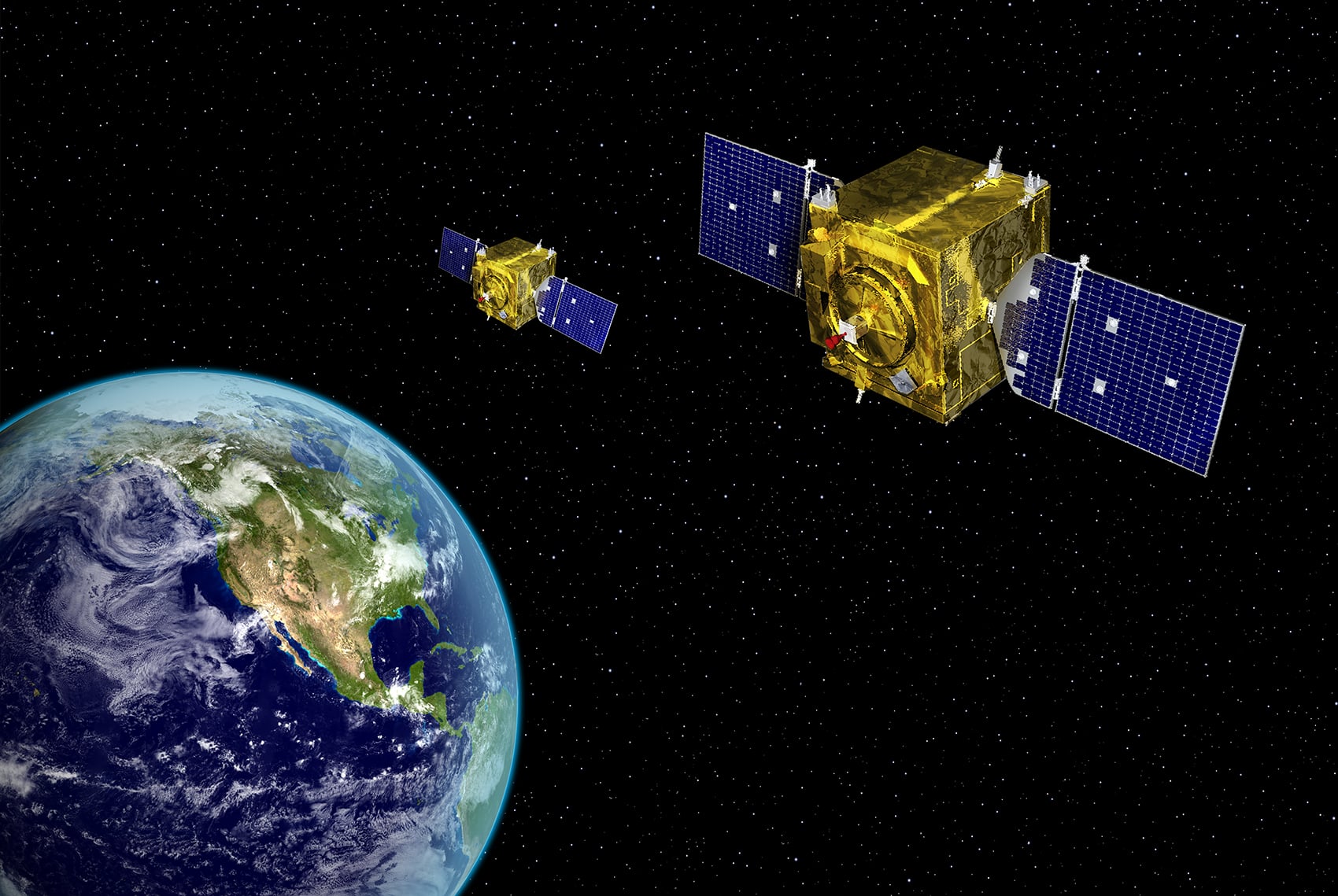
Ten days ago the Secretary of the Air Force, Troy Meink, told a conference hall at National Harbor that the Space Force has on-orbit space control weapons. It was the first time a Pentagon official had said it plainly, and he confirmed afterwards that the phrasing had been deliberate. We covered the admission itself when it happened.
What has followed is more interesting than the announcement. The first substantial European expert response has come from Zurich, and it opens by deflating the story rather than inflating it.
Clémence Poirier is a senior researcher in cyberdefence at the Center for Security Studies at ETH Zurich. Asked by the Tages-Anzeiger whether the weapon the United States has now named was recently put into orbit, her answer was one word long.
Informations clés
- What was said: US Air Force Secretary Troy Meink confirmed the Space Force operates on-orbit space control weapons, 14 September 2026
- The expert view: Clémence Poirier, senior researcher, Center for Security Studies, ETH Zurich, interviewed by the Tages-Anzeiger
- Her central point: Nothing new was launched. An existing capability was relabelled as a weapon
- Legal position: The 1967 Outer Space Treaty bans only weapons of mass destruction in orbit. Conventional anti-satellite weapons are not prohibited
- The economic stake: A single day without GPS would cost the United States around $1 billion, by a Department of Commerce estimate
- The Swiss angle: Switzerland operates no state satellites, which Poirier argues makes it a candidate mediator — but the armed forces are spending CHF 850 million to change that
The United States Did Not Launch Anything. It Renamed Something.
This is the part that got lost in the headlines, and it is the difference between an event and a statement.
Nothing went up. Nothing changed in orbit on 14 September. What changed was a word, and Poirier’s argument is that the word is the escalation. The growing armament of space has been visible for years, so the existence of the capability surprises nobody. Admitting it publicly is new, and other states may read the admission itself as a move — which produces a security dilemma and, from there, an arms race, with China and Russia the most likely to respond by accelerating their own counterspace programmes.
That is a specific and testable claim, and it is more useful than the alternative framing, which is that America has secretly parked a death ray over your house.
Militarisation Is Sixty Years Old. Weaponisation Is Not.
Poirier draws a distinction that most coverage collapses, and everything downstream depends on it.
Militarisation means using satellites to support military operations on the ground: reconnaissance, communications, navigation, missile warning. That has been routine since the 1960s and nobody seriously contests it. Weaponisation means putting weapons in orbit. The first is about operations on Earth, assisted from space. The second is about space itself as the place where the fighting happens.
She is also careful about where American capability actually sits. The United States holds weapons in every category — kinetic, non-kinetic, electronic and cyber — but most of them are on the ground, not in orbit. Ground-launched anti-satellite missiles are not orbital weapons, and conflating the two makes the situation look further along than it is.
The categories are worth keeping straight. Non-kinetic covers directed energy: lasers and microwaves. Electronic and cyber cover jamming and attacks on a satellite’s links and software. Kinetic covers physically hitting the target, which so far has meant missiles fired from Earth. The United States, the Soviet Union and later Russia, China and India have all demonstrated this by destroying their own satellites.
The category that would genuinely change things is co-orbital kinetic: an armed satellite attacking another satellite. As far as anyone outside the programmes knows, that does not yet exist.
The Treaty Bans Exactly One Thing
The 1967 Outer Space Treaty is usually invoked as though it prohibits weapons in space. It does not. It prohibits weapons of mass destruction in orbit, and nothing else.
That gap also tells you what the American weapon almost certainly is not. Washington has repeatedly insisted its activities remain consistent with the treaty, and nuclear weapons are the single category the treaty explicitly forbids in orbit. Stating compliance and deploying the one banned thing would be an odd combination.
Efforts to close the gap have gone nowhere, and Poirier is blunt about why. China and Russia have proposed a treaty banning space weapons at the United Nations without defining what a space weapon is. A ban on an undefined object is not a ban.
The One Time Somebody Did Set Off a Nuclear Weapon in Orbit
There is a reason the nuclear option sits in its own category, and it is not squeamishness. It is Starfish Prime.
On 9 July 1962 the United States detonated a 1.4 megaton warhead at an altitude of 400 km, carried up by a Thor rocket from Johnston Atoll and set off about 31 km to the south-west. It was not aimed at anything. There was nothing up there to aim at.
The electromagnetic pulse reached Hawaii, roughly 1,450 km away, where it knocked out around 300 streetlights and damaged a telephone company microwave link, cutting calls from Kauai to the other islands. That was the visible part. The lasting damage was above: the detonation pumped high-energy electrons into artificial radiation belts around the Earth, and over the following months six or more satellites died of it, their solar arrays and electronics degraded. Telstar 1, the first commercial communications relay, was among them. So were Transit 4B, Britain’s first satellite Ariel 1, TRAAC and Injun.
A weapon detonated at nobody, in an orbit that was nearly empty, disabled a meaningful fraction of everything humanity had put in space. There are now roughly 14,000 active satellites.
Why Nobody Wants This, the United States Least of All
Poirier makes a point that cuts against the instinct to read the American announcement as sabre-rattling: the United States has more to lose in orbit than anyone.
It operates the most satellites and has the most space-dependent economy. Shooting down someone else’s satellite produces a debris cloud that does not check passports, and a piece of debris one centimetre across can destroy a multi-tonne spacecraft. A significant share of the debris already up there comes from anti-satellite tests. Cascading collisions — the Kessler syndrome — are showing early signs at some altitudes.

And then there is the number that makes the point without any hardware at all. A calculation by the US Department of Commerce found that if GPS alone were unavailable in the United States for a single day, it would cost the American economy in the order of $1 billion. Not the satellites. Not the launch. Just the absence of the signal, for one day.
Space is the one domain where the strongest power is also the most exposed.
The Swiss Opening
This is where the interview stops being a briefing and starts being a proposal, and it is the part with direct consequences for Bern.
Poirier’s argument is that Switzerland is unusually well placed to mediate in orbit, and the reason is almost absurdly simple: it has no state satellites of its own. A country with nothing in orbit has no position to defend up there, which makes it credible in a way that no other European state currently is.
The specific jobs she sketches are not abstract. Opening channels between operators who have no way of talking to each other. Confidence-building before an incident and de-escalation after one. Mediating for states with no diplomatic relations at all — she names North and South Korea, and Israel and Iran. And then the genuinely novel work: what does a ceasefire in orbit even look like? How do you withdraw from a conflict in orbit? How do you monitor a truce there? How do you deactivate systems you cannot simply unplug? Nobody has answers, and somebody will need them.

And How Narrow the Window Is
Here is the part the interview gestures at with one word — yet — and which deserves spelling out, because it is on a published timetable.
The Swiss Armed Forces are in the middle of acquiring exactly the thing whose absence underpins the neutrality argument. A Space Competence Centre was established on 1 January 2026, sitting inside the Joint Operations Command within the Swiss Air Force. The programme carries a cost ceiling of CHF 850 million over twelve years, covering investment and operation, and is staffed by 222 specialist conscripts plus a professional core team. The first concrete services, in Earth observation and telecommunications, are expected in 2027 and 2028.
Five capabilities are declared. An operational picture of activity and threats in space. Earth observation for intelligence, reconnaissance and surveillance. Redundant and resilient troop communications. Precision navigation. And, fifth, countermeasures: protection against space-based reconnaissance and the disruption of hostile systems.
Read that last one again. It is, in the vocabulary Poirier uses earlier in the same interview, a counterspace capability. Modest, defensive in intent, and entirely reasonable for a country that currently depends on foreign infrastructure for everything it sees and sends. It is also the precise category of thing that makes a state a participant rather than a referee.
So the window is roughly two years wide. Switzerland can credibly offer itself as the neutral instance in orbit for about as long as it has nothing in orbit, and it has already bought the ticket out of that position. Whether those two things can coexist — a small sovereign constellation and a mediating role — is a policy question nobody in Bern appears to have been asked yet. It is worth asking now rather than in 2028.
What Europe Should Actually Ask For
Poirier’s recommendation for European states is deliberately unglamorous. Go through diplomatic channels and ask the Americans which weapons they are talking about.
It does not have to be public. It does have to be shared. Allies who are expected to plan around a capability should be able to know what the capability is, and at the moment European governments are reading about it in the same conference reports as everybody else. That is a thin basis for an alliance in a domain where the response time to an incident is measured in minutes.
Sources: Interview with Clémence Poirier by Joachim Laukenmann, Tages-Anzeiger, 21 September 2026 (quotations translated from German); Center for Security Studies, ETH Zurich; swissinfo.ch; the Swiss Armed Forces (vtg.admin.ch) on space-based capabilities; NASA Orbital Debris Program Office; US Department of Commerce GPS economic impact study; Wikipedia entry for Starfish Prime



0 Comments