
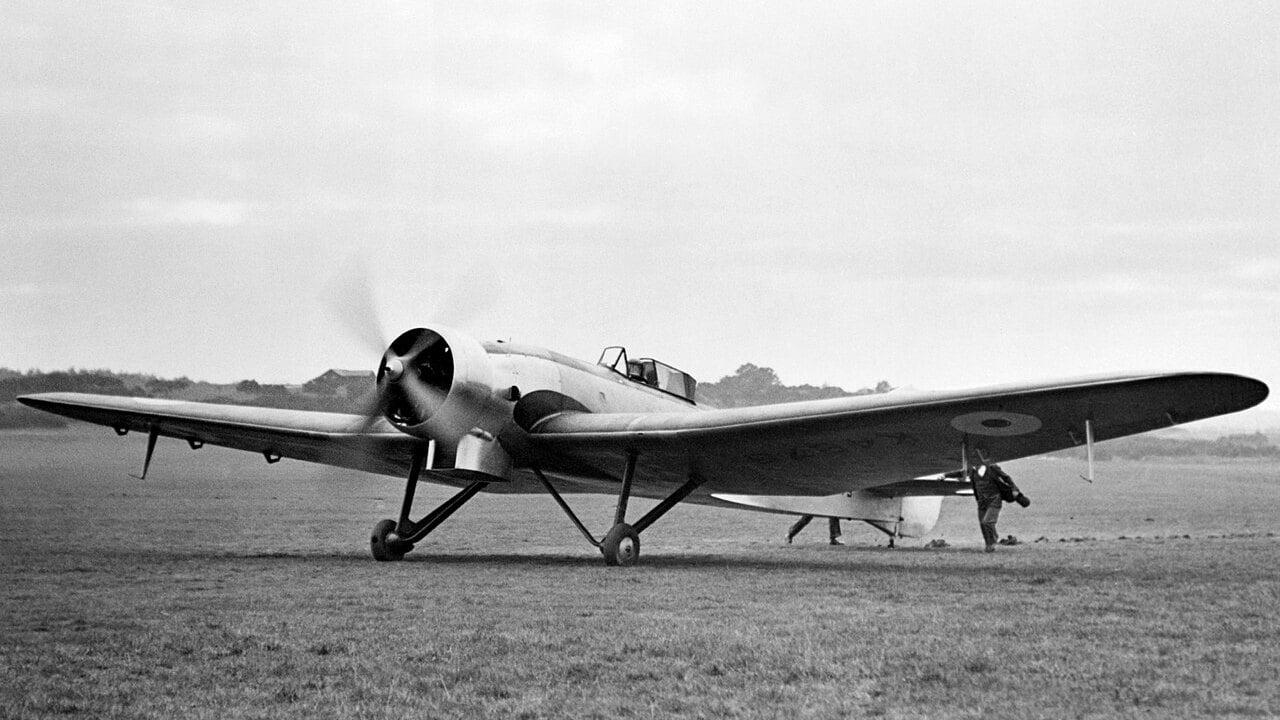
Somewhere above 45,000 feet over southern England on 28 September 1936, Squadron Leader F.R.D. Swain sat inside a rubberised suit, sealed into a helmet with a window in front of his face, and realised he could not get enough air. Below him, the whole English coast was spread out like a map. Above him there was almost nothing.
He was flying the Bristol Type 138A, a wooden monoplane built for one purpose: to climb higher than any aeroplane had climbed before. That afternoon it did. And to get home alive, Swain had to cut his way out of his own helmet.
Informations clés
- Aéronef: Bristol Type 138A high-altitude research monoplane, serial K4879
- Built to: Air Ministry Specification 2/34, for 50,000 ft
- Premier vol : 11 May 1936, Cyril Uwins
- Moteur: Bristol Pegasus P.E.6S, 500 hp, two-stage supercharger with intercooler
- Taille: 66 ft (20.12 m) span, 44 ft (13.41 m) long, mostly wooden
- Record 1: 28 September 1936, Sqn Ldr F.R.D. Swain, 49,967 ft (15,230 m)
- Record 2: 30 June 1937, Flt Lt M.J. Adam, 53,937 ft (16,440 m)
- Second airframe: Type 138B (Kestrel engine), never flown
The race for the stratosphere
In the early 1930s, the world altitude record was a matter of national prestige. Britain’s Cyril Uwins took it in an open-cockpit Vickers Vespa in September 1932 at 43,976 feet. France’s Gustave Lemoine took it back in a Potez 50 in 1933, and Italy’s Renato Donati pushed it to 47,352 feet in a Caproni in April 1934.
The Bristol Aeroplane Company had an odd place in this race. Its engines had powered several of the record-breakers, including the two Westland Wallaces that flew over Everest in 1933, yet Bristol itself had no record aircraft. Designer Frank Barnwell proposed one in November 1933. Donati’s flight changed the mood in Whitehall, and in June 1934 the Air Ministry issued Specification 2/34 for an aircraft able to reach 50,000 feet.
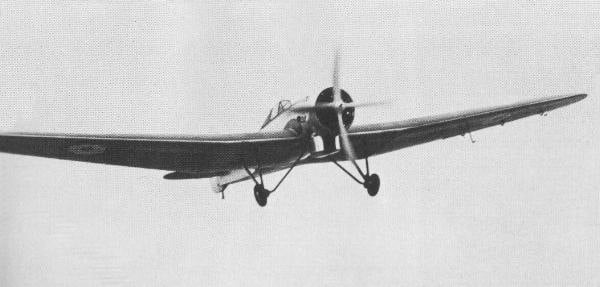
Barnwell’s answer was the biggest single-seat aeroplane anyone had built, with a 66-foot wing on a 44-foot fuselage. Weight mattered more than anything, so the airframe was almost all wood: a plywood skin glued over mahogany longerons, with only the engine mount and cowling in steel. Even the undercarriage stayed fixed, because a retracting gear would have weighed more than the drag it saved.
A Pegasus with two lungs
The heart of the aircraft was a 500 hp Bristol Pegasus P.E.6S radial with a two-stage supercharger and an intercooler between the stages. The first stage ran all the time. The pilot clutched in the second stage by hand once he was high enough, because at low level it would have forced too much air into the cylinders.
The aircraft, serial K4879, first flew on 11 May 1936 in the hands of Bristol chief test pilot Cyril Uwins, the same man who had set the 1932 record. The special engine was not ready, so the early flights used a standard Pegasus with a three-blade propeller. Later in 1936 the record engine and a four-blade propeller went in, and the 138A moved to the Royal Aircraft Establishment at Farnborough.
Archive footage of the Bristol Type 138 high-altitude monoplane in 1937.
A diving suit for the sky
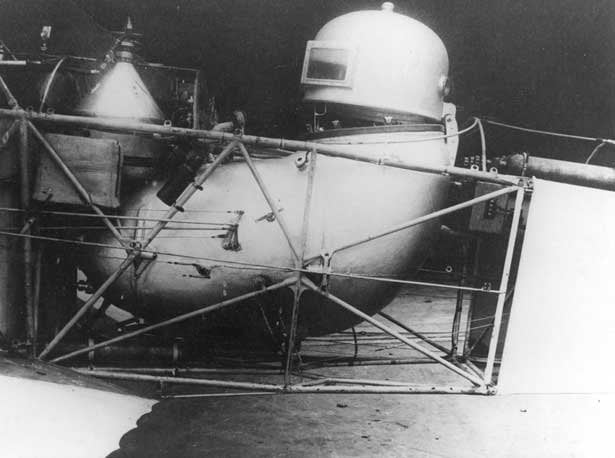
No cockpit of the day could be pressurised, so the pressure had to travel with the pilot. The idea went back to the physiologist John Scott Haldane, and the diving firm Siebe Gorman turned it into hardware: a two-piece suit of rubberised fabric, sealed at the waist, with a helmet that had a large window at the front.
Oxygen came in by hose and circulated in a closed loop, with a canister of chemicals scrubbing carbon dioxide out of the pilot’s breath before it came back to him. The suit was rigid and tailored to fit only in a sitting position, according to an account in Air Force Magazine. That rigidity nearly killed its first record pilot.
28 September 1936: Swain’s climb
Swain had joined the RAE’s experimental section in 1933 and was picked to fly the record attempts. He took off from Farnborough on 28 September 1936. Air Force Magazine’s account says that at 45,000 feet he could see the English coastline from Margate to Land’s End.
British Pathé newsreel of the 1936 world altitude record flight.
At the top of the climb his recording instruments were later calibrated at 49,967 feet, nearly ten miles up, and the FAI accepted it as a world record. But coming down, Swain felt dizzy and short of oxygen. He could not open the suit or the cockpit window, so once he was low enough he cut through the window of his helmet with a knife and breathed outside air.
He had beaten Donati’s official record and the unofficial 48,698 feet France’s Georges Détré had reached in a Potez 506 only weeks before. Britain held the record. For a while.
30 June 1937: Adam’s answer
On 8 May 1937, Italy’s Lieutenant Colonel Mario Pezzi took the record back in a Caproni Ca.161 at about 51,360 feet. Bristol and the RAE had been refining the 138A, mostly by shedding weight and improving the supercharger, and the response came quickly.
On 30 June 1937, Flight Lieutenant M.J. Adam took the 138A up for a flight of about two and a quarter hours and reached a certified 53,937 feet (16,440 metres). Near the top, the cockpit canopy cracked open. The pressure suit and helmet that had almost suffocated Swain protected Adam instead.
A second British Pathé newsreel on the 1936 altitude record.
It was the 138A’s last record. A second airframe, the two-seat Type 138B with a supercharged Rolls-Royce Kestrel, was delivered to Farnborough in 1937 but never received its engine and ended its days as a ground instructional airframe. Pezzi reclaimed the record in October 1938 in the Ca.161bis at 56,046 feet, a piston-engine mark that stood for decades.
What the wooden giant left behind
The Bristol 138 never fought, never carried a bomb and never went into production. Its value was in the data. The flights gave British scientists early practical experience of what the human body needs above 50,000 feet, and of the suits, helmets and breathing systems that keep a pilot alive there.
Within a few years, high-altitude flight would stop being a stunt. Pressurised cockpits, partial-pressure suits and, eventually, the full pressure suits of U-2 and SR-71 pilots all solved the same problem Swain faced with a knife in his hand. The 138 was where the Royal Air Force first met it head on.
Sources: Flight (1 October 1936; 8 July 1937), TIME (12 October 1936), Robert E. van Patten, “The Race for the Stratosphere” (Air Force Magazine, 1999), C.H. Barnes (Bristol Aircraft since 1910, Putnam, 1964), Air Historical Branch (RAF), British Aviation Project Team


0 Comments