
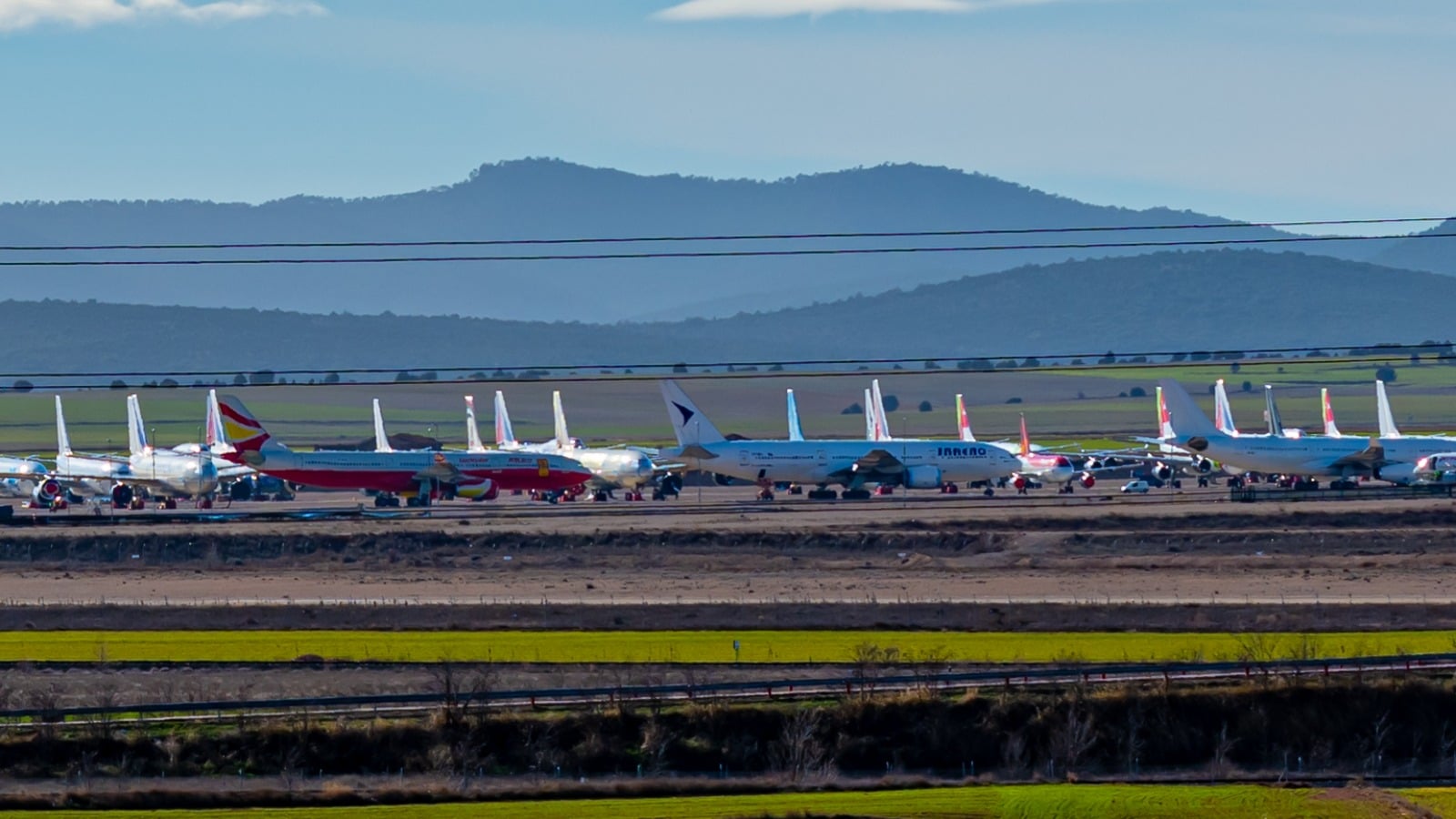
Drive north out of Teruel, in the dry uplands of Aragón, and the horizon does something odd. A line of tail fins rises above the stubble fields — Iberia red and yellow, Cathay Pacific green, TAP, Air Europa, a Boeing 777 with its engines sealed — parked nose to tail along an apron that runs for most of a kilometre. Nothing moves. No jet bridges, no baggage trains, no passengers.
The pictures from places like this almost always get filed under “aircraft graveyard”, and the phrase does real damage, because it implies an ending. Teruel is not an ending. It is a car park with a maintenance contract, run by a company owned by Airbus and Safran, and most of the aircraft in that line are being kept deliberately airworthy so that somebody can collect them.
Civil aircraft storage is a real industry with customers, engineers, waiting lists and an expansion problem. It is also almost entirely invisible, because the only time anyone photographs it is when the world stops flying. Here is how it actually works, and where the aeroplanes go.
Quick Facts: the civil aircraft storage business
Europe’s biggest operator: TARMAC Aerosave, founded at Tarbes in 2007 by Airbus, Safran Aircraft Engines and SUEZ
Its three sites: Tarbes-Lourdes (100 aircraft), Teruel (120 aircraft, 20 engines), Toulouse-Francazal (60 aircraft) — 280 parking spaces in total
Aircraft handled: the company says it received its 2,000th aircraft in 2026
Southern hemisphere: Alice Springs, operated by Asia Pacific Aircraft Storage since June 2014; 152 aircraft at the pandemic peak
Largest US civil yard: Victorville, California — ComAv’s 240-acre (97 ha) site, capacity quoted at over 500 aircraft
Why deserts: low humidity and hard ground slow corrosion and need no paving
What it is not: a scrapyard — part-out and recycling are separate businesses that happen later, if at all
Who Runs Europe’s Biggest Aircraft Park
TARMAC Aerosave was put together in 2007 at Tarbes, in the French Pyrenees, by three shareholders who between them cover the whole life of an airframe: Airbus, which builds them, Safran Aircraft Engines, which powers them, and SUEZ, which recycles things. The company describes itself as a subsidiary of all three. The first aircraft arrived at Tarbes in 2009.
Today it runs three sites. Tarbes-Lourdes, the headquarters, holds 100 aircraft and has a 22,000 square metre storage warehouse and an engine shop alongside. Teruel, opened in 2013, is the biggest at 120 aircraft and 20 engines, with four hangars that can swallow three A380s or a 777. Toulouse-Francazal, added in 2017, takes another 60. That is 280 parking spaces across the group, and the company says it received its 2,000th aircraft in 2026.
Teruel itself is an unusual airport. It has no scheduled passengers. It sits at 1,026 metres above sea level with a single 2,825-metre runway, and it is owned not by Spain’s national airport operator but by a consortium of the regional government of Aragón and the city council. Figures for how much it can hold vary depending on who is counting: TARMAC Aerosave quotes 120 aircraft for its own operation, while the airport as a whole has been credited with space for up to 250.
The reason it is in Aragón and not on the Costa Brava is salt. TARMAC Aerosave is explicit about it on its own site: “No coastal exposure here. Our sites are located inland to minimize corrosion risk and protect aircraft structures over time.” Salt-laden coastal air is the enemy of a parked aluminium structure, and so is standing water. Dry, inland, high and flat is the specification.
Sam Chui’s walk around Teruel is the best look most people will get inside the fence, and it shows the two halves of the business sitting side by side: aircraft being kept alive, and aircraft being taken apart.
What an Airline Is Actually Buying
The intuition is that you are renting a parking space. You are not. The space is the cheap part. What an airline is buying is a maintenance programme that stops a complex machine from quietly destroying itself while standing still.
Tom Vincent, who runs Asia Pacific Aircraft Storage at Alice Springs, described the sequence to the ABC in April 2020, as the first wave of grounded jets arrived. An aircraft goes through a storage-induction check on arrival, and after that, in his words, “once the storage-induction check is complete, we’ll then start carrying out the periodic checks every week”. Covers go over the engines, and the engines themselves are run up roughly once a fortnight to keep them in condition. By the ABC’s count, an aircraft parked for a year goes through more than a hundred maintenance checks in that time.
That is why the economics work at all. A site that simply let aircraft sit would be selling asphalt, and asphalt is not scarce. A site that returns an aircraft to its owner in a condition where it can be recertified and flown within weeks is selling something much harder to replicate — and that is a labour business. Vincent told the ABC in July 2020 that the Alice Springs operation had “nearly 50 employees here full time maintaining the aircraft”.
The alternative is visible at any number of regional airports where somebody simply parked a jet and stopped paying attention. Vincent is blunt about what that does to an airframe.
Alice Springs: Australia’s Answer to Arizona
Asia Pacific Aircraft Storage began operating at Alice Springs in June 2014, after the airport was picked in 2011 as the first large-scale storage yard of its kind outside the United States. The logic was geographic. Alice Springs sits at 1,789 feet in the centre of the continent, with a 2,438-metre main runway long enough for a widebody, and the humidity that wrecks aircraft in Singapore or Hong Kong simply is not there.
That was the pitch Vincent made in 2019 when Silk Air sent six grounded Boeing 737 MAX 8s south from Changi, where they had sat for six months. “Climactic conditions all throughout Asia are not suitable for long-term storage of aircraft,” he told the ABC. The aircraft were preserved at Alice Springs and later recertified and reactivated.
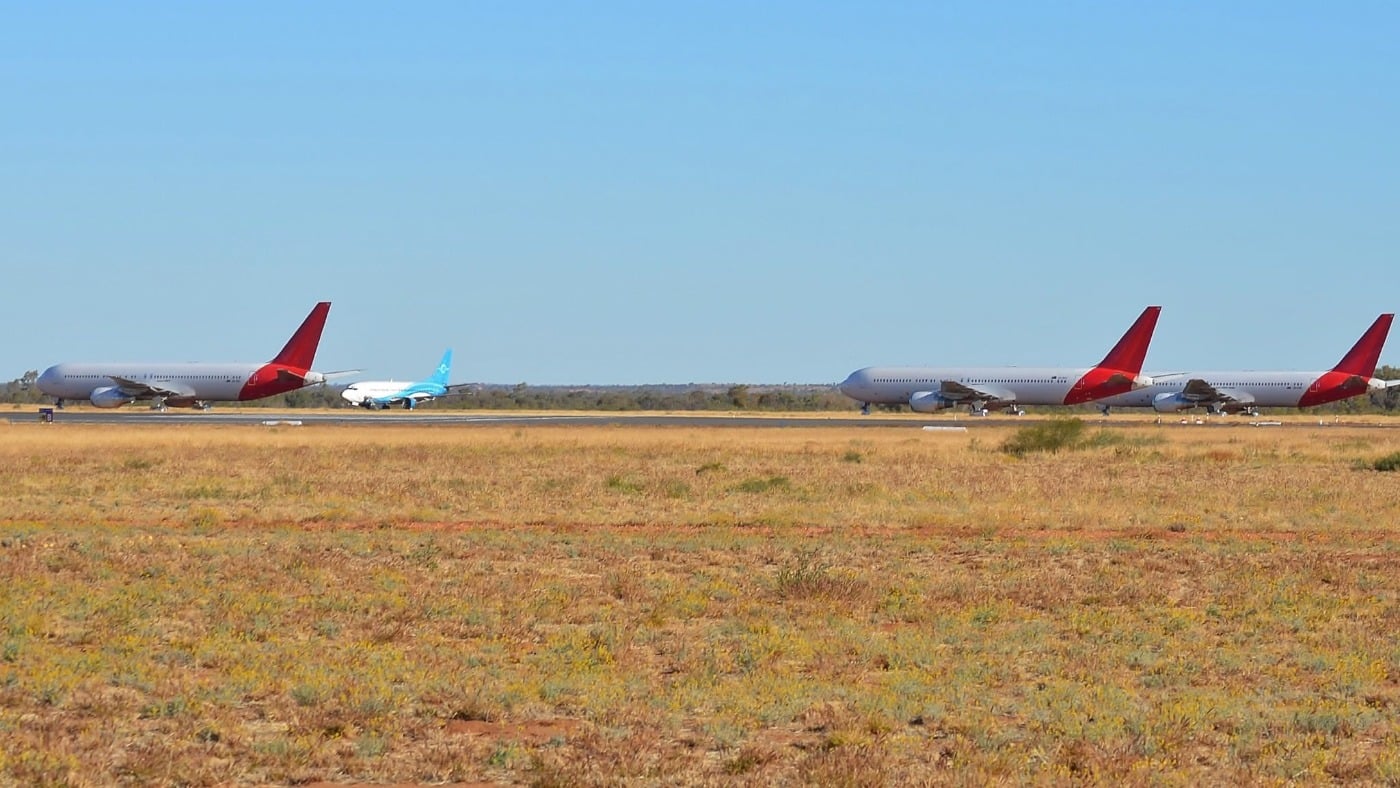
Then 2020 happened. Alice Springs had been storing up to 18 aircraft at a time before the pandemic. By the end of July 2020 it held 44, with another thirty expected within a month, and the Northern Territory government had put a further A$3.5 million into the site on top of an earlier A$1 million grant. At the peak, 152 aircraft were parked there. The expansion plan at the time was to lift capacity from around 100 aircraft to as many as 200.
The number that matters most, though, is the one from the other end. The last of those pandemic-era aircraft left Alice Springs in June 2024, returning to service with Cathay Pacific. The yard did not become a graveyard. It emptied.
An aerial pass over the Alice Springs storage yard, which gives a far better sense of the scale of the site than any photograph taken from the fence line.
Victorville, Pinal and the American Overflow
The United States has the deepest bench, partly because it has the most desert and partly because it has been doing this longest. The civil side is distinct from the military one: the vast government yard at Davis-Monthan in Arizona is a separate world, with its own rules and its own reasons, and it is not where an airline sends a surplus A330.
The biggest civil yard by quoted capacity is at Victorville, California, where ComAv Technical Services runs a 240-acre (97-hectare) open storage facility at Southern California Logistics Airport with room for more than 500 aircraft, plus hangars for maintenance. It sits at 2,885 feet on the edge of the Mojave. By late March 2020 roughly 275 airliners were parked there, including 50 Southwest Boeing 737-700s; Qantas began moving its entire A380 fleet in that July.
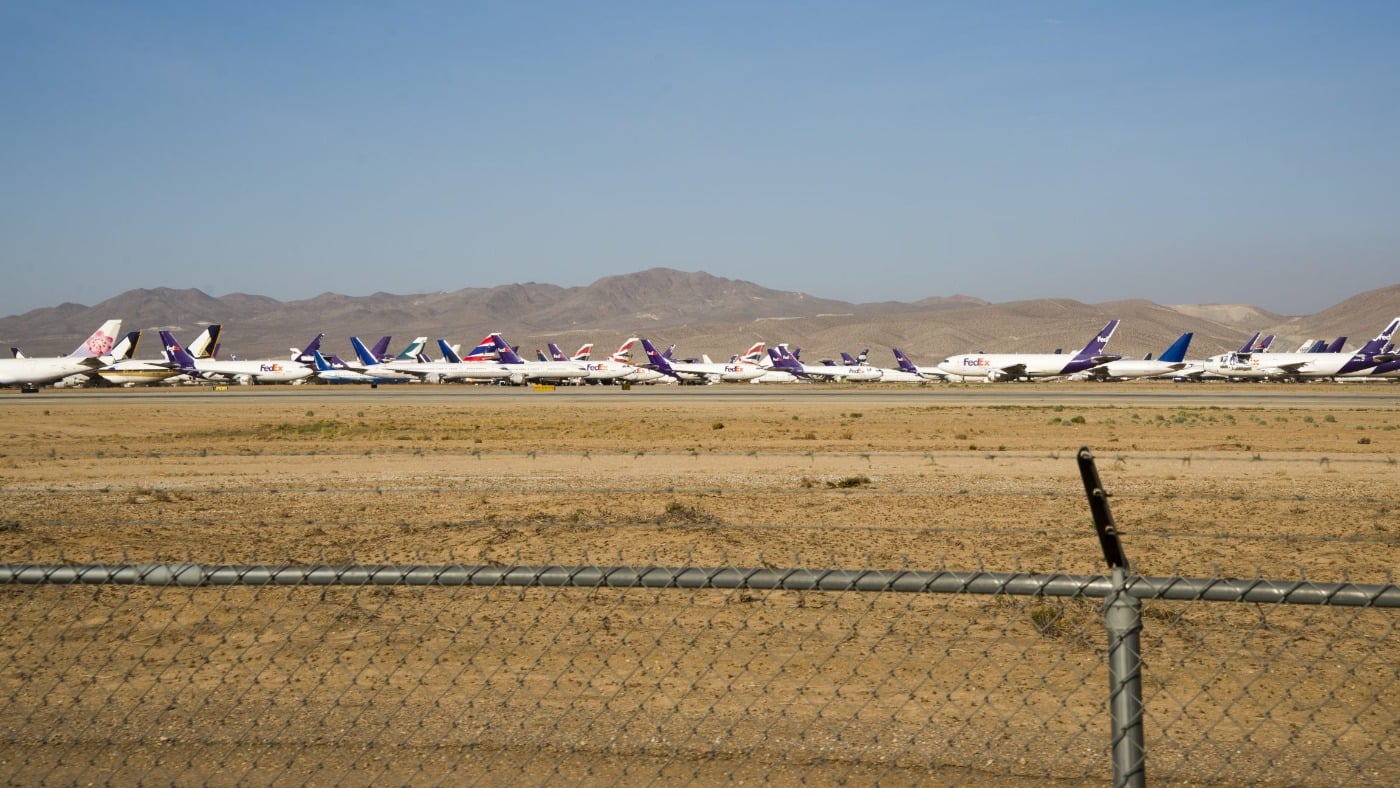
Pinal Airpark, north-west of Tucson, is the other name that comes up constantly. It is owned by Pinal County and hosts several independent companies — Ascent Aviation Services and Jet Yard among them — and it bills itself as the largest commercial aircraft storage and heavy maintenance facility in the world, a claim it makes for itself rather than one anybody else audits. Cathay Pacific, Delta, Northwest and Spirit have all parked there. Mojave Air and Space Port, better known for rocket work, takes airliners too.
What these sites share is not just climate. They are all places where land is cheap, the ground is hard enough to park a loaded widebody on without paving it, and nobody complains about the view.
The Bill Nobody Publishes
One question dominates the searches and has no honest short answer: what does it cost? None of the major operators publishes a rate card. Storage contracts are negotiated per aircraft, per type and per programme, and the headline figures that circulate online are almost always somebody’s estimate rather than a quoted price.
What can be said with confidence is where the money goes. The parking space is not the expensive part. The expensive parts are the engineers, the recurring checks, the ferry flight in and the ferry flight out, and the reactivation work at the end — which is why an operator will quote very different numbers for an aircraft parked in flight-ready condition and one put away in a deeper preservation state with no intention of flying soon. TARMAC Aerosave puts it in commercial terms on its own site: each aircraft gets “a tailored preservation strategy aligned with its next step: return to service, lease transition, sale, end-of-life processing, or strategic holding”. Those five outcomes carry five different price tags.
The last of them is where storage shades into the other business. When an owner decides an airframe will not fly again, the same sites take it apart: engines and landing gear off first, because that is where the value is, then the airframe itself. TARMAC Aerosave claims a recycling rate of over 94 per cent, and says its processes recover more than 92 per cent of an aircraft’s mass — two figures it quotes on different pages, which is a reminder to read the small print on any recycling claim. We covered what happens after that decision in What Happens to a Retired Airliner.
Flightradar24 went inside TARMAC Aerosave earlier this month. Its own framing is the whole business in one line: some aircraft come here to fly again, others leave as spare parts.
Which is the point that the word “graveyard” keeps obscuring. A storage yard is a decision deferred, not a decision made. The jets at Teruel with their windows taped and their engines bagged are not waiting to die. They are waiting for a lease to be signed, a market to recover, or an accountant to finish a calculation — and for most of them, somebody eventually turns up with a crew and flies them away.
Sources: TARMAC Aerosave (storage, sites and company pages); ABC News, 1 October 2019, 28 April 2020 and 31 July 2020; Wikipedia entries for Teruel Airport, Alice Springs Airport, Southern California Logistics Airport, Pinal Airpark and Mojave Air and Space Port; Flightradar24.


0 Comments