
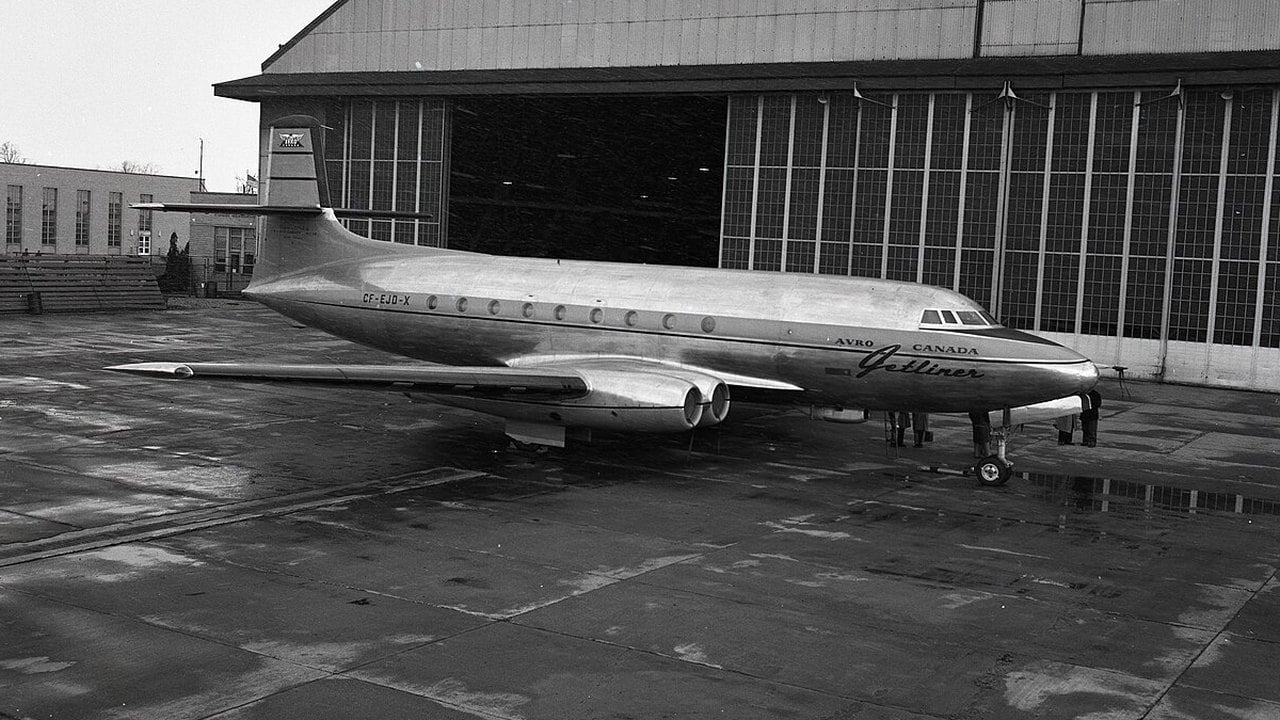
On 18 April 1950, a silver four-engined airliner touched down at New York’s Idlewild Airport after a flight of just under an hour from Toronto. Officials and a crowd of onlookers were waiting. Jet engines were so new that airport staff parked it well away from the terminal and slid drip pans under its engines.
The aircraft was the Avro Canada C102 Jetliner, the first jet airliner ever to fly in North America. It had beaten every American design into the air by years. Airlines wanted it, the US Air Force wanted it, and Howard Hughes wanted 30 of them.
Six years later it was cut up for scrap. Only its nose survives.
Informations clés
- Aéronef: Avro Canada C102 Jetliner, medium-range jet airliner prototype
- Designer: Jim Floyd, Avro Canada, Malton, Ontario
- Premier vol : 10 August 1949, about two weeks after the de Havilland Comet
- Moteurs : Four Rolls-Royce Derwent V turbojets
- Enregistrer: Toronto to New York in about 59 minutes, 18 April 1950
- Construit: One flying prototype; a second was broken up unfinished
- Annulé: 1951, so Avro could concentrate on the CF-100 Canuck
- Survivant: Nose section at the Canada Aviation and Space Museum, Ottawa
An airline asks for a jet
The story began in 1945 at Trans-Canada Air Lines (TCA), the forerunner of Air Canada. Its engineering chief Jim Bain wanted to explore jet power for passengers, and Avro’s new Canadian subsidiary, set up in the former Victory Aircraft factory at Malton outside Toronto, took on the job.
The man sent to design it was Jim Floyd, a Manchester-born engineer who had worked on the Avro Lancaster and its successors. The specification TCA signed off in April 1946 called for a short-haul jet with at least 36 seats, a cruise of about 425 mph and a range of 1,200 miles, able to use existing 4,000-foot runways.
The contract was strange from the start. TCA demanded a fixed price of C$350,000 per aircraft and barred Avro from selling the Jetliner to any other airline for three years. In 1947 Avro admitted it could not meet those terms, and TCA walked away. The government minister C.D. Howe kept the programme alive with C$1.5 million, at a slower pace.
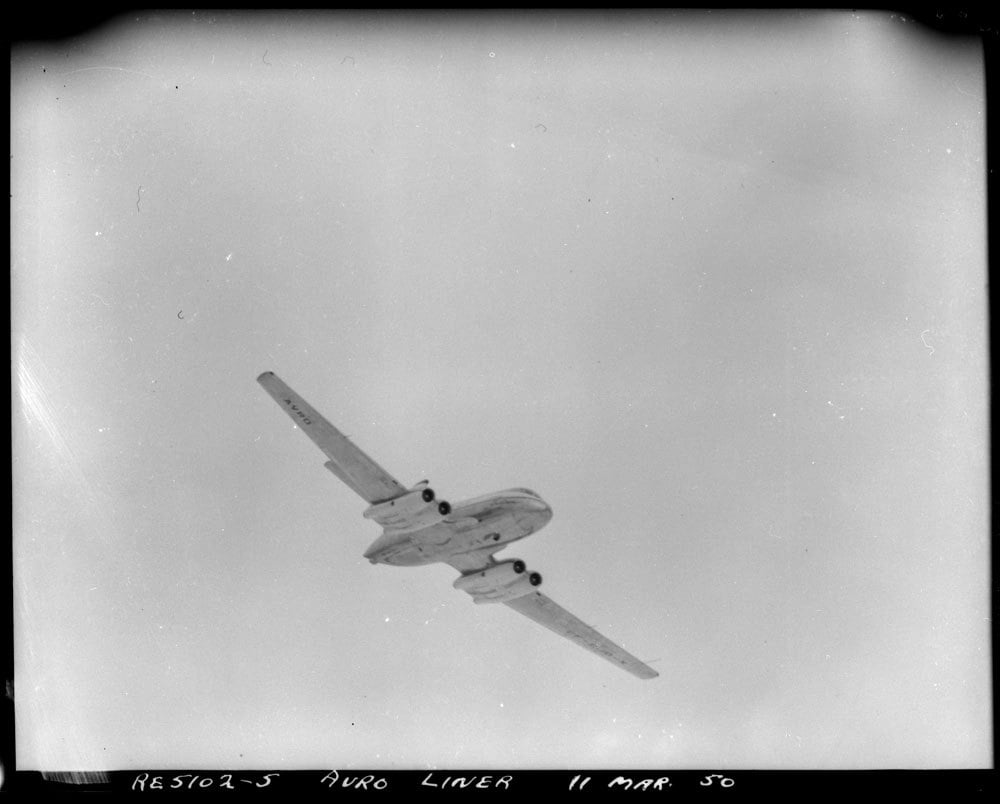
Four Derwents instead of two Avons
Floyd’s original design used two Rolls-Royce AJ65 engines, the axial-flow turbojet that became the Avon. But Rolls-Royce could not promise a civil-certified version in time, so Avro switched to four Rolls-Royce Derwent V centrifugal engines, the same family that powered the Gloster Meteor.
The change cost fuel, but it had an upside. With four engines, losing one cost only a quarter of the thrust, and the resulting yaw was small enough to trim out by hand. Floyd’s small team kept a straight wing rather than redesign for the 500 mph cruise TCA later asked for.
British Pathé newsreel footage of the Avro Canada C102 Jetliner from 1949.
The Jetliner flew for the first time from Malton on 10 August 1949, about two weeks after Britain’s de Havilland Comet. That made it the second purpose-built jet airliner in the world to fly, and the first in North America.
Fifty-nine minutes to New York
The April 1950 flight to New York was the Jetliner’s big moment. It carried mail and covered the distance from Toronto to Idlewild in about 59 minutes. It is credited with the first jet airmail delivery, and the press loved it.
Interest poured in. The US carrier National Airlines was negotiating to buy a fleet of Jetliners, and a stretched second prototype for up to 60 passengers was taking shape in the Malton hangar. The US Air Force looked at the type as a trainer for its new jet bomber crews and reportedly set money aside for 20 aircraft.
The Jetliner also earned its reputation the hard way, in ramp-to-ramp trials across the continent that showed off its speed, low maintenance and reliability. According to Canada’s Aviation Hall of Fame, those trials also helped American regulators work out how jet passenger aircraft should be certified and operated, years before any US jet airliner entered service.
Floyd himself received the Wright Brothers Medal in 1950 for his work on jet transports, the first time the award had gone to a non-American.
The Korean War and the Canuck
Then the world changed. The Korean War began in June 1950, and Canada needed its new all-weather interceptor, the CF-100 Canuck, for the Royal Canadian Air Force. The CF-100 programme was behind schedule, and Avro was the only company that could build it.
In 1951 Howe ordered Avro to put everything into the fighter. Work on the Jetliner stopped, the National deal was dropped and the half-finished second prototype was broken up. Floyd never accepted that the decision was about engineering.
Ruairidh MacVeigh’s documentary on the Jetliner, the world’s second jet airliner to fly.
Howard Hughes takes it for a spin
Even grounded by politics, the Jetliner had one more admirer. In 1952 Howard Hughes leased the prototype and kept it at his airfield in Culver City, California, for about six months. He wanted 30 for TWA and, when Avro said it had no capacity, explored building it under licence at Convair.
The US Air Force’s interest in a bomber-crew trainer came to nothing as well. There was a bitter irony in Ottawa, too: in November 1951, a few months after the Jetliner was stopped, the RCAF ordered two British Comets, becoming the first air force to operate jet transports.
That went nowhere either. Howe blocked the deals, and the US government decided that Convair’s military work came first. TCA, the airline that had started it all, went on to buy Vickers Viscount turboprops instead.
A lecture on the history of the Avro C102 Jetliner, from its TCA origins to its scrapping.
Back in Canada, the Jetliner spent its last years as a test and photography aircraft for Avro, including camera work on CF-100 trials. Test pilot Don Rogers flew it for the last time in November 1956. In December it was cut up and sold to a scrap dealer.
Only the nose survives
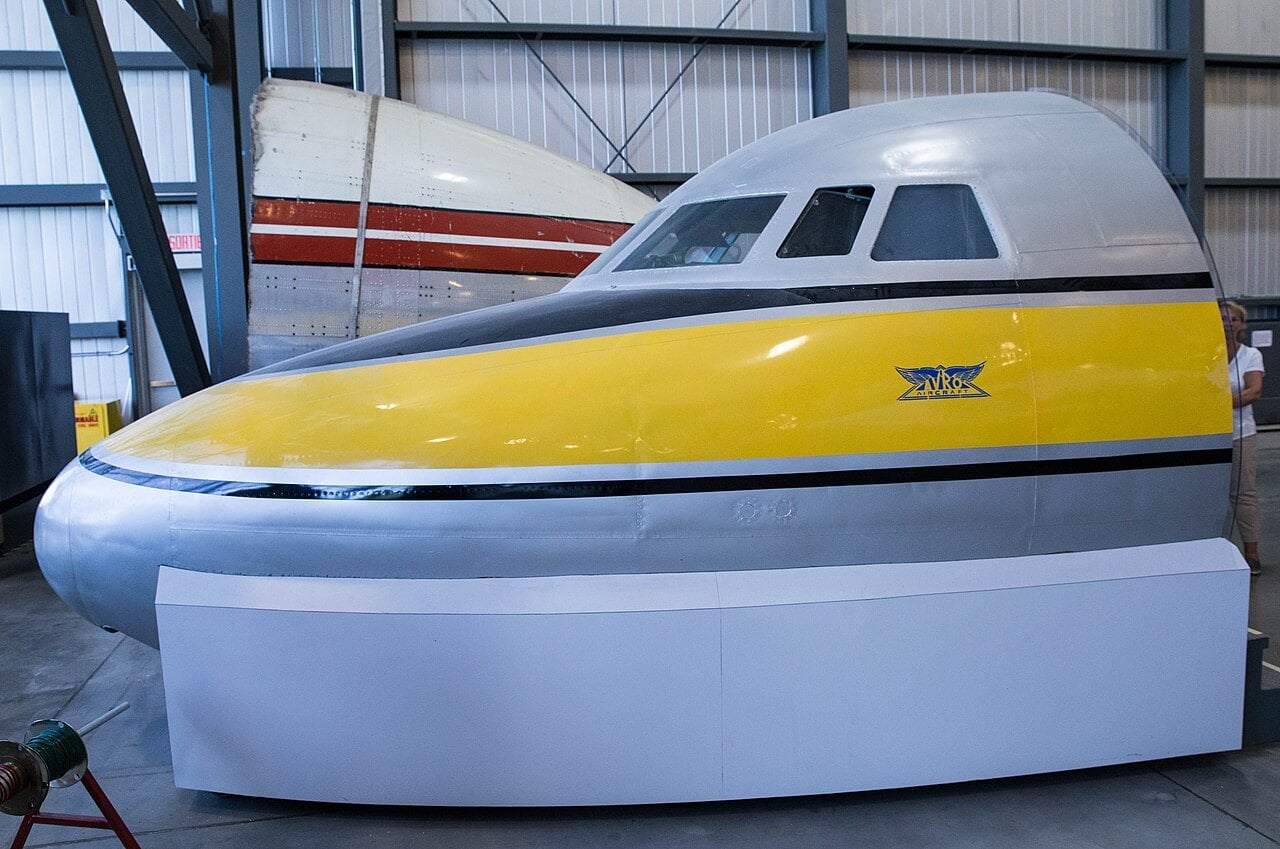
The National Research Council took the nose section to study cockpit layouts, which is the only reason anything is left. Today that nose is displayed at the Canada Aviation and Space Museum in Ottawa, a few metres of polished aluminium from an aircraft that could have given North America its jet age.
Would it have sold? Floyd thought so, but no one will ever know. What is certain is that the next airliner built by Floyd’s company would suffer a similar fate on a far bigger stage: the Avro Arrow interceptor, cancelled in 1959. The Jetliner was the first Canadian dream to be scrapped. It was not the last.
Sources: Jim Floyd (The Avro Canada C-102 Jetliner, 1987), Graham Chandler (Air & Space/Smithsonian), The Canadian Encyclopedia, Canada’s Aviation Hall of Fame, Canada Aviation and Space Museum, MilitaryBruce.com
0 Comments