
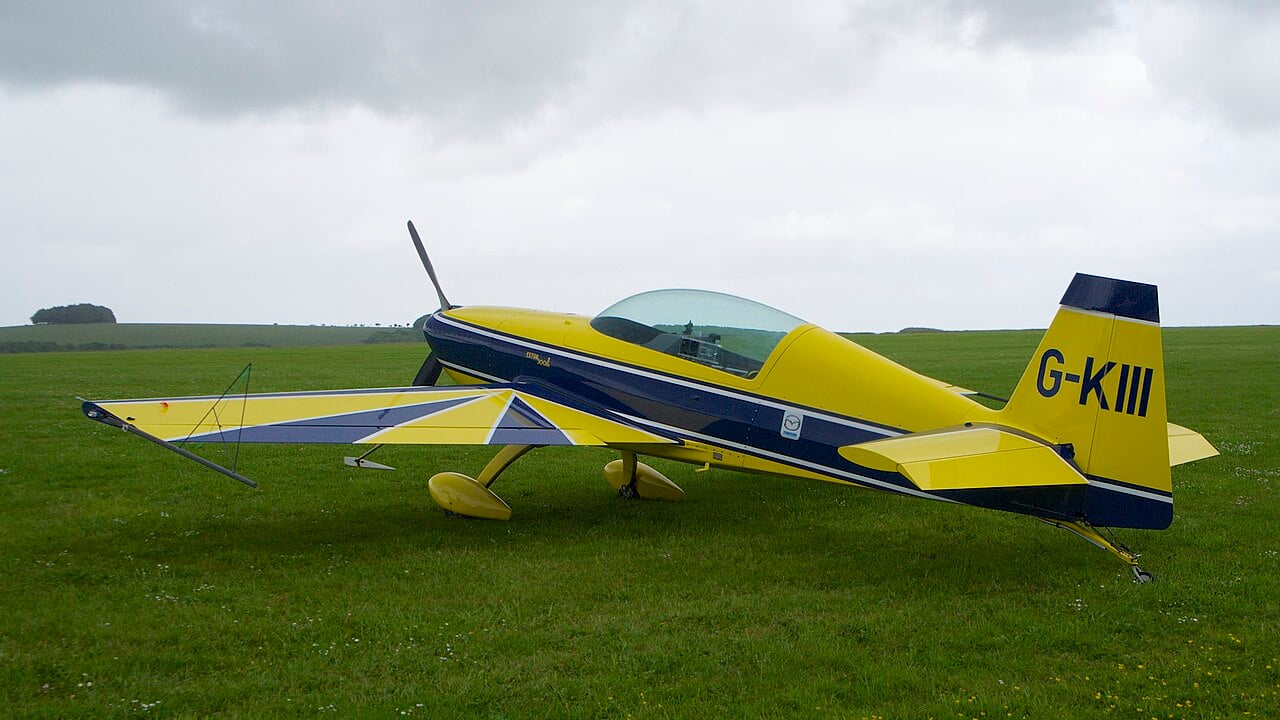
Push the throttle forward and, by the time your hand reaches the stop, the Extra is already fast enough to lift its tail. Pull up at 200 knots and an Extra 300L will climb some 2,500 feet straight up before it runs out of energy. Roll it, and the horizon spins around you at roughly 400 degrees per second.
For almost four decades, that little German monoplane has been the aeroplane aerobatic pilots dream about. It has carried world champions, military display teams on three continents and thousands of ordinary pilots learning what an airframe can do when it is built for nothing but manoeuvring. And it began with one competition pilot who simply could not buy the aeroplane he wanted.
Informations clés
- Taper: Two-seat aerobatic monoplane, Unlimited category
- Designer: Walter Extra, Extra Flugzeugbau, Hünxe, Germany
- Premier vol : 6 May 1988 (German type certificate 16 May 1990)
- Moteur: Lycoming AEIO-540, 300 hp (330 series: AEIO-580, 315 hp)
- Structure : Welded steel-tube fuselage, carbon-fibre composite wing
- g limits: ±10 g with one aboard, ±8 g with two
- Main variants: 300, 300S, 300L, 300LP, 330LX, 330SC, 330LT
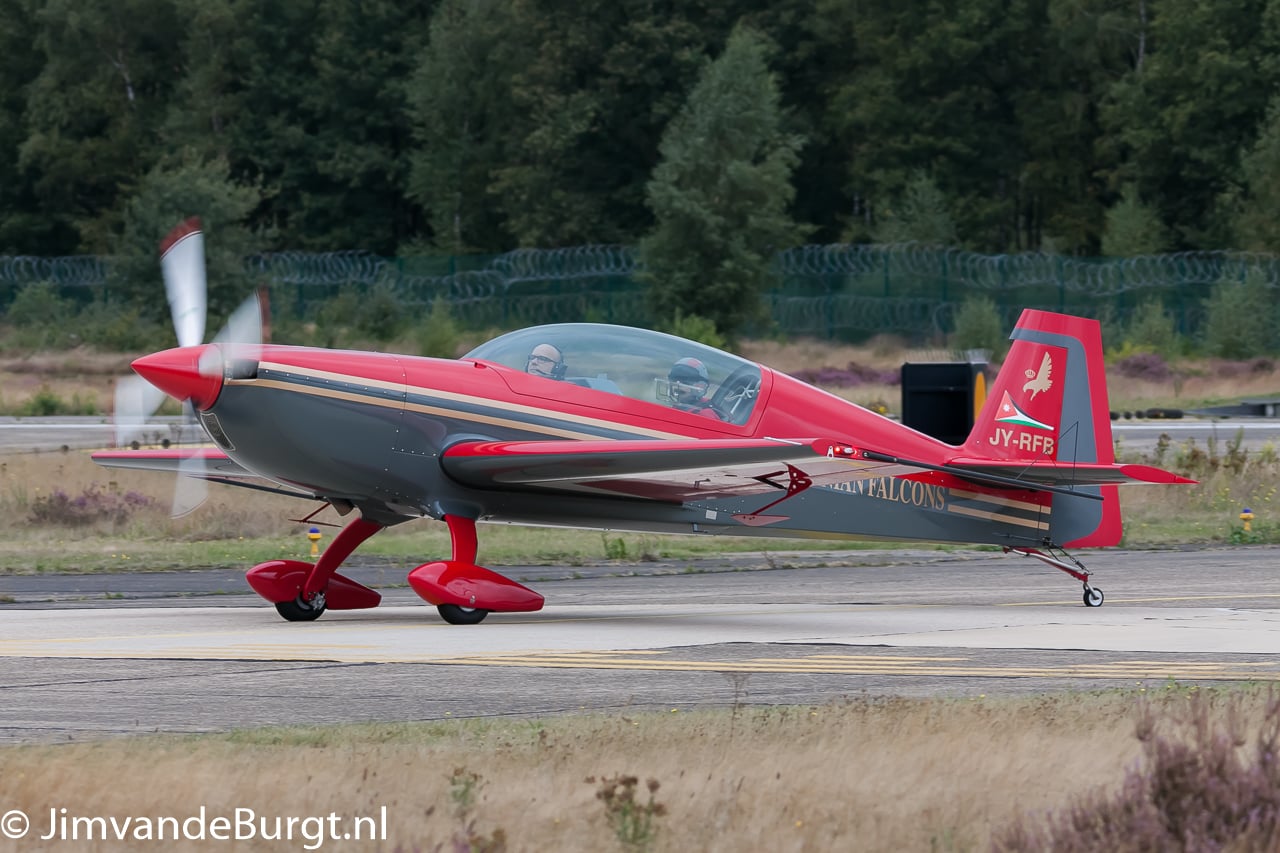
- Military display teams: Halcones (Chile), Royal Jordanian Falcons, Kris Sakti (Malaysia), French Air Force Équipe de voltige
A pilot who built his own
Walter Extra trained as a mechanical engineer and learned to fly in gliders before turning to powered aerobatics. In the early 1980s he built and flew a single-seat Pitts Special biplane, the competition machine of the day. Then, as he told AOPA, he watched the American champion Leo Loudenslager fly a Laser monoplane of his own design and concluded that the biplane’s time was up.
Extra built his own Laser with modifications of his own, and when he took it to European contests other pilots asked him to build aircraft for them. Competing at the 1982 World Aerobatic Championships pushed him further. His first true design, the single-seat Extra 230, flew in 1983 and became famous for the fine woodwork in its wing and its strength, lightness and performance.
The company he founded, Extra Flugzeugbau, sits at Dinslaken airfield in Hünxe, on the edge of Germany’s Ruhr valley. It was there that he set out to do something that had not been done well before: a two-seat aeroplane able to fly the toughest, Unlimited category of competition aerobatics with two people aboard.
Steel, carbon and a symmetrical wing
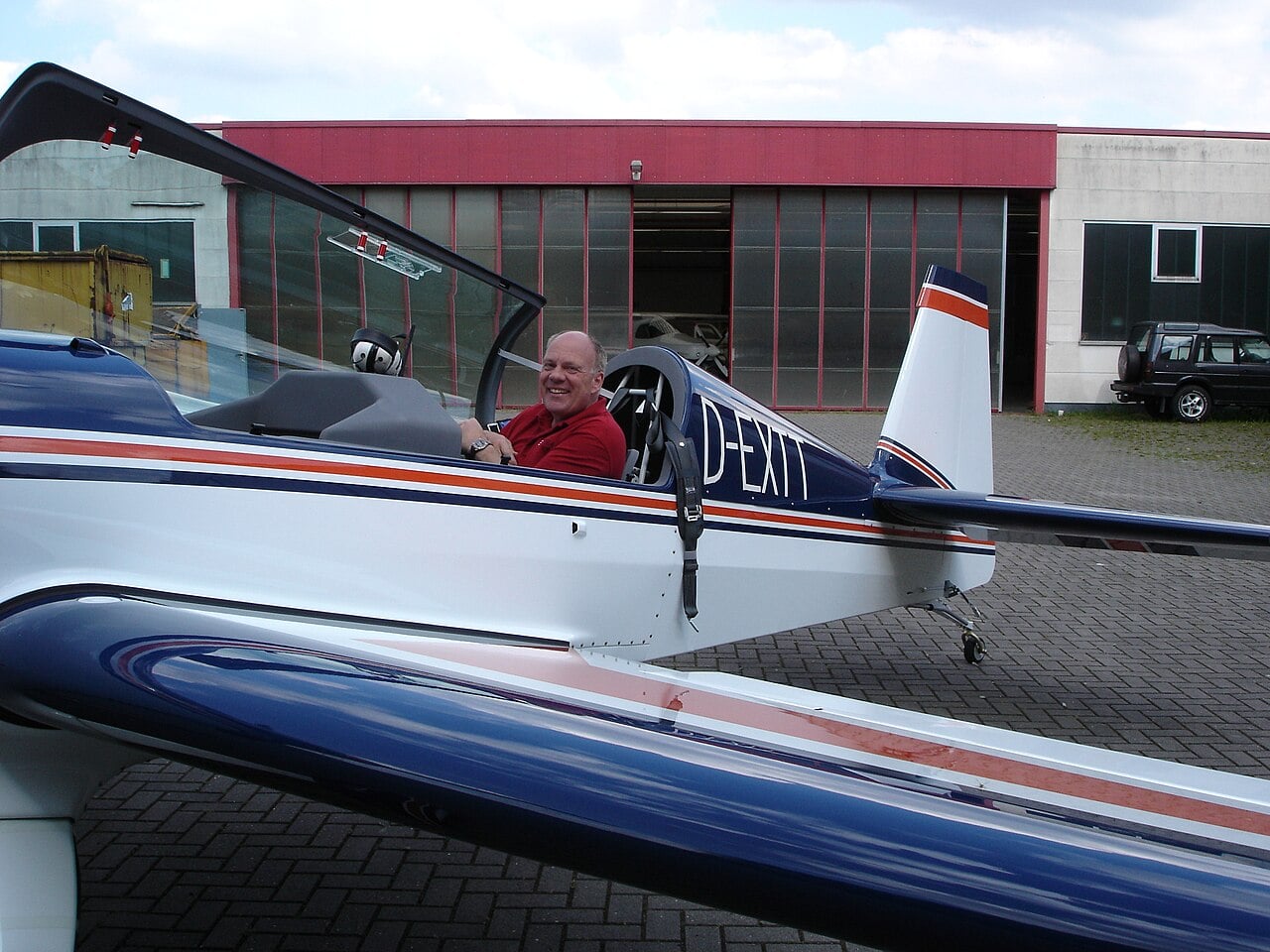
The two-seat Extra 300 first flew on 6 May 1988 and won German type certification on 16 May 1990. Its recipe has barely changed since. The fuselage is a welded steel-tube frame covered in aluminium and fabric. The wing has a carbon-fibre composite spar and carbon skins, and its symmetrical aerofoil is set at zero incidence, so it flies just as well upside down as the right way up.
Up front sits a fuel-injected, six-cylinder Lycoming AEIO-540 of 300 horsepower, hence the name. The landing gear is a fixed tailwheel layout with composite main legs. The result is stressed to plus and minus 10 g with one person aboard and plus and minus 8 g with two, numbers that leave the pilot, not the airframe, as the weak link.
A single-seat 300S followed in March 1992, with a shorter wing and bigger ailerons. Then came the variant that would sell more than any other: the 300L, which moved the wing from the middle of the fuselage to the bottom. AOPA Pilot noted that owners of the mid-wing 300 could barely see the runway on landing; the low wing fixed that and made the front cockpit easier to climb into.
Three-time US national aerobatic champion Patty Wagstaff explains how to fly a hammerhead in an Extra 300, for Sporty’s Pilot Shop.
Ce que l'on ressent en volant
When AOPA Pilot flew a brand-new 300L in 1995, it compared the aeroplane to Secretariat. With a power loading of 6.39 pounds per horsepower it took off in 305 feet and climbed at 3,200 feet per minute, and the magazine described pulling into a 3 g chandelle straight after lift-off and rolling out on the downwind leg at 1,000 feet in under 20 seconds.
The controls are so light that newcomers tend to overcontrol. The American dealer Jim Moser told AOPA he advises pilots to hold the stick with three fingers, like a pencil or an artist’s brush. That featherweight harmony was no accident. Extra designed the aeroplane so that the pilot’s attention could go into the sequence, not into simply keeping control.
The 300L is certified to plus and minus 10 g, and AOPA reported that its wing could take about twice that. The 1995 report also quoted the then US national champion, Phil Knight, who saw something new in a two-seater: an aeroplane an instructor and student could share that was still good enough to win at the top level.
Champions, racers and air forces
Extras soon dominated the sport. Patty Wagstaff, three times US national champion, flew Extra 230, 260 and 300 models in competition and at air shows, and her Extra 260 went to the Smithsonian’s National Air and Space Museum. The single-seat 330SC, the line’s current Unlimited machine, is listed by the factory as the world champion aerobatic aircraft in 2009, 2013 to 2017, 2019, 2022 and 2023.
Extra even built a racing variant, the 300SR, with a special high-lift wing for the Red Bull Air Race World Series, although the racing field came to be dominated by the Zivko Edge 540, MXS-R and Corvus Racer.
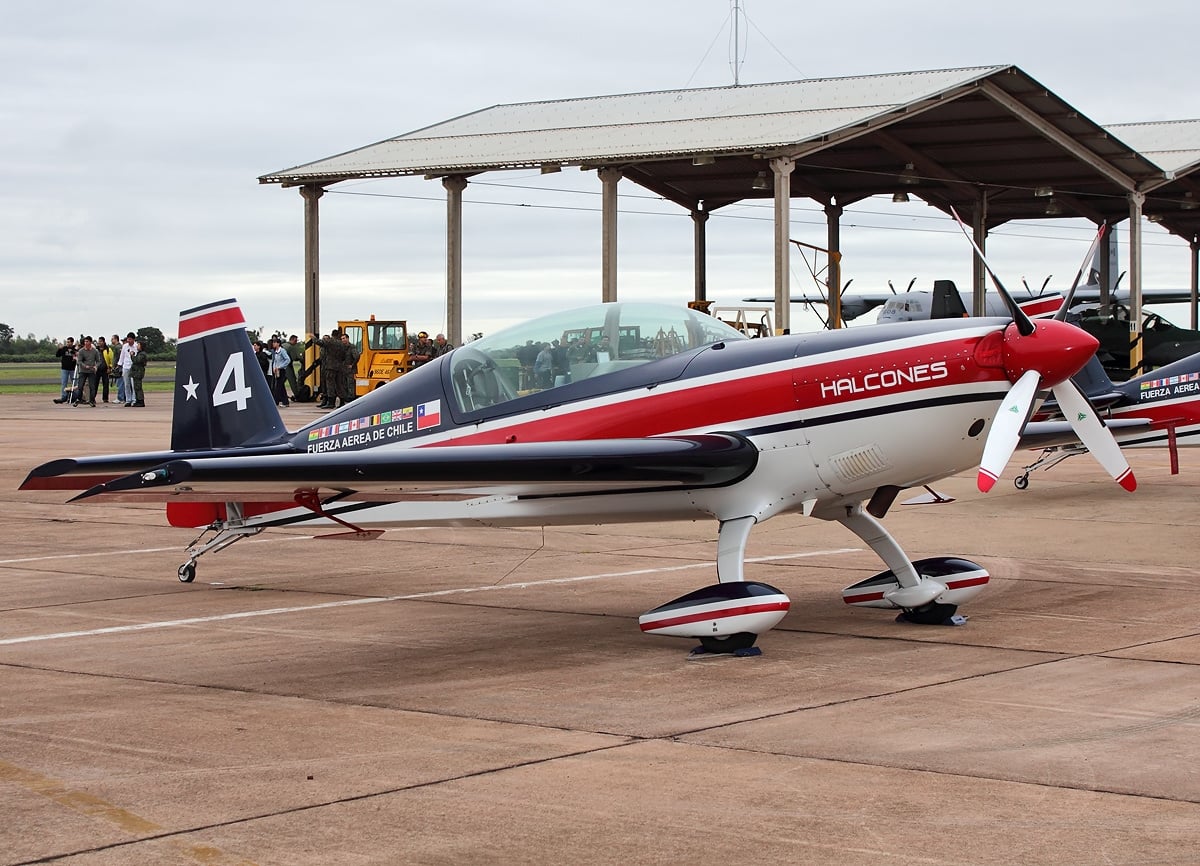
Air forces noticed too. The Chilean Air Force’s Halcones replaced their Pitts biplanes with the Extra 300 around 1990, later flying the improved 300L, and stayed with Extras until the GameBird GB1 arrived in 2019. The Royal Jordanian Falcons moved from Pitts to Extra 300s in 1992, then to the 300L and, from 2018, the Extra 330LX.
Archive footage of the Chilean Air Force Halcones’ Extra 300s passing over the 1995 military parade in Santiago.
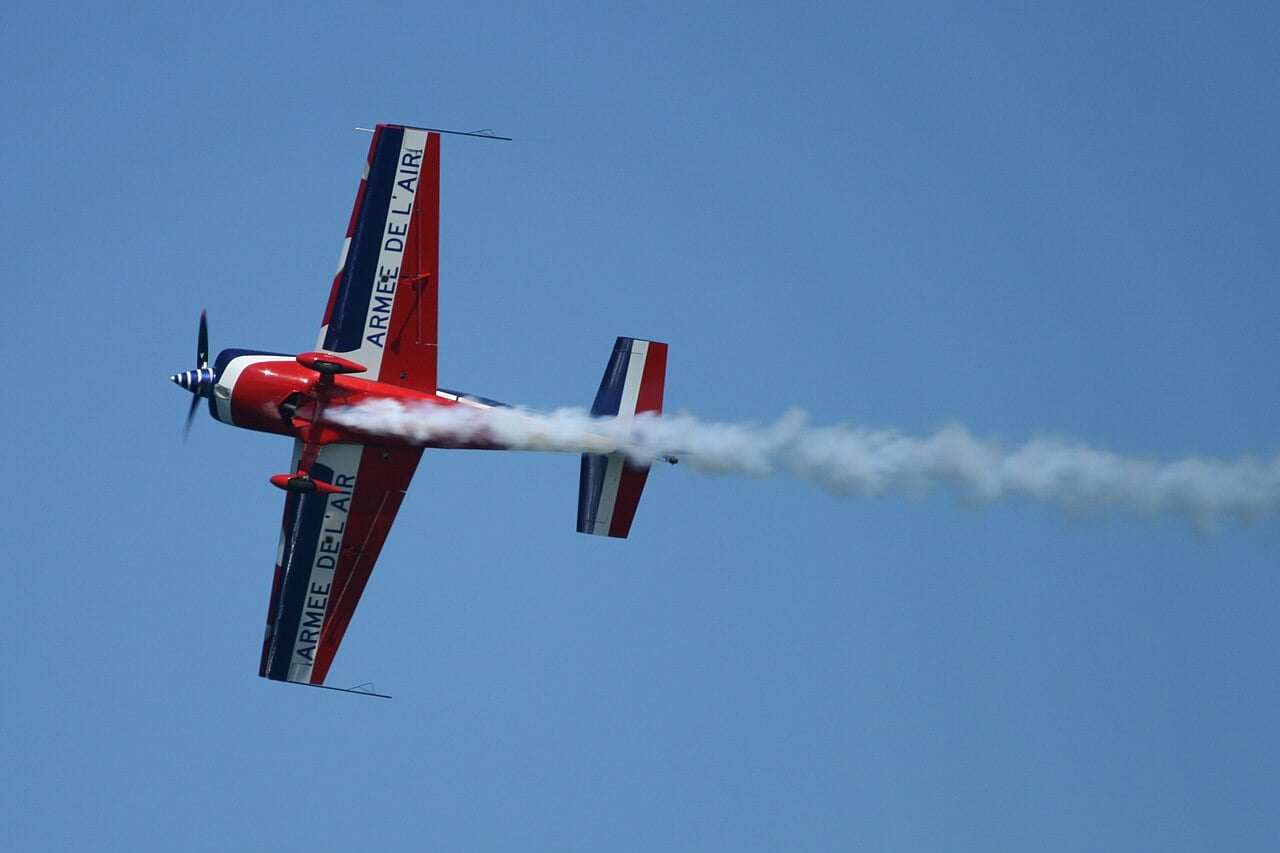
In 2011 the Royal Malaysian Air Force formed the Kris Sakti team on four Extra 300Ls, after its pilots trained with the British civilian Blades team, which also flies Extras. France’s air force aerobatic team, the Équipe de voltige at Salon-de-Provence, which both displays and competes for world titles, flies the Extra 330.
Where pilots meet the Extra
For most pilots, the Extra is not a trophy but a classroom. Aviation Performance Solutions flies a fleet of eight Extra 300Ls for upset prevention and recovery training in Mesa, Arizona, and Arlington, Texas, teaching pilots how to recover an aeroplane that has ended up in an unusual attitude. The Blades in Britain offer passenger flights and aerobatic training on their Extras.
The family kept growing: the two-seat 330LX with a 315-horsepower Lycoming AEIO-580, the touring 330LT, and the single-seat 330SC and 330SX. In March 2017 an electric Extra 330LE, powered by a Siemens motor, set speed records at Dinslaken and became the first electric aircraft to tow a glider aloft.
FlightChops follows two pilots training in an Extra 300L as they prepare for solo and competition aerobatics.
Through booms and busts, Walter Extra told AOPA in 2013, his factory kept producing about three new aircraft a month, with roughly half of his aerobatic aircraft going to the United States. The man who never meant to become a manufacturer ended up building the standard tool of his own sport.
Climb into the front seat of an Extra today and the formula is the one he settled on in 1988: steel tube, carbon wing, a big Lycoming and controls you fly with your fingertips. On Afterburner we have covered the biplanes it replaced. The Extra is the reason they were replaced.
Sources: AOPA Pilot (“Aerial sports car”, July 1995; “Aviation legends: Walter Extra”, December 2013), Extra Aircraft (official EA-330LX and EA-330SC specifications), Sporty’s Pilot Shop, FlightChops
Header photo: Ian Kirk / Wikimedia Commons, CC BY 2.0
0 Comments