

Le US Air Force has a tanker problem, and a Washington think tank has just put a price on fixing it. In a report released on 27 October, the Hudson Institute argues that the Air Force should stop buying the KC-46A Pegasus sooner than planned and spend the money on something new: a medium-sized, long-range tanker built around a blended wing body.
The report, Resilient Reach: Redesigning Aerial Refueling for Contested Global Operations, is written by Timothy A. Walton and Shane Dennin of Hudson's Center for Defense Concepts and Technology. Its central claim is blunt. American air power runs on aerial refuelling, and aerial refuelling still depends on vulnerable forward bases and medium-range tankers that a peer adversary can find and hit.
By 2035, the authors write, China's People's Liberation Army could potentially suppress forward tanker operations altogether. That is not an abstract worry in 2026. The tanker fleet has just been through a war.
Informations clés
- Report: Resilient Reach, Hudson Institute, 27 October 2026
- Authors: Timothy A. Walton and Shane Dennin
- KC-46 recommendation: No more than 75 additional aircraft, 260 in total
- Proposed new tanker: 250 Medium Blended Wing Body tankers, procurement from FY2032
- 30-year cost: $397.6 billion, $15.5 billion less than an all-KC-46 fleet
- Air Force requirement: 502 tankers
- Epic Fury losses: One KC-135 destroyed (12 March 2026); five damaged at Prince Sultan Air Base
Cap the KC-46, then build something new
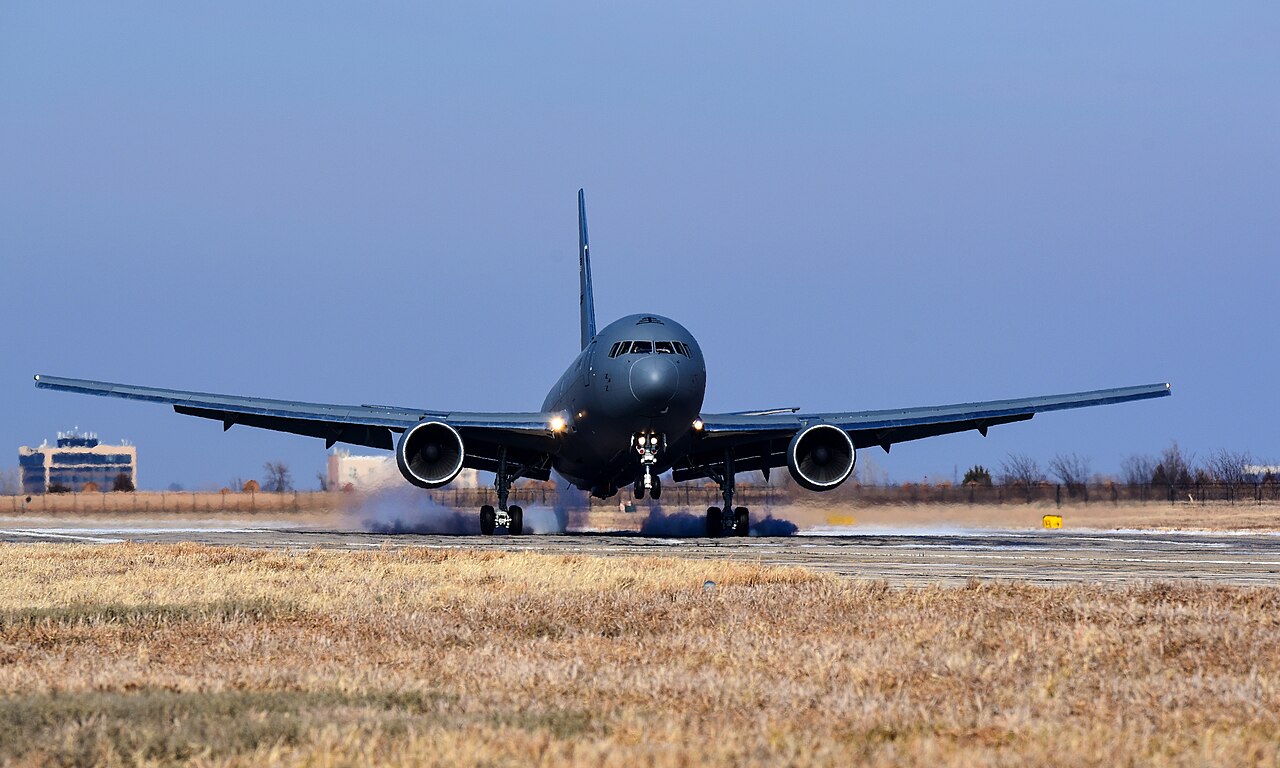
The Air Force currently plans up to 75 more KC-46As under what it calls the KC-46A Tanker Production Extension. Walton told Breaking Defense that 75 should be the upper limit of that buy. Taken to its maximum, the extension gives a KC-46 fleet of 260 aircraft. The report also sketches a budget-constrained variant that trims the extension to 49 jets, for 234 in total.
The rest of the fleet, in Hudson's preferred option, would be 250 new Medium Blended Wing Body tankers. Combined with the 260 KC-46s, that makes 510 tankers against an Air Force requirement of 502. Research funding for the new aircraft would start in fiscal 2027, a development contract would follow in fiscal 2028 after demonstrator flights, and procurement would begin in fiscal 2032, ramping up to 21 aircraft a year.
The report's figures are deliberately framed as a saving, not an extra bill. Its recommended plan comes to $397.6 billion over 30 years, covering research, procurement and operating costs. Buying 510 KC-46s instead would cost $413.2 billion, according to the same analysis, so the blended wing plan is $15.5 billion cheaper while, the authors claim, delivering 58 percent more offload capacity.

Why a blended wing body?
A blended wing body merges the fuselage and wings into one lifting surface. For a tanker, the attraction is simple: more fuel carried further for the same thrust. Hudson argues that 250 Medium BWBs could refuel more than twice as many fighter packages as 250 KC-46As, or reach more than twice as far, and could move forces across the Pacific more than twice as quickly.
Walton stresses that the report used a representative design rather than a specific product. Other manufacturers could offer viable aircraft. The Air Force is, however, already funding a blended wing demonstrator from JetZero, a contract awarded in 2023, which gives the idea a real test vehicle rather than a slide.
The new tanker is only one of three recommendations. The report also wants hardened, better-defended tanker airfields with distributed fuel storage, at roughly $35.5 billion, and about $13 billion over a decade for new mission systems on existing tankers, including $8 billion for active self-defence equipment on 260 KC-46As.
The Hudson Institute's own summary of the key findings in Resilient Reach.
The lesson of Operation Epic Fury
Hudson's case leans heavily on what happened to American tankers during Operation Epic Fury, the 2026 air campaign against Iran. On 12 March 2026 a KC-135 went down over western Iraq in friendly airspace, killing all six people on board. US Central Command said the loss was not due to hostile fire or friendly fire. Air & Space Forces Magazine has since reported that the aircraft collided with a second KC-135, which survived with part of its tail missing; the investigation is ongoing.
Days later, according to two US officials quoted by the Wall Street Journal, an Iranian missile strike on Prince Sultan Air Base in Saudi Arabia damaged five KC-135s on the ground. President Trump disputed how serious the damage was. The Hudson report itself notes that Iran's attacks damaged tankers and destroyed other aircraft.
Not everyone agrees. Breaking Defense reports that Air Force Chief of Staff Gen. Ken Wilsbach is among those who oppose building more hardened shelters, and senior officers have defended the KC-46's wartime record.

Que se passe-t-il ensuite ?
A think-tank report does not change a procurement plan on its own. But it lands at a moment when the Air Force is already asking what comes after the KC-46, and when Congress has watched tankers burn on the ground in a real war. The argument that the next tanker must fly further, carry more and survive more than today's jets is no longer theoretical.
Walton puts the possible service entry of a blended wing tanker at around 2032. Whether it gets there depends on a budget fight that has barely begun. What Hudson has done is change the question from "how many more KC-46s?" to "why any more than 75?"
Task & Purpose on the state of the US Air Force tanker fleet.
Sources: Hudson Institute (Resilient Reach report and PDF), Breaking Defense, Air & Space Forces Magazine, Military Times, US Air Force / CENTCOM, Stars and Stripes



0 Comments