
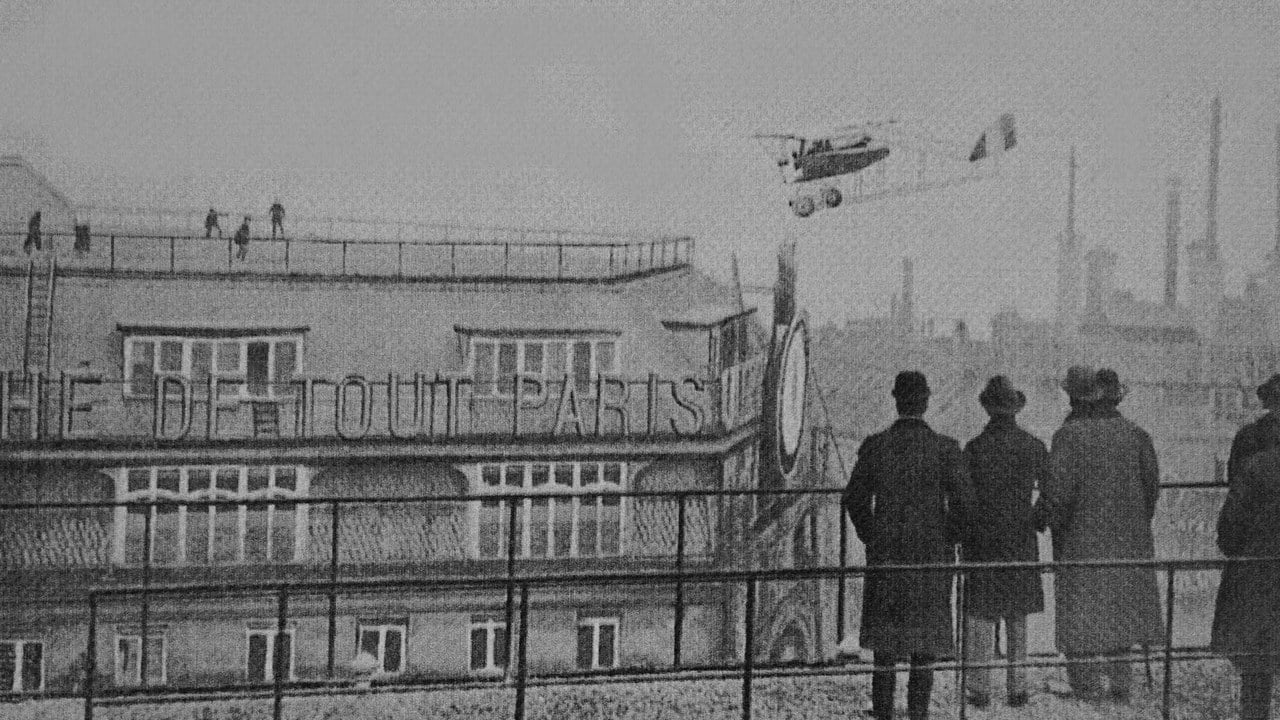
Shortly before 1 p.m. on Sunday 19 January 1919, a small biplane came out of the fog over the grands boulevards of Paris, flying only 25 or 30 metres above the rooftops. Photographers and cameramen had been waiting since half past six in the morning on the terrace of the Société Générale bank across the street. Down on the Boulevard Haussmann, crowds stood with their heads tipped back.
The pilot was Jules Védrines, one of the most famous, and most foul-mouthed, aviators in France. His target was a strip of flat roof on top of the Galeries Lafayette department store, 28 metres long and 12 metres wide, ringed by a railing and dotted with little rooftop pavilions. Miss it, and there was nowhere to go but the street.
He did not miss. Védrines became the first pilot to land an aeroplane on the roof of a building in a big city, collected a prize of 25,000 francs, and was promptly fined by the Paris police for his trouble.
Informations clés
- Pilote: Jules Védrines (1881 to 1919), French aviator
- Date: Sunday 19 January 1919, around 12.40 p.m. after a long fog delay
- Aéronef: Caudron G.3 biplane, flown from Issy-les-Moulineaux
- Zone d'atterrissage : Roof terrace of the Galeries Lafayette, Boulevard Haussmann, 28 by 12 metres
- Prix: 25,000 francs, offered by the store before the First World War
- Penalty: Fined by the Paris police prefecture for landing in the city
- Earlier fame: Won the 1911 Paris to Madrid race and the 1912 Gordon Bennett race
- Death: 21 April 1919, engine failure near Saint-Rambert-d’Albon on a flight to Rome
The mechanic from Saint-Denis
Védrines was born in 1881 in Saint-Denis, the industrial suburb on the northern edge of Paris, and grew up tough. He worked his way into aviation through the Gnome engine works and a spell as mechanic to the British actor and aviator Robert Loraine, then learned to fly at the Blériot school at Pau. The Aéro-Club de France granted him pilot’s licence number 312 on 7 December 1910.
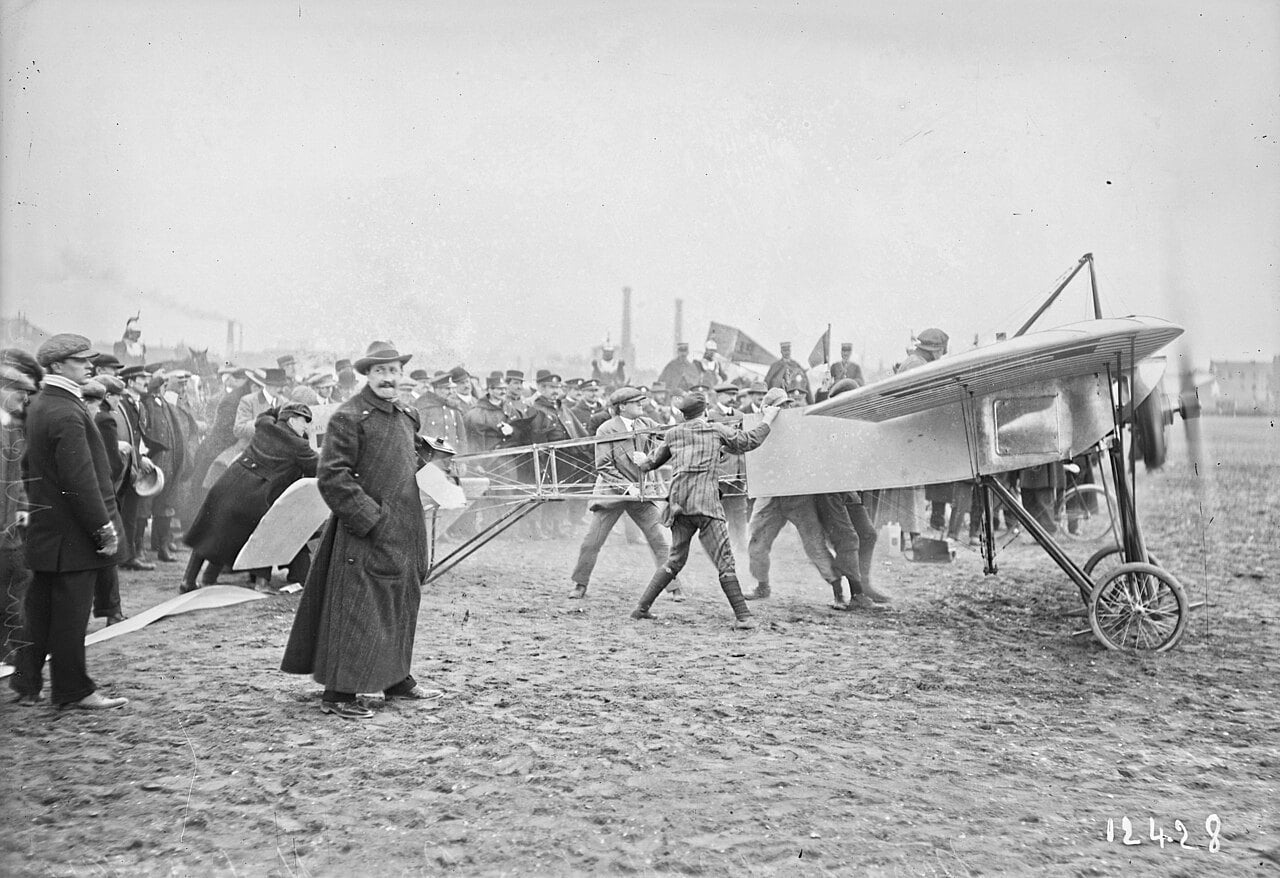
Within six months he was a national hero. In May 1911 he won the Paris to Madrid air race in a Morane monoplane, a prize worth 100,000 francs. In February 1912 he pushed the world speed record to about 159 km/h in a Deperdussin racer, and that September he won the Gordon Bennett Trophy race in Chicago.
He was also a showman and a troublemaker. He dropped bouquets of violets on a carnival procession on the Place de la Concorde, scattered leaflets demanding more aircraft for the army over the French parliament, and stood for election as a socialist. In late 1913 he flew from Nancy to Cairo in a Blériot, slipping past an official ban by taking off westwards and turning east once he was out of sight.
Agents behind the lines
When war came in 1914, Védrines flew with escadrille MS 3, the unit that became famous as the Cigognes, the Storks. His speciality was among the most dangerous jobs in the French air service: landing behind German lines to drop off intelligence agents, then going back to collect them. He called it running the bus. According to Le Figaro, he flew 53 of these special missions.
His aircraft carried a cow’s head and the words La Vache, the Cow, a nod to his family’s rural roots. He helped bring on a young pilot named Georges Guynemer, who joined the same escadrille in 1915, and was cited in army orders, awarded the Médaille militaire and made a knight of the Légion d’honneur.
Védrines landing his Morane monoplane on the beach at San Sebastián during the 1911 Paris to Madrid race.
A prize nobody had dared to claim
The Galeries Lafayette had offered its 25,000 francs before the war, to the first aviator who would land on the store’s roof. It was a wonderful publicity stunt, and a safe one, because nobody seemed mad enough to try. A 1912 decree by the Paris prefect of police banned aircraft from landing inside the city anyway.
Védrines, back in civilian life and full of plans for long-distance flights, decided the time had come. He practised short landings, and the store prepared the roof. Sandbags were laid on the terrace, part of a railing around a glass skylight was moved back, and helpers were posted to grab the aircraft’s wings once it was down.
His aircraft was a Caudron G.3, a light and slow two-seat biplane that had served as a reconnaissance and training machine during the war. The plan was to take off from Issy-les-Moulineaux, south-west of the city centre, between 7 and 7.30 in the morning. Thick fog delayed everything by more than five hours.
Steering by the Eiffel Tower
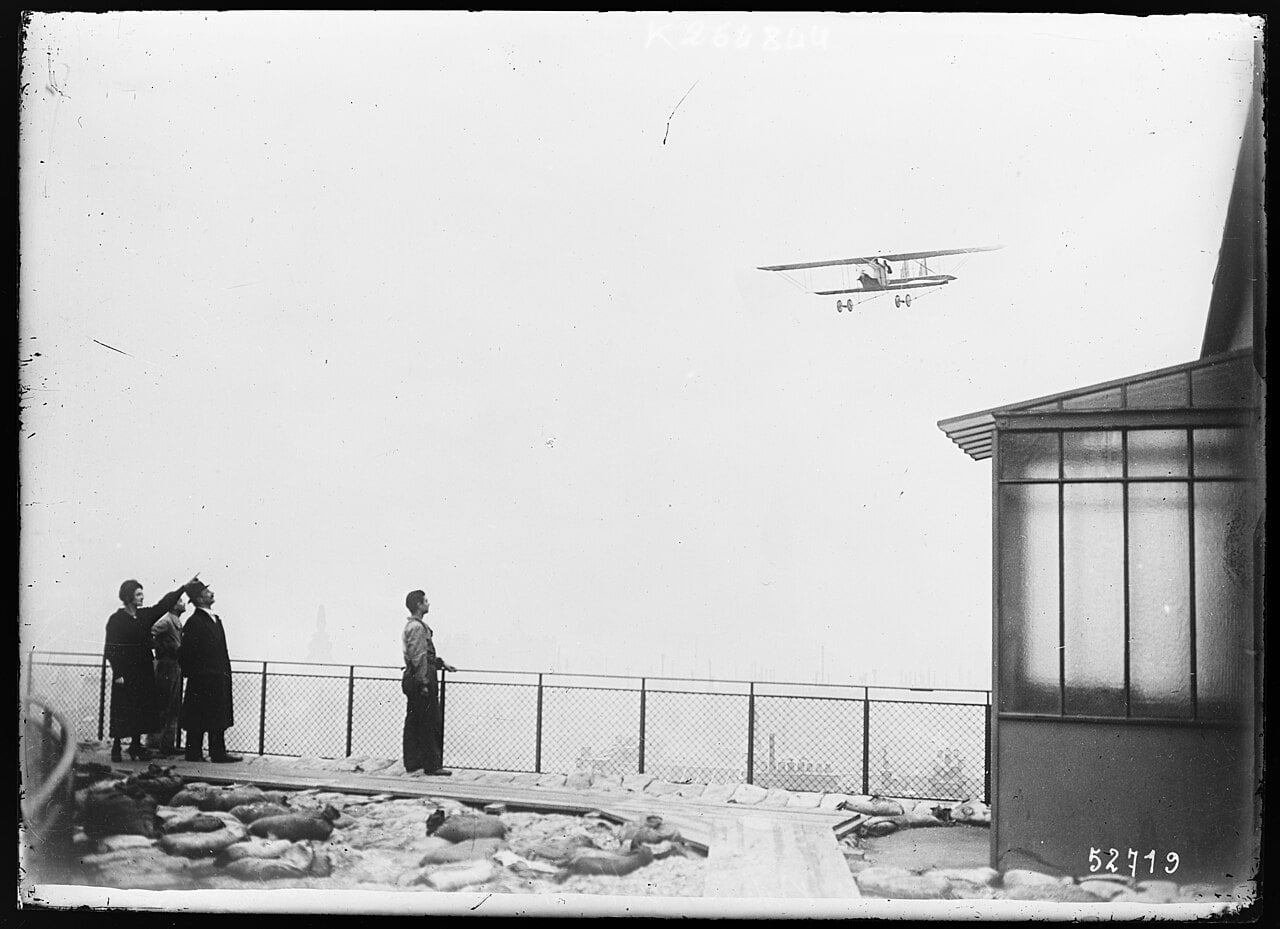
When Védrines finally took off, he climbed into the murk with the Eiffel Tower as his landmark, came down too high between the Comédie-Française and the Opéra, and spotted the roof when he saw the store’s staff scatter to clear it. He had meant to circle two or three times and come in slowly. Instead, nerves frayed after two days of administrative delays, he went straight in.
Le Figaro’s reporter watched him cross the Chaussée-d’Antin crossroads at around 100 km/h, cut across the edge of the building at five metres, dive onto the terrace, bounce, settle and stop with a slight crack. Védrines jumped out and ran to the balustrade to wave to the crowd below, who cheered.
Accounts of the damage differ. Speaking to Le Figaro moments after landing, Védrines insisted that only one bracing wire had given way and that he had delivered the borrowed aircraft intact. Later retellings describe a much harder arrival, with the biplane badly damaged and the pilot hurt. What every account agrees on is that he got down in one piece, on a roof, in the middle of Paris.
The prefecture fined him for breaking the ban on landing in the city. Le Figaro, which called the attempt mortally dangerous, summed him up as the war having left him exactly what he had always been: an infernal and fearless Paris street kid.
Archive film of Védrines landing his Caudron G.3 on the roof of the Galeries Lafayette, from the Eye Filmmuseum collection.
Three months later
Védrines did not have long to enjoy it. He wanted to open air routes between the great cities, starting with a fast flight from Paris to Rome. On 21 April 1919 he set out from Villacoublay in a twin-engined Caudron C.23. When an engine failed, he tried to put down near Saint-Rambert-d’Albon, south of Lyon, and crashed. He and his mechanic, Marcel Guillain, were killed.
He was buried at the Pantin cemetery in Paris with great ceremony. The store did not forget him either. A memorial obelisk on the terrace recorded that on 19 January 1919 the aviator Jules Védrines had, for the first time, landed an aeroplane on the roof of a house in a big city.
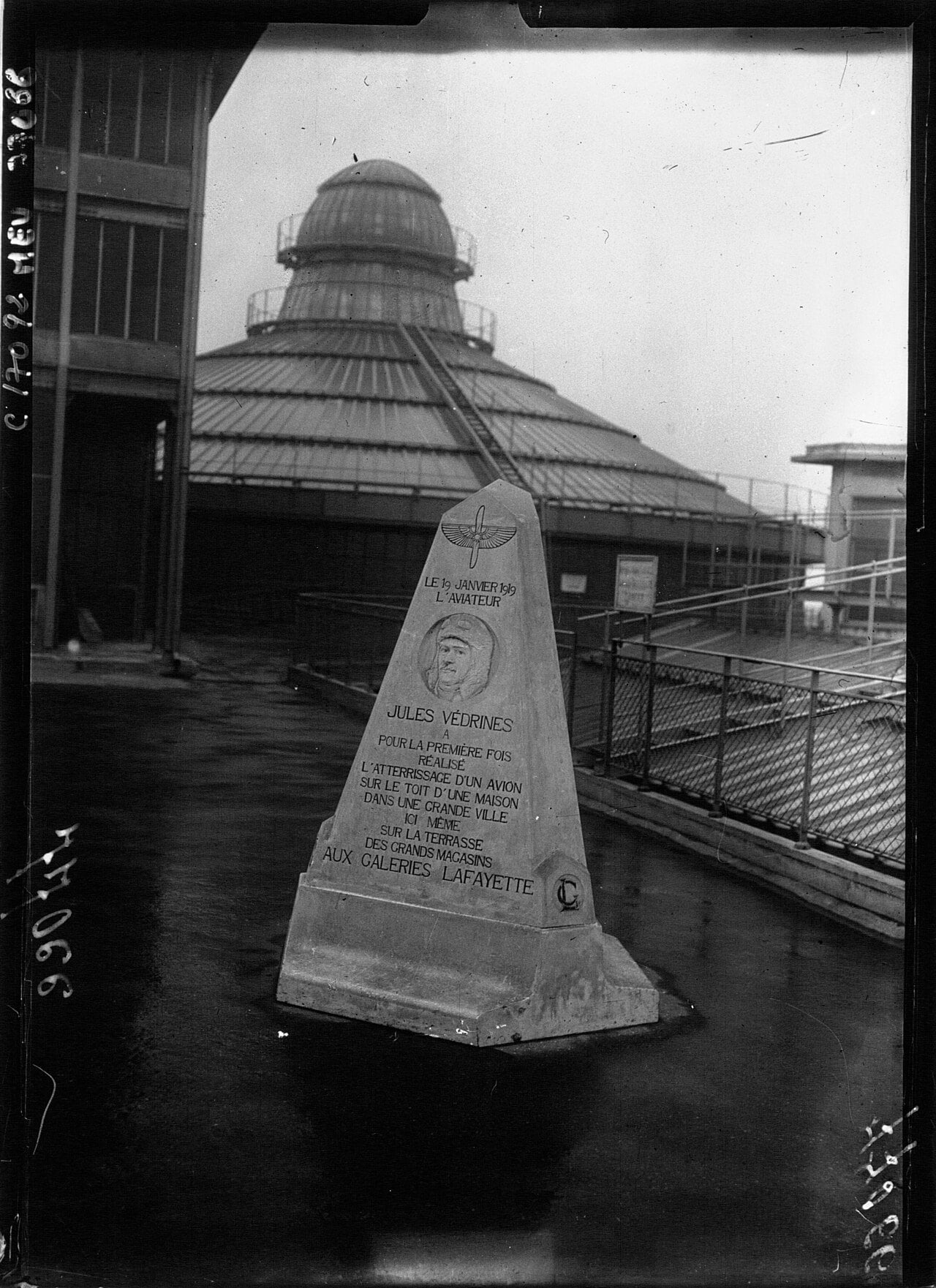
A memorial to Védrines is still there on the rooftop of the Galeries Lafayette Haussmann, where these days visitors come for the view over the Opéra and the city. Few of them realise that a Caudron biplane once dropped out of the fog onto the very same spot.
France Télévisions’ Télé Matin looks back at the aviator who landed on a Paris department store (in French).
Rooftop landings never caught on, of course. But Védrines had made his point, two months after the Armistice: the aeroplane was no longer just a weapon, and the man who flew it could land anywhere he dared.
Sources: Le Figaro (archives, report of 20 January 1919, and Marie-Aude Bonniel, 2019), France Today, Aero International, This Day in Aviation, Bibliothèque nationale de France (Gallica press photographs)

0 Comments