
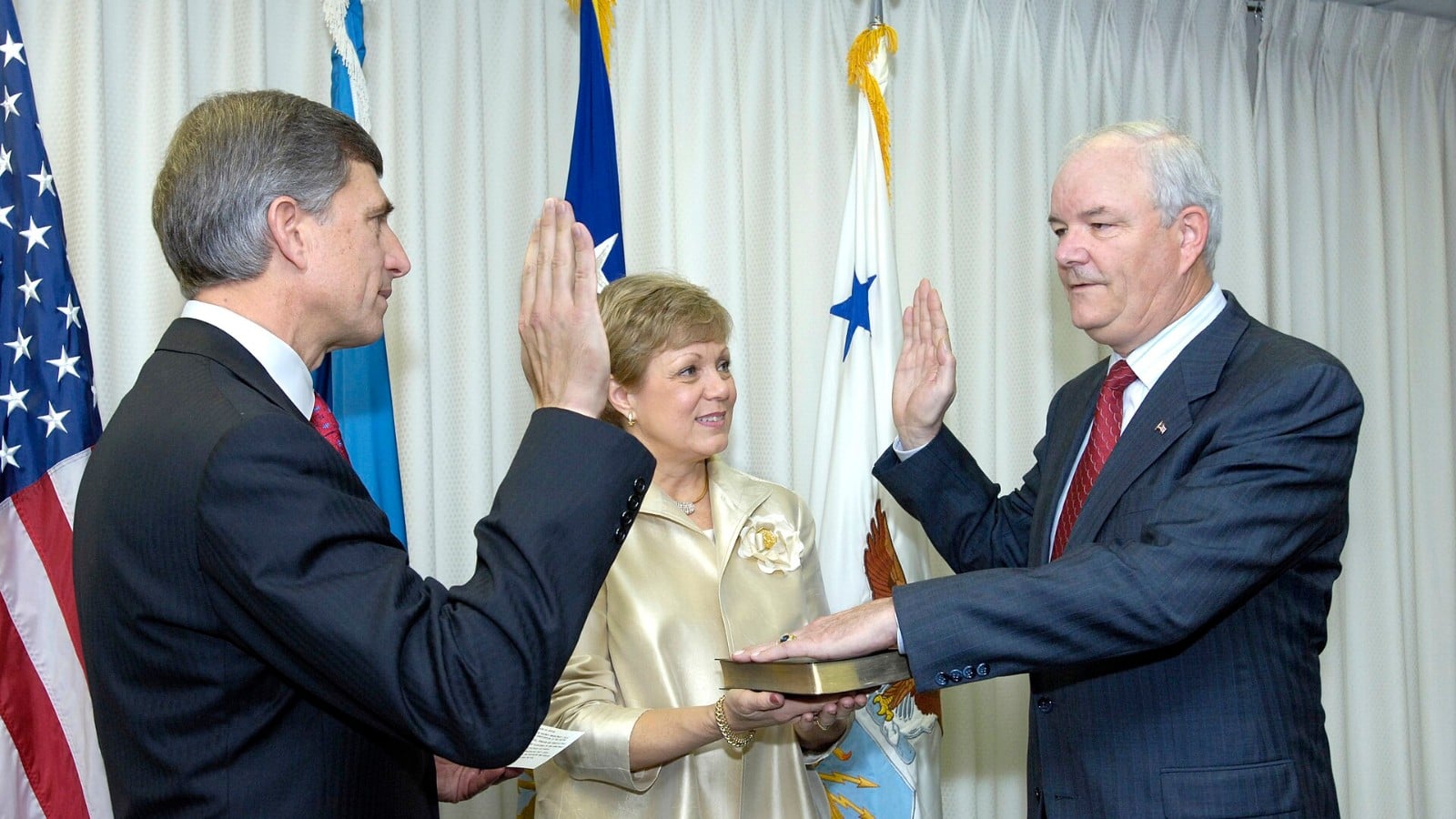
On the day Michael Wynne reported for active duty in August 1966, the news came through that his older brother had been shot down over Vietnam. Forty-two years later, the younger Wynne would leave the Air Force for the last time, as its civilian head, fired by the Secretary of Defense on the same afternoon as his chief of staff.
Wynne, the 21st Secretary of the Air Force, died on 17 October 2026 at the age of 82, Air & Space Forces Magazine reported on 22 October. He led the service from November 2005 to June 2008, through the Iraq surge, the battle over the F-22 Raptor and a nuclear-weapons scandal that ended his tenure.
Informations clés
Nom: Michael Walter Wynne
Né: 4 September 1944, Clearwater, Florida
Décédé: 17 October 2026, aged 82
Éducation: West Point (class of 1966); M.S., Air Force Institute of Technology; MBA, University of Colorado
Air Force service: 1966 to 1973, leaving as a captain
Industry: General Dynamics and Lockheed Martin executive
Secretary of the Air Force: 4 November 2005 to 5 June 2008
Dismissed by: Defense Secretary Robert Gates, with Gen. T. Michael Moseley
An engineer, not a pilot
Wynne was born in Clearwater, Florida, and graduated from West Point in 1966, but chose the Air Force. His brother Patrick, an F-4C pilot with the 555th Tactical Fighter Squadron, was shot down over North Vietnam on 8 August 1966; his remains were not returned until 1977. Wynne recalled the timing years later.
He served seven years, earning a master’s degree in electrical engineering from the Air Force Institute of Technology and ending as a captain teaching astronautics at the Air Force Academy. Then came more than two decades in industry, mostly at General Dynamics, with a spell at Lockheed Martin. In 2001 he joined Donald Rumsfeld’s Pentagon as the number two acquisition official, and he ran the acquisition office as acting under secretary from 2003 to 2005.
Michael Wynne interviewed by Aviation Week while Secretary of the Air Force.
Fighting for the F-22
As Secretary, Wynne argued with his own boss over the shape of the future Air Force. Gates suggested the service could do without more F-22s because the F-35 was coming. Wynne disagreed, telling Air Force Magazine that “the F-22 is clearly an air superiority and air dominance weapon”, with the F-35 a complement rather than a replacement. He also pushed early for cyberspace to be treated as a warfighting domain, and on his last day in office pointed to the 2007 surge in Iraq, when the Air Force increased its sorties by 400 percent.
His closest ally was Gen. T. Michael “Buzz” Moseley, the chief of staff. Moseley later said the two had the best relationship he had seen with any of the more than 13 secretaries he worked with.
Six nuclear warheads nobody knew about
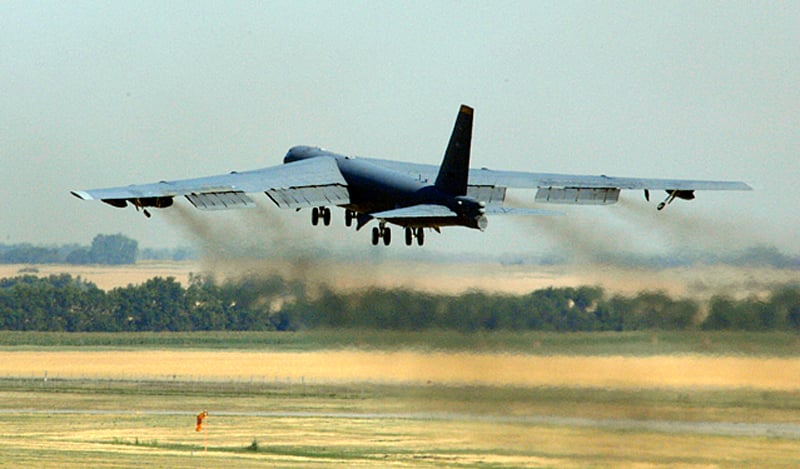
The crisis that ended his tenure began at Minot Air Force Base in North Dakota. On 29-30 August 2007, a B-52 flew to Barksdale Air Force Base in Louisiana carrying six AGM-129 cruise missiles armed with nuclear warheads, which crews had loaded believing them to be inert. For some 36 hours, nobody realised they were missing. In early 2008 came a second shock: nuclear missile nose-cone fuzes had been shipped to Taiwan in 2006 in place of helicopter batteries.
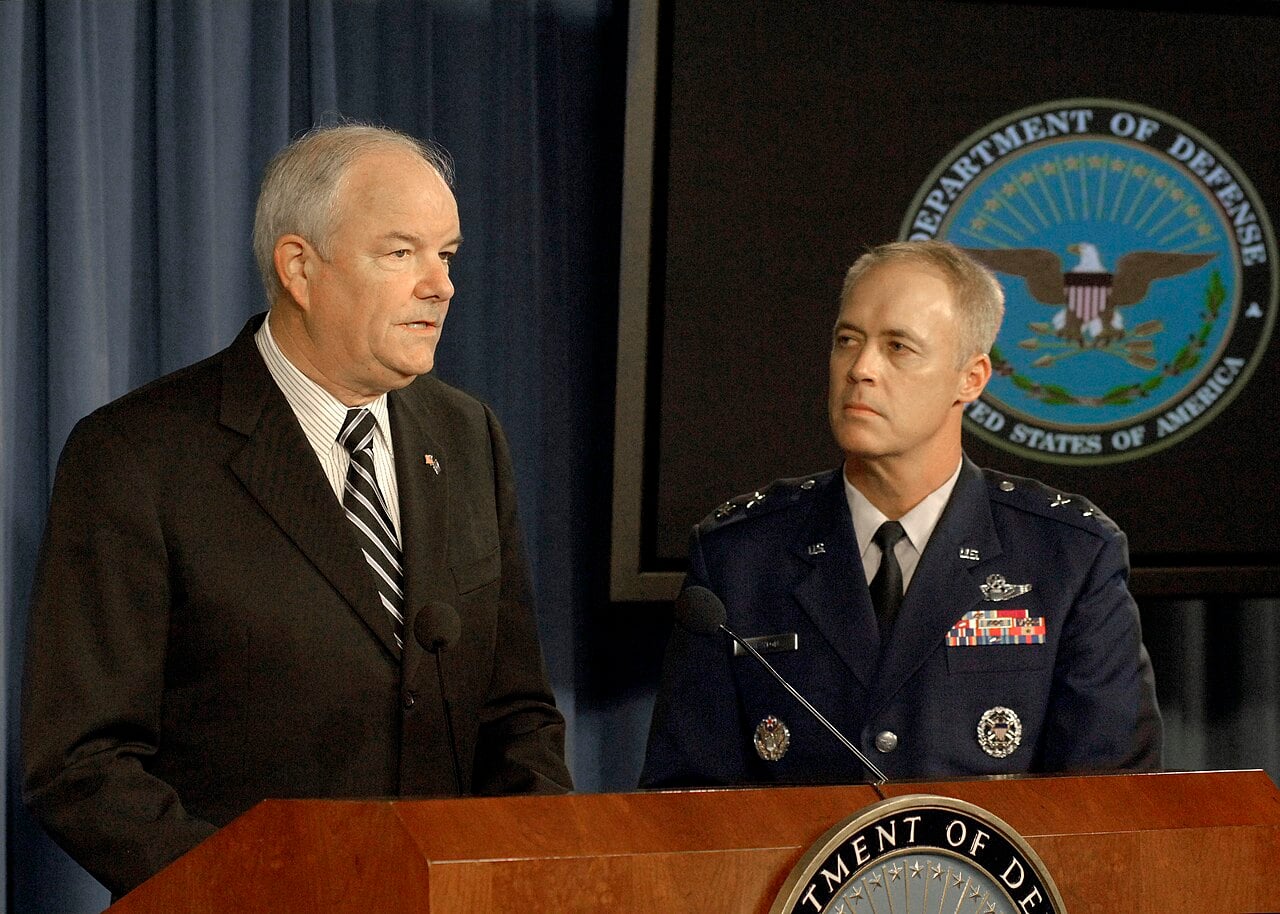
On 5 June 2008, after a critical report by Admiral Kirkland Donald on the Taiwan shipment, Gates asked for and accepted the resignations of both Wynne and Moseley, citing a decline in the Air Force’s nuclear mission focus and performance. Few people inside the building believed that was the whole story. Disputes over budgets, manpower, modernisation and the F-22 had been building for months, and Gates had criticised the services for “next-war-itis”. According to Lt. Gen. David Deptula, then on the Air Staff, Wynne refused an order to fire Moseley, so Gates fired them both.
Robert Gates accepts the resignations of Wynne and Moseley, June 2008 (Associated Press).
“He put principle above position”
Gates presided at Wynne’s departure ceremony and pinned a medal on him. Wynne used his farewell to talk about Airmen rather than aircraft, saying that it is the people of the Air Force that make the Air Force, “so in loving the Air Force, we love the people.” Weeks later he told Air Force Magazine he would probably get fired again over his objection to joint basing.
In 2020 he was appointed to the Air Force Academy’s Board of Visitors. He is survived by his wife, Barbara, and four daughters. National War College professor Richard Andres, who spoke with him weekly in the months before the firing, summed up his choice simply: “He cared more about what the nation needed than about keeping his job.”
The military explains the 2007 Minot-Barksdale nuclear weapons mistake (AP Archive).
Sources: Air & Space Forces Magazine (22 Oct 2026), Wikipedia (Michael Wynne; 2007 United States Air Force nuclear weapons incident), U.S. Department of Defense, Associated Press



0 Comments