
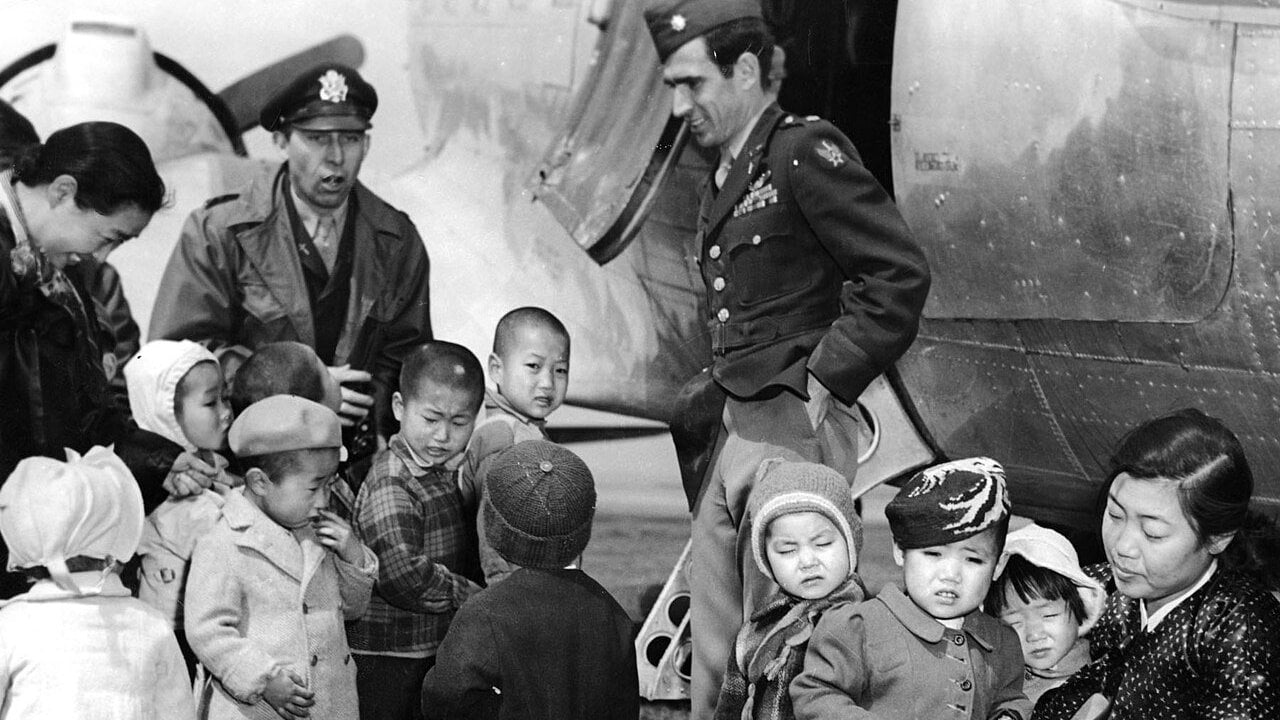
On the morning of 20 December 1950, sixteen four-engined transports sat on the frozen ramp at Kimpo, outside Seoul, with their crews waiting. Their cargo was two hours late. When it finally arrived, in a convoy of trucks a chaplain had more or less hijacked at the docks, it climbed aboard in quilted jackets and knitted caps: close to a thousand Korean children with nobody left in the world but the strangers loading them.
That was Operation Kiddy Car, one of the strangest and kindest missions of the Korean War. The men who made it happen were an Air Force chaplain, Lieutenant Colonel Russell L. Blaisdell, and his assistant, Staff Sergeant Merle "Mike" Strang. For decades almost nobody knew their names, because a Hollywood film handed the credit to someone else.
Informations clés
- Opération: Kiddy Car Airlift
- Date: 20 December 1950
- Itinéraire: Kimpo, near Seoul, to Jeju (Cheju) Island
- Aéronef: 16 Douglas C-54 Skymaster transports
- Evacuated: Roughly 950 to 1,000 orphans plus about 80 caregivers
- Organisers: Chaplain Lt. Col. Russell L. Blaisdell and SSgt. Merle Y. Strang, Fifth Air Force
- Airlift arranged by: Col. T.C. Rogers, Fifth Air Force director of operations
- Reception on Jeju: Lt. Col. Dean Hess
- Remembered: 75th anniversary ceremony at Osan Air Base, 17 December 2025
A City Full of Children
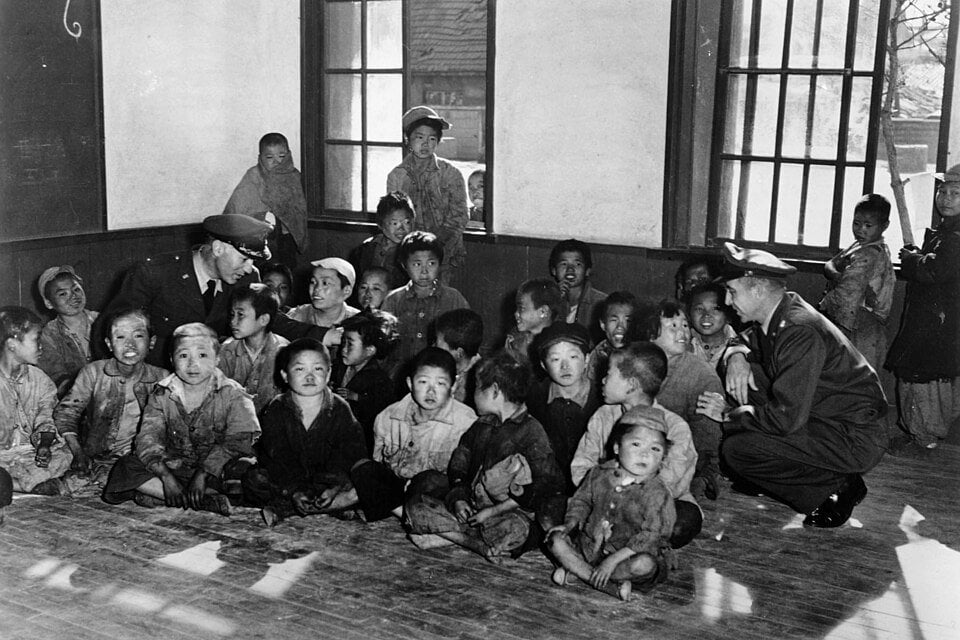
When United Nations forces retook Seoul in September 1950, after the Inchon landing, they found a capital in ruins and a population of children living in it on their own. Their parents had been killed in the fighting, executed during the occupation or simply lost in the chaos of two armies passing through.
Russell Blaisdell, a minister educated in Minnesota and Chicago who had been an Army Air Corps chaplain since 1940, was by then a lieutenant colonel on the staff of the Fifth Air Force. He and another chaplain, Colonel Wallace I. Wolverton, began trying to feed and house the children they saw in the streets around the airfields.
At first the children went to an existing Seoul orphanage, which filled almost at once. So Blaisdell, Wolverton, Staff Sergeant Strang and a group of Korean social workers set up what they called the Orphans Processing Center. Strang, Blaisdell's assistant and driver, toured Seoul in a truck with the social workers, picking up children who were sick, starving or freezing. Before long the centre was feeding and sheltering more than a thousand of them, and when Wolverton left Korea, Blaisdell ran it.
It was entirely unofficial. Responsibility for civilians belonged to the Army, not the U.S. Air Force, and according to researcher George Drake, Blaisdell later had to defend himself to his superiors for getting involved at all.
The Front Comes Back
Then the war turned again. In late November the Chinese People's Volunteer Army struck across North Korea, and by December the UN armies were retreating south. Seoul was going to fall a second time, and the Fifth Air Force began pulling out of the city.
Blaisdell's first plan was to move the children by sea. On 19 December he and Strang drove them to the port of Inchon to board a ship for Jeju, the large island off Korea's southern tip. The plan collapsed: the ships did not take them. Blaisdell was left at the docks with roughly a thousand children, about 80 Korean caregivers and the Chinese army getting closer every hour.
He raced back to Seoul in a jeep. Most of the senior officers had already gone, but Colonel T.C. Rogers, the Fifth Air Force director of operations and one of the last officers still in the city, listened. Within hours Rogers had found 16 Douglas C-54 Skymaster transports and scheduled them to fly the children out of Kimpo the next morning.
Pusan Perimeter TV's episode on the 20 December 1950 orphan airlift from Seoul.
Two Hours Late
That left the problem of getting the children from Inchon to Kimpo. The trucks Blaisdell had arranged did not arrive. So the chaplain did what chaplains are not supposed to do: he pulled rank. Standing at the port, he ordered empty military trucks to the school where the children were sheltering, a company of Marine Corps vehicles among them, and simply kept them.
The convoy reached Kimpo more than two hours after the planned departure. Blaisdell had every reason to expect an empty ramp. Instead the transports were still there. A detailed account by the blog ROK Drop credits Colonel Cecil Childre, commander of Combat Cargo in Korea, with keeping them on the ground. Blaisdell's own summary, written later, was brief: although they were two hours late, the planes waited.
The children were loaded aboard, often lifted bodily through the cargo doors by airmen, and the C-54s flew south to Jeju. Wikipedia's biography of Blaisdell gives the total as 964 orphans and 80 orphanage staff; other accounts round it to nearly 1,000 children, and the Air Force's 2025 anniversary account says more than 1,000 orphans and caretakers.
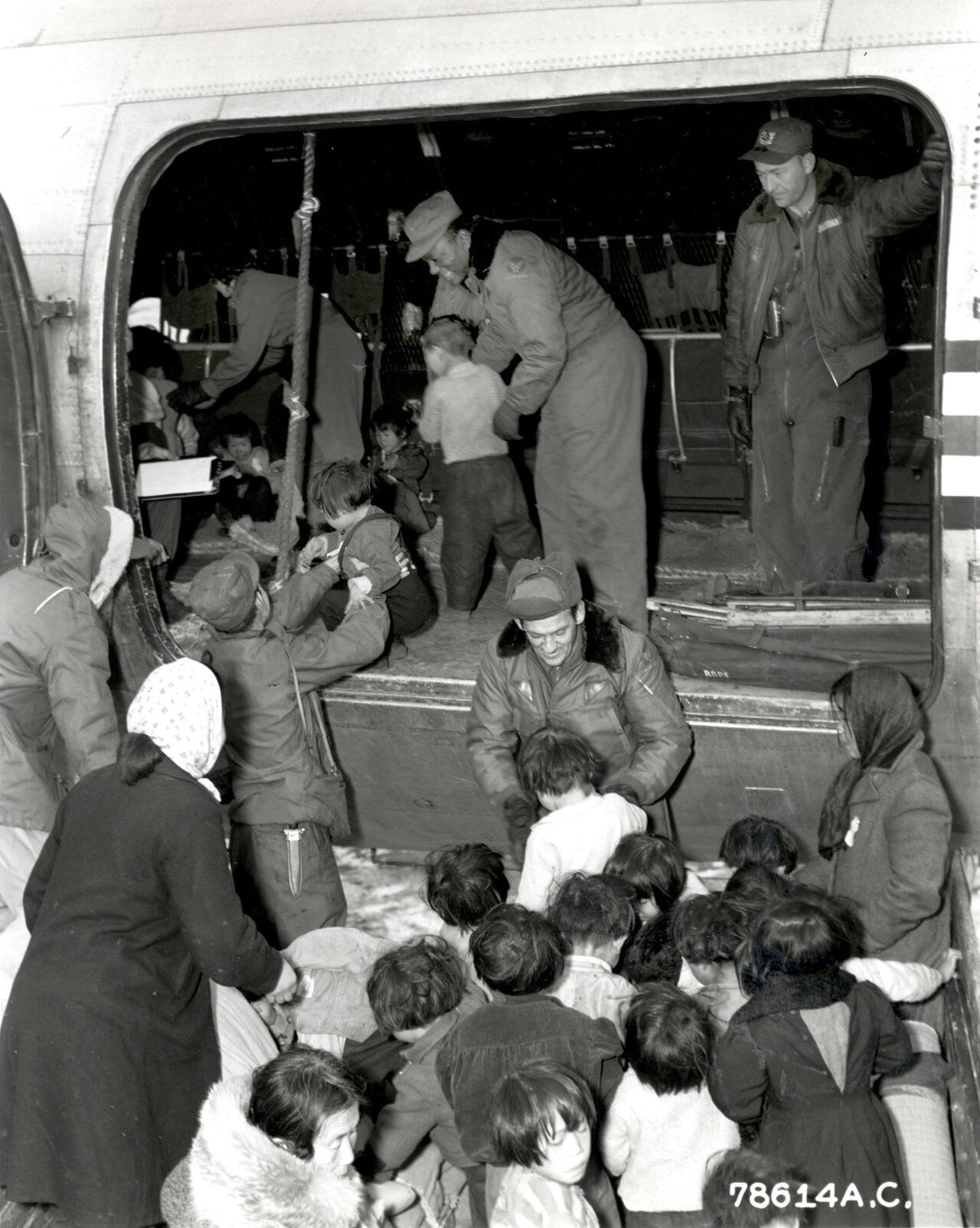
The C-54 was the right aircraft for the job. A military version of the Douglas DC-4 airliner and a mainstay of the Berlin Airlift only two years earlier, it was a four-engined workhorse with a long cabin that could take cargo, stretchers or, as it turned out, dozens of small children sitting on the floor.
On Jeju they were received by Lieutenant Colonel Dean Hess, a fighter pilot and ordained minister who had flown 63 missions in P-47 Thunderbolts over Europe. In Korea he commanded Bout One Project, which trained pilots of the fledgling Republic of Korea Air Force on the P-51D Mustang. Hess, who had also been caring for orphans, arranged a school to house them.
An orphanage was set up on the island and run by Whang On-soon, an experienced Korean orphanage director, until the end of the war, when it moved back to Seoul. According to ROK Drop, some of the children were reclaimed in the following months by surviving parents who had heard about the airlift.
The Film That Changed the Story
According to Drake, the first Associated Press and Pacific Stars and Stripes reports of the rescue named Blaisdell as its organiser. That changed in 1956, when Hess published his autobiography, Battle Hymn. A year later it became a film, with Rock Hudson playing Hess. According to Stars and Stripes, the book mentions Blaisdell, but the film does not, and it presents Hess as the hero of the airlift.
Mike Strang was furious, and wrote to Blaisdell in 1957 asking whether they should publicly correct the record. Blaisdell said no. Hess had pledged the book and film proceeds to Korean orphans, and Blaisdell was content as long as that promise was kept. The royalties did go to a new orphanage near Seoul.
It was a remarkably generous position for a man watching a film star act out his own week in December 1950. His son, the Rev. Russell Carter Blaisdell, later said his father did not consider himself a hero, and that Hess deserved credit for what he did do.
So the Hollywood version stood for nearly half a century. In 2004, George Drake, a Korean War veteran who has spent years documenting what U.S. servicemen did for Korean children, published a sharp critique of Hess's account, arguing that Hess had only arranged to receive the children on Jeju. "He had nothing to do with the airlift," Drake told Stars and Stripes in 2017. Hess himself acknowledged Blaisdell's contribution in later years, and the Republic of Korea Air Force still holds a remembrance for Hess, whose work for orphans went on long after the war.
The 1957 trailer for Battle Hymn, the Rock Hudson film that made Dean Hess the face of the orphan rescue.
The Father of a Thousand
Recognition came late. In December 2000, for the 50th anniversary of the war, the Air Force's Airman magazine told the full story. In 2001 Blaisdell flew back to South Korea, where he was greeted by First Lady Lee Hee-ho, given an honorary doctorate and described in the Korean press as the Schindler of Korea. He was also reunited with Whang On-soon, then 102. In 2003 he received the Air Force's Four Chaplains Award.
Strang did not live to see any of it. He died in 1998 and was posthumously awarded the Bronze Star in 2003. Blaisdell died in 2007, aged 96, and in 2009 a statue was unveiled in his honour in Gwangju.
On 17 December 2025, the 51st Fighter Wing marked the 75th anniversary of Operation Kiddy Car at Osan Air Base, alongside South Korean officials and survivors of the war. Major General Trent Davis, the Air Force's chief of chaplains, called it "a shared act of compassion" that still defines the alliance.
No air-to-air victory or bombing record came out of 20 December 1950. Just sixteen transports, a stolen convoy, and around a thousand children who grew up because a chaplain refused to leave them on a dock.
Sources: Wikipedia (Russell L. Blaisdell, Dean Hess), Stars and Stripes, National Museum of the U.S. Air Force, 51st Fighter Wing Public Affairs (Osan Air Base), The Korea Times / Yonhap, ROK Drop, Pusan Perimeter TV
0 Comments