
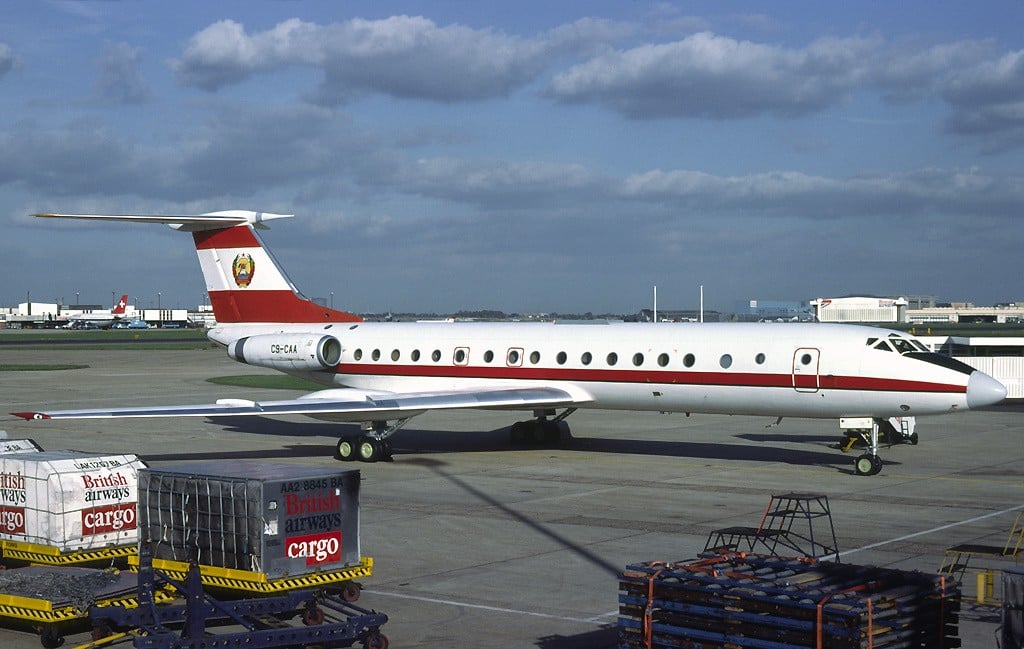
It was a clear night over the Lebombo Mountains, with ten kilometres of visibility and only scattered cloud. At 21:21 on 19 October 1986, a Tupolev Tu-134 carrying the President of Mozambique flew into a hillside at Mbuzini, just inside South Africa and about 150 metres from the Mozambican border. The crew had been looking for the lights of Maputo. Maputo was 65 kilometres away.
Samora Machel, the man who led Mozambique to independence, was killed along with 33 others. Forty years later, nobody has been able to prove exactly why his aircraft turned off course, and the question still divides two countries.
Informations clés
- Date: 19 October 1986, impact at 21:21:39 local time
- Aéronef: Tupolev Tu-134A, registration C9-CAA, built 1980
- Itinéraire: Mbala, Zambia, to Maputo, Mozambique
- Lieu du crash : Mbuzini, South Africa, about 65 km west of Maputo
- À bord : 44 people: 35 passengers and 9 crew
- Tué : 34 in the crash, including President Samora Machel; one survivor died later
- Survivants : 10, including the Soviet flight engineer
- Cause: Disputed: crew error (South African inquiry) or a false navigation beacon (Soviet view)
A President's Jet With a Soviet Crew
C9-CAA was a Tu-134A built in August 1980 with about 1,105 flying hours on it. Like many aircraft in Soviet-aligned states, it was flown by a crew lent by the Soviet Union: Captain Yuri Novodran, First Officer Igor Kartamyshev, navigator Oleg Kudryashov, flight engineer Vladimir Novoselov and radio operator Anatoly Shulipov. Four Mozambican cabin crew looked after the passengers.
That day Machel had flown to Mbala in northern Zambia for a summit with regional leaders. The party left Mbala at 18:38 for the non-stop flight home, due in Maputo at 21:25. The jet cruised at 35,000 feet, then began its descent towards the capital in the dark.
Journeyman Pictures on the theories surrounding the crash that killed Samora Machel.
The 37-Degree Turn
At about 21:10 the Tu-134 turned right for almost a minute, swinging its heading from 184 to 221 degrees. Instead of following the coast down to Maputo, it was now pointing inland, towards the hills on the South African side of the border. The crew had been cleared to 3,000 feet and told not to go lower until they could see the runway lights.
They kept descending. When the city lights did not appear, the cockpit voice recorder captured the captain's confusion.
The ground proximity warning sounded and kept sounding for about 32 seconds. The captain's only response, according to the inquiry, was an exclamation and a slight pull on the controls. In the last seconds the navigator said there were no beacons to be found, and the captain answered that there was no ILS either. Then the left wing struck a tree and the aircraft hit the ground.

Two Explanations, No Closure
South Africa, then under apartheid and openly hostile to Machel's government, led the investigation. Its Margo Commission concluded that the crew had descended below the minimum safe altitude in darkness, under visual rules, and ignored the ground proximity warning. It put the fatal turn down to the navigator's use of the autopilot, and thought it probable that a VOR receiver had been tuned by mistake to the beacon at Matsapa in Swaziland, on 112.3 MHz, instead of Maputo's 112.7 MHz.
The Soviet delegation rejected that. It argued that a false VOR beacon had lured the jet off course on purpose, and that an earlier warning in the cockpit had been triggered by the decoy signal. Mozambique also refused to accept the findings. In 2001, South Africa's Truth and Reconciliation Commission said the possibility of a false beacon needed further investigation and found no conclusive evidence either way.
Suspicion of South African involvement has never gone away. South African investigators later said they found no evidence of complicity, in 2003 and again in 2008. No decoy beacon has ever been found.

Thirty-Five Pipes on a Hillside
In 1999 Nelson Mandela, Graça Machel and President Joaquim Chissano opened a memorial at the crash site, paid for by the South African government. Mozambican architect José Forjaz designed it around 35 steel pipes, one for each person who died, which whistle when the wind blows across the hill. In 2006 it was declared a South African national heritage site.
Today South Africa and Mozambique mark 40 years since the crash. The airport lights of Maputo are still just over the horizon from Mbuzini, and the question the captain asked into the dark still has no agreed answer.
SABC News on preparations at Mbuzini to mark 40 years since the crash.
Sources: Wikipedia (1986 Mozambican Tupolev Tu-134 crash), South African Board of Inquiry (Margo Commission) and Truth and Reconciliation Commission findings as summarised there, Journeyman Pictures, SABC News, AP via WRAL

0 Comments