
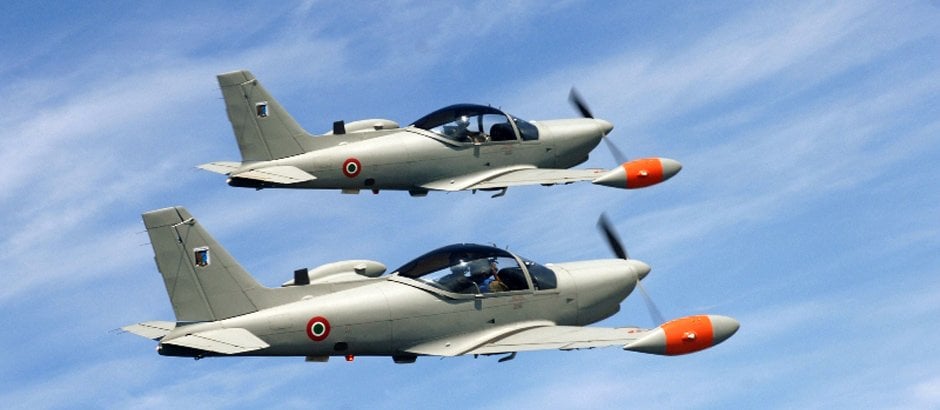
It was meant to be a rich pilot's toy: a sleek, three-seat sport plane that could loop and roll like a fighter. Instead, the SIAI-Marchetti SF-260 became the aircraft in which thousands of military pilots learned to fly.
Designed by Stelio Frati and first flown on 15 July 1964, the little Italian low-wing monoplane went on to serve with some 27 air forces. Leonardo, its current owner, calls it the most successful Italian aircraft produced in peacetime, and the company's own nickname for it is the sports car of the air.
Six decades on, it still trains pilots in Italy. Here is how a design for weekend aerobatics ended up as one of the world's classic military trainers.
Informations clés
- Designer: Stelio Frati
- Premier vol : 15 July 1964 (as the F.260)
- Manufacturers: Aviamilano, SIAI-Marchetti, Aermacchi, Leonardo
- Engine (SF-260M): Lycoming O-540, 260 hp
- Turboprop version: SF-260TP, Allison 250, 350 shp
- Max speed (SF-260M): 333 km/h at sea level
- g limits: +6 / -3
- Construit: 976 including prototypes, production to 2017
A Sport Plane From Frati's Drawing Board
In the early 1960s Frati, already known for elegant light aircraft such as the Falco, began work on a new three-seat aerobatic design. Unusually for a civil aircraft of the time, it was meant to have aerobatic ability close to that of contemporary combat aircraft, and to be equipped for instrument flight.
The design borrowed heavily from Frati's earlier work, sharing the wing and a similar structure with the Falco F8L. It was his first all-metal aircraft. Initially called the F.250 after the horsepower of its engine, it flew in its F.260 form on 15 July 1964, built by the Milan firm Aviamilano.
Soon afterwards SIAI-Marchetti bought the rights to the design and took over production, and the aircraft became the SF.260. The company kept building it until Aermacchi bought SIAI-Marchetti in 1997.
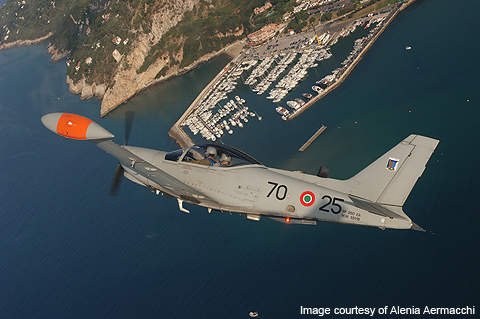
Built Like a Fighter in Miniature
The SF-260 is a low-wing cantilever monoplane with retractable tricycle landing gear and distinctive tip tanks. Its skin is extensively flush-riveted to cut drag, and its compact, dense structure gives it handling that pilots often describe as jet-like.
The original engine was a 260 hp Lycoming O-540 six-cylinder piston engine driving a two-blade constant-speed Hartzell propeller. In the 1980s, Flying magazine summed up the result in one line.
The SF-260M is cleared to +6 and -3 g and reaches 333 km/h at sea level. There is a catch for aerobatics: the rear seat must be empty and the tip tanks drained first, which cuts endurance to roughly an hour and a half. The pilot normally sits on the right, flying with the right hand on the stick and the left on the throttle, just as a military student would in a jet.
For a fast, slippery aircraft its manners are kind. Stall behaviour is relatively tame, helped by vanes on the tip tanks that speed up the airflow over the wingtips and ailerons, and there is usually plenty of aerodynamic warning. The flip side of its responsive controls is that pilots must watch their speed closely, and the landing gear's speed limits are often listed among its few weak points.
The Italian Air Force's own close-up look at the SF-260EA trainer.
From Weekend Toy to Military Trainer
Air forces noticed. Between 1964 and 1984 most SF-260s went to military customers, who used them as trainers and as light ground-attack aircraft, while private buyers struggled to get hold of one. A late-1960s attempt to sell it in the United States as the Waco Meteor, despite no link to the Waco company, did not succeed.
The militarised SF-260M, with a strengthened airframe and improved aerodynamics, first flew in 1970. The armed SF-260W Warrior added underwing hardpoints and proved popular with smaller air forces that could hang guns, rockets or bombs on it for close air support.
Libya was the biggest single customer, ordering 240 SF-260WLs. The first 60 were built in Italy and the rest assembled from kits at a new plant in Sebha, and Libyan aircraft were used for ground attack during the long conflict in Chad. The Philippines ordered 48 in the early 1970s, with the first six delivered in May 1973, and Turkey ordered 40 in 1990, 34 of them built under licence by Turkish Aerospace Industries.
Small Wars, Small Air Forces
The Warrior's low cost and simple systems took it into conflicts its designer never imagined. Despite an arms embargo, Rhodesia obtained 17 SF-260Cs and 14 SF-260Ws in 1977 through various routes, using the trainers for instruction and the Warriors for light attack and convoy escort.
In the Philippines, the 15th Strike Wing at Sangley Point flew SF-260W Warriors alongside T-28 Trojans before the survivors were disarmed and returned to training. Burkina Faso's small air force used Warriors during the Agacher Strip War with Mali, and Sri Lanka's SF-260TPs, bought for training in 1985, were later drawn into the fight against the Tamil Tigers.
The Turboprop Generation
In 1980 SIAI-Marchetti flew the SF-260TP, powered by an Allison Model 250 turboprop flat-rated at 350 shp. It gave air forces a trainer that ran on jet fuel and behaved much like the piston version, and several operators later upgraded older airframes to the same standard.
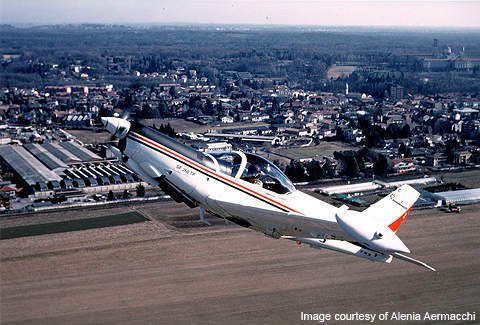
Civil sales never vanished either. In the late 1970s and 1980s American airline pilot Frank Strickler became a major reseller, buying SF-260s from the factory in small batches and selling them on to US owners. In 1986 SIAI-Marchetti asked Gates Learjet to adapt the SF-260TP for FAA civil certification, which brought aerodynamic changes such as shark's-teeth leading-edge extensions to lower the stall speed.
In 1991-92 SIAI-Marchetti offered an updated SF-260, with an enlarged canopy and revised fuel system, for the US Air Force's Enhanced Flight Screener competition. The Slingsby T67 Firefly won, but the work fed into the fuel-injected SF-260E and the SF-260F.
After the Aermacchi takeover in 1997, the design was overhauled to simplify production, adding a new fuel system, air conditioning, a cockpit tailored to military training, an autopilot and modern avionics, according to Leonardo. In 2005 the Italian Air Force took delivery of 30 SF-260EAs for a total of 33 million euros.
The Breitling Devils SF-260 aerobatic team training at Thiene in Italy.
Still Flying, Still Teaching
Production continued at a low rate until 2017, by which time 976 aircraft, including prototypes, had been built. Leonardo says more than half of its 27 military operators placed repeat orders, and five came back three or four times.
In Italy the SF-260 is the workhorse of the 70th Wing at Latina, the Italian Air Force's basic flying school, according to MalpensaNews. The type has also flown with civilian and military display teams, and in 1983 nine SF-260s flew across the Atlantic to mark 50 years since Italy's 1933 Decennial Air Cruise.
Archive film of the Belgian Air Force's Swallows display team flying the SF-260.
For a sport plane that was never meant to go to war, it has had a remarkable career. Frati drew a fast, pretty three-seater for private pilots; air forces on several continents turned it into a classroom, a light strike aircraft and a display-team mount, and kept ordering more.
Sources: Wikipedia (SIAI-Marchetti SF.260), Leonardo, MalpensaNews, Airforce Technology, Aeronautica Militare
0 Comments