
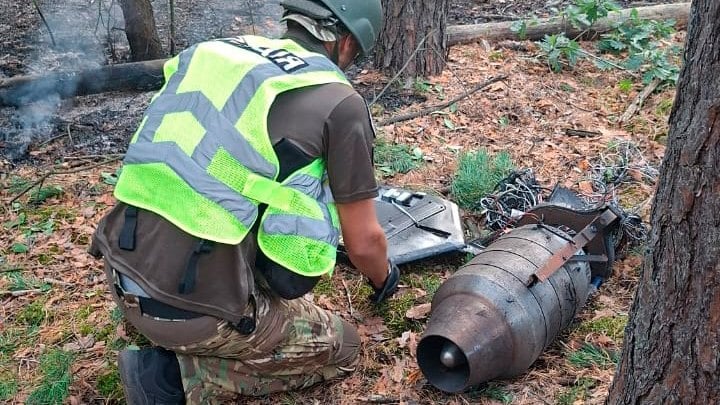
Russia's jet-powered Geran-4 drones were built to outrun the cheap defences that tamed the propeller Shahed. On Monday 27 October, Ukraine's General Staff published a number that suggests the gap is starting to close: over the past three months, its forces have shot down almost 60% of the Geran-4 jet drones launched against them.
During some individual attacks, the General Staff said, the rate for jet-powered drones reached 80%. Fighter aircraft are doing much of the work, while a growing ring of guns, interceptor drones and shoulder-fired missiles is filling the gap left by a shortage of surface-to-air missiles.
Almost 60% is progress, not victory. Against the older, propeller-driven Shahed types, Ukraine has reported interception rates of around 95%, according to the Kyiv Independent. Roughly four in ten Geran-4 jet drones are still not shot down.
Quick Facts
- Claim: Almost 60% of Geran-4 jet drones shot down on average
- Period: The past three months, per the General Staff's analysis
- Best case: Up to 80% of jet drones downed during some attacks
- Published: 27 October 2026, General Staff of the Armed Forces of Ukraine
- Fighters named: F-16, Mirage, MiG-29
- Short-range layer: Gepard, Shilka, Skynex, Skyranger, Terrahawk Paladin, interceptor drones, mobile fire groups
- Geran-5: No interception rate published
- Comparison: About 95% for propeller Shaheds, per the Kyiv Independent
From 57% to almost 60%
The new figure fits a slow upward curve. On 28 September, President Volodymyr Zelensky said in his evening address that Ukraine was intercepting about 70% of all Russian drones but only 57% of the jet-powered ones, a rate he called significantly lower than needed, as reported by Ukrainska Pravda, UNITED24 Media and NV.
The General Staff's statement, posted on its official Telegram channel, gives a three-month average of almost 60% for the Geran-4 type specifically. It does not say how many drones the figure is based on, and it gives no rate at all for the newer Geran-5.
That omission matters. The Geran-4 is the Shahed's airframe idea rebuilt around a small Chinese turbojet; Ukraine's military intelligence agency HUR put its speed at up to 500 km/h when it published a teardown in May. The Geran-5 flies higher and faster again. An unnamed senior engineer at a defence contractor told the Kyiv Independent it is about 150 km/h faster than the Geran-4.
BFBS Forces News on Ukraine's race to counter Russia's faster jet-powered Geran drones.
Fighters carry the heaviest load
According to the General Staff, tactical aviation now plays a major role in destroying jet drones, and it names three types: the F-16, the Mirage and the MiG-29. Ukraine's Mirages are Mirage 2000-5F fighters supplied by France.
Fighters suit the problem. A jet drone at several hundred kilometres per hour leaves a gun crew seconds to react, but a fighter can be vectored onto its track and fire a heat-seeking missile or its cannon from behind. The cost is the issue: every Sidewinder fired at a drone is a missile that is not available for a cruise missile or an aircraft.

The small air defence layer
The second half of the statement is about what Ukrainians call “small air defence”: everything below the long-range missile batteries. The General Staff lists Gepard and Shilka anti-aircraft guns, the newer Skynex, Skyranger and Terrahawk Paladin systems, interceptor drones and the mobile fire groups drawn from every branch of the armed forces.
Those mobile fire groups carry machine guns, but also man-portable air defence systems. The General Staff frames the whole effort as a response to a shortage of guided surface-to-air missiles, which is why the guns, the shoulder-fired missiles and the cheap interceptors matter so much.
Cost is the other driver. The General Staff says work continues to make each interception cheaper and that new interceptors are in testing, some of which have already shot down several dozen Russian jet Gerans. It did not name them.
The numbers Russia is betting on
Russia is betting on volume. Ukrainian intelligence estimates, reported by the Kyiv Independent on 1 October, put Russian production of Geran-4 and Geran-5 jet drones at about 3,000 a month. At that pace, even 60% leaves well over a thousand jet drones a month to get through if Russia launched every one, which is why the 80% nights matter more than the average.

The statement also leaves the Geran-5 question open. If the jet Gerans keep getting faster, the guns and propeller interceptors that worked against the Shahed 136 will need to be replaced by something quicker, and Ukraine's fighters will keep doing work that was never part of their job description.
Sources: General Staff of the Armed Forces of Ukraine (Telegram), Kyiv Independent, Ukrainska Pravda, Censor.NET, Ukrinform, UNITED24 Media, NV, DroneXL



0 Comments