
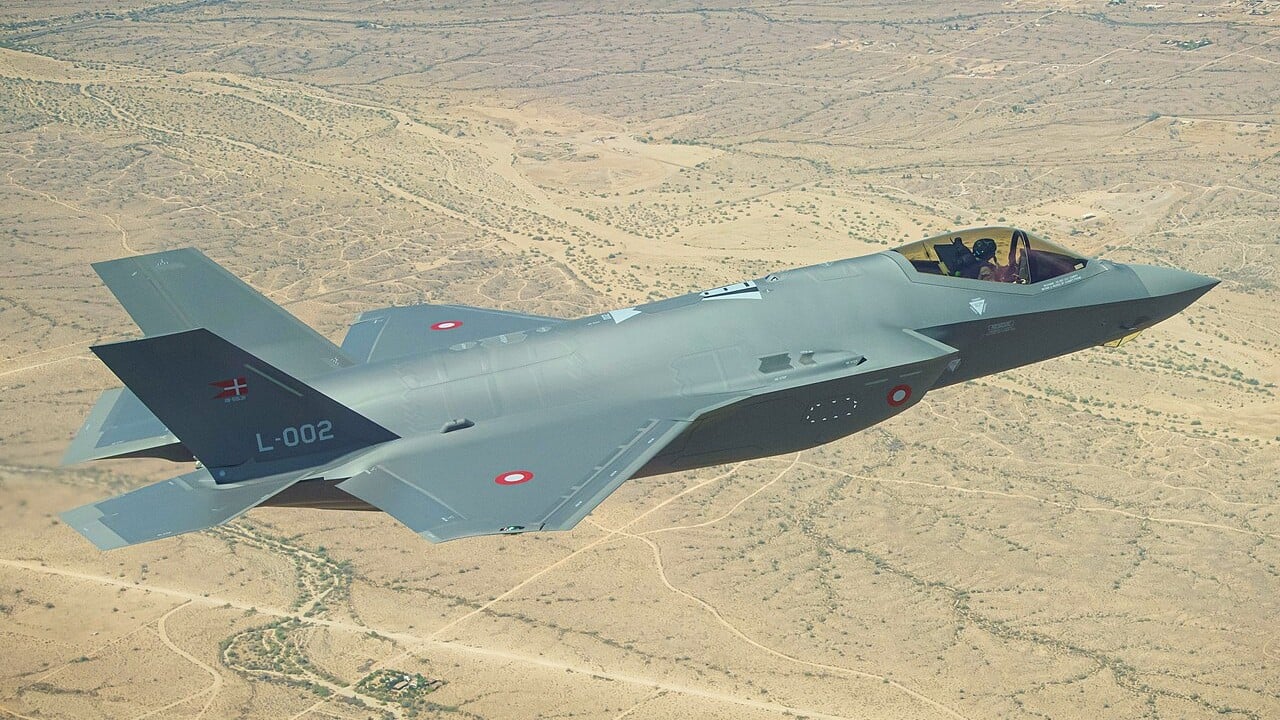
Denmark has quietly finished buying sixteen more F-35As, taking its fleet from twenty-seven to forty-three. Nobody announced it. It surfaced in a Pentagon accounting document.
The Danish government and the F-35 Joint Program Office closed the deal by 21 April 2026. The Pentagon dated the report that day, then did not clear it for release until 3 August. Aviation Week found it at the end of that month. It reached the wider press this week.
Which means Denmark’s largest fighter expansion in a generation was completed four and a half months before most people heard about it.
Quick Facts — Royal Danish Air Force F-35A
Original order: 27 aircraft, agreed 9 June 2016
Additional order: 16 aircraft, announced 10 October 2025
New total: 43 aircraft, complete by about 2030
Finalised: By 21 April 2026, per the Pentagon’s FY2027 Selected Acquisition Report
Lot split: 8 in Lot 20, 6 in Lot 21, 2 in Lot 22
Cost of the 16: ~DKK 29 bn (~US$4.5 bn), inside a DKK 88 bn 2025–2033 package
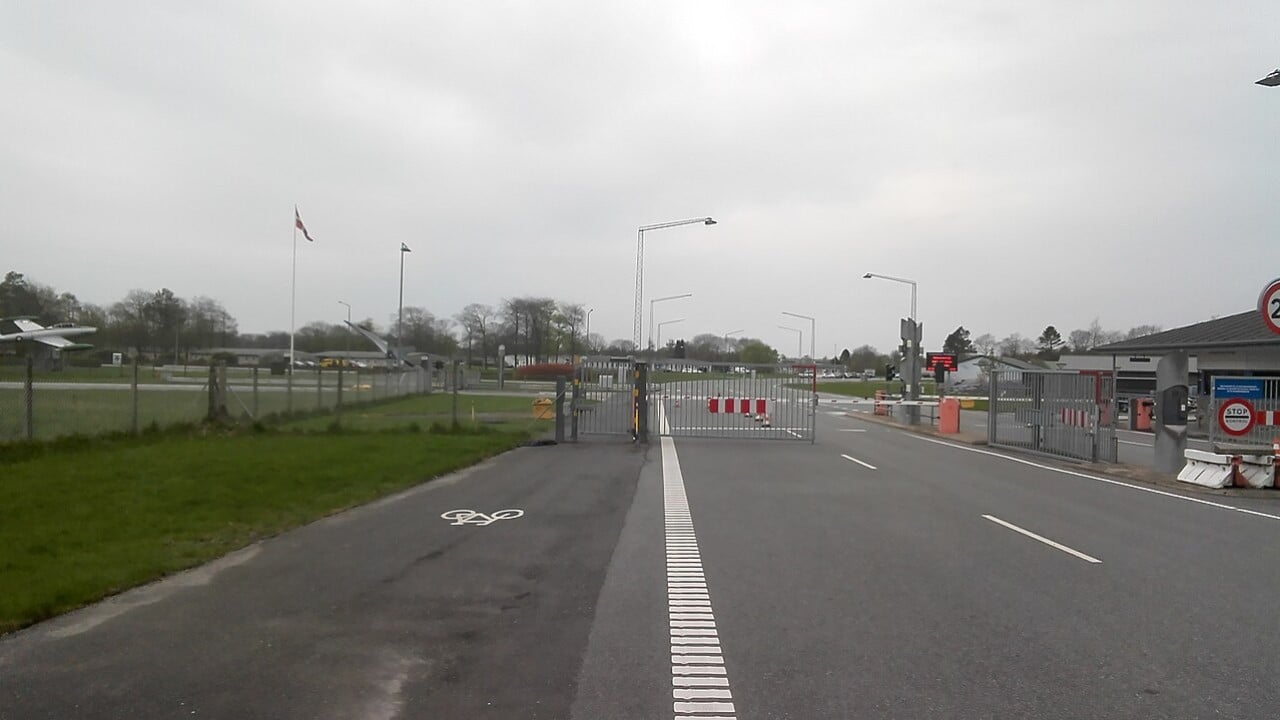
Base: Fighter Wing Skrydstrup, Southern Jutland — Eskadrille 727
Delivered so far: 23 of the original 27, as of June 2026
Programme membership: Partner nation since 1997
How Denmark Got to 43
The 2016 agreement bought 27 aircraft. The F-35A beat the Eurofighter Typhoon and the Boeing F/A-18F Super Hornet — not the Gripen, which Saab had withdrawn from the Danish contest in 2014 without submitting a final bid. Denmark rated the F-35A superior in all four evaluation categories, and Boeing formally disputed the methodology.
Then, on 10 October 2025, the government and the parties to the defence agreement announced sixteen more. Twenty-seven plus sixteen is forty-three.
Poulsen no longer holds the office. Jeppe Bruus has been Denmark’s Minister of Defence since 3 June 2026, and has not commented publicly on the F-35 expansion.
The Chief of Defence was blunter about why.
The Jet That Caught Fire, and What It Does Not Mean
The same Pentagon report contains a detail that has been widely misread this week, so it is worth being exact.
The report states that repairs are ongoing for the third Lot 17 F-35A, damaged by a 270-volt battery fire on the production line, and that despite the setback the aircraft is still scheduled for delivery alongside three Lot 18 aircraft in September 2026.
Several outlets have run this as though the fire prompted the sixteen-jet order. It did not, and it cannot have. The burned aircraft is a Lot 17 airframe — one of the original twenty-seven, not one of the new sixteen. And the order was politically agreed in October 2025, six months before the report was even dated. The fire and the order are two unrelated line items that happen to sit in the same annual document.
What the fire does explain is the arithmetic of this month. Denmark had received 23 of its 27 aircraft as of June 2026. The damaged Lot 17 jet plus three Lot 18 aircraft is exactly four. If that September delivery holds, Denmark completes its original order within weeks.
Whether it holds is unknown. The Joint Program Office, Lockheed Martin and the Danish Ministry of Defence all declined to answer Aviation Week’s questions about the repair schedule.
Greenland Is the Reason
The sixteen jets are one line in a DKK 88 billion package running to 2033, and the rest of that package explains the fighters.
DKK 27.4 billion of it goes to Arctic and North Atlantic defence: two more Arctic-capable patrol vessels, a maritime patrol aircraft capability, a new Arctic Command headquarters in Nuuk, a submarine cable between Denmark and Greenland, drones, and a radar capability in East Greenland. Danish F-35s already patrol over Greenland.
The political backdrop is not subtle. President Trump has repeatedly said Greenland should be controlled by the United States rather than Denmark. Prime Minister Mette Frederiksen’s answer has been that Greenland is not for sale. Denmark’s response has been to buy sixteen more American fighters and put the money into the Arctic — a combination that tells you something about how small NATO states are managing this particular moment.
Separately, on 5 June 2026 the US State Department cleared a possible sale of 200 AGM-158 JASSM-ER cruise missiles to Denmark, worth $842 million, explicitly to strengthen its F-35 capability. Note that the official notice says only AGM-158 JASSM-ER; the B and B-2 sub-designations that have appeared in coverage are not in the document.
The Bill Nobody Mentioned
Six weeks before the finalisation surfaced, Denmark’s national audit office published a report that the Ministry of Defence will not have enjoyed.
Rigsrevisionen found that the ministry had estimated DKK 57.1 billion in 2017 for buying and operating the 27 aircraft over thirty years, and had held to that figure until January 2026 — despite a decade of accumulating evidence that it was wrong. In February 2026, prompted by the audit, the ministry revised it to DKK 71.2 billion. That is DKK 14.1 billion more, about 24.7 per cent, or roughly half a billion kroner a year.
Two details sharpen it. The audit found the DKK 17.2 billion purchase total given to the Finance Committee in October 2025 was at least DKK 2.3 billion too low. And the ministry had included no contingency reserve at all, contrary to normal practice for a purchase of this size.
They went further on the second point, rating it “meget utilfredsstillende” — very unsatisfactory — that the ministry had failed to inform the Folketing properly. That is level three on their five-point scale.
One clarification that most coverage has skipped: this overrun is almost entirely in operations and maintenance over thirty years, driven by personnel costs and rising common costs in the international F-35 partnership. It is not the price of the aeroplanes going up. Rigsrevisionen specifically recommended the ministry track costs more closely on the sixteen-jet follow-on.
The Defence Minister must now submit a formal response, and the Public Accounts Committee takes its final position in November.
Where the Fleet Actually Is
As of October 2025, 21 aircraft had been delivered: 15 in Denmark and 6 at Luke Air Force Base in Arizona, where Danish pilots train with the 308th Fighter Squadron. By June 2026 the total received was 23. No fresher breakdown of the in-Denmark versus in-Arizona split has been published.
The first four aircraft landed at Skrydstrup in October 2023. On 1 April 2025 the F-35 entered Denmark’s quick reaction alert rotation alongside the F-16. Full operational capability for the original 27 is expected in 2027.
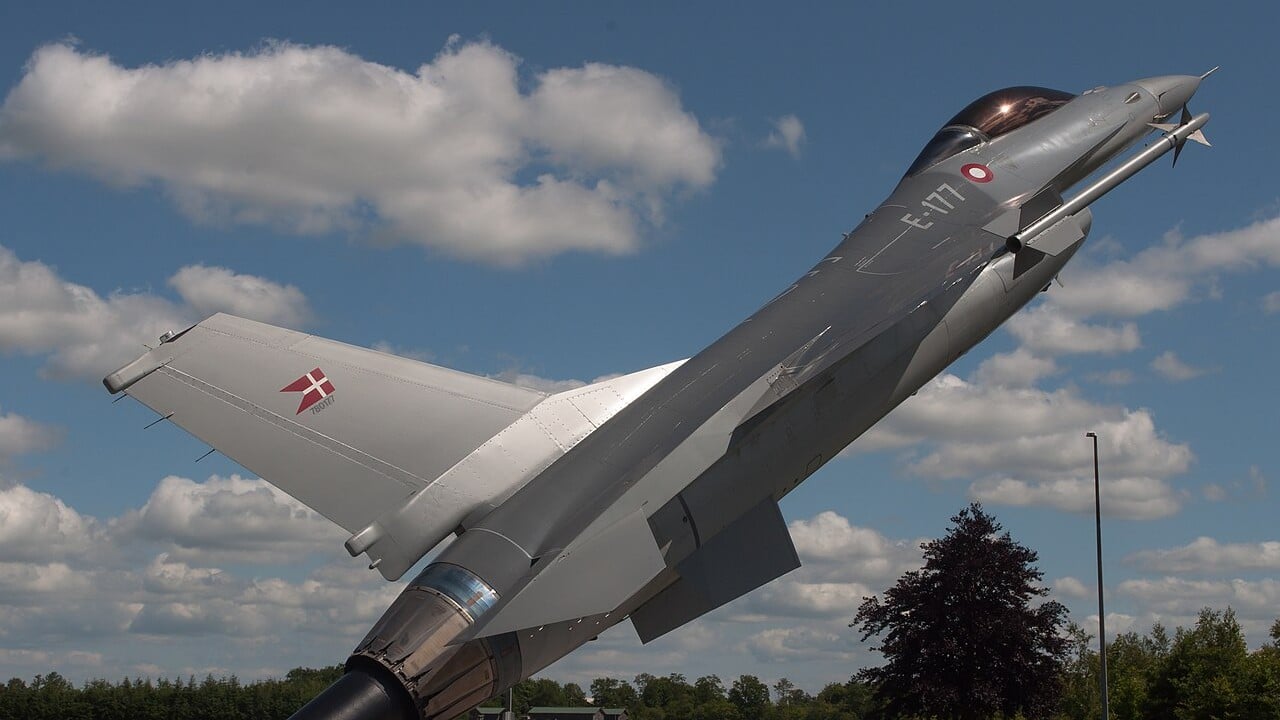
And the F-16 is gone. The Royal Danish Air Force flew its last on 18 January 2026, forty-six years after the type entered Danish service in 1980, with a farewell in Hangar 3 at Skrydstrup. The man who spoke was the officer who had landed Denmark’s first F-16 there, to the day, forty-six years earlier.
The Danish Armed Forces’ own film of the first F-35s leaving the United States for Denmark.
Domande frequenti
How many F-35s is Denmark buying?
When will Denmark receive the additional 16 F-35s?
Did a fire on the production line cause Denmark to order more jets?
Why is Denmark expanding its fighter fleet?
How much has the Danish F-35 programme actually cost?
Which aircraft did the F-35 beat in the Danish competition?
What happened to Denmark’s F-16s?
Sources: US Department of Defense F-35 Selected Acquisition Report FY2027 (via Aviation Week, Steve Trimble, 31 August 2026); Danish Ministry of Defence (fmn.dk); Forsvaret; Rigsrevisionen report 18/2025 and Statsrevisorernes remarks, 8 June 2026; US Federal Register / DSCA Transmittal 26-73; Defense News; Breaking Defense; High North News; Militarnyi.

0 Commenti