
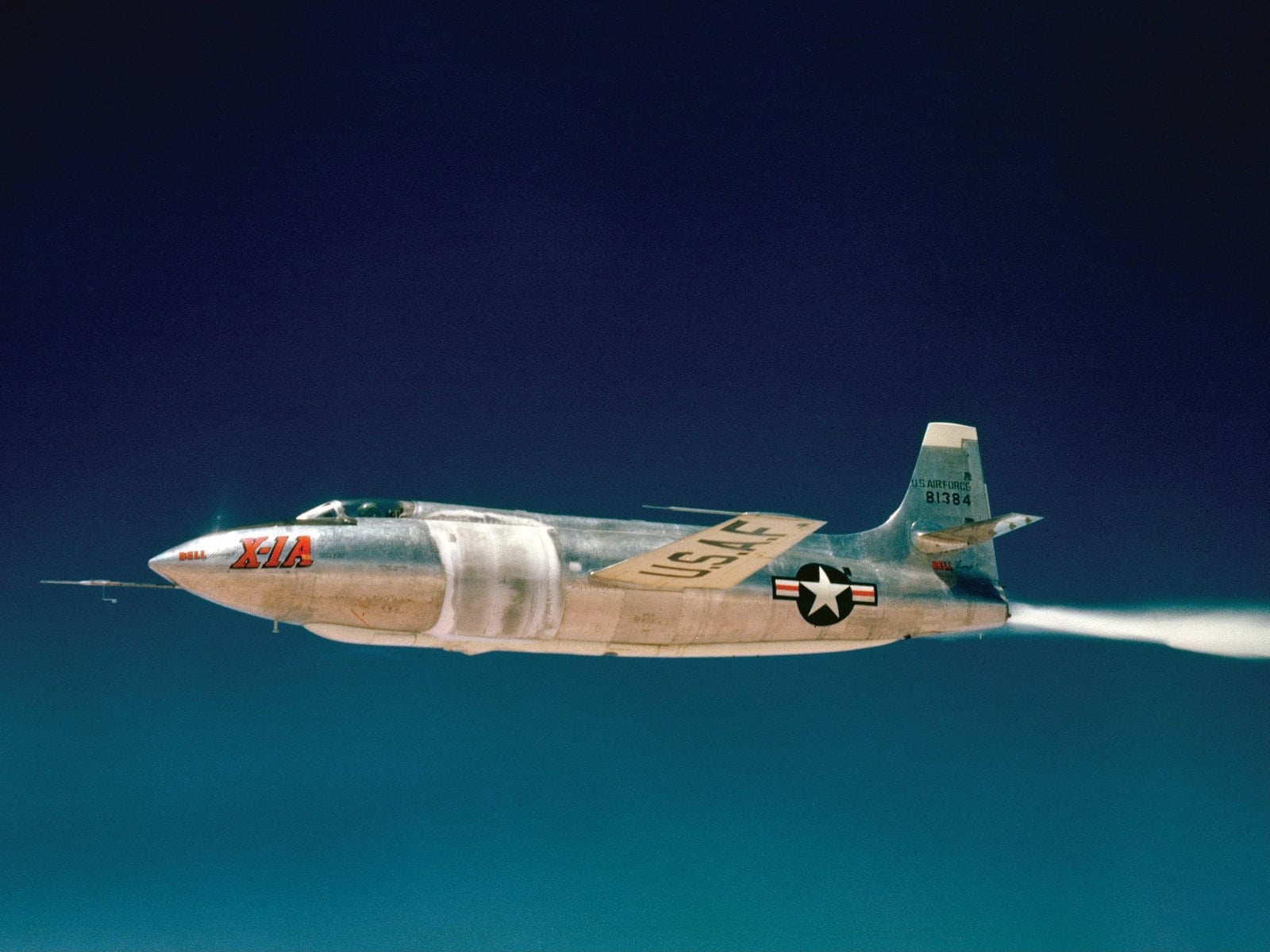
On 12 December 1953, Chuck Yeager pushed the Bell X-1A to Mach 2.44, faster than any human had flown. Seconds later the rocket plane went completely out of control. It rolled, yawed and tumbled end over end, slamming Yeager’s helmet into the canopy hard enough to crack it, and fell almost 50,000 feet before he got it back.
He landed it, too. The record flight that nearly killed him is one of the great survival stories of the early jet age, and it taught engineers about a killer they did not yet understand: inertia coupling.
Informazioni rapide
- Aeromobili: Bell X-1A, serial 48-1384, rocket-powered
- Pilota: Maj. Charles E. “Chuck” Yeager, US Air Force
- Data: 12 December 1953
- Velocità massima: Mach 2.44, about 1,620 mph
- Altitudine: About 74,700 ft at peak speed, falling to around 25,000 ft
- Causa: Inertia coupling, not yet understood at the time
A Bigger X-1 for a Faster Race
The X-1A was a stretched, second-generation version of the Bell X-1 in which Yeager had broken the sound barrier in 1947. It carried more propellant, giving its rocket engine a longer burn. Like its predecessor, it was carried aloft under a bomber, in this case a B-50, and dropped at about 31,000 feet.
The pressure to fly it fast was real. Just three weeks earlier, on 20 November 1953, NACA pilot Scott Crossfield had become the first person to reach Mach 2, in the Douglas D-558-2 Skyrocket. Yeager’s X-1A flight would go faster still, and in his own words decades later he made the distinction carefully: he was first to fly faster than Mach 2, not up to it.
Mach 2.44, Then Chaos
Yeager climbed to roughly 74,700 feet, levelled off and let the rocket run. The X-1A reached Mach 2.44, about 1,620 mph. Then, as the propellant ran out and he began to ease the throttle, the aircraft started a Dutch roll, began rolling rapidly to the right and departed from controlled flight.
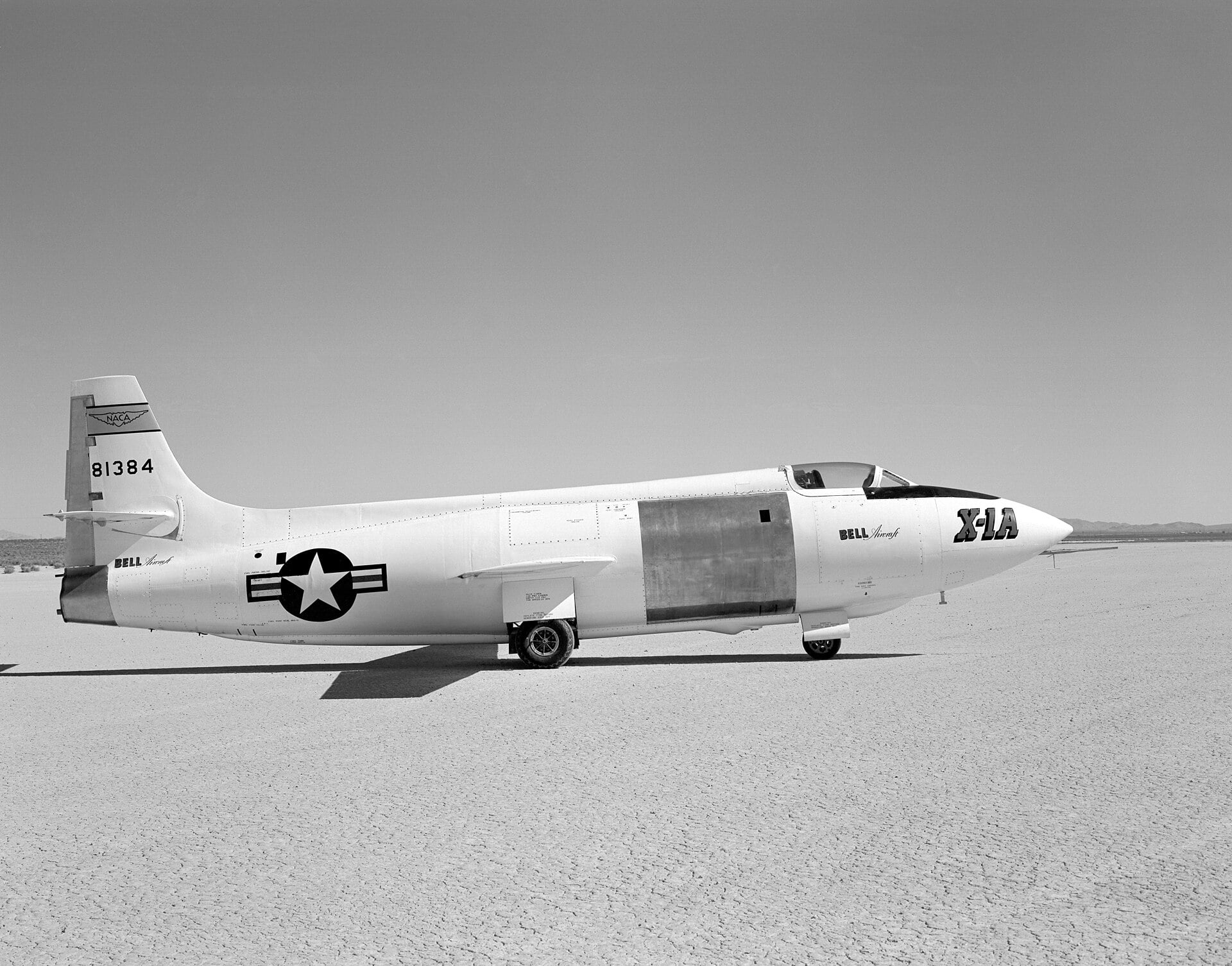
What followed was a violent tumble around all three axes. Yeager was thrown around the cockpit, his pressure-suit helmet struck and cracked the inner canopy, and he briefly lost consciousness. The X-1A fell from above 70,000 feet to around 25,000 feet in roughly a minute. There was no ejection seat to save him.
Somewhere in the denser air below 30,000 feet, the X-1A dropped into a normal spin. That, Yeager knew how to fix. He recovered, glided back to the lakebed at Edwards and landed. Later he described the difference simply: a spin was something he knew how to get out of, but the tumble was something nobody could figure out.
The Hidden Killer: Inertia Coupling
The X-1A had run into inertia coupling, a phenomenon that appears when an aircraft with most of its mass packed into a long, slim fuselage and relatively small wings and tail rolls at high speed. The heavy fuselage tends to swing away from the direction of flight, and at thin, high-altitude air, the tail can no longer push it back.
Engineers were only just beginning to understand it. The same phenomenon would trouble the Douglas X-3 and the early F-100 Super Sabre, and in 1956 it killed Capt. Mel Apt in the Bell X-2. Larger tails, stability augmentation and, eventually, computer flight controls tamed it.
What Happened to the X-1A
The X-1A flew on. On 28 May 1954, Maj. Arthur “Kit” Murray took it to an altitude of 90,440 feet. Its end came on 8 August 1955, when an explosion ruptured its liquid oxygen tank while it was still attached to its mothership. NASA pilot Joe Walker climbed out to safety, and the X-1A was jettisoned over the desert, where it exploded on impact.
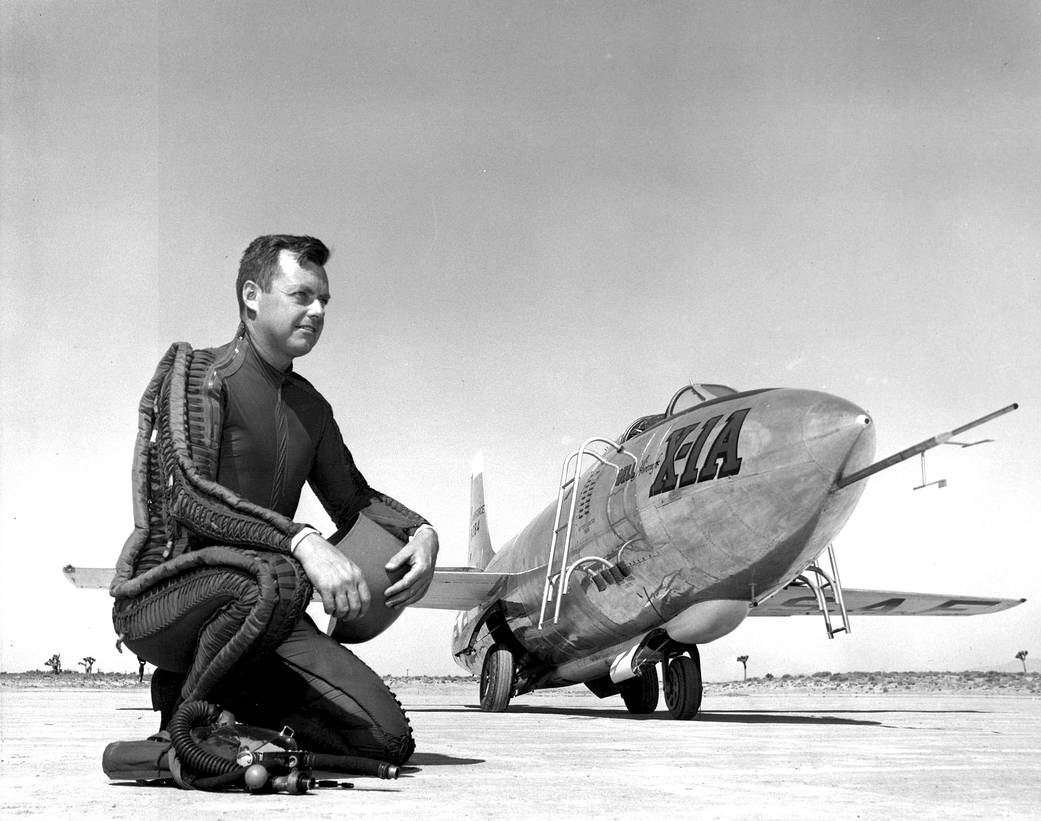
Retro Space HD has restored the period footage and Yeager’s radio audio from the 12 December 1953 flight:
Sources: Wikipedia (Bell X-1), This Day in Aviation, NASA, Chuck Yeager on X

0 Comments