
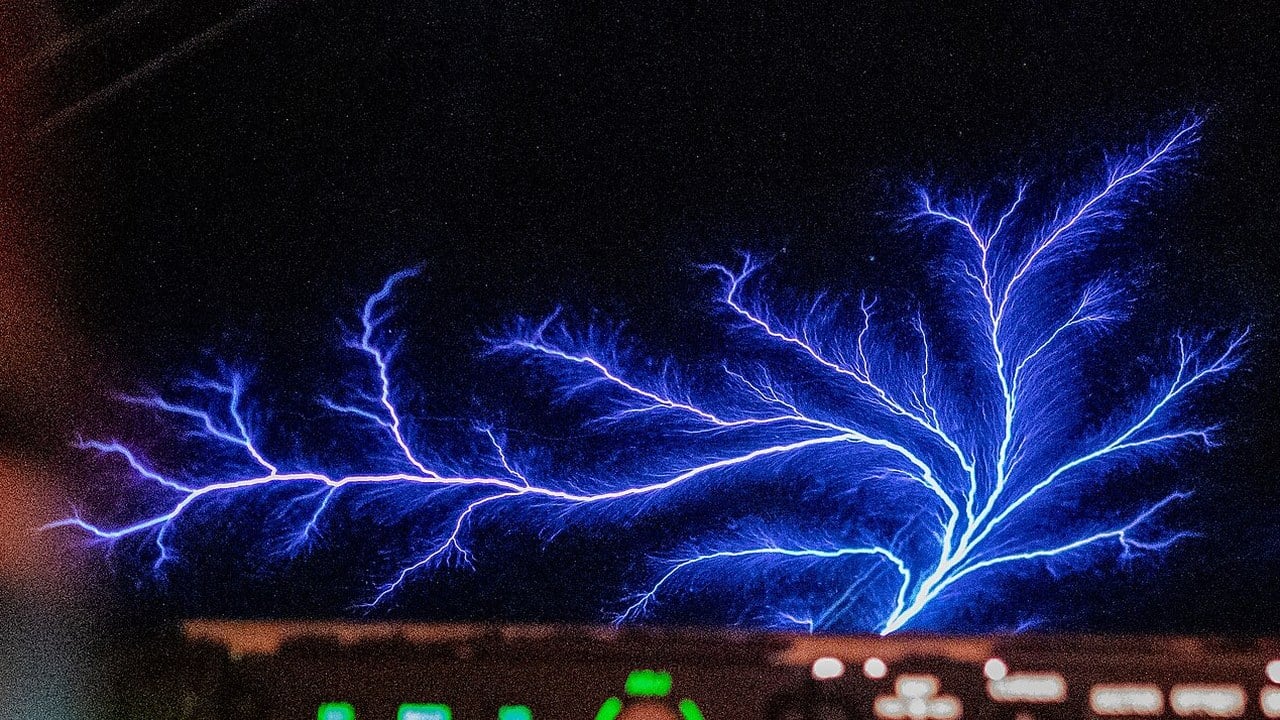
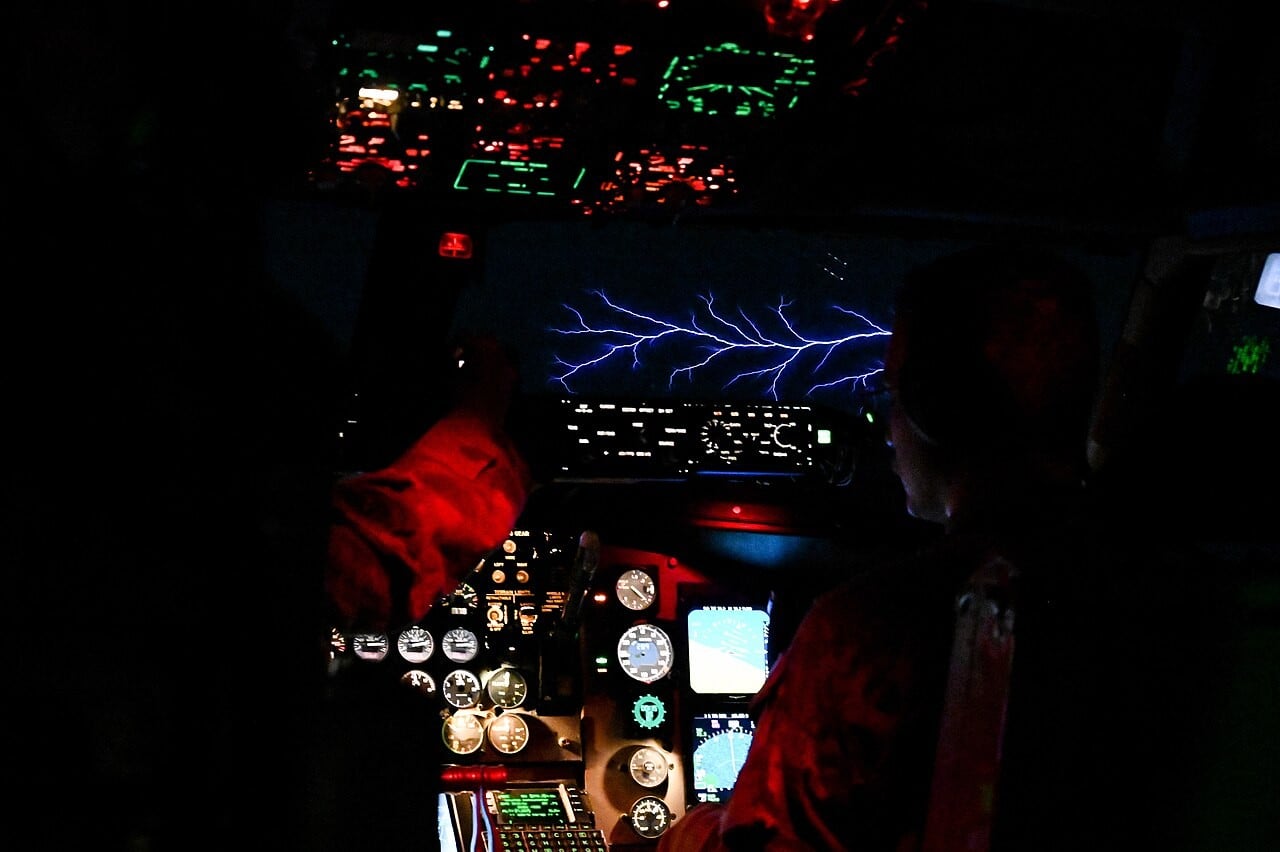
It is the middle of the night over stormy country, and the windscreen of a KC-135 Stratotanker suddenly fills with light. Violet and blue tendrils branch across the glass like living lightning, crawling and flickering, while the instruments glow calmly below. Nothing has hit the aircraft. Nothing is on fire.
The crew is watching St Elmo's fire, one of the oldest weather phenomena in recorded history and one of the most beautiful things a pilot can see. Sailors knew it for centuries as a glow dancing on the tops of their masts. Today it most often appears on the windscreens, wingtips and propellers of aircraft flying near thunderstorms.
Here is what St Elmo’s fire actually is, when pilots see it, why it is harmless but worth respecting, and why every airliner carries a row of small spikes on its wings to keep the electricity behind it under control.
Informazioni rapide
- Che cos'è: A corona discharge: luminous plasma formed when a strong electric field ionises the air around an object
- Colour: Usually blue or violet, sometimes greenish; may hiss or buzz
- Prende il nome da: St Erasmus of Formia (St Elmo), a patron saint of sailors
- Where on aircraft: Windscreens, wingtips, tail surfaces, antennas, propeller tips
- Quando: Near thunderstorms, in charged cloud, snow, ice crystals or volcanic ash
- Dangerous?: Not in itself, but a sign of thunderstorm activity and a possible precursor to lightning
- Static wicks: Bleed off charge to cut radio noise by about 50 dB (FAA)
- Famous accounts: Nagasaki mission, 1945; British Airways Flight 9, 1982
A glow made of electrified air
St Elmo’s fire is a corona discharge: a luminous plasma created when a strong electric field ionises the air around an object. The field is most concentrated around sharp points and edges, so the discharge appears there first, as a blue or violet glow, often with a hissing or buzzing sound. The colour comes from the nitrogen and oxygen in the air, glowing by the same mechanism that lights a neon tube.
It is not lightning. Lightning is a single, violent leap of current across a long gap. St Elmo’s fire is a steady leak of charge into the air immediately around the object, which is why it can flicker for minutes without harming anything.
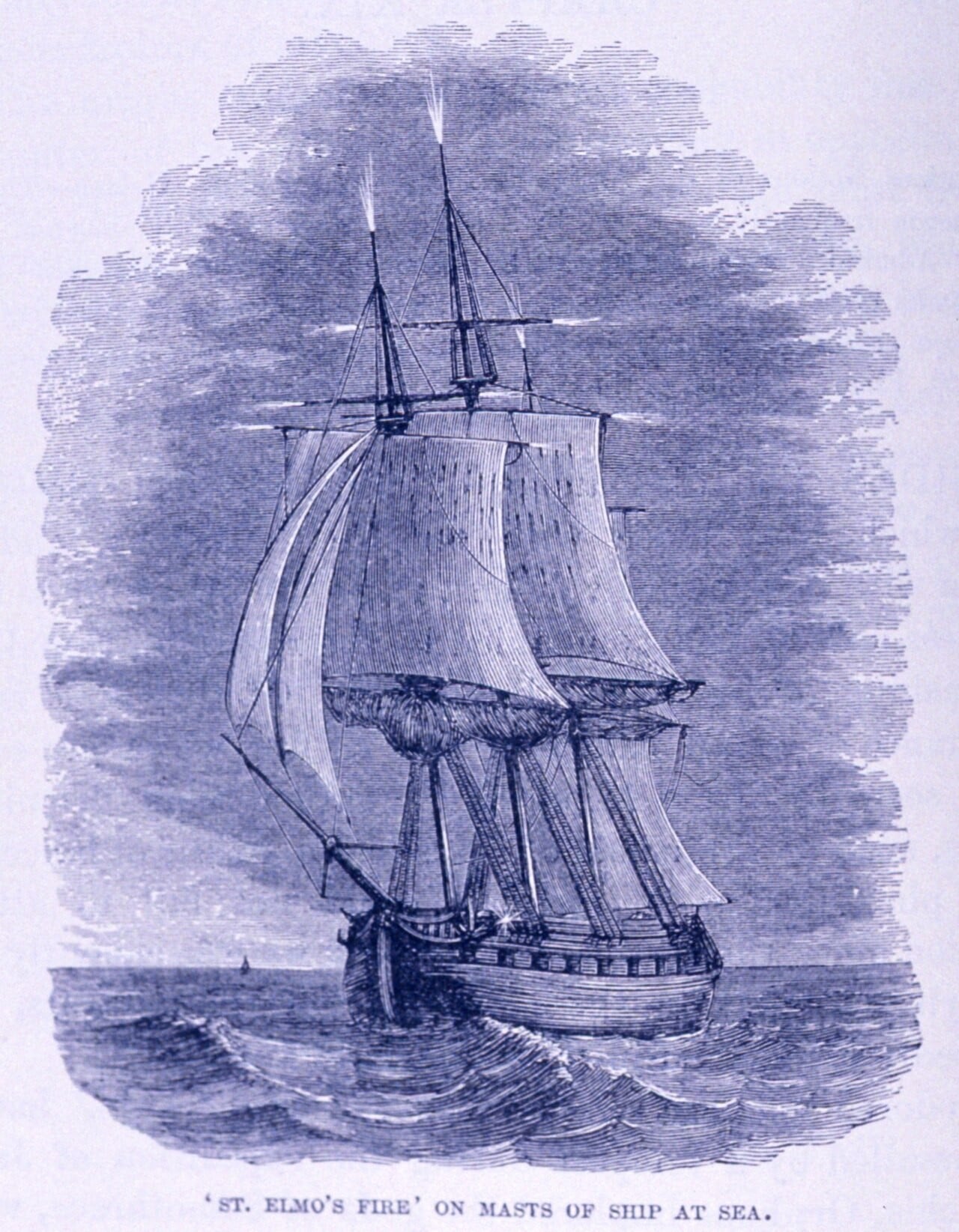
The name comes from St Erasmus of Formia, also known as St Elmo, a patron saint of sailors, who often took the glow on the rigging as a sign of his protection. The phenomenon appears in ancient Greek and Roman writing and in the journal Antonio Pigafetta kept on Magellan’s circumnavigation. Mariners had good reason to watch for it.
Why aircraft light up
An aircraft builds up its own electrical charge in flight. The FAA’s Aeronautical Information Manual explains that as an aircraft flies through rain, snow, sleet, hail, dust or volcanic ash, the impacts leave a negative charge on its skin, and within a very short time that charge becomes substantial. Fly into the strong electric fields around a thunderstorm and the effect multiplies.
When the voltage gets high enough, the aircraft goes into what the FAA calls corona, discharging from its extremities: wingtips, tail surfaces, antennas and propeller tips. The windscreen, with its frame and tiny imperfections, is another favourite spot. To the crew, the result is St Elmo’s fire, usually seen in or near thunderstorm clouds, in snow and ice crystals, and in volcanic ash.
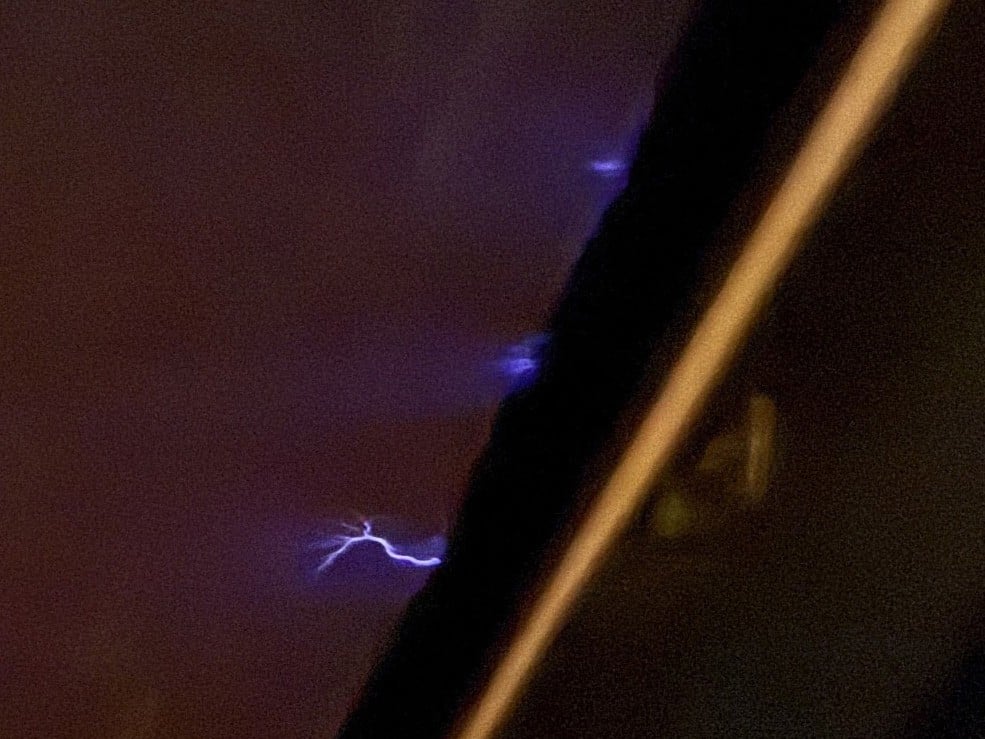
SKYbrary, the aviation safety knowledge base, describes it as brushlike fiery jets extending from an aerial, wing, propeller or windscreen, usually bluish or violet but sometimes with a greenish tinge. It can even be heard “singing” on the radio, as a frying or hissing sound.
Captain Joe explains whether St Elmo’s fire is dangerous for aircraft, and what pilots do when they see it.
Harmless, but a warning
St Elmo’s fire is not a hazard in itself. The light cannot burn the aircraft, and crews fly through it routinely. But it is a reliable sign that the air around the aircraft is heavily charged, which means thunderstorm activity, and SKYbrary notes it may be a precursor to a lightning strike.
IL Royal Air Force made the same point in October 2020, when a crew of No. 99 Squadron filmed it from the cockpit of a C-17 Globemaster III at night over the Inter Tropical Convergence Zone near the equator.
In August 2023, as Hurricane Idalia approached Florida, the US Air Force evacuated its aircraft from MacDill Air Force Base in Tampa. A crew from the 50th Air Refueling Squadron, a KC-135 unit, recorded an especially vivid display on the way out, somewhere over Virginia according to one of the airmen on board.
The little spikes on every airliner
Look at the trailing edge of an airliner’s wing next time you board and you will see a row of thin rods or spikes pointing backwards. These are static dischargers, or static wicks, and they exist because of the same charge that creates St Elmo’s fire.
Left alone, that charge escapes in bursts from the aircraft’s extremities and creates precipitation static, or P-static: radio noise that pilots hear in their headsets. The FAA lists the symptoms reported by crews, from complete loss of VHF radio and erroneous magnetic compass readings to a high-pitched squeal on the audio, loss of avionics in cloud and, on the list too, St Elmo’s fire on the windshield.
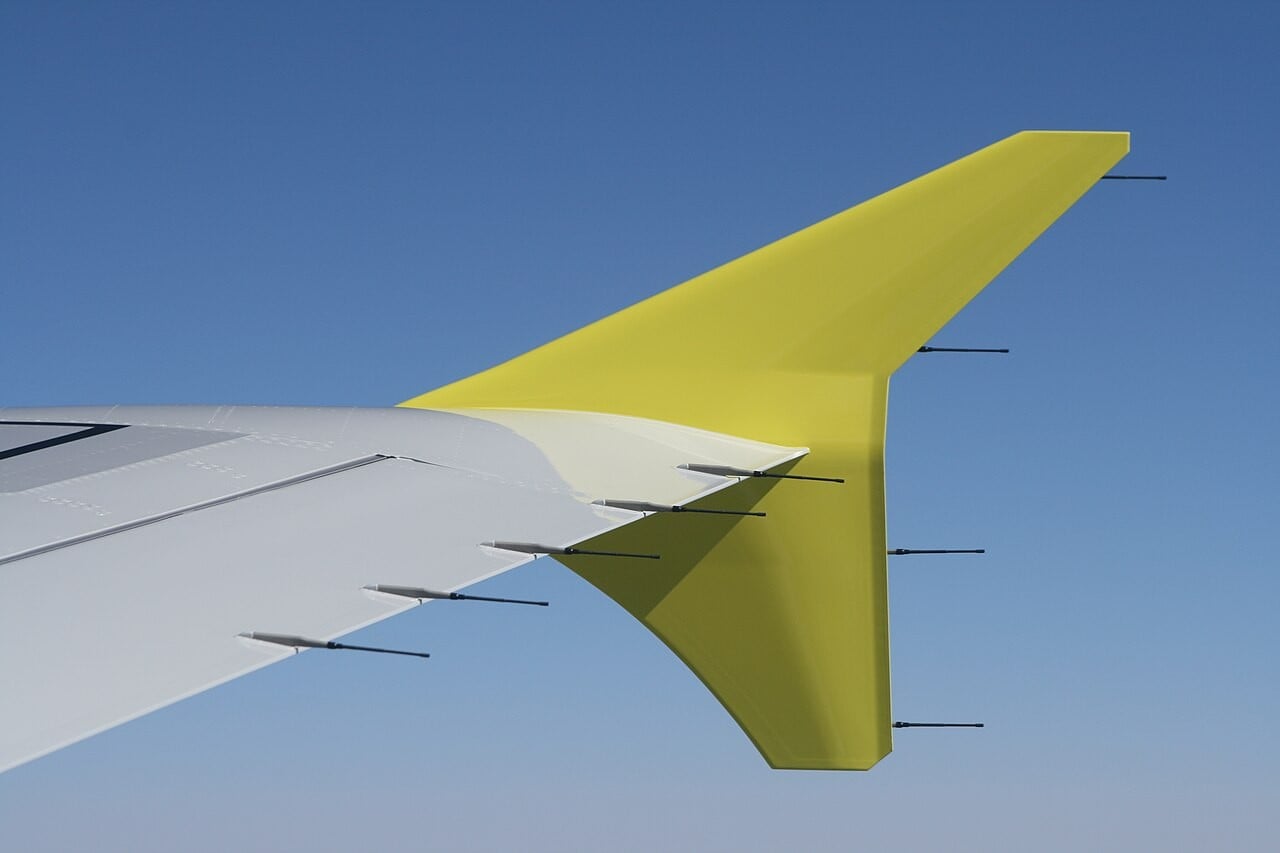
Static dischargers give the charge an easy way out. Using fine metal points, carbon-coated rods or carbon wicks, they let it bleed away gradually instead of building up and discharging off the trailing edges in a way that interferes with the avionics. According to the FAA, this cuts static noise by about 50 decibels, enough in most cases to keep it below the threshold of interference. It only works on a properly bonded airframe, with a conductive path from every part of the aircraft to the dischargers.
Mentour Pilot on the dangers of static electricity and how aircraft are built to handle it.
Famous sightings
One of the most vivid accounts came from the night of 9 August 1945. New York Times science reporter William L. Laurence was flying aboard The Great Artiste, IL B-29 instrument aircraft on the Nagasaki mission, when the aircraft flew through a storm. Its propellers, he wrote, had become “great luminous discs of blue flame”.
Laurence feared the electricity might threaten the bomb aboard the aircraft ahead. The pilot, Captain Frederick Bock, was unbothered. “It is a familiar phenomenon seen often on ships. I have seen it many times on bombing missions. It is known as St. Elmo’s Fire,” he told the reporter.
Almost four decades later, on the night of 24 June 1982, the crew of British Airways Flight 9 noticed an effect resembling St Elmo’s fire on the windscreen of their Boeing 747 over the Indian Ocean south of Java. It was the first sign that they had flown into the ash cloud of Mount Galunggung. Within minutes, all four engines had stopped. The glow they saw is now attributed to ash particles striking the leading edges of the aircraft, rather than to a true electrical corona.
AccuWeather’s WeatherWhys explains what St Elmo’s fire is and how it forms.
For the sailors who first named it, St Elmo’s fire was an omen. For pilots today it is physics they can see: proof that their aircraft is soaking up charge from a storm, and that the static wicks behind them are earning their keep. Enjoy the light show. Then keep an eye on the weather radar.
Sources: FAA Aeronautical Information Manual (ch. 7, Precipitation Static), National Weather Service lightning safety factsheet, SKYbrary (St Elmo’s Fire), Atomic Heritage Foundation (William L. Laurence, Nagasaki eyewitness account), Air Force Times, Guinness World Records, Wikipedia (St. Elmo’s fire; Static discharger; British Airways Flight 9; The Great Artiste; No. 99 Squadron RAF; MacDill Air Force Base)
0 Comments